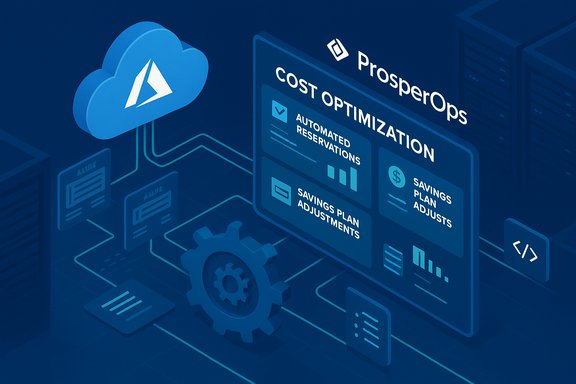
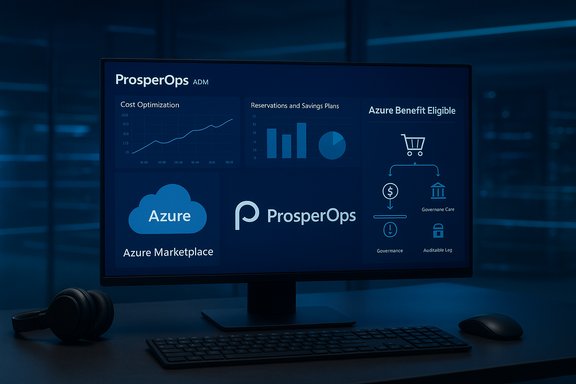
ProsperOps’ announcement that it has achieved Microsoft Azure IP Co‑Sell status on December 17, 2025 marks a consequential step for the cloud‑cost optimization vendor and gives Azure customers a new, marketplace‑transactable route to apply ProsperOps purchases toward Microsoft Azure Consumption Commitments (MACCs).
ProsperOps, a FinOps automation and rate‑optimization platform founded in 2018, has built its reputation on automating cloud discount management—primarily for reservations and savings plans across major public clouds—and on packaging that capability for enterprise FinOps teams. The company has pushed Azure support in 2025 with its Autonomous Discount Management (ADM) for Azure, which the vendor declared generally available and integrated for Azure Marketplace procurement earlier in the year. Microsoft’s Azure IP Co‑Sell program is part of the broader Partner Center and Microsoft AI Cloud Partner Program ecosystem: it’s designed to make third‑party offers readily discoverable to Microsoft field sellers, marketplace customers, and channel partners while enabling eligible Marketplace transactions to count toward a customer’s Azure spend commitments (MACCs). The co‑sell eligibility for IP solutions carries technical, revenue, and marketplace requirements set by Microsoft. Among the most notable is an organization‑level revenue threshold: at least USD 100,000 of Azure Consumed Revenue or Marketplace Billed Sales over the trailing 12 months to qualify for Azure IP co‑sell eligible status. The program also requires Azure technical validation and that offers be transactable on Marketplace.
ProsperOps’ Azure IP Co‑Sell status signals that it has navigated the Marketplace onboarding, met Microsoft’s platform validation, and presumably crossed the revenue threshold required for IP co‑sell eligibility. That does not guarantee comparative superiority—other vendors also compete in automated commitment management—but it does make ProsperOps easier to procure for organizations that prefer Azure Marketplace procurement and want MACC alignment. Microsoft’s co‑sell eligibility rules provide the guardrails for what that status means in practice.
ProsperOps’ new co‑sell eligibility is a practical and commercially meaningful development for Azure customers seeking automated commitment management—one that reduces procurement friction and opens new pathways for Microsoft‑assisted sales motions. The designation enhances ProsperOps’ channel access, but the onus remains on customers to validate outcomes in their own estates, enforce governance around automated purchases, and lock contractual protections into procurement agreements before scaling the automation.
Source: ACCESS Newswire ProsperOps Achieves Microsoft Azure IP Co-Sell Status
 Background
ProsperOps, a FinOps automation and rate‑optimization platform founded in 2018, has built its reputation on automating cloud discount management—primarily for reservations and savings plans across major public clouds—and on packaging that capability for enterprise FinOps teams. The company has pushed Azure support in 2025 with its Autonomous Discount Management (ADM) for Azure, which the vendor declared generally available and integrated for Azure Marketplace procurement earlier in the year. Microsoft’s Azure IP Co‑Sell program is part of the broader Partner Center and Microsoft AI Cloud Partner Program ecosystem: it’s designed to make third‑party offers readily discoverable to Microsoft field sellers, marketplace customers, and channel partners while enabling eligible Marketplace transactions to count toward a customer’s Azure spend commitments (MACCs). The co‑sell eligibility for IP solutions carries technical, revenue, and marketplace requirements set by Microsoft. Among the most notable is an organization‑level revenue threshold: at least USD 100,000 of Azure Consumed Revenue or Marketplace Billed Sales over the trailing 12 months to qualify for Azure IP co‑sell eligible status. The program also requires Azure technical validation and that offers be transactable on Marketplace. What the announcement says — the facts
- ProsperOps publicly declared it has achieved Azure IP Co‑Sell status via a press release distributed on December 17, 2025, and emphasized that purchases of ProsperOps made through the Azure Marketplace can now be applied toward a customer’s MACC credits.
- The company positioned the milestone as a means to streamline procurement for Azure customers and to deepen its cooperative selling motion with Microsoft field and partner teams. The ProsperOps statement includes a quote from Joe Benincasa, Director of Product Management, highlighting customers’ preference for solutions that integrate into their financial and operational workflows on Azure.
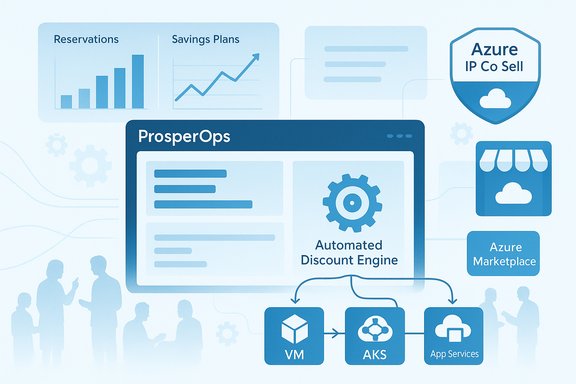
- ProsperOps’ product capabilities for Azure—Autonomous Discount Management (ADM)—are described in vendor materials as automating the management of Azure Reservations and Savings Plans for compute (VMs, AKS, App Services, etc., continuously optimizing commitments and maximizing savings and flexibility. The company published a product blog announcing general availability of ADM for Azure and a prior Marketplace launch notice in May 2025.
Why Azure IP Co‑Sell status matters to customers
Streamlined billing and MACC burndown
For organizations that use Microsoft Azure, MACCs are a common instrument: customers negotiate Azure Consumption Commitments in exchange for discounted pricing, but those agreements require that certain types of spending count toward the committed threshold. With IP Co‑Sell eligible offers, Marketplace purchases can be applied toward those commitments—so buying ProsperOps via the Azure Marketplace can reduce administrative friction and make the economics of adoption clearer to procurement teams. Microsoft’s Partner Center documentation makes this explicit: IP co‑sell eligible offers are Azure benefit eligible and can contribute to customers’ consumption commitments. This removes a practical purchase barrier: procurement teams that have locked-in MACCs often prefer to spend Marketplace funds against that commitment rather than use separate procurement channels that don’t contribute to the MACC. For FinOps practitioners, that can materially accelerate trials and production adoption because the path from procurement to value is shorter.Greater Microsoft field engagement
Azure IP Co‑Sell status is designed to increase collaboration between ISV sellers and Microsoft account teams. That can translate into:- more co‑sell opportunities and potential for Microsoft field sellers to recommend the product in customer conversations;
- easier access to channel partners and systems integrators who lean on Microsoft‑validated Marketplace offers;
- improved discoverability inside Partner Center and the Azure Marketplace.
How ProsperOps’ ADM works (vendor description vs. practical mechanics)
ProsperOps’ ADM for Azure markets itself as an autonomous engine that:- ingests usage telemetry and billing data;
- models usage variability and commitment risk;
- purchases and adjusts Azure Reservations and Savings Plans for compute workloads to maximize realized discount while minimizing commitment lock‑in; and
- performs ongoing rate optimization to align committed spend with actual consumption curves.
Critical analysis — strengths
1. Real procurement and accounting value when Marketplace billing counts toward MACC
Allowing Marketplace purchases to count toward MACC is a non‑trivial commercial advantage. It simplifies procurement negotiations, permits organizations to reallocate Azure budget without extra approvals, and lowers the barrier to PoC and pilot buy‑ins. Because FinOps teams often operate under constrained budgets with strict MACC accounting, accessible Marketplace options are compelling. Microsoft documentation confirms that transactable Marketplace offers that are Azure IP Co‑Sell eligible are shown as Azure benefit eligible and can be applied toward MACC thresholds.2. Automation addresses operational scaling of commitment management
Managing reservations and savings plans manually across many accounts and subscriptions is a time‑consuming, error‑prone task. Automated rate optimization can materially reduce operational overhead and human error, especially for large estates where workloads fluctuate. ProsperOps’ ADM is designed to address that gap, and the company’s GA announcement demonstrates product maturity and feature stabilization for Azure use cases.3. Co‑sell alignment can accelerate enterprise adoption
A validated Marketplace presence combined with Microsoft sales alignment often shortens procurement cycles for enterprise customers, particularly those that already rely on Microsoft sellers or partners for cloud strategy and implementation. This is a pragmatic commercial benefit that can translate into faster enterprise trials and production rollouts if the partner motion is executed. ProsperOps’ press release highlights that closer collaboration with Microsoft teams is an objective and a benefit of the status.Critical analysis — risks and caveats
1. Co‑sell status is not a technical endorsement or a one‑click guarantee of results
Azure IP Co‑Sell status is a marketplace and go‑to‑market designation, not a warranty of outcomes. Microsoft’s co‑sell program has material prerequisites—including a trailing‑12‑month revenue threshold and technical validation—but the designation doesn’t replace customer due diligence. Customers must still validate technical fit, security posture, data residency, and auditability for their compliance requirements. Microsoft documentation outlines the co‑sell eligibility steps and the $100,000 ACR threshold explicitly.2. Vendor claims on savings and risk reduction require independent validation
ProsperOps and other vendors in this space publish savings figures (for example, claims of 50%+ savings or “world‑class Effective Savings Rates” in vendor pages). These are often based on optimized scenarios and may not generalize to every enterprise environment. Independent validation—through a trial on representative workloads, controlled A/B testing, or third‑party audits—is essential before committing to multi‑year adoption. ProsperOps’ marketing materials describe strong historic savings, but those remain vendor claims until validated in the customer’s environment.3. Optimization algorithms can increase commitment risk if misconfigured
Automated commitment purchases reduce manual effort but can introduce commitment lock‑in if not properly bounded. A system that aggressively purchases long commitments based on transient spikes could increase overall cost rather than reduce it. Buyer due diligence should include:- governance controls on commitment size and duration;
- human approval gates for large or cross‑subscription commitments; and
- transparent rollback and exportable audit logs for every Marketplace transaction.
4. Marketplace billing flows and MACC accounting details must be audited
Although Microsoft’s documentation explains that co‑sell eligible Marketplace transactions can count toward MACC, the precise accounting and invoicing mechanics—especially across enterprise agreements, CSP (Cloud Solution Provider) channels, and partner reseller flows—vary. Procurement teams must confirm how the Marketplace charges will appear on invoices, how they will be reconciled against MACC targets, and whether any partner reseller margins or pass‑through charges alter the effective value. Microsoft’s Partner Center guidance highlights the transactable Marketplace requirement and the Azure benefit eligible designation but does not substitute for contract‑level verification.What WindowsForum and IT buyers should look for before adopting ProsperOps via Azure Marketplace
Tech and security evaluation checklist
- Integration with Azure billing and tagging: Confirm ProsperOps reads the same billing and tagging metadata your FinOps and chargeback processes rely on.
- Data residency and logistic controls: Verify where telemetry and billing data is stored and whether that meets regulatory needs.
- Encryption and key management: Demand details on encryption at rest and in transit, and whether tenant‑managed keys (BYOK) are supported for sensitive artifacts.
- Auditability: Verify that historical reservation purchases, cancellations, and algorithmic decisions are exported as tamper‑evident logs for finance and compliance teams.
- Human oversight controls: Ensure that policy guardrails exist for commitment size, duration, and cross‑account purchases.
Commercial and procurement checklist
- MACC accounting test: Work with your Microsoft account team to simulate a Marketplace purchase and confirm it will count toward your MACC in Partner Center reporting.
- Pricing transparency: Confirm Marketplace billing metrics, any partner margins, and whether benefits like refunds or adjustments exist for algorithmic missteps.
- Exit and export terms: Validate you can export committed position data, reservation artifacts, and necessary artifacts to migrate away if needed.
- SLAs and indemnities: Negotiate SLAs for correct billing actions and indemnities for incorrect marketplace charges or algorithmic errors.
How this fits into the broader FinOps and cloud‑optimization market
The market for automated reservation and savings‑plan management has matured as cloud providers introduced Savings Plans and multiple commitment instrument types. Vendors that automate the lifecycle of these commitments—ingesting usage, forecasting, purchasing commitments, and handling exchanges or cancellations—are a natural evolution of FinOps tooling.ProsperOps’ Azure IP Co‑Sell status signals that it has navigated the Marketplace onboarding, met Microsoft’s platform validation, and presumably crossed the revenue threshold required for IP co‑sell eligibility. That does not guarantee comparative superiority—other vendors also compete in automated commitment management—but it does make ProsperOps easier to procure for organizations that prefer Azure Marketplace procurement and want MACC alignment. Microsoft’s co‑sell eligibility rules provide the guardrails for what that status means in practice.
Practical scenarios where ProsperOps + Marketplace procurement makes sense
- Large Azure customers with active MACCs who want to route purchases through Marketplace to meet procurement governance.
- Organizations running dynamic compute workloads (AKS, ephemeral VMs, autoscaling services) where manual commitment management is operationally impractical.
- Enterprises seeking a co‑sell aligned vendor to reduce friction when introducing tools through Microsoft field or partner recommendations.
What this announcement does not change
- It doesn’t remove the need for a pilot phase: expect to test ProsperOps on a controlled subset of accounts and workloads before scaling to the entire enterprise.
- It is not a blanket endorsement that ProsperOps will deliver uniform savings across all workload classes; outcomes depend on workload shapes, time‑series stability, and governance configuration. ProsperOps’ public blog and company materials make the product case, but empirical validation in your estate is necessary.
Vendor claims to verify during procurement
- Any stated savings percentage, e.g., “50%+ savings,” should be verified on your own billing data (vendor claims should be accompanied by methodology and sample calculations).
- Claims of being the “only” or “leading” automated multi‑cloud optimizer should be treated as competitive messaging; request independent references and ask for comparative analyses or third‑party benchmarks where available.
- Confirm ProsperOps’ partner certifications (for example, ISV Success or AWS/Azure program recognitions) directly in Partner Center or via vendor documentation. ProsperOps’ company materials identify several partner recognitions and FinOps Foundation membership; these are useful context but not substitutes for proof points in procurement.
Final assessment
ProsperOps gaining Azure IP Co‑Sell status is meaningful from both procurement and go‑to‑market perspectives. For Azure customers constrained by MACCs and procurement governance, the ability to buy an automated FinOps solution in the Marketplace and have those charges count toward existing commitments simplifies economic justification and procurement flow. Microsoft’s co‑sell rules formalize the path by which Marketplace offers can be used in this way, and ProsperOps’ ADM product is explicitly positioned to take advantage of that channel. However, the practical value will be realized only when organizations complete disciplined pilots and confirm that ProsperOps’ automation aligns with their governance, cost allocation, and compliance requirements. Co‑sell status speeds access and improves discoverability—it does not replace technical and financial due diligence. Buyers should insist on measurable pilot success criteria, transparent billing flows for MACC accounting, and contractual protections against algorithmic missteps or billing anomalies.Takeaways for WindowsForum readers and IT decision makers
- If your organization has Azure Consumption Commitments, buying ProsperOps through Azure Marketplace could simplify procurement and make the expense count toward MACC—worth exploring with a pilot and your Microsoft account team.
- Validate technical fit and governance: insist on controls for commitment sizing, human approval, and exportable audit logs before enabling any automated purchase capability.
- Treat vendor savings figures as aspirational until proven in your environment. Run comparative pilots and ask for references with similar workload profiles.
- Confirm Marketplace billing mechanics with your procurement and Microsoft field team to ensure charges appear correctly against MACC and that invoicing reconciles with internal accounting.
ProsperOps’ new co‑sell eligibility is a practical and commercially meaningful development for Azure customers seeking automated commitment management—one that reduces procurement friction and opens new pathways for Microsoft‑assisted sales motions. The designation enhances ProsperOps’ channel access, but the onus remains on customers to validate outcomes in their own estates, enforce governance around automated purchases, and lock contractual protections into procurement agreements before scaling the automation.
Source: ACCESS Newswire ProsperOps Achieves Microsoft Azure IP Co-Sell Status