

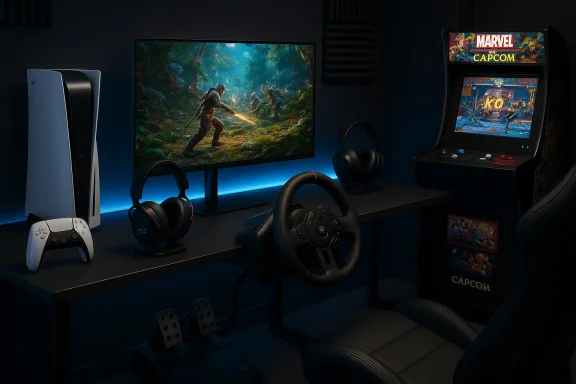
Sony’s PS5 Pro, HyperX’s battery‑marathon headset, Xbox’s updated wireless cans, and a wave of premium sim rigs and retro arcade cabinets are all reshaping how players outfit a modern gaming room — but not every “must‑have” claim on retail pages or roundups stands up to scrutiny. The shopping list TMZ promoted this week spotlights powerful hardware and nostalgic kiosks that promise immersion, portability, and longevity, yet each item brings tradeoffs around compatibility, real‑world performance, and value that buyers should weigh carefully. view
The current retail cycle blends two parallel trends: manufacturers are pushing higher‑fidelity console upgrades and PC‑adjacent peripherals that promise dramatically longer battery life or AI‑driven image improvements, while boutique brands continue to monetize nostalgia with home arcade cabinets and pocketable retro handhelds. This convergence means consumers can choose between raw graphical upgrades (a more powerful console), more believable audio/force‑feedback experiences (sim rigs and spatial audio headsets), or the thrift of retro authenticity (Arcade1Up and Super Pocket devices). The TMZ roundup samples all three categories, from the PlayStation 5 Pro to arcade cabinets and racing cockpits.
Below I verify the bhlight what’s genuinely useful, and flag technical or economic caveats readers should consider before purchasing.
PlayStation 5 Pro: what Sony actually shipped — and what PSSR means
The headline claims
Sony’s own announcement and follow‑up product pages frame the PlayStation 5 Pro as a measured, developer‑focused performance step up: a larger GPU, faster memory, advanced ray tracing, and PlayStation Spectral Super Resolution (PSSR) — a proprietary AI‑driven upscaling technology intended to deliver sharper 4K images without the same rendering cost as native resolution. Sony lists improved rendering throughput (advertised as roughly a mid‑40s percentage faster in PlayStation’s technical brief), enhanced ray tracing performance, and a 2 TB internal SSD in the retail package.What PSSR is — and what it isn’t
- PSSR is an upscaling pipeline: Sony positions it as an in‑house, machine‑learning upscaler that replaces or augments temporal anti‑aliasing/upscalers used today (TAAU, FSR2, DLSS alternatives) to produce cleaner images at 4K and, in some modes, enable 8K output claims for supported titles. The PlayStation Blog explains the feature as part of the Pro’s end‑to‑end performance improvements.
- It is not a miracle: like DLSS and FSR before it, PSSR’s effectiveness will vary by title and developer implementation. Independent outlets and early reporting note PSSR’s potential but advise evaluation on a per‑game basis; developers must opt in and tune their games to take advantage of the Pro’s dedicated ML blocks. Early previews and reporting also suggest Sony plans future updates and potential integrations (e.g., elements of AMD’s FSR 4 collaboration discussions), reinforcing that upscaling tech is iterative.
Box contents and practical realities
Most retail product listings for the PS5 Pro confirm the console ships as a digital‑only unit with a 2 TB SSD, one DualSense controller, basic cables, and a pre‑installed copy of ASTRO’s PLAYROOM. Sony’s launch materials and major retailers list a standard complement of accessories included in the box. However, a few third‑party listings have occasionally differed about tiny extras (for example, whether a vertical stand is included), so buyers should confirm the standard retail package from their chosen retailer before purchase.Strengths and risks — PS5 Pro
- Strengths:
- Tangible GPU and memory improvements that translate into faster render times and better ray tracing headroom for games that support it.
- PSSR gives a modern, console‑level answer to image‑quality vs. performance tradeoffs when implemented by developers.
- A 2 TB internal SSD helps with today’s ballooning install sizes for AAA titles.
- Risks:
- Developer adoption is uneven. Not every game will be “PS5 Pro Enhanced” at launch; improvements depend on studio patches and support.
- Upscaling artifacts and tradeoffs. Like all upscalers, PSSR can introduce haloing, shimmering, or temporal artifacts in some scenes; generic marketing language can overpromise.
- Digital‑only format. Users who own disc libraries must buy a separate external drive or a disc‑capable model if they need optical media support.
Audio essentials: HyperX Cloud Alpha Wireless and the Xbox Wireless Headset
HyperX Cloud Alpha Wireless — the battery monster
HyperX claims the Cloud Alpha Wireless can deliver “over 300 hours” of battery life on a single charge and pairs DTS Headphone:X spatial audio with HyperX’s dual‑chamber drivers and plush memory‑foam cushions. The HyperX product listing reiterates those battery figures and the company’s testing conditions, while independent reviewers confirm that the headset’s battery life significantly outperforms most competitors, though real‑world numbers depend on volume levels and active features. Tech reviews praise its comfort and endurance but note the dongle‑based wireless connectivity is a reliance point: losing the USB dongle can affect functionality.Key takeaways:
- The 300‑hour claim is manufacturer‑tested at 50% volume; real-world use with higher volumes and active microphone or RGB (if present) will reduce runtime.
- The headset is a great choice for users who prize multi‑day battery life and comfort; pros who need low latency competitive setups should evaluate dongle latency vs. wired alternatives.
Xbox Wireless Headset — spatial tech and practical battery life
Microsoft’s Xbox Wireless Headset supports Windows Sonic, Dolby Atmos, and DTS Headphone:X spatial technologies on supported content and platforms, boasts Bluetooth 5.3, and advertises up to 20 hours of battery life on a single charge. Microsoft’s official product page lists 20 hours as the standard battery metric and highlights convenience features like fast‑charge behavior (30 minutes ≈ 4 hours of use). The Verge’s coverage of the headset update corroborates Microsoft’s battery and mic improvements, noting the refresh increased battery life relative to earlier models.Strengths and risks:
- Strengths:
- Platform integration with Xbox services and the Xbox Accessories app grants quick EQ tweaks and firmware updates.
- Wired and Bluetooth options make the headset versatile for console, PC, and mobile.
- Risks:
- 20 hours is solid but not exceptional compared to some very long‑life specialty headsets; buyers expecting all‑week use without charging should note the difference from HyperX’s 300‑hour claim.
- Spatial audio experiences (Dolby Atmos et al.) require supported content or supplemental apps and sometimes additional purchases.
PlayStation Pulse Explore earbuds — small form, broad compatibility
Sony’s Pulse Explore wireless earbuds are marketed as PlayStation‑centric earbuds (branded PlayStation, with a white/black aesthetic) that nevertheless offer compatibility with PCs, Macs, and mobile devices. Sony has tied the Pulse family to PlayStation Link ecosystems, and firmware/adapter updates have broadened PC compatibility in recent months. Earbuds like these aim to blend casual gaming and portable listening — they’re not substitute replacements for full over‑ear gaming headsets in terms of positional accuracy or long‑session comfort, but they are compelling for on‑the‑go play and cross‑device use. Independent coverage of Sony’s Pulse line also highlights that the ecosystem approach (earbuds + Link adapter + software) unlocks the most features.Racing and sims: HORI Racing Wheel and Next Level Racing F‑GT
HORI Racing Wheel (Xbox) — entry‑level, surprisingly functional
The HORI Racing Wheel Overdrive (full‑size wheel + pedals) is an officially licensed Xbox peripheral offering a 270‑degree turn radius, adjustable outputs, and a robust clamp system for mounting to desks or stands. The HORI page confirms the 270° default, an on‑the‑fly 180° mode, and compatibility with Xbox Series X|S, Xbox One, and Windows systems. Reviews and user feedback generally classify the device as an excellent value starter wheel — solid for beginners and casual sim racers who want better control without investing in high‑end direct‑drive systems.Why it matters:
- A 270° wheel with decent pedals moves a console sim setup from “gamepad” to “sim‑like control,” improving steering precision and immersion.
- For serious racers, the wheel is a stepping stone: direct‑drive wheels and high‑end load‑cell pedals remain the gold standard for pro‑level simulation.
Next Level Racing F‑GT — a full cockpit for serious simmers
The Next Level Racing F‑GT cockpit targets enthusiasts and pros. It offers a dual‑position cockpit that converts between Formula and GT seating positions, includes a premium racing seat with lumbar support, adjustable wheel and pedal mounts, and is designed to accept high‑end wheels and pedals (including Thrustmaster, Fanatec, and Logitech bolt patterns). The manufacturer positions the F‑GT as suitable even for professional driver training, emphasizing rigidity and modularity. If you intend to run a direct‑drive wheel or serious pedal set, a solid frame like the F‑GT is a necessary investment.Practical considerations:
- Expect to spend more than the cockpit on the wheel, pedals, and a good seat if you want realism.
- Cockpit footprint and setup complexity mean this is for dedicated play spaces rather than casual living‑room use.
Nostalgia done right — Arcade1Up and the Capcom Super Pocket
Arcade1Up Marvel Vs. Capcom (X‑Men ’97 Deluxe)
Arcade1Up’s deluxe X‑Men ’97 / Marvel vs. Capcom 2 cabinet targets collectors with a tall, 17″ display, light‑up marquee, dual speakers, and Wi‑Fi LIVE online play through the Arcade1Up companion app. The official product documentation lists the included ROMs and emphasizes online leaderboards and community features. These machines blend authentic artwork and a modern connectivity layer that allows remote score challenges. For fans wanting a living‑room arcade experience, the cabinet is a strong option — but buyers should factor in the physical size, assembly, and shipping/stock constraints that often surround premium Arcade1Up models.Arcade1Up Pac‑Man Legacy Deluxe
Arcade1Up’s Pac‑Man Legacy Deluxe cabinet includes 14 licensed Bandai Namco games, Wi‑Fi live play, a light‑up marquee, and classic artwork. Arcade1Up’s legacy models emphasize authenticity (coin‑door styling, riser options) plus modern conveniences like Wi‑Fi leaderboards across selected titles. If your priority is a retro look that also provides online community features, Arcade1Up’s legacy series delivers strong value versus full‑sized restorations — though again, consider footprint and durability for heavy use.Capcom Super Pocket — pocketable and Evercade compatible
The Capcom Super Pocket (manufactured under Hyper Mega Tech / Evercade‑adjacent lines) bundles a modest set of preinstalled Capcom arcade classics and advertises Evercade cartridge compatibility, enabling access to a library of physical cartridges (45+ cartridges and 500+ games claimed by some retailers). Manufacturer and retail pages show the small 2.8″ IPS screen, USB‑C charging, and roughly four hours of battery life at typical use. Independent reviews praise the low price and portability but call out build‑quality and emulation quirks relative to premium retro handhelds. If you want accessible retro gaming or a collector’s novelty, the Super Pocket is compelling; collectors who demand perfect emulation or long battery life may prefer higher‑end alternatives.Risks and caution:
- The Super Pocket’s Evercade compatibility is powerful but depends on cartridge availability, regional firmware support, and occasional quality‑control reports from users about cartridge recognition. These are solvable issues but worth noting before you buy.
How to prioritize: a short buyer’s guide
If you’re building or upgrading a gaming room, here are practical priorities and a recommended sequence based on budget and goals.- Core performance first:
- If you need higher‑fidelity visuals and longer console life, prioritize PS5 Pro (if platform allegiance is PlayStation) or invest in a PC GPU upgrade for more modular growth.
- Audio next:
- Invest in a quality headset that matches your play style:
- For marathon sessions and comfort, consider HyperX Cloud Alpha Wireless (stellar battery claims, verified by reviews).
- For platform integration and a balance of features, Xbox Wireless Headset offers tight Xbox ecosystem support.
- Invest in a quality headset that matches your play style:
- Input and immersion:
- For racing fans, get a wheel + pedals (HORI is a budget‑friendly starter; Next Level Racing is the cockpit investment if you want pro‑grade simulation).
- Nostalgia and versatility:
- Pick a retro handheld (Super Pocket) or an Arcade1Up cabinet if nostalgia, authenticity, or a statement centerpiece matters.
- Room logistics:
- Factor in space, noise, power, and ventilation for consoles and large cabinets; sim rigs require floor protection and a stable mounting surface.
Final analysis: value, durability, and long‑term thinking
The TMZ shopping roundup hits many user sensibilities: upgrade your visuals with a PS5 Pro; never charge a headset again with a HyperX; experience authentic wheel force with HORI and *and let your inner arcade kid out with Arcade1Up and Super Pocket hardware. But buyers should treat each marketing bullet with informed skepticism.- Verify “best‑in‑class” claims against independent reviews and the manufacturer’s fine print (battery test conditions, PSSR developer adoption, or online service longevity).
- Consider lifecycle and upgrade paths: consoles are sealed platforms where patching and developer support matter; PC components and modular sim rigs allow incremental improvement.
- Physical logistics are real costs: arcade cabinets and cockpits require space and potentially professional assembly; warranty and customer support are crucial for large purchases.
Conclusion
The products in TMZ’s roundup reflect how 2025–2026 gaming gear walks two paths: relentless technical iteration (AI upscaling, bigger SSDs, refined spatial audio) and curated nostalgia (cabinet reissues and pocket consoles). Each brings a compelling promise, but the difference between marketing and everyday reality comes down to developer support, usage patterns, and honest evaluation of technical claims. If you’re upgrading this season, use the manufacturer specs and independent reviews highlighted above to match purchases to your playstyle — and don’t assume one headline feature (300‑hour battery, PSSR, or Wi‑Fi leaderboards) will automatically solve every problem. Buy thoughtfully, and your next setup will be worth the investment.Source: tmz.com Level Up Your Gaming Experience with These Must-Haves