

Madrid’s tourism arm and several large city governments have quietly moved from AI experiments to production-scale services, using Azure OpenAI Service and commercial partners to power public-facing chatbots that serve millions of visitors and residents — a shift that promises easier access to services, new data for planners, and fresh governance questions about safety, privacy, and vendor dependence.
Cities around the world face two connected pressures: rising expectations for 24/7 digital service and limited public-sector staffing to meet those expectations. In response, municipal IT teams and tourism offices increasingly adopt generative AI—large language model (LLM) systems that produce fluent, contextual replies—to automate routine queries, personalize recommendations, and triage or route complex cases to human staff.
Two high-profile examples illustrate the trend. Madrid’s VisitMadridGPT (built with local partner iUrban and deploying Azure OpenAI) offers multilingual, personalized tourist assistance and serves as an always-on “virtual office of tourism.” Meanwhile, Buenos Aires has evolved its long-running public chatbot, Boti, into a ChatGPT-integrated system that the city reports handles millions of monthly queries and has materially reduced the operational burden on municipal teams. This article summarizes those deployments, verifies the major technical and operational claims, analyzes the benefits and risks, and offers a practical checklist municipal technology leaders can use when evaluating AI-driven civic assistants.
For municipal IT leaders, the immediate priority is pragmatic: start with bounded use cases, require verifiable data governance, and treat LLMs as a service component that needs continual tuning, staff training, and public accountability. The payoff — more accessible civic services and data-driven planning — is clear; realizing it safely will depend on careful technical design and robust governance now.
Source: Microsoft AI in Government: Improving Civic Experience
 Background
Cities around the world face two connected pressures: rising expectations for 24/7 digital service and limited public-sector staffing to meet those expectations. In response, municipal IT teams and tourism offices increasingly adopt generative AI—large language model (LLM) systems that produce fluent, contextual replies—to automate routine queries, personalize recommendations, and triage or route complex cases to human staff.Two high-profile examples illustrate the trend. Madrid’s VisitMadridGPT (built with local partner iUrban and deploying Azure OpenAI) offers multilingual, personalized tourist assistance and serves as an always-on “virtual office of tourism.” Meanwhile, Buenos Aires has evolved its long-running public chatbot, Boti, into a ChatGPT-integrated system that the city reports handles millions of monthly queries and has materially reduced the operational burden on municipal teams. This article summarizes those deployments, verifies the major technical and operational claims, analyzes the benefits and risks, and offers a practical checklist municipal technology leaders can use when evaluating AI-driven civic assistants.
How these city chatbots work: quick overview
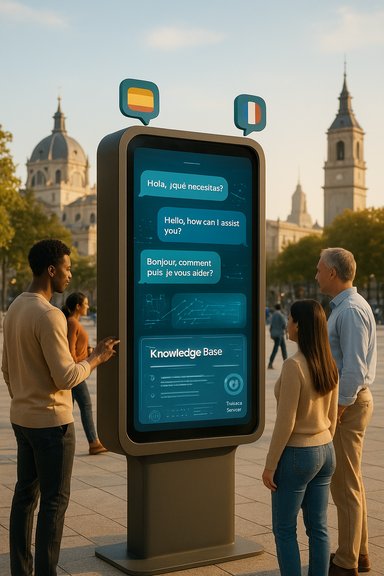
- The core interaction is a conversational interface—web chat, WhatsApp, or kiosk/totem—that accepts natural-language questions.
- Behind the chat, a knowledge layer aggregates authoritative content (city websites, event calendars, transport timetables, museum pages) and a retrieval mechanism maps user queries to that content.
- An LLM (here, Azure OpenAI Service models) synthesizes natural-language answers, often with system prompts and guardrails to match local tone, accessibility rules, and factual constraints.
- Analytics and management consoles gather usage metrics, extract insights about visitor interests, and allow staff to update or correct content without retraining the full model.
Verified technical claims
- Platform choice: Cities reported choosing Azure OpenAI Service for model hosting and integration with existing cloud infrastructure. Microsoft customer materials and press coverage confirm Azure OpenAI as the backbone in both Madrid and Buenos Aires deployments.
- Language coverage: Madrid’s assistant (marketed as VisitMadridGPT / Cicerone in partner materials) is designed to support up to 95 languages for real-time responses, a capability explicitly cited in Microsoft and partner announcements. Cross-referenced partner interviews and Microsoft press confirm the 95-language claim as a design and marketing metric. This is a vendor-reported figure; independent measurement of live-language coverage may vary by channel and feature set.
- Scale metrics (Buenos Aires): The Government of the City of Buenos Aires reports that Boti (with ChatGPT integration) manages roughly 2 million queries per month and that that automation has reduced operational workload by ~50%. These figures appear in Microsoft’s detailed customer story and are repeated in Microsoft cloud blogs; they are city-reported operational metrics rather than independent third-party audits. Readers should treat them as vendor- and customer-sourced performance reporting.
Case study: Madrid — digital tourism with an always-on assistant
What was launched
Madrid’s municipal tourism organization partnered with iUrban and used Azure OpenAI Service to create VisitMadridGPT (also referenced in iUrban marketing and Microsoft customer stories). The assistant is positioned as a 24/7 virtual tourist office that produces personalized itineraries, accessibility-aware recommendations, and multilingual support.Key claims and verification
- The assistant can generate itineraries and answer questions based on content from official city portals and cultural calendars. This is documented in partner interviews and Microsoft customer materials.
- It supports an expansive list of languages (advertised at 95), enabling broad accessibility for international visitors. This number is present in both Microsoft News and partner materials; it is a design objective and marketing statement that the city and vendor cite.
- Madrid attracted more than 10 million visitors in recent seasons; digital tools like VisitMadridGPT are presented by the municipal agency as part of a broader digital-tourism strategic plan to serve that audience. The visitor statistics in Microsoft customer storytelling contextualize why a scalable bot matters.
Operational mechanics and governance
Madrid’s rollout emphasizes content control: the assistant is trained or instructed to source answers from the city’s official channels and to provide pathways to human help when the assistant lacks confidence. Partner statements also stress accessibility and the ability to email the conversation transcript to the user — a design choice that improves usability and auditability.Case study: Buenos Aires — a conversation at municipal scale
Boti’s evolution
Boti began as an official city chatbot in 2019 and, after integrating LLM capabilities, evolved into an LLM-backed assistant (marketed as “Boti with ChatGPT” in Microsoft material). The platform handles a broad range of public services and has been used for public health, permits, and tourism information. Microsoft and the city report significant uptake during public events and pandemic response.Reported impact and verification
- Scale: City materials and Microsoft’s customer story state Boti manages roughly 2 million queries per month. This number is directly reported by the city in collaboration with Microsoft and appears across Microsoft channels. While widely reported, independent auditing of that number is not publicly available; it should be treated as city-reported usage data.
- Operational relief: The city claims a ~50% reduction in operational workload for certain teams after transitioning to an LLM-enhanced Boti. This is presented in Microsoft’s narrative and corroborated by the city’s public technology briefings; again, this is city-vendor reported and not an independent forensic evaluation.
What to note technically
Boti’s approach mixes retrieval from official data sources with model-generated language; the city also uses human-in-the-loop processes for oversight and to correct model outputs that could “hallucinate.” The architecture emphasizes centralizing government content into a single knowledge repository to improve accuracy across channels.Benefits observed (and claimed)
Cities and partners highlight several recurring advantages:- 24/7 availability and multilingual coverage: instant access for visitors and residents outside office hours and across languages reduces friction and improves inclusion.
- Operational efficiency: routing routine queries to chatbots frees staff to handle complex or high-impact tasks, with cities citing reduced ticket loads and faster first-contact resolution.
- Data-driven insights: conversation logs can reveal trending questions, unmet information needs, and opportunities for policy or marketing adjustments — for example, identifying high demand for restaurant recommendations or museum hours.
- Personalization: LLMs can create tailored itineraries and recommendations, improving the visitor experience and helping smaller attractions get visibility.
Risks, limitations, and governance challenges
The rapid adoption of generative AI in the public sector exposes several clear risks that must be planned for deliberately.Hallucinations and factual errors
LLMs can produce plausible but incorrect statements (so-called hallucinations). City deployments mitigate this by constraining answers to verified municipal data and by using retrieval-augmented generation approaches, but hallucinations remain a meaningful risk that requires monitoring and human oversight. Do not rely on LLM outputs as authoritative unless they are explicitly linked to verified sources.Privacy and data handling
Municipal chatbots interact with personal information. Madrid and partner messaging emphasize encryption and European data residency practices; iUrban and Microsoft communications point to retention rules (e.g., analytics data retained for limited periods such as six months) and contractual safeguards. These are vendor and city commitments; independent audits or public records would be required to fully verify compliance in operational detail. Treat retention and deletion claims as vendor-reported until audited.Bias, inclusion, and language quality
Multilingual support is a major benefit, but quality varies across languages. Testing and localized moderation are necessary to avoid lower-quality answers for minority languages and to ensure tone and cultural norms (for example, local dialect or "voseo" in Argentina) are respected. Buenos Aires explicitly localized tone to match local usage, demonstrating the need for careful linguistic tuning.Vendor lock-in and cost
Using proprietary LLM hosting introduces operational and contractual lock-in. Cities should plan for cost fluctuations (API pricing, model upgrades) and ensure exit or portability clauses, plus data export mechanisms, are in place. Microsoft/Azure is the platform in these case studies; procurement teams must weigh those trade-offs.Auditability and democratic oversight
Public-sector AI should be auditable. Conversation logs and model decision trails must be stored and reviewed under transparent governance rules. Several cities already route transcripts to email or staff review to increase traceability, but long-term oversight frameworks are often immature.Practical checklist for municipal IT leaders
- Define use cases precisely: prioritize high-volume, low-risk interactions (tourism queries, opening hours, route suggestions) before automating sensitive services (health, legal, licensing).
- Choose a retrieval-by-design architecture: anchor LLM outputs to verifiable city content to minimize hallucinations.
- Set clear data governance rules: retention periods, encryption at rest and in transit, and explicit non-use for model re-training unless consented and audited.
- Localize and test extensively: ensure tone, dialect, and accessibility (WCAG) criteria are met across target languages.
- Implement human-in-the-loop escalation: route low-confidence answers to staff and maintain edit controls for content owners.
- Monitor metrics and audit for fairness: track conversation accuracy, escalation rates, language quality, and demographic coverage.
- Plan procurement and exit strategies: include SLAs, data portability clauses, and cost caps when contracting cloud LLM providers.
- Publish transparency docs: describe the assistant’s capabilities, limitations, and complaint pathways publicly to build trust.
Deployment patterns and recommended architecture (high level)
- Front-end channels: web chat, WhatsApp, kiosks/totems, mobile apps.
- Access and identity: anonymous queries for general info; authenticated flows for transactional services.
- Knowledge base: canonical city content ingested into a document store with version control.
- Retrieval layer: semantic search (vector store) that returns citations or evidence snippets.
- LLM layer: Azure OpenAI or equivalent model with instruction prompts, safety layers, and fallback templates.
- Orchestration: middleware that decides when to call LLMs, when to use templated responses, and when to escalate to humans.
- Analytics and reporting: dashboards for traffic, intent classification, and satisfaction measures.
- Governance: retention guards, red-team testing, and public transparency.
The wider public-sector AI landscape: context and comparators
Beyond Madrid and Buenos Aires, other governments and agencies are experimenting with LLMs for citizen services, translations, and internal knowledge management. Publications on public AI deployments in Latin America and Europe show an accelerating trend of AI-enabled chat assistants for tourism, social services, and transport, often relying on cloud LLM services and regional partners. These efforts collectively point to an emerging standard architecture and a shared set of governance challenges. Public claims about scale, language coverage, and impact often come from vendor-customer case studies; independent audits are still rare.Critical analysis: strengths, gaps, and what to watch next
Strengths
- Practical impact: The most compelling evidence is operational — cities report measurable reductions in routine workload and clear service availability improvements. Vendor-customer case studies show real value when chatbots are aligned to concrete, high-volume tasks.
- Accessibility gains: Multilingual support and 24/7 availability directly improve tourist experiences and widen inclusion for non-native speakers.
- Data for decision-making: Conversation analytics give planners near-real-time feedback on visitor needs and service gaps.
Gaps and caveats
- Vendor and customer reporting bias: Most high-scale metrics appear in vendor-hosted case studies or vendor-recirculated press; independent verification is scarce. Numbers such as “2 million queries/month” or “95 languages supported” should be treated as reported performance rather than third-party validated facts.
- Auditability and oversight are uneven: Implementation details about model prompts, training data, and incident handling are not always publicly disclosed, hindering independent safety assessments.
- Operational risk: Cost volatility, API rate limits, and the need for continuous human curation are often underemphasized in marketing materials. Cities should budget for ongoing moderation and maintenance, not just an initial deployment.
Conclusion
Generative AI is moving from proof-of-concept into production in municipal services, with Madrid’s VisitMadridGPT and Buenos Aires’ Boti offering tangible examples of what’s possible: multilingual, 24/7 assistance that scales to millions of interactions and frees staff to focus on complex work. The technical pattern is now familiar — knowledge retrieval + LLM synthesis + human oversight + analytics — and major cloud providers such as Azure are central to many deployments. However, the most important differentiator for cities will be governance: how they limit hallucinations, protect personal data, audit model behavior, and maintain service continuity without being locked into a single vendor. The leading deployments already pair technological capability with operational safeguards and localization work; the next wave should add independent evaluation, published transparency reports, and procurement terms that protect the public interest.For municipal IT leaders, the immediate priority is pragmatic: start with bounded use cases, require verifiable data governance, and treat LLMs as a service component that needs continual tuning, staff training, and public accountability. The payoff — more accessible civic services and data-driven planning — is clear; realizing it safely will depend on careful technical design and robust governance now.
Source: Microsoft AI in Government: Improving Civic Experience
