

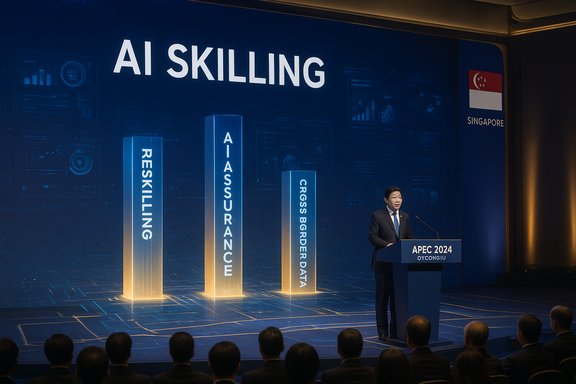
Prime Minister Lawrence Wong used the APEC leaders’ stage in Gyeongju to deliver a clear policy imperative: governments must take the lead in preparing workers for the AI transition rather than leaving reskilling and social protection to the market alone. This message — delivered at the Asia‑Pacific Economic Cooperation (APEC) Economic Leaders’ Meeting on 31 October–1 November 2025 — frames workforce training, AI assurance, and cross‑border data frameworks as the three pillars that will determine whether AI’s gains are widely shared or captured narrowly by capital owners. The HardwareZone report of his remarks captured the core of his argument and the tangible steps Singapore is already taking, including the AI Verify Foundation and a national research consensus on AI safety.
The 2025 APEC Leaders’ Meeting in Gyeongju endorsed an APEC AI Initiative aimed at building capacity, sharing policy practices, and encouraging resilient AI infrastructure across the 21 Pacific‑rim economies. The Initiative is explicitly focused on voluntary cooperation: economy‑level readiness reviews, stakeholder exchanges, and capacity building to increase meaningful participation in AI adoption while encouraging investment in secure and sustainable AI infrastructure. This international-level framing is intended to help economies manage both the economic upside of AI and the societal risks that come with rapid adoption. Singapore’s contribution at APEC was notably practical. Prime Minister Wong argued that the city‑state — which cannot realistically lead on frontier foundation‑model training at hyperscale — should instead focus on applying foundation models to high‑impact domestic and regional sectors (finance, logistics, healthcare, advanced manufacturing), and on building interoperable assurance mechanisms and workforce pipelines so those applications benefit workers as well as companies. He placed particular emphasis on three interlocking priorities: reskilling/upskilling and job redesign, building trust via testing and standards, and keeping trusted data corridors open for AI innovation.
PM Wong’s argument is direct: “Just because it happened in the past doesn’t mean it will also happen in the future. We cannot leave this to the market.” That is a call to public action on three fronts:
These are not low‑cost commitments. They require sustained funding, technical competence, and political will. But without them, the likely alternative is faster automation with slower, patchier social adaptation — an outcome that will be more costly to reverse. APEC economies now have a voluntary architecture and concrete operational models at hand; the urgent work is implementation — turning summit statements into measurable, accountable programs that deliver opportunity, not just headlines.
Source: HardwareZone PM Wong urges governments to take lead in AI workforce training
 Background / Overview
The 2025 APEC Leaders’ Meeting in Gyeongju endorsed an APEC AI Initiative aimed at building capacity, sharing policy practices, and encouraging resilient AI infrastructure across the 21 Pacific‑rim economies. The Initiative is explicitly focused on voluntary cooperation: economy‑level readiness reviews, stakeholder exchanges, and capacity building to increase meaningful participation in AI adoption while encouraging investment in secure and sustainable AI infrastructure. This international-level framing is intended to help economies manage both the economic upside of AI and the societal risks that come with rapid adoption. Singapore’s contribution at APEC was notably practical. Prime Minister Wong argued that the city‑state — which cannot realistically lead on frontier foundation‑model training at hyperscale — should instead focus on applying foundation models to high‑impact domestic and regional sectors (finance, logistics, healthcare, advanced manufacturing), and on building interoperable assurance mechanisms and workforce pipelines so those applications benefit workers as well as companies. He placed particular emphasis on three interlocking priorities: reskilling/upskilling and job redesign, building trust via testing and standards, and keeping trusted data corridors open for AI innovation.Why the government must act: the case for public leadership in AI skilling
The economics are ambiguous — policy matters
Past technological waves (industrial machinery, PC and internet revolutions) show net job creation over long horizons, but there is no economic law guaranteeing the same outcome for AI. The critical difference with today’s AI wave is speed, scale, and the kinds of cognitive tasks subject to automation — making timing, distribution, and policy design decisive for real outcomes.PM Wong’s argument is direct: “Just because it happened in the past doesn’t mean it will also happen in the future. We cannot leave this to the market.” That is a call to public action on three fronts:
- Fund and coordinate large‑scale reskilling and apprenticeship pipelines that guarantee workplace rotations and employer commitments.
- Redesign job taxonomies and career ladders to reward AI oversight, verification and stewardship roles instead of leaving displaced workers to market frictions.
- Use procurement and public programs to shape vendor incentives toward accountable, auditable AI systems.
What effective public programs look like
Governments have several concrete levers to make reskilling effective and equitable:- Map tasks, not job titles: conduct AI exposure audits by job family to identify augmentable vs. at‑risk tasks.
- Fund dual‑education and apprenticeship schemes with guaranteed placement commitments and transferable microcredentials.
- Require outcome‑focused credentialing that measures task‑level competencies (prompt validation, hallucination detection, model oversight) and is vendor‑neutral.
- Use public procurement to require auditability, human‑in‑the‑loop (HITL) systems for high‑risk decisions, and contractual non‑training clauses for public data.
These design elements reduce the risk of superficial upskilling and help ensure that retraining translates into durable employment outcomes.
Building trust: AI Verify Foundation and assurance ecosystems
What Singapore has built so far
Singapore has positioned itself as a pragmatic builder of AI assurance tools and communities. The AI Verify Foundation — launched from IMDA’s AI Verify toolkit initiative — is a not‑for‑profit foundation designed to develop open testing tooling, standards and best practices for AI testing and governance. The foundation offers:- An open‑source testing framework and toolkit for governance checks and technical tests.
- A Global AI Assurance Sandbox for deployers and testers to trial generative AI apps and generate testing reports.
- Industry collaboration channels that bring together model developers, cloud providers, enterprise users and third‑party testers.
Why open testing matters for governments and enterprises
Testing and assurance are not just technical niceties; they are the operational basis for trust. A few consequential benefits:- Measurable, comparable reports make procurement decisions evidence‑based rather than marketing‑led.
- Shared testbeds reduce duplication and lower barriers for SMEs and regulators to validate models.
- Technical testing complements policy frameworks (privacy, safety) and informs standards that can travel across jurisdictions.
Cross‑border data flows: keeping corridors open while managing risk
Data is the raw material for AI
PM Wong and the Singapore delegation urged APEC economies to preserve trusted data corridors because data powers modern AI models. Singapore supports APEC’s Cross‑Border Privacy Rules (CBPR) system as a practical mechanism for balancing cross‑border data flows with privacy protections. Trade agreements with digital provisions (for example, the Digital Economy Partnership Agreement) are complementary instruments to facilitate data‑enabled services across jurisdictions.Practical policy trade‑offs
Open data corridors accelerate model quality and enable cross‑economy collaboration. But they also raise legitimate privacy, national security and regulatory concerns. The pragmatic policy mix includes:- Sectoral safeguards for health, finance and critical infrastructure data.
- Mutual recognition frameworks and auditing regimes that lower compliance friction for cross‑border flows.
- Technical options like secure compute clean rooms and federated learning that allow collaborative model development without wholesale data export.
APEC AI Initiative and the multilateral context
What APEC endorsed in Gyeongju
APEC leaders issued the Gyeongju Declaration and endorsed the APEC AI Initiative (2026–2030), which sets three strategic objectives: foster resilient growth by advancing AI innovation; increase economies’ participation in AI transformation through cooperation and capacity building; and cultivate investment ecosystems for resilient AI infrastructure (cloud, data centers, power). The Initiative emphasizes voluntary policy exchange, capacity building, and investment facilitation rather than binding harmonized regulation.Geopolitics and competing global visions
The APEC meeting also highlighted competing approaches on the global stage. High‑level interventions — from calls for a global AI governance body to differing national risk appetites — underline that regional cooperation like APEC’s is likely to be a patchwork of voluntary frameworks and collaborative projects, not immediate global treaty obligations. That makes operational cooperation (testing, workforce programs, data frameworks) even more important as practical, non‑political workstreams. Recent reporting shows leaders used APEC to advance distinct multilateral proposals and political positioning on AI governance.The Singapore Consensus on Global AI Safety Research Priorities
In parallel to the APEC discussions, Singapore convened a technical forum that produced the Singapore Consensus on Global AI Safety Research Priorities — a living document identifying research areas to improve AI risk assessment, trustworthy behaviors, and control mechanisms for advanced models. The Consensus emerged from the 2025 Singapore Conference on AI (SCAI) and reflects contributions from leading safety researchers and practitioners across academia, industry and government. It is intended to align research agendas and inform policymakers about where technical progress is needed to make advanced systems safer and more verifiable.Practical implications for IT leaders and WindowsForum readers
AI policy at the state level will cascade into procurement, identity, endpoint security, and governance choices that matter directly to IT administrators, engineers and CIOs running Windows estates. Key, actionable implications:- Treat AI rollout as change management: pilot in controlled environments, measure outcomes (error rates, verification time, escalation frequency) and scale only with clear governance.
- Inventory "shadow AI": discover which consumer LLMs and productivity assistants staff are using and for what data types; apply DLP and sensitivity labels to block or route sensitive content away from public models.
- Prefer enterprise AI / Copilot offerings with contractual non‑training guarantees, audit rights, and clear data protections; negotiate portability and exit terms.
- Invest in learning‑in‑flow microtraining tied to defined job outcomes (e.g., Copilot templates for helpdesk triage) and reward stewardship skills (agent ops, model validation) in performance frameworks.
- Harden endpoints: MFA, up‑to‑date patching, least privilege and endpoint telemetry to detect anomalous model interactions.
These steps convert summit rhetoric into operational controls that reduce data leakage, governance blind spots, and vendor lock‑in risk.
Critical analysis — strengths, limitations and implementation risks
Notable strengths
- Focused pragmatism: Singapore’s approach (apply, govern, test) is realistic for small economies that cannot train frontier foundation models but can build high‑impact integrations and governance tools.
- Operational cooperation: APEC’s Initiative and technical workstreams (assurance sandboxes, research consensuses) create concrete pathways for knowledge sharing and capacity building across diverse economies.
- Industry engagement: Open testing foundations and broad membership (major cloud vendors and enterprise players) help align incentives for technical assurance and market acceptance. IMDA and AI Verify’s rapid membership growth shows real market interest.
Key risks and blind spots
- Implementation gap: Declarations and initiatives are only as good as follow‑through funding, published KPIs, employer hiring commitments and measurable placement rates. Experience shows that enrollment numbers alone are a weak proxy for impact.
- Vendor capture and credentialization: Large vendor‑led training programs and platform‑centric certification ecosystems can lock public procurement and narrow skills portability. Governments must insist on open, interoperable credentials.
- Timing and distribution: Even if AI creates net jobs in the long run, short‑term mismatches in skill requirements and local labor markets could lead to political and social stress unless retraining and portable benefits are adequately resourced.
- Data governance friction: Opening cross‑border data corridors requires trust infrastructures, audits, and legal harmonization — a multiyear undertaking that will not move at the same speed as corporate model deployments.
Where public leadership is necessary — not optional
The central analytic conclusion is straightforward: market forces alone are unlikely to manage timing, distribution and trust with sufficient speed and fairness. Public leadership is necessary to:- Build scale in equitable, vendor‑neutral reskilling programs.
- Insist on procurement terms that shape vendor behavior toward auditability and human oversight.
- Fund public assurance infrastructure (testing sandboxes, neutral validators) that lowers adoption barriers for SMEs and regulators.
Without these interventions, productivity gains risk being concentrated and politically destabilizing.
Verifying headline claims and flagging uncertainties
Three frequently cited claims warrant careful verification:- AI Verify Foundation membership: IMDA and the AI Verify Foundation’s website report steady membership growth; IMDA currently lists more than 180 general members and nine premier members, while other contemporaneous reports cite slightly lower snapshots (e.g., “more than 170”) — a normal difference caused by timing. Treat public membership counts as time‑bound snapshots, and verify the live roster for procurement or partnership decisions.
- APEC AI Initiative and Gyeongju Declaration: The APEC Secretariat published the Gyeongju Declaration and the APEC AI Initiative as formal leaders’ outcomes endorsing voluntary cooperation on AI capacity and infrastructure for 2026–2030. These are public, verifiable commitments at APEC’s institutional level.
- The Singapore Consensus: The technical consensus document from SCAI (May 2025) is a living, community‑sourced output that identifies priority research directions for AI safety; it is intended as guidance for global researchers and policymakers rather than a binding regulatory text. Confirm authorship and participant lists in the published document for precise attribution.
A practical playbook for policymakers and enterprise leaders
- Map AI exposure by job family within 3 months: classify tasks into augmentable, redeployable, and at‑risk buckets.
- Launch outcome‑focused apprenticeship pilots within 6 months: require employer placement commitments and transferable microcredentials.
- Embed assurance into procurement within 9 months: mandate test reports, HITL gates for high‑risk uses, and non‑training clauses for sensitive public data.
- Fund national assurance sandboxes and shared compute for SME access within 12–24 months.
- Publish annual KPIs: placement rates, wage trajectories of retrained cohorts, and audit summaries for public AI deployments.
Conclusion
Prime Minister Lawrence Wong’s appeal at APEC crystallises a central, practical choice facing governments today: either treat AI as a market technology and accept widely distributed, policy‑driven inequalities, or proactively invest in people, standards, and cross‑border trust mechanisms so AI’s returns are broadly shared. The APEC AI Initiative, Singapore’s AI Verify Foundation and the Singapore Consensus on research priorities are complementary pillars of a pragmatic strategy: build capability, test and assure systems, and keep data and investment channels open in trustworthy ways.These are not low‑cost commitments. They require sustained funding, technical competence, and political will. But without them, the likely alternative is faster automation with slower, patchier social adaptation — an outcome that will be more costly to reverse. APEC economies now have a voluntary architecture and concrete operational models at hand; the urgent work is implementation — turning summit statements into measurable, accountable programs that deliver opportunity, not just headlines.
Source: HardwareZone PM Wong urges governments to take lead in AI workforce training
