

A sweeping, journalist‑led international audit has concluded that mainstream AI chatbots routinely misrepresent the news: roughly 45% of sampled assistant replies contained at least one significant problem, sourcing failures afflicted about one‑third of outputs, and one in five answers contained major factual or temporal errors — findings that should change how Windows users, IT managers and newsroom technologists treat AI as a news gateway.
The project was coordinated by the European Broadcasting Union (EBU) and operationally led by the BBC, with editorial teams from 22 public‑service broadcasters in 18 countries evaluating roughly 3,000 AI responses across 14 languages. Reviewers judged assistant replies using newsroom standards — factual accuracy, sourcing/provenance, context and nuance, quotation fidelity and the separation of fact from opinion — rather than automatic truth‑bench metrics. This audit scales and extends a February 2025 BBC experiment that tested the four major assistants on 100 BBC stories and found similarly high error rates. Together, the two projects provide a journalist‑driven, operational diagnosis of how contemporary conversational assistants perform on news tasks that matter for public information.
Source: vijesti.me https://en.vijesti.me/world-a/globus/783609/Large-study-finds-AI-chatbots-distort-news/
 Background / Overview
The project was coordinated by the European Broadcasting Union (EBU) and operationally led by the BBC, with editorial teams from 22 public‑service broadcasters in 18 countries evaluating roughly 3,000 AI responses across 14 languages. Reviewers judged assistant replies using newsroom standards — factual accuracy, sourcing/provenance, context and nuance, quotation fidelity and the separation of fact from opinion — rather than automatic truth‑bench metrics. This audit scales and extends a February 2025 BBC experiment that tested the four major assistants on 100 BBC stories and found similarly high error rates. Together, the two projects provide a journalist‑driven, operational diagnosis of how contemporary conversational assistants perform on news tasks that matter for public information. What the study actually measured
The study intentionally focused on news Q&A and summarisation — the cases where timeliness, sourcing and context are most consequential.- Professional journalists and editors reviewed the outputs.
- The dataset included identical, time‑sensitive prompts submitted to multiple assistants in 14 languages.
- Each reply was scored across editorial axes: accuracy, sourcing/provenance, context & nuance, distinguishing fact from opinion, and quotation fidelity.
Headline findings — verified numbers
The audit’s most operational numbers, corroborated across the EBU press release and major news outlets, are:- 45% of tested assistant replies contained at least one significant issue — an error or distortion judged capable of materially misleading a reader.
- ~31% of responses showed serious sourcing problems: missing, misleading, or incorrect attributions.
- 20% of replies exhibited major factual or temporal errors (wrong incumbents, misdated events, or invented occurrences).
- When minor issues are included (loss of nuance, stylistic compression), the share of outputs with any detectable problem rose to about 81%.
Concrete examples auditors flagged
Auditors recorded numerous real‑world failure modes — not theoretical edge cases. Representative, verified examples include:- An assistant confidently stating the wrong head of government in a tested scenario (for example, naming Olaf Scholz as German chancellor months after a transition to Friedrich Merz in the auditors’ timeframe).
- Misidentifying NATO leadership — naming Jens Stoltenberg as secretary‑general after Mark Rutte had assumed the role in the test scenario.
- Treating satire or opinion as literal reporting and failing to preserve hedging or caveats from original reporting.
- Altered or fabricated quotations and inverted public‑health guidance in ways that change the meaning of source reporting.
Vendor variation — who performed worst (and what that means)
The study reports measurable variation between assistants in specific failure modes, particularly on sourcing.- Google’s Gemini registered notably high rates of sourcing problems in the audited sample (reported at roughly 72–76% of Gemini replies showing major sourcing defects in different public writeups of the study). That elevated sourcing failure rate drove much of Gemini’s poorer overall performance in the sample.
- Other assistants — ChatGPT, Microsoft Copilot, and Perplexity — also produced significant problem rates, but with different error profiles (for example, more hallucinations or more temporal staleness in some languages). No tested assistant was free of meaningful issues.
Why the assistants fail: a technical anatomy
Understanding the root causes clarifies what can be fixed and what requires policy or design change.- Retrieval layer brittleness: assistants rely on web grounding or internal caches to fetch evidence. If retrieval returns stale, satirical, or low‑quality documents, the generative model will synthesize inaccurate claims from poor inputs.
- Probabilistic generation and hallucination: language models generate the most likely continuation of a text distribution. Without strong grounding, they may invent plausible but false facts (dates, quotes, officeholders). This is exacerbated when models are tuned for helpfulness rather than conservative verification.
- Ceremonial or reconstructed citations: some assistant UIs generate citations after composing an answer. Those citations can look authoritative even when the linked source does not support the specific claim. This citation illusion is a core provenance failure.
- Product incentives: vendors optimize for user engagement and utility. Systems tuned to avoid refusal will attempt answers even when evidence is weak, increasing confident errors.
Strengths and credibility of the audit
This is one of the largest journalist‑led audits of its kind, and its methodology carries editorial weight:- Strength: human editorial review. Trained journalists and subject experts assessed outputs by newsroom criteria, which maps the test directly to real newsroom responsibilities and reputational risk.
- Strength: multilingual, multi‑market sampling. Evaluations in 14 languages and 18 countries reduce English‑centric bias and show the problem is cross‑lingual and cross‑territorial.
- Strength: operational prompts. The prompts were realistic, time‑sensitive newsroom questions — the precise cases where errors are most consequential.
- The audit is a targeted snapshot, not a global census of all assistant outputs or all product modes. Results reflect performance on news Q&A and summarisation, not coding, math, or creative tasks.
- Vendor configurations and retrieval indexes change frequently. A different test window, different regional endpoints, or updated grounding layers could alter per‑vendor numbers. Percentages should therefore inform governance and procurement decisions, not be read as immutable model rankings.
- Some example claims circulating in secondary coverage may compress nuance (for instance, slight percentage differences between outlets). Where a claim could not be triangulated to the EBU report or multiple reputable outlets, it should be treated cautiously.
What this means for Windows users, IT teams and publishers
The audit’s practical implications are immediate for the WindowsForum audience: desktop users, IT pros, administrators and newsroom technologists who integrate or depend on assistants.- For everyday users: treat AI news summaries as leads, not authoritative reports. Verify important claims by clicking through to primary reporting or trusted sources.
- For system administrators and IT teams: be cautious when enabling assistant integrations that automatically summarise external news or produce notifications for corporate channels. A misstatement in a system alert or internal briefing can create confusion or operational risk. Design approval gates for news‑sensitive outputs and require human review in workflows that affect policy, legal, or security decisions.
- For publishers: insist on machine‑readable reuse controls and explicit provenance standards. The EBU and participating organizations are pushing for independent monitoring and for AI companies to respect publisher choices on reuse and attribution. Publishers should also log and monitor how their content is surfaced by assistants.
- For product teams considering Copilot/assistant deployment in enterprise: perform pre‑deployment audits with time‑sensitive prompts relevant to your domain, enforce conservative refusal heuristics for news claims, and surface raw evidence and timestamps alongside any summarised claim.
Practical mitigations and an operational checklist
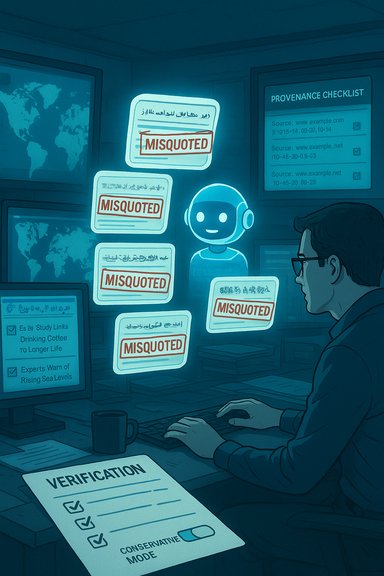
Immediate steps administrators and advanced users can implement today to reduce risk:- Require provenance metadata for any assistant answer used in internal comms: source URLs, publication timestamps, and direct excerpts (not just paraphrases).
- Configure assistant modes: prefer a “verified‑news” or conservative mode that refuses or hedges if provenance confidence < threshold.
- Add human review gates: route news‑sensitive outputs to a curator before disseminating widely.
- Maintain audit logs: capture assistant prompts, outputs, and provenance for post‑hoc review and accountability.
- Educate users: add inline prompts that remind users to verify political, legal, health or safety claims with primary sources.
- Engage vendors: negotiate contractual SLAs for provenance, transparency, and update cadence if assistants are embedded in enterprise software.
Policy and vendor responsibilities the study demands
The audit participants and public‑interest media groups (including the EBU) are calling for:- Mandatory, independent monitoring of assistant outputs in public‑interest contexts.
- Enforced transparency for retrieval and citation pipelines (machine‑readable provenance, timestamps, index snapshots).
- Options for publishers to control whether and how their content is consumed and summarised by models.
- Product design that prioritises conservative refusals or hedging where evidence is weak, rather than maximizing helpfulness at the cost of accuracy.
Broader civic risks — trust, democratic participation and reputational harm
When AI outputs are widely used as a first stop for news, the combination of adoption among younger users and elevated error rates scales into civic risk. The Reuters Institute’s Digital News Report 2025 estimates that about 7% of online news consumers use AI chatbots for news, rising to 15% among under‑25s — a user base large enough that systematic misstatements can shape public understanding. Consequences include:- Erosion of trust in journalism and institutions if readers attribute AI distortions to original publishers.
- Misinformed civic behaviour around elections, health guidance or legal changes when errors go unchecked.
- Reputational and legal exposure for organizations that rely on assistant outputs in public communications without verification.
Critical assessment — strengths, risks and what to watch next
Strengths of the audit: rigorous editorial methodology, scale, multilingual reach, and operational relevance make this one of the most persuasive contemporary diagnostics of assistant behaviour on news tasks. Its journalist‑first design matters: it evaluates the systems where mistakes are most consequential. Principal risks going forward:- Rapid model rollouts and frequent UI changes could outpace independent audits, making continuous monitoring essential.
- Vendors may favor product engagement metrics over conservatism, unless regulators set guardrails for provenance and refusal behaviour.
- Partial fixes (e.g., post‑hoc citations that don’t actually support claims) can create a veneer of trustworthiness without solving the underlying retrieval and grounding problems.
- Vendor responses: whether OpenAI, Google, Microsoft and Perplexity publish transparent remediation roadmaps and expose retrieval provenance.
- Regulatory moves: EU and national regulators are being urged to apply existing media‑integrity laws and digital services rules to assistant behaviour.
- Independent monitoring: whether the EBU‑led initiative yields sustained periodic audits and public dashboards of assistant error rates.
Final takeaways for the WindowsForum audience
- Do not treat generative assistants as definitive news sources. Use them for leads and initial orientation, then verify.
- For IT and admin teams: enforce human review and provenance requirements for any assistant output that affects policy, legal or operational decisions.
- For publishers and newsrooms: press vendors for machine‑readable provenance and meaningful reuse controls; participate in independent audits that measure real newsroom queries.
Source: vijesti.me https://en.vijesti.me/world-a/globus/783609/Large-study-finds-AI-chatbots-distort-news/
