

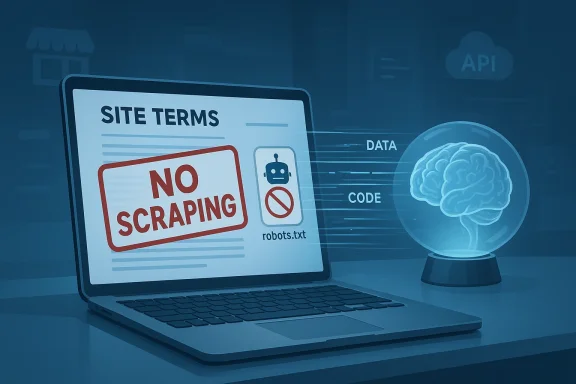
Paul Thurrott’s site has quietly—and unambiguously—reasserted that the content it publishes is proprietary and intended for personal, non‑commercial use only, explicitly forbidding automated scraping, bulk copying, and any reuse that would act as a “source of or substitute for the Service.”
The short excerpt at the center of the debate is straightforward in tone and scope: the publisher emphasizes that the material made available through its Service was assembled using the site’s own methods and editorial judgment, and is protected both by copyright and by contractual terms that serve as a license governing downstream use. The language singles out automated access—“robots, spiders, scrapers, web crawler, or other automated means”—and adds that users must not bypass robot exclusion headers or other technical controls intended to limit automated access.
That clause did not appear in isolation. The conversation around it has landed where tech, law, and AI research intersect: publishers are defending commercial models for the work they produce, while researchers and downstream services want clarity on what they can ingest, index, or repurpose for model training and machine‑generated outputs. The debate has already generated dedicated threads among Windows‑focused communities and commentary about the consequences for downstream tools and aggregators.
At the same time, contract law and copyright law have different remedies and thresholds. Copyright cases hinge on copying protected expression; contract cases hinge on the enforceability of the terms and whether the defendant agreed to them. For operators of automated crawlers, the legal calculus depends on both dimensions, and enforcement strategies may include cease‑and‑desist letters, DMCA takedowns (where applicable), or litigation over breach of contract.
Importantly, where a site’s ToS expressly forbids bypassing robots.txt or similar measures, that statement can feed legal claims—particularly in contexts where a party deliberately bypasses protective measures. The ToS language we’re discussing leaves no doubt that the publisher intends robots.txt and the like to be respected.
But intent alone is not a solution. The language creates operational friction for AI developers, researchers, and indexers and raises enforceability and fairness questions that will not be resolved by contracts alone. The path forward requires more than a ban—it requires marketplaces, APIs, and industry standards that let publishers monetize and control their work while giving researchers and responsibly governed services predictable, legal access to build the next generation of tools.
For now, the practical takeaway for each stakeholder is clear: publishers should couple restriction with pragmatic access options; developers and researchers should favor licensed sources and respect technical signals; and platform builders should invest in transparent, standards‑based licensing and output governance. That approach preserves both the economic engine that funds quality journalism and the innovation that depends on large, diverse datasets—ideally without forcing either side into a series of expensive, reputation‑damaging fights.
Source: Thurrott.com store - Thurrott.com
 Background
The short excerpt at the center of the debate is straightforward in tone and scope: the publisher emphasizes that the material made available through its Service was assembled using the site’s own methods and editorial judgment, and is protected both by copyright and by contractual terms that serve as a license governing downstream use. The language singles out automated access—“robots, spiders, scrapers, web crawlerThat clause did not appear in isolation. The conversation around it has landed where tech, law, and AI research intersect: publishers are defending commercial models for the work they produce, while researchers and downstream services want clarity on what they can ingest, index, or repurpose for model training and machine‑generated outputs. The debate has already generated dedicated threads among Windows‑focused communities and commentary about the consequences for downstream tools and aggregators.
Why this matters: content economics, discovery, and AI
Two core tensions underlie the practical importance of the clause.- Publishers rely on unique content as a revenue and audience mechanism. Clear terms that restrict automated ingestion protect the value proposition of a site—its curated news, analysis, and product reviews—by attempting to prevent third parties from recreating or substituting the site’s offering. This is precisely the point made in the policy language shown above.
- Modern AI systems and many indexing services rely on large, diverse corpora collected automatically from the web. When a publisher says “no automated means,” it complicates the data‑collection processes many researchers and companies use to build models, summarize news, or surface snippets for search and chat experiences. That tension is what motivated the vigorous community discussion following the policy reminder.
Legal and practical analysis
Contract vs. copyright: two separate but overlapping tools
The language a publisher adds to a site’s Terms of Service (ToS) is a contract between the publisher and the user. Where enforceable, it can forbid uses the copyright owner does not wish to permit, even if a use might otherwise be argued to fall within “fair use” under copyright law. In practice, a publisher’s contractual prohibition on scraping and reuse is intended to create a private right the publisher can assert against violating parties. The excerpt reflects the typical strategy: coupling copyright notice with a contract that governs permitted uses and technical controls.At the same time, contract law and copyright law have different remedies and thresholds. Copyright cases hinge on copying protected expression; contract cases hinge on the enforceability of the terms and whether the defendant agreed to them. For operators of automated crawlers, the legal calculus depends on both dimensions, and enforcement strategies may include cease‑and‑desist letters, DMCA takedowns (where applicable), or litigation over breach of contract.
The "robots" line: technical controls and legal weight
The clause specifically calls out “robot exclusion headers” and other measures that limit automated access. That is a nod to the longstanding web convention of robots.txt and to HTTP headers that site operators use to express crawling preferences. From a practical standpoint, robots.txt is easy to implement and generally respected by ethical crawlers; it is not a robust security control, but it is part of a publisher’s record of intent about allowed automated access.Importantly, where a site’s ToS expressly forbids bypassing robots.txt or similar measures, that statement can feed legal claims—particularly in contexts where a party deliberately bypasses protective measures. The ToS language we’re discussing leaves no doubt that the publisher intends robots.txt and the like to be respected.
Ambiguity and friction: “source of or substitute for the Service”
One phrase in the excerpt that raises practical problems is the prohibition of using the Service “in a manner that (i) is a source of or substitute for the Service or the content.” That kind of broad, qualitative restriction is difficult to apply consistently.- What counts as a “source of” the Service? Is an AI model trained on hundreds of sites that answers a question using aggregated knowledge a prohibited substitute?
- What is the line between aggregation (e.g., an index that points to the publisher’s content) and substitution (a product that answers user queries using the underlying text)?
What publishers gain—and what they risk
Strengths of the approach
- Revenue protection: Explicit restrictions on scraping and reuse reduce the chance that downstream services will deliver the same editorial product without driving traffic or paying for the work.
- Clarity of intent: Strong language provides a clear basis for enforcement actions against bad‑faith actors who republish or repackage content wholesale.
- Technical alignment: Calling out robot exclusion headers and other controls aligns legal terms with technical signals used by web crawlers.
Risks and unintended consequences
- Chilling research and innovation: Overbroad prohibitions can block legitimate academic and nonprofit research that depends on web‑scale datasets. That risks slowing important work—security research, journalism meta‑analysis, and algorithmic fairness studies—that benefits the public.
- Public relations cost: Heavy‑handed ToS language can generate pushback in community forums and social media, especially when users or developers feel the restrictions are disproportionate. The debate thread captured such reactions when the policy was reemphasized.
- Enforceability questions: Courts may narrow or reinterpret broad contract language; moreover, enforcement is expensive, and many publishers lack the resources to litigate every violation.
- Fragmentation: If every publisher uses different, incompatible restrictions, downstream services face a compliance nightmare—raising real operational costs for indexing and model builders.
Case studies and precedents from the archive
To understand how these clauses fit into a broader ecosystem, it helps to look at other historic examples that used similar language.- Google’s Music Beta Terms and other early cloud/media service agreements famously spelled out limits on automated uses and distribution of data, tying access to user licenses and clarifying the provider’s rights when transforming or transmitting content for technical compatibility. Those agreements provide a precedent for coupling functional, technical steps with contractual permissions.
- Microsoft’s Store and Dev Center policies have evolved to manage publishers, distribution, and monetization across a broad platform. Recent product and store changes—such as update management, multi‑app installer features, and developer onboarding—show how platform operators balance distribution convenience with commerce and control. Those platform dynamics are the real world in which publisher ToS decisions have economic consequences.
Practical guidance for stakeholders
Below are concrete, actionable recommendations tailored to the three main stakeholder groups affected by restrictive ToS language: publishers, researchers/AI developers, and platform or tool builders.For publishers (how to protect value without killing discovery)
- Offer a clear, tiered licensing model:
- Free, limited access for personal, non‑commercial users.
- Paid or API access for commercial aggregators, AI trainers, and enterprise customers.
- Publish a machine‑readable policy in robots.txt and an explicit API terms page; tie technical limits to contractual terms so intentions are unambiguous.
- Provide an official API or dataset offering with usage rules and pricing. An API redirects demand away from illicit scraping and toward monetized, controlled access.
- Use rate limiting, CAPTCHAs on suspicious traffic, and tokenized API keys; log and monitor patterns to detect bulk scraping.
- Make enforcement predictable: publish DMCA and abuse reporting procedures and be prepared to follow them consistently, but reserve litigation for high‑harm actors only.
- Communicate openly with the community—explain why the rules exist, what they protect, and how developers and researchers can get legitimate access. Transparency reduces backlash.
For researchers and AI developers (how to reduce legal and ethical risk)
- Prefer licensed or permissioned datasets. Whenever possible, obtain explicit licenses or use data offered under clear, machine‑readable terms.
- Respect robots.txt and technical measures. It’s a low‑cost way to demonstrate good faith and reduces the risk of claims that you circumvented protective measures.
- Use differential sampling and transformation. Avoid wholesale verbatim ingestion and consider analytic approaches (e.g., extractive features, transformations) that reduce the chance of direct reproduction.
- Document provenance and retention. Keep records of where data came from and under what terms; this matters if questions arise later.
- Engage publishers. Reach out with clear proposals for research use; some publishers will grant permission or offer an API, especially for non‑commercial research.
- Design outputs to avoid verbatim replication. Implement filtering to detect and block generation that duplicates copyrighted content beyond short excerpts.
For platform and tool builders (implementing operational controls)
- Build compliance-first ingestion pipelines:
- Respect site‑level directives.
- Maintain contact lists and whitelists for publishers who grant permission.
- Implement automated detection of high‑risk outputs (verbatim reproduction), and include a remediation workflow (remove, re‑train, or block).
- Offer publishers reciprocal features: traffic attribution, monetization opportunities, or visibility dashboards so they see how their content is used.
- Consider a shared industry standard for machine‑readable content‑use licenses to reduce friction and ambiguity across sites.
Technical controls publishers should adopt (short list)
- Robots.txt / robots meta tags — explicit crawl rules for bots.
- Rate limiting and request throttling — restrict large off‑pattern fetch behaviors.
- API keys and tokenized throttles — authenticated, metered access for legitimate partners.
- CAPTCHAs and behavior‑based detection — block automated headless browsers.
- Honeypot endpoints and decoys — detect and collect evidence of scraping.
- Legal and DMCA readiness — clear takedown procedures and enforcement policies.
Balanced policy alternatives: a menu for publishers who want protection without isolation
Rather than a binary “block everything” stance, publishers can choose an intermediate strategy that preserves both their value and the public interest:- Open metadata, closed content: Publish article metadata (title, summary, keywords) freely for indexing and discovery while gating full text behind an API or paywall.
- Time‑delayed access: Allow broad crawling after a short embargo (e.g., 30–90 days) to protect immediate traffic and monetization.
- Research access program: Offer a non‑commercial research license with clear restrictions and attribution requirements.
- Commercial licensing for model builders: Charge reasonable fees or create revenue‑share arrangements with large platforms that depend on site data.
- Machine‑readable rights statements: Use standardized tags or schema that make permissible uses explicit for automated systems.
Critical caveats and unverifiable areas
A responsible read of the policy requires acknowledging uncertainty.- The single excerpt we are analyzing is a contract excerpt; we cannot, from this text alone, determine how aggressively the publisher will enforce the terms in practice, or whether enforcement has already occurred in specific cases. That is a factual claim that would require additional, contemporaneous reporting or official statements to verify.
- The practical boundary between “substitute for the Service” and legitimate aggregation or model‑based summarization is not defined in bright lines within the excerpt; that ambiguity is real and has been flagged by community discussion as a source of friction. Resolving that ambiguity requires either a legal ruling or mutually agreed technical standards.
- How this policy interacts with other platforms (for example, whether the Microsoft Store’s changing technical ecosystem affects discoverability or publisher economics) is real but complex; the Store’s ongoing feature changes are contextually relevant but do not, by themselves, determine the outcome of enforcement or business negotiations.
The bigger picture: standards, interoperability, and the next five years
The clash over content reuse, scraping, and AI training data is not a single‑publisher problem—it’s an industry problem that will require standardization and new commercial models. If publishers continue to rely only on prohibitory ToS language, the result is likely to be:- Fragmented compliance approaches that are hard to scale for data consumers.
- Increased litigation and takedown activity that consumes resources on both sides.
- Possible innovation slowdowns in areas (like academic research and public interest AI) that rely on broad web access.
- Industry frameworks for rights metadata so automated systems can determine what is allowed without parsing ToS prose.
- Publisher APIs and standardized licensing that make commercial terms simple and transactable.
- Research safe harbors for bona fide academic work under clear conditions that preserve publishers’ revenue streams.
- Technical guardrails in model training and output filtering to reduce verbatim leakage of copyrighted text.
Conclusion
The policy language that warns against automated use—“personal, non‑commercial use only,” prohibition on robots and scraping, and forbidding any service that acts as a “source of or substitute for the Service”—is both legally pointed and pragmatically blunt. It reflects a publisher’s legitimate interest in protecting the value of editorial work, and it clearly signals what the publisher expects from users and automated systems.But intent alone is not a solution. The language creates operational friction for AI developers, researchers, and indexers and raises enforceability and fairness questions that will not be resolved by contracts alone. The path forward requires more than a ban—it requires marketplaces, APIs, and industry standards that let publishers monetize and control their work while giving researchers and responsibly governed services predictable, legal access to build the next generation of tools.
For now, the practical takeaway for each stakeholder is clear: publishers should couple restriction with pragmatic access options; developers and researchers should favor licensed sources and respect technical signals; and platform builders should invest in transparent, standards‑based licensing and output governance. That approach preserves both the economic engine that funds quality journalism and the innovation that depends on large, diverse datasets—ideally without forcing either side into a series of expensive, reputation‑damaging fights.
Source: Thurrott.com store - Thurrott.com
