

Pure Storage’s new Azure-focused toolkit — from a fully managed Pure Storage Cloud Azure Native service for Azure VMware Solution to FlashArray integration with Azure Local and expanded Portworx capabilities for KubeVirt — promises to simplify migrations, tighten hybrid security, and give enterprises a lower-friction path to AI-ready data platforms. The announcements combine a generally available Azure-native block service with preview-stage on‑prem integrations and container/VM unification features designed to let organizations migrate at their own pace while preserving operational consistency, protecting data sovereignty, and reducing storage-related cloud costs. This piece dissects the technical substance of the partnership, separates marketing claims from verifiable facts, and provides a pragmatic evaluation and action plan for IT leaders planning Azure migration and hybrid modernization projects.
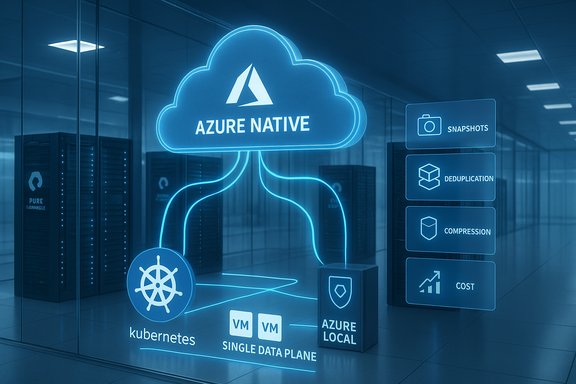
Microsoft and Pure Storage have deepened their partnership in several complementary ways: a joint Azure Native Integrations service that brings Pure Storage block volumes into the Azure Portal and Azure VMware Solution (AVS); FlashArray support for Microsoft’s Azure Local on-premises extension; and expanded Portworx capabilities to bridge VMs and containers on Kubernetes (KubeVirt). Together, these moves aim to remove three friction points IT teams repeatedly face: expensive, tightly coupled cloud storage in AVS; compliance and sovereignty constraints that require local residency; and the operational complexity of running both VMs and containers across hybrid and multi-cloud estates.
These announcements are not a single product launch but a coordinated set of capabilities rolled out at different maturity levels:
Pure Storage positions FlashArray as an accelerator for that path, asserting that customers can avoid replatforming by running SQL Server 2025 on high-density FlashArray hardware to achieve better performance density and smaller storage footprints for embeddings.
For IT leaders, the sensible next move is controlled experimentation: run focused POCs that measure cost, performance, and recovery for your actual workloads; validate vendor claims using your data; and stage migrations so that legal, procurement, and operations can adapt without risk. Where Pure Storage and Microsoft promise operational simplicity and cost savings, the technical reality is that those benefits are achievable — but only when measured and validated against the organization’s unique workload profile, compliance needs, and operational capabilities.
Source: CXOToday.com Microsoft and Pure Storage Simplify Migration to Azure
 Background / Overview
Microsoft and Pure Storage have deepened their partnership in several complementary ways: a joint Azure Native Integrations service that brings Pure Storage block volumes into the Azure Portal and Azure VMware Solution (AVS); FlashArray support for Microsoft’s Azure Local on-premises extension; and expanded Portworx capabilities to bridge VMs and containers on Kubernetes (KubeVirt). Together, these moves aim to remove three friction points IT teams repeatedly face: expensive, tightly coupled cloud storage in AVS; compliance and sovereignty constraints that require local residency; and the operational complexity of running both VMs and containers across hybrid and multi-cloud estates.These announcements are not a single product launch but a coordinated set of capabilities rolled out at different maturity levels:
- Pure Storage Cloud Azure Native (for AVS) reached general availability as an Azure Native Integration, providing a fully managed block storage-as-a-service that is provisioned and billed inside the Azure Portal.
- FlashArray + Azure Local integration is moving through preview phases to enable external storage for Azure Local clusters (initially via Fibre Channel in preview).
- Portworx for KubeVirt and Portworx platform enhancements are delivering enterprise-grade storage, protection, and VM mobility for Kubernetes-based virtualization, with partnerships and product updates announced in 2025.
What Pure Storage Cloud Azure Native Means for AVS Migration
A native, fully managed block service inside Azure
Pure Storage Cloud Azure Native is presented as a jointly engineered service that appears inside the Azure Portal and is managed as a first-class Azure resource. That changes the operational model in two important ways:- Storage is provisioned and managed using Azure tooling (portal, CLI, ARM templates), reducing the need to jump between separate vendor consoles.
- Billing and consumption are integrated with Microsoft Azure Customer Commitments, simplifying procurement and cloud‑budget alignment.
Decoupled compute and storage to lower AVS TCO
A key technical problem for AVS customers has been vSAN’s tightly coupled compute-storage model: to add storage capacity you often had to add AVS nodes (compute and memory) even when only capacity was required. Pure Storage Cloud decouples storage from compute, enabling independent scaling of capacity and performance so teams can:- Avoid provisioning extra AVS nodes solely for capacity,
- Use enterprise storage features (snapshots, thin provisioning, vVols support where applicable) to modernize operations,
- Potentially reduce AVS node counts and related compute costs.
What’s verifiable — and what requires a POC
- Verifiable: The Azure Native integration and general availability status are confirmed in Microsoft documentation and Pure Storage press materials; the solution can be managed from the Azure Portal and integrates with AVS workflows.
- Caveat: Percentages for cost savings (20–50% or “up to 50%”) and claims about reduced node counts are vendor-provided benchmarks and case examples. These are directional and useful for screening but must be validated through a formal proof-of-concept (POC) using representative workloads and realistic dedupe/compression assumptions.
Security, Sovereignty, and Azure Local: FlashArray as External Storage
Azure Local and on‑premises Azure experiences
Azure Local (the rebranded extension of Microsoft’s on‑premises Azure Stack HCI family) is Microsoft’s managed way to run Azure services — VMs, AKS (Azure Kubernetes Service), AVD (Azure Virtual Desktop), and other Azure primitives — inside customer data centers or edge sites while being connected to Azure control planes for management and billing consistency. Microsoft documentation shows Azure Local is evolving rapidly with features for disconnected operations, AKS on Azure Local, and hardened security baselines.FlashArray integration: what it delivers
Pure Storage announced a FlashArray integration for Azure Local to provide external storage that decouples compute and storage inside Azure Local clusters. Initial public preview focuses on Fibre Channel connectivity, with iSCSI and NVMe planned later. The integration is intended for:- Customers with strict data residency or regulatory requirements,
- Workloads that need predictable, enterprise-grade storage performance locally,
- Organizations that want a consistent operational model between on‑prem FlashArray operations and the Azure experience.
Practical constraints and billing
- Azure Local deployments bring layered billing and procurement complexity. The integration likely requires close coordination among Azure Local billing, Azure Marketplace subscriptions, and Pure Storage Evergreen or subscription commercial terms.
- Features like Fibre Channel connectivity for Azure Local clusters will require compatible hardware, certified Fibre Channel switching, and network architecture that maintains latency SLAs for mission‑critical workloads.
Compliance and data sovereignty
For organizations that must demonstrate data residency and precise control over where data is stored, FlashArray + Azure Local is a strong technical option because it allows mission‑critical workloads to run under a familiar Azure control plane while the physical data sits in a customer-controlled facility. Legal and compliance teams should still run a protocol-level review to ensure the combined architecture meets the letter of any jurisdictional data residency laws.AI-Readiness: SQL Server 2025 + FlashArray
SQL Server 2025’s vector features and the strategic angle
Microsoft’s roadmap for SQL Server 2025 includes native vector capabilities—a move toward embedding vector indexing and search (DiskANN-backed vector indexing, T‑SQL integrations, and REST interfaces) directly in SQL Server. That’s a significant shift: instead of standing up a separate vector database, organizations can start adding embeddings, RAG (retrieval-augmented generation) workflows, and vector search within their existing relational estate.Pure Storage positions FlashArray as an accelerator for that path, asserting that customers can avoid replatforming by running SQL Server 2025 on high-density FlashArray hardware to achieve better performance density and smaller storage footprints for embeddings.
The claims: “3X performance density” and “up to 60% smaller embedding storage”
Pure Storage marketing materials and product pages claim:- Up to 3X more performance density per rack unit for OLTP and SQL Server workloads versus competitive systems, and
- Up to 60% smaller AI vector embedding storage footprints through data reduction, compression, and optimized I/O handling on FlashArray//XL hardware.
How to treat these claims
- Treat the figures as vendor benchmarks and marketing guidance, not as universally guaranteed outcomes.
- Embedding storage footprint reductions depend heavily on: embedding vector dimensionality and precision, compression and dedupe effectiveness for a particular dataset, and how often embeddings are updated.
- Performance density (IOPS per RU) claims are workload-sensitive and can shift dramatically based on concurrency, object sizes, and database tuning.
Recommended verification steps
- Run a targeted POC that imports representative embeddings and query patterns to measure:
- Compression and dedupe ratios on your actual embedding datasets.
- Query latency under expected concurrency and query mix.
- Test SQL Server 2025 vector functionalities with FlashArray-backed storage to confirm both performance and operational behaviors (backups, restores, snapshotting).
- Validate recovery SLAs for vector stores under simulated failure scenarios.
Managing Kubernetes and Hybrid Complexity: Portworx, KubeVirt, and VM Modernization
Portworx’s position: unify data plane for containers and VMs
Portworx (part of the Pure Storage family) is being positioned as the enterprise data plane that enables:- Enterprise-grade data protection, DR, and mobility for stateful containerized workloads,
- Support for VMs running inside Kubernetes via KubeVirt, through offerings like Portworx for KubeVirt,
- Workflows that allow teams to run VMs and containers side‑by‑side on Kubernetes, easing modernization by letting teams move at their preferred pace.
Why this matters operationally
- It reduces the operational fork between virtualization teams and platform engineering teams: the same storage control plane can protect and move VMs and containers.
- Portworx claims customers have realized 30–50% cost savings in virtualization spend when using Portworx with OpenShift virtualization—again, a vendor-cited range that should be validated.
- By enabling VMs on Kubernetes, Portworx provides a route to standardize operations on Kubernetes while preserving legacy VM workloads rather than forcing immediate refactoring.
Caveats and readiness considerations
- Running VMs on Kubernetes (KubeVirt) isn’t zero‑cost: it introduces Kubernetes platform operational overhead, and teams need Kubernetes SRE/DevOps capabilities.
- Licensing, support contracts, and compatibility across AKS, ARO, and private Kubernetes distributions should be clarified before embarking on large-scale VM migration to KubeVirt.
- Networking, storage QoS, and backup models may require redesign to achieve equivalent SLAs for VMs compared with classical hypervisor approaches.
Operational Reality: Preview vs GA, Billing, and Procurement
Know the exact status of features and regions
- Pure Storage Cloud Azure Native for AVS is generally available and listed in Microsoft’s Azure partner material; that means you can provision it through the Azure Portal in supported regions, but check region support for your target geography.
- FlashArray + Azure Local is rolling through preview stages; Pure Storage has published public preview timing for specific capabilities (e.g., initial Fibre Channel support) with dates that should be confirmed during procurement conversations.
- Portworx updates and KubeVirt support are available but may be published under different release tracks; product compatibility matrices should be verified against your Kubernetes distribution and version.
Billing and contract complexity
- When storage is offered as an Azure Native Integration, billing usually flows through Azure’s consumption model. Clarify whether all components (FlashArray hardware, Pure Evergreen subscriptions, support contracts) are included in Azure billing or remain separate invoices from Pure.
- Azure Local deployments typically have vendor and Azure-layer billing that must be coordinated (hardware procurement, managed services, and Azure consumption). Contract teams must map how credits, MACC usage, and subscription entitlements apply.
Practical Migration & Modernization Roadmap (Actionable Steps)
- Inventory and classify workloads by migration strategy:
- Lift-and-shift (keep VM footprint and migrate to AVS),
- Replatform (move to cloud-native patterns),
- Transform (rewrite apps to cloud-native microservices).
- For AVS candidates, run a storage-focused POC with Pure Storage Cloud Azure Native:
- Measure dedupe/compression on VMware datastores.
- Capture real node reduction and compute savings scenarios.
- For sovereignty-sensitive workloads, pilot FlashArray + Azure Local:
- Validate fiber channel connectivity, latency, and recovery workflows.
- Complete legal/compliance sign-off with precise residency controls.
- For AI/embedding use cases, pilot SQL Server 2025 with FlashArray:
- Measure embedding compression and query latency vs an incumbent vector DB.
- Confirm snapshot/backup behaviors for embedding datasets.
- For virtualization modernization, pilot Portworx for KubeVirt:
- Define the supported KubeVirt distribution (e.g., OpenShift Virtualization).
- Test synchronous DR and file-level backup for Linux VMs.
- Establish an exit and rollback plan for each pilot:
- Verify data egress paths, consistent snapshot semantics, and recovery timelines.
- Review contracts and billing models with procurement:
- Clarify Azure billing for native integrations, third-party invoices, and support SLAs.
Risks, Limitations, and Mitigations
- Vendor benchmark risk: Many numeric claims (3X density, up to 60% smaller embedding storage, 20–50% cost reductions) are vendor-supplied. Mitigation: mandate POCs with your representative datasets and workload patterns before committing to capacity or TCO promises.
- Operational complexity: Bringing VMs to Kubernetes can centralize tooling but increases platform complexity. Mitigation: invest in Kubernetes SRE training, start small, and maintain hybrid support paths.
- Billing surprises: Combining Azure Native integrations with on‑prem gear (Azure Local) creates layered billing. Mitigation: require fully itemized cost models and clarify Azure Marketplace subscription vs vendor invoices.
- Support and compatibility: Preview features and early integrations may lack complete ecosystem support. Mitigation: plan for conservative timelines, vendor escalations, and validated compatibility matrices.
- Data sovereignty nuance: Azure Local + FlashArray is a strong option, but legal/regulatory approval remains essential. Mitigation: involve legal and compliance teams early and verify audit/logging capabilities.
Final Assessment — Strengths and Where Caution Is Warranted
Strengths:- Pure Storage Cloud Azure Native solves a clear AVS pain point — decoupling storage from compute — and the GA status makes it a practical option now rather than a roadmap promise.
- FlashArray + Azure Local gives a workable, Azure-consistent way to run mission-critical workloads with local data residency and enterprise-grade storage features.
- Portworx advances create a credible path to simplifying the coexistence of VMs and containers under a unified data plane, which can accelerate modernization without forcing an immediate replatform.
- Cost and performance percentages are vendor benchmarks; real-world results will vary by workload, dedupe/compression ratios, and concurrency patterns.
- Azure Local previews and some Portworx/KubeVirt capabilities require careful planning around compatibility and operational maturity.
- Legal, compliance, and billing complexities must be resolved before large-scale adoption.
Conclusion
Microsoft and Pure Storage have stitched together a pragmatic set of capabilities that address common blockers for cloud migration, hybrid modernization, and initial AI adoption. The combination of a true Azure-native block service for AVS, on‑prem FlashArray support for Azure Local, and a unified data plane through Portworx positions customers to migrate gradually, protect data better, and reuse existing investments—rather than forcing wholesale replatforms.For IT leaders, the sensible next move is controlled experimentation: run focused POCs that measure cost, performance, and recovery for your actual workloads; validate vendor claims using your data; and stage migrations so that legal, procurement, and operations can adapt without risk. Where Pure Storage and Microsoft promise operational simplicity and cost savings, the technical reality is that those benefits are achievable — but only when measured and validated against the organization’s unique workload profile, compliance needs, and operational capabilities.
Source: CXOToday.com Microsoft and Pure Storage Simplify Migration to Azure
