

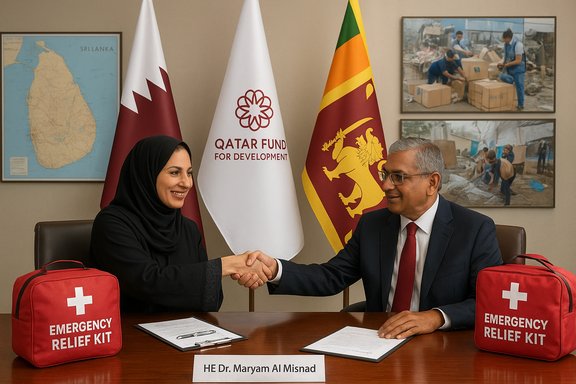
Qatar’s Minister of State for International Cooperation, HE Dr. Maryam bint Ali bin Nasser Al Misnad, met with Sri Lanka’s Ambassador to Qatar, HE Roshan Sithara Khan Azard, on December 4, 2025, in a meeting that moved quickly from routine diplomatic courtesies to urgent coordination on humanitarian assistance after Cyclone Ditwah devastated large parts of Sri Lanka.
Qatar and Sri Lanka maintain longstanding bilateral relations spanning labour, remittances, trade, and cultural exchange. In recent years the relationship has broadened to include humanitarian and development cooperation through Qatar’s bilateral channels and state-funded agencies such as the Qatar Fund for Development (QFFD), Qatar Charity (QC), and the Qatar Red Crescent Society (QRCS). That diplomatic and institutional architecture framed the meeting between Dr. Al Misnad and Ambassador Roshan Sithara Khan Azard, which focused primarily on humanitarian needs and recovery planning in the wake of Cyclone Ditwah. Sri Lanka’s Ambassador, Roshan Sithara Khan Azard, assumed duties in Doha in January 2025 and is Sri Lanka’s first woman ambassador to Qatar. She brings decades of foreign‑service experience and a track record of focusing on trade, diaspora welfare, and consular services—areas that are immediately relevant while large numbers of Sri Lankans in Qatar seek to support families back home.
Implementation risks and constraints that will determine impact:
Source: Qatar Tribune https://www.qatar-tribune.com/article/207948/nation/al-misnad-meets-sri-lankan-ambassador/amp/
 Background
Qatar and Sri Lanka maintain longstanding bilateral relations spanning labour, remittances, trade, and cultural exchange. In recent years the relationship has broadened to include humanitarian and development cooperation through Qatar’s bilateral channels and state-funded agencies such as the Qatar Fund for Development (QFFD), Qatar Charity (QC), and the Qatar Red Crescent Society (QRCS). That diplomatic and institutional architecture framed the meeting between Dr. Al Misnad and Ambassador Roshan Sithara Khan Azard, which focused primarily on humanitarian needs and recovery planning in the wake of Cyclone Ditwah. Sri Lanka’s Ambassador, Roshan Sithara Khan Azard, assumed duties in Doha in January 2025 and is Sri Lanka’s first woman ambassador to Qatar. She brings decades of foreign‑service experience and a track record of focusing on trade, diaspora welfare, and consular services—areas that are immediately relevant while large numbers of Sri Lankans in Qatar seek to support families back home. What happened: the meeting and immediate outcomes
The meeting on December 4, 2025, was short and sharply focused: Al Misnad and Ambassador Azard discussed bilateral cooperation and, crucially, the humanitarian situation and recovery plans following Cyclone Ditwah. Qatar’s ministerial office and QFFD announced coordinated interventions intended to deliver emergency relief and early recovery support to affected communities. The public reporting of the meeting was handled through official channels and national press outlets; the coverage emphasizes humanitarian coordination rather than any broader political agenda. Key points reported in Qatari media after the meeting include:- Qatar Fund for Development (QFFD) launching emergency humanitarian interventions in Sri Lanka in partnership with Qatar Charity and the Qatar Red Crescent Society.
- Planned distributions and assistance packages aimed at households and first responders, described in initial project briefs as including relief kits, search-and-rescue equipment, and multipurpose cash or livelihood support intended for the early recovery phase.
- Expressions of gratitude from the Sri Lankan Ambassador and confirmation that Qatar’s diplomatic channel would coordinate with Sri Lankan authorities and civil-society networks.
The humanitarian context: Cyclone Ditwah and the scale of the crisis
Cyclone Ditwah made landfall on Sri Lanka’s eastern coast in late November 2025, triggering torrential rain, large‑scale flooding and multiple, deadly landslides across the island. The human impact has been substantial and evolving as rescue and assessment operations proceed. International agencies and national authorities reported rapidly rising casualty and displacement figures in the days after landfall. Key indicators (as they stood in the immediate aftermath and in the rapidly changing reporting window) include:- Multi‑agency rapid assessments and national updates placed the number of people affected in the low millions, with more than 1.4–1.6 million people reported affected across Sri Lanka’s 25 districts in successive situational updates. These totals were updated frequently as new assessments arrived.
- Death tolls and missing-person counts rose sharply across multiple official updates; published figures moved from the low hundreds to several hundreds within days (estimates reported in the range of 200–480+ deaths and hundreds missing) as access to remote areas improved and more complete tallies became available. Fatality and missing-person totals were in flux; numbers reported on different days reflect that volatility.
- Displacement numbers also climbed rapidly: official and UN partner reporting documented tens to hundreds of thousands of people in government-run shelters or temporary accommodation centres while many more faced food insecurity, water and sanitation challenges, and critical damage to livelihoods (agriculture, fisheries, and small businesses).
Qatar’s pledge: scope, modalities, and implementation challenges
Qatar’s immediate public commitment—through the QFFD and partnerships with Qatar Charity and QRCS—targets a combined package of emergency relief and early recovery measures. Initial project descriptions reported in Doha’s media included:- The distribution of 2,500 comprehensive relief kits to Sri Lankan communities, with packages reportedly containing food, clothing, hygiene items and cooking utensils.
- Provision of search-and-rescue equipment to support local authorities’ response capabilities.
- In parallel programming (for Vietnam in a linked QFFD initiative) an emphasis on cash assistance, agricultural inputs and cash-for-work schemes; these elements indicate the QFFD’s preference for combining immediate in-kind relief with support that protects incomes and restores livelihoods during the early recovery phase.
Implementation risks and constraints that will determine impact:
- Logistics and access: flood-damaged roads, landslides in hill country, and transportation bottlenecks make last‑mile delivery difficult. Deploying and distributing 2,500 kits and search‑and‑rescue hardware at scale requires reliable transport corridors and local coordination mechanisms.
- Targeting and duplication: multiple international donors will be mobilising. Clear targeting criteria, coordination with the Sri Lankan authorities and UN clusters, and information sharing via the UN’s coordination mechanisms will be essential to avoid duplication and ensure the most vulnerable groups are reached.
- Regulatory and customs bottlenecks: expedited customs clearance for humanitarian cargo is often a constraint in sudden‑onset disasters; Doha‑Colombo coordination will need to rely on both formal MOFA channels and ground logistics partners to ensure shipments move quickly.
Sri Lankan diaspora in Qatar: a strategic channel for support
The Sri Lankan expatriate community in Qatar mobilised quickly after the cyclone, collecting food and non‑food items and organising fundraising drives. Qatari press reports cited the Ambassador’s gratitude for diaspora efforts and noted more than 6,000 kilograms of essential items collected by the Sri Lankan community in Doha for shipment to affected areas—an example of diasporic solidarity that complements state-to-state assistance. Why the diaspora matters:- Diaspora resources (in‑kind goods, remittances, and fundraising) frequently provide critical bridging support in the immediate aftermath of disasters while larger state or international operations scale up.
- Well‑organised diaspora networks can accelerate needs‑based targeting—particularly to communities that have direct social ties with families in specific districts—assuming those networks coordinate with official humanitarian channels.
- The presence of a large Sri Lankan worker population in Qatar creates both a humanitarian and a consular imperative for robust bilateral cooperation on evacuation, documentation and family support services.
Diplomatic and geopolitical implications
Humanitarian diplomacy in this instance carries multiple effects beyond immediate relief:- Soft-power and reputation: Qatar’s humanitarian engagement reinforces Doha’s profile as a regional donor with global reach, an actor that combines state funds (QFFD) with humanitarian NGOs and Red Crescent assets. Such contributions consolidate Doha’s role as a key humanitarian stakeholder in the region.
- Bilateral leverage and long-term ties: beyond lifesaving aid, coordinated reconstruction and development financing (e.g., QFFD programmes, investment facilitation) can strengthen commercial and labour ties. Qatar’s role as an employer of Sri Lankan nationals and investor in regional projects gives it leverage to convert short‑term relief into longer-term strategic cooperation.
- Risk of politicisation: large‑scale donor engagement risks becoming entangled in domestic politics if recovery funds or projects are perceived to favour particular regions or political constituencies. Transparent, needs‑based programming and clear alignment with national recovery plans will help mitigate such risks.
Critical analysis: strengths, gaps, and risks
Strengths- Speed of response: Qatar’s rapid mobilization of QFFD, QC and QRCS resources demonstrates an effective, high‑level decision loop for emergency action. The ministerial meeting itself signalled immediate political will to act.
- Use of existing humanitarian architecture: partnering with QC and QRCS leverages organisations with proven field experience and logistical muscle in difficult environments. This reduces start‑up time and helps channel resources to where needs are greatest.
- Diaspora engagement: active participation by Sri Lankans in Qatar amplifies resource mobilisation and stands as a force multiplier for state assistance.
- Scale vs. scope mismatch: early public figures (e.g., distribution of 2,500 kits aimed at 12,500 beneficiaries in Sri Lanka) are valuable, but the disaster’s scale—affecting over a million people in many reports—means these interventions address only a fraction of immediate needs unless rapidly scaled. Qatar’s contribution is important but necessarily partial.
- Operational bottlenecks: road and logistics damage, shelter needs, and damaged health infrastructure create complex operational environments that can slow assistance delivery. International donors must be prepared for extended timelines and adaptive logistics.
- Data uncertainty: casualty and displacement figures were changing rapidly across official and agency reports; any donor programme relying on early estimates must be flexible and committed to iterative needs assessments to avoid misallocation. Numbers cited in media reports should be treated as provisional snapshots, not final totals.
- Humanitarian coordination failure: without participation in UN cluster coordination, donors risk duplication or gaps. Qatar’s implementing partners should integrate into UN‑led coordination mechanisms and national recovery planning.
- Logistical risk: damaged infrastructure increases delivery costs and timelines, raising the risk that perishable or season‑sensitive aid misses target windows.
- Political optics: if recovery projects are perceived to favour certain localities or political constituencies, they may fuel domestic contention—especially given the scale of damage and public focus on government response.
What to watch next: implementation and transparency signals
- Channel and partner updates: look for QFFD, Qatar Charity or QRCS to publish concrete operational plans—manifest lists, transport routes, implementing partner names, and monitoring frameworks. These will indicate whether the initiative is moving from pledge to delivery.
- Coordination with UN clusters and Sri Lanka’s DMC: evidence of active coordination—shared needs assessments, joint distribution lists, or inclusion in the Joint Response Plan—will signal efficiency and reduced duplication.
- Beneficiary feedback and monitoring: publishable monitoring reports, beneficiary satisfaction surveys, or third‑party monitoring will be essential to demonstrate accountability and the humanitarian neutrality of aid.
- Scale and follow‑on commitments: whether Qatar expands assistance into reconstruction financing, technical assistance for resilient rebuilding, or concessional financing through QFFD will shape medium‑term recovery outcomes and bilateral economic ties.
Practical recommendations for stakeholders
For Qatar and implementing organisations:- Integrate fully with Sri Lanka’s national coordination structures and the UN cluster system to ensure needs‑based targeting and to avoid duplication.
- Prioritise logistics: pre-clearance for humanitarian cargo, local transport partnerships, and surge capacity for field distribution teams.
- Commit to transparent reporting: publish implementation timetables, partner names, and monitoring indicators to strengthen accountability.
- Facilitate expedited customs and clearance processes for humanitarian consignments and prioritise safe access corridors.
- Provide consolidated needs lists to international partners that reflect sectoral priorities (shelter, WASH, health, food security, livelihoods).
- Establish grievance and feedback mechanisms to capture beneficiary perspectives and to improve targeting.
- Ensure QFFD and related actors are included in cluster coordination and joint assessments, promoting harmonised programming.
- Prioritise multi‑donor pooled funds (where appropriate) to finance early recovery and reconstruction activities with oversight and coherence.
Broader implications: climate shocks, migration and development finance
Cyclone Ditwah is a reminder that climate‑driven disasters are increasing in frequency and severity across the Indian Ocean and South Asia. For small island and low‑lying states, big storms compound structural vulnerabilities: fragile infrastructure, concentrated poverty in hazard‑prone areas, and limited fiscal buffers. Donor responses need to be both immediate and strategic—combining relief with investments in climate‑resilient reconstruction and risk reduction to break cycles of repeated loss. Qatar’s interest in early recovery and development financing creates a policy entry point: channel immediate goodwill into longer term resilience building that reduces future humanitarian burden. Labour migration and remittances also matter. Large Sri Lankan expatriate populations in countries like Qatar send remittances that support household resilience. Protecting migrants’ rights, facilitating safe remittance channels, and leveraging diaspora networks for coordinated support are practical levers to enhance disaster response effectiveness.Conclusion
The December 4 meeting between HE Dr. Maryam Al Misnad and HE Roshan Sithara Khan Azard crystallised a pragmatic diplomatic response to a rapidly unfolding humanitarian emergency. Qatar’s pledge to mobilise QFFD resources, supported by Qatar Charity and the Qatar Red Crescent Society, demonstrates rapid state-level responsiveness and a willingness to combine in‑kind relief with early recovery measures. However, the sheer scale of Cyclone Ditwah’s impact—measured in the hundreds of casualties, hundreds of thousands displaced, and well over a million affected—means Qatar’s intervention, while valuable, must be part of a broader, well‑coordinated international response that emphasises transparent implementation, logistical agility, and long‑term resilience financing. Rapid, needs‑based aid that is coordinated with Sri Lankan authorities and UN mechanisms will save lives now—and, if followed by resilient reconstruction planning, help Sri Lanka reduce vulnerability to future climate shocks. The meeting in Doha was a necessary diplomatic and operational step; success will be judged by how quickly and effectively pledged resources reach the most vulnerable, and by whether short‑term goodwill is converted into durable recovery and resilience investments.Source: Qatar Tribune https://www.qatar-tribune.com/article/207948/nation/al-misnad-meets-sri-lankan-ambassador/amp/
