

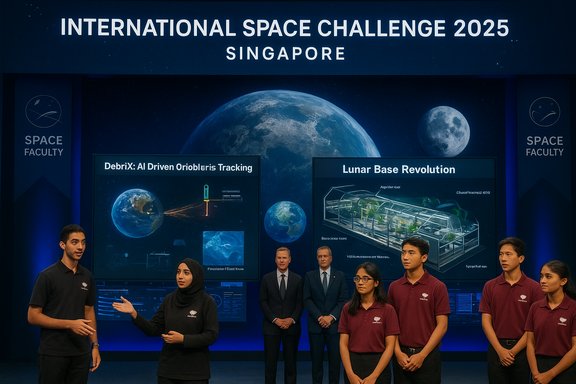
Qatar Foundation students returned from Singapore this month with high-profile recognition at the International Space Challenge 2025, delivering two ambitious, future-facing projects that put Qatar’s Pre‑University Education programmes squarely on the global STEM map.
The International Space Challenge (ISC) is a long-running, Singapore‑based competition that invites student teams from schools and universities around the world to propose engineering, scientific and systems solutions for real problems in space — from satellite servicing to life-support and orbital sustainability. The ISC is organised by Space Faculty and regularly draws teams from national universities and secondary schools across Asia and beyond; recent editions have featured winners from NUS and NTU among other institutions. This year’s competition emphasised space sustainability — the growing set of technical and policy challenges that arise as low Earth orbit becomes more congested with active satellites, defunct spacecraft, and fragments. Student projects ranged from orbital debris mitigation to enclosed agriculture for long-duration habitats. Qatar Foundation’s Pre‑University Education (PUE) sent two composite teams that stood out: “Karisoma” from Qatar Academy for Science and Technology (QAST) with DebriX, and “Quartex” from Education City High School (ECHS) with Lunar Base Revolution. The teams won recognition for technical promise and presentation quality at the ISC award ceremony in Singapore.
For Qatar Foundation and other school systems, the path forward is clear: treat competition success as the starting line, not the finish. Invest in the supervision, funding and governance education that permit student ideas to evolve into safe, auditable research programmes. If that investment is made, the ISC wins will be more than headlines — they will become the earliest chapters of research projects and careers that contribute to the safety, sustainability and habitability of space for everyone.
Source: Qatar Tribune https://www.qatar-tribune.com/artic...ine-at-intl-space-challenge-in-singapore/amp/
 Background / Overview
The International Space Challenge (ISC) is a long-running, Singapore‑based competition that invites student teams from schools and universities around the world to propose engineering, scientific and systems solutions for real problems in space — from satellite servicing to life-support and orbital sustainability. The ISC is organised by Space Faculty and regularly draws teams from national universities and secondary schools across Asia and beyond; recent editions have featured winners from NUS and NTU among other institutions. This year’s competition emphasised space sustainability — the growing set of technical and policy challenges that arise as low Earth orbit becomes more congested with active satellites, defunct spacecraft, and fragments. Student projects ranged from orbital debris mitigation to enclosed agriculture for long-duration habitats. Qatar Foundation’s Pre‑University Education (PUE) sent two composite teams that stood out: “Karisoma” from Qatar Academy for Science and Technology (QAST) with DebriX, and “Quartex” from Education City High School (ECHS) with Lunar Base Revolution. The teams won recognition for technical promise and presentation quality at the ISC award ceremony in Singapore. The International Space Challenge: scale and significance
What the ISC is and why it matters
The ISC is more than a student showcase; it is a staged design challenge that simulates industry constraints and stakeholder review. It offers students a condensed version of systems engineering: mission definition, constraints analysis, trade studies, and stakeholder-facing demonstration. The competition’s format — often including industry judges, academic supervisors, and policy‑level observers — gives high-performing teams exposure to real‑world critique and potential follow-up opportunities. Space Faculty’s own pages and university newsrooms in Singapore consistently document ISC projects being spun into research modules, capstone projects, or even industry‑backed prototypes.A track record of university-level participation
National universities and polytechnic programmes commonly use ISC as a capstone platform. NUS and NTU have publicised teams that won grand prizes and industry awards in recent ISC editions, illustrating the competition’s role as a talent funnel for space engineering pipelines in the region. That institutional participation is relevant context for Qatar’s PUE entries: these student teams were competing against advanced university‑level submissions and multidisciplinary student groups, not merely inter‑school science fair projects.QF in Singapore: the teams and their projects
Karisoma — DebriX (Qatar Academy for Science and Technology)
Karisoma’s DebriX is described as an integrated system combining artificial intelligence, orbital tracking and laser pulses intended to address space debris and protect Earth’s orbital environment. The Qatar Tribune coverage credits the team with winning the ISC’s New Challenger Award, a category aimed at promising scientific projects. Student statements and coordinator commentary emphasise the combination of innovative research and polished presentation that impressed programme leaders and officials at the awards event. Why this project resonates: the combination of precise orbital tracking, AI‑driven targeting/decision logic, and directed‑energy concepts maps directly onto active research streams in the orbital debris community. Ground‑based and space‑based laser concepts — whether for nudging small fragments into a decaying trajectory or performing micro‑ablation to alter orbital elements — have been studied for decades and continue to appear in peer‑reviewed literature and lab projects. Recent scientific reviews and experimental work describe pulsed lasers, adaptive optics, and sophisticated tracking algorithms as plausible components of a debris‑remediation architecture. Those technical foundations give a credible baseline for student designs such as DebriX.Quartex — Lunar Base Revolution (Education City High School)
Quartex presented Lunar Base Revolution, a self‑sustaining agricultural system adapted for the Moon’s environment. According to event reporting, the project drew praise from Singapore’s Minister of Sustainability when presented during the ISC programme. The student team described closed‑loop cultivation ideas, resource recovery and habitat integration — themes that align with NASA’s and university research into bioregenerative life support systems (BLSS) and regolith‑based crop production. Lunar agriculture is an active scientific field: experiments have tested plant growth in lunar regolith simulants and even small samples of Apollo regolith, while university labs develop inflatable/contained greenhouses and nutrient recycling strategies intended for long‑duration bases. The student design’s focus on self‑sufficiency taps into that research and the open technical questions around regolith reactivity, radiation stress on plants and in‑situ resource utilisation (ISRU).Technical assessment: how plausible are DebriX and Lunar Base Revolution?
DebriX — feasibility, strengths and limits
Strengths:- The team’s blend of AI for target discrimination and orbital tracking is technically sensible. Modern conjunction assessment relies heavily on predictive models and data fusion; applying ML to distinguish hazardous fragments or optimise laser timing is an active research area.
- The use of pulsed rather than continuous lasers for momentum transfer follows prior scientific recommendations: pulsed beams can ablate small surface material and produce impulse with less average power, which is attractive for both ground and space platforms.
- Scale and energy. Published analyses and modelling show that ground‑based or space‑based laser remediation requires either enormous average power or near‑orbital proximity to be effective for objects larger than a few centimetres. Energy budgets, beam control, and atmospheric effects (for ground lasers) are nontrivial engineering hurdles.
- Tracking accuracy and object attitude. Small debris tumble unpredictably; precise impulse application requires centimetre‑to‑metre tracking and real‑time attitude prediction. That part of DebriX’s concept is difficult at scale and demands sophisticated sensors, adaptive optics and perhaps radar/optical fusion.
- Policy and legal issues. Directed‑energy systems in orbit or on the ground invite national security and international law considerations. A platform that can change orbital trajectories could be regulated as a dual‑use capability; coordination and transparency are essential for safe deployment. Existing literature flags both technical and political obstacles to laser‑based ADR at operational scale.
Lunar Base Revolution — feasibility, strengths and limits
Strengths:- The project tackles bioregenerative life support issues that are central to long‑term lunar habitation: atmosphere regeneration, water recycling, nutrient cycling and in‑situ resource use. These are well‑established research priorities for NASA and academic labs, which makes the team’s focus scientifically sound.
- There is strong precedent for student‑to‑research progression: ideas developed in competitions often become capstone or university research projects that iterate toward higher technology readiness levels. Quartex’s design could seed longer-term investigations into regolith amendment and hydroponic/hybrid systems.
- Regolith chemistry and plant stress. Experiments with real Apollo samples and simulants show plants suffer oxidative stress and ionic imbalances without extensive amendment; regolith is not a benign planting medium. Any lunar agriculture solution must address regolith conditioning, nutrient bioavailability and dust mitigation.
- Radiation and long‑term ecology. Lunar surface habitats face high radiation flux compared with Earth; shielding or subsurface habitats are often prerequisites for reliable plant growth over the long term. BLSS proposals typically pair plant modules with robust shielding designs, controlled lighting and multi‑species nutrient loops — complexity that student prototypes can only model, not fully validate.
- Logistics and resilience. A “self‑sustaining” system must be resilient to single‑point failures and scalable across crewed missions — design spaces that require rigorous redundancy planning, which is often outside the scope of short competition timelines.
Educational value and institutional impact
What this win means for Qatar Foundation’s schools
QF’s entries — and the praise they received at ISC — are an endorsement of the Gifted and Talented Programme and the STEM pipeline that QF operates across Education City. Student quotes from the reporting highlight learning outcomes that matter for long‑term talent development: hands‑on systems design, teamwork under time‑pressure, and exposure to ministerial and industry audiences. Those experiences are precisely what produces the kinds of students who pursue aerospace engineering, systems engineering and research careers. Institutionally, the wins:- Raise visibility for QF’s Pre‑University Education among global STEM networks.
- Provide concrete portfolio material useful for scholarships, university admissions and research collaborations.
- Help attract mentors, university partners and local industry partnerships seeking early‑stage talent.
Practical next steps QF and similar programmes should consider
- Convert competition projects into longer-term research partnerships with university labs or industry sponsors, enabling prototyping beyond competition deliverables.
- Establish a formal transition pathway from school‑level projects to university capstones, including mentoring, seed funding and lab access.
- Build governance awareness into project curricula: ethics, regulatory constraints, and dual‑use risk should be taught alongside sensors and software.
- Publish validated design artefacts where possible (datasets, simulation models, hardware bills of materials) to facilitate replication and to attract collaborators.
Critical analysis: strengths, caveats and broader risks
Notable strengths
- Authentic problem framing: Both DebriX and Lunar Base Revolution tackle problems with real societal and technical relevance: orbital sustainability and lunar food/security resilience.
- Interdisciplinary design: The projects integrate AI, physics, hardware concepts and ecological design — a hallmark of mature engineering thinking.
- High‑value exposure: Presenting to ministers and industry at ISC accelerates learning and can catalyse follow‑on support.
Important caveats and risks
- Media claims vs. independent verification. The Qatar Tribune’s report is the primary public account of QF’s ISC awards; at the time of reporting, contest organisers’ public winner lists and third‑party press coverage that mention these specific team names and awards were limited. That means the Qatar Tribune item is a strong indicator, but independent corroboration beyond the tournament’s own channels would strengthen the record. Readers and institutional stakeholders should seek confirmation from Space Faculty’s official results and QF’s own announcements where available.
- Operational feasibility gap. Competition prototypes and conceptual designs are valuable educationally; however, there is often a large gap between a winning student concept and an operational system in space. For DebriX especially, the jump from simulation and concept to an operational ADR system requires major engineering and legal work.
- Dual‑use sensitivities. Directed‑energy systems and orbital interventions involve national security and export control considerations. Any follow‑on research or partnership should ensure clear transparency, civilian oversight, and adherence to international norms and space traffic management agreements.
Recommendations for educators, funders and policymakers
- For educators:
- Embed governance and ethics modules into STEM projects that touch on dual‑use technology (e.g., lasers, satellite control).
- Create scaffolded research pathways that move competition projects into university labs or industrial internships.
- Prioritise reproducibility: require teams to document code, simulations and datasets to enable replication and academic follow‑up.
- For funders and sponsors:
- Consider small seed grants that allow top competition teams to access supervised lab prototyping and independent safety review.
- Fund collaborative challenges that include industry judges and follow‑on prototype calls, reducing the “one-off” nature of many competitions.
- For policymakers:
- Encourage transparent frameworks for responsible ADR research; support multilateral norms on testing and data sharing to reduce mistrust around debris‑remediation demonstrations.
- Invest in national education‑to‑research pipelines, ensuring that promising school‑level innovation can scale into university and industry projects.
Wider context: Singapore’s ISC and the global STEM talent pipeline
Singapore’s ISC sits within a broader ecosystem of academic competitions and industry partnerships that feed space programmes, startups and research labs across Asia. University success at ISC has historically translated into research projects, internships and occasionally industry spinouts. Space Faculty’s model — combining a public challenge with industry mentorship — amplifies a pragmatic lesson: public competitions excel at discovery and demonstration; sustained development requires institutions to build bridges from contest outcomes to funded research. QF’s entry into that ecosystem is strategically smart: participation exposes Qatar’s students to rigorous international review and builds global networks for future collaboration.Conclusion
Qatar Foundation’s strong showing at the International Space Challenge 2025 in Singapore is a clear signal that its Pre‑University Education system is maturing into a serious feeder for aerospace engineering and space science talent. The Karisoma team’s DebriX and the Quartex team’s Lunar Base Revolution both map to active international research problems — orbital debris remediation and bioregenerative lunar agriculture — and they demonstrate the kind of interdisciplinary, system‑level thinking competition organisers prize. At the same time, turning concept wins into operational impact will require careful attention to technical scale, regulatory context, and long‑term institutional support.For Qatar Foundation and other school systems, the path forward is clear: treat competition success as the starting line, not the finish. Invest in the supervision, funding and governance education that permit student ideas to evolve into safe, auditable research programmes. If that investment is made, the ISC wins will be more than headlines — they will become the earliest chapters of research projects and careers that contribute to the safety, sustainability and habitability of space for everyone.
Source: Qatar Tribune https://www.qatar-tribune.com/artic...ine-at-intl-space-challenge-in-singapore/amp/
