

Qatar’s Ministry of Education and Higher Education has begun a measured push to introduce Microsoft’s Copilot tools into the school and higher-education ecosystem, running hands‑on workshops that pair product demonstrations with role‑based training and immediate license activation for participants — a move framed by officials as part of wider national digital-skilling objectives. ar’s public-sector AI push has gathered pace in recent months, with government ministries and agencies piloting generative-AI assistants to speed routine work, improve drafting and data synthesis, and build a cadre of staff familiar with AI‑powered productivity tools. The Ministry of Education’s introductory workshop on Microsoft Copilot is one of several parallel efforts — alongside campaigns run by the Ministry of Communications and Information Technology and training delivered through the Qatar Digital Academy — to mainstream Copilot use across institutions.
The immediate objective of these capabilities, demonstrate safe and productive workflows in Word, Excel, PowerPoint, Outlook and Teams, and ensure that technical and administrative controls are understood before users apply Copilot to day‑to‑day tasks. Officials presented the activity as part of a broader Digital Agenda that links technology adoption to skills development and public-sector efficiency.
Those figures are notable because they signal heavy usage and potential productivity gains. But a careful read shows the numbers are self‑reported program outcomes*, and the ministry has not yet published the underlying measurement methodology — how a “task” is defined, whether hours saved aetry or survey extrapolations, and which categories of work were included. Until those methods are published or an independent audit is available, these metrics should be treated as indicative .
Yet there are unanswered questions that will determine whether the program is transformational or merely symbolic:
Source: Qatar Tribune Education ministry organises introductory workshop on Microsoft Copilot program
Source: Gulf Times Shura Council Speaker meets Saudi Ambassador
Source: Gulf Times Amiri Guard Commander meets Internal Security Attache at French Embassy
Source: Gulf Times Ministry of Education is organizing an introductory workshop on the Microsoft Copilot program
The immediate objective of these capabilities, demonstrate safe and productive workflows in Word, Excel, PowerPoint, Outlook and Teams, and ensure that technical and administrative controls are understood before users apply Copilot to day‑to‑day tasks. Officials presented the activity as part of a broader Digital Agenda that links technology adoption to skills development and public-sector efficiency.
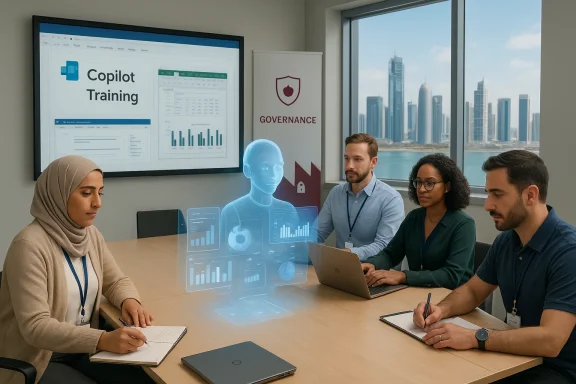 What the workshop covered
Hands-on demos and immediate access
The combined demonstrations of Copilot workflows with guided exercises and Q&A. Participants — drawn from information systems departments and educational units — were shown practical scenarios such as:- Drafting and editing official communications in Word using Copilot
- Summarizing long email threads and extracting action items in Outlook and Teams
- Generating slide decks from outlines in PowerPoint
- Conducting quick data analysis and pivot-table assistance in Excel
Who organised and who attended
The Ministry of Education and Higher Education led the sessions local training partners and Microsoft’s regional skilling teams. Senior officials framed the program as an institutional capacity-building exercise: Assistant Undersecretary for Infrastructure and Operations Affairs Sami Al Shammari emphasized the workshop’s role in building “national cadres capable of adopting AI technologies.”What Microsoft Copilot actually is — a technical primer
For clarity, the Copilot name covers several related but doesn't matter for education IT teams and administrators:- Copilot Chat: a chat-based assistant available to many Microsoft 365 customers; it can provide web‑grounded answers or, with a Copilot license, work-grounded responses using your organization’s content.
- Microsoft 365 Copilot: the licensed, enterprise-grade integration that taps the Microsoft Graph, calendars, emails, documents and meetings to give context-aware drafting, summarization and data‑driven answers across Word, Excel, PowerPoint, Outlook and Teams.
- Copilot agents / Notebooks / Studio: higher-level tools that let organisations build repeatable assistants, collect session artifacts, or orchestrate multi-step processes inside the Copilot environment.
Privacy, data handling and enterprise controls — what administrators must know
Microsoft’s public documentation and privacy FAQs make three points relevant to institutional deployments:- Tenant-scoped processing and enterprise protections: Copilot in enterprise settings is designed to operate within the bounds of the tenant, integrating with Entra ID for identity, Microsoft Purview for data classification and retention controls, and administrative policy to restrict connectors and external integrations.
- Model training and customer data: Microsoft states it does not use customer content (emails, files, tenant data) to train its general models unless a customer explicitly consents to optional data sharing; enterprise accountabilityunts are described as excluded from default model-training pipelines. That boundary is a key procurement consideration for regulated institutions.
- Feature and license differentiation: Copilot Chat without a Copilot add‑on license generally cannot access organizational data; the Copilot add‑on unlocks work-grounded responses and deeper integrations. Admins can therefore create safer entry paths by offering Copilot Chat first for low-risk exploration and gating full Copilot licenses behind training and governance checks.
The official impact claims — and why they require scrutiny
Across recent government briefings and press releases, MCIT and partner outlets have published encouraging headline figures from early Copilot deployments: roughly 62% adoption among target users, more than 9,000 active users, around 1.7 million tasks executed, and an estima hours saved* during the pilot phase. These numbers have been repeated in national press coverage.Those figures are notable because they signal heavy usage and potential productivity gains. But a careful read shows the numbers are self‑reported program outcomes*, and the ministry has not yet published the underlying measurement methodology — how a “task” is defined, whether hours saved aetry or survey extrapolations, and which categories of work were included. Until those methods are published or an independent audit is available, these metrics should be treated as indicative .
Strengths of the Ministry’s approach
Qatar’s education-sector rollout shows several strengths that reflect best practice in enterprise AI adoption:- Training-first deploymenth structured workshops reduces misuse risk and accelerates productive adoption. The Ministry’s immediate license activation for trained staff helps translate learning into practice.
- Alignment with national digital strategy: situating Copilot adoption inside the Digital Agenda and Qatar Digital Academy creates governance and funding continuity beyond a single pilot.
- Governance scaffolding: the programme emphasises internal Copilot champions, AI councils and staged activations — practical governance moves that move beyond a purely technical rollout.
- Vendor-integration benefits: using Microsoft’s enterprise stack offers built-in identity controls, Purview classification, and auditability options that would be costly to replicate in bespoke systems. Those platform benefits help satisfy regulatory and compliance needs if correctly configured.
Risks, grey areas and implementation gaps
Deploying Copilot in educational institutions — especially where student data and sensitive records are involved — carries real risks that must be actively managed.Data classification and exposure risk
Copilot’s power comes from its ability to pull context from mail, files and calendar content. If license assignment or connector settings are too permissive, sensitive student records, disciplinary notes or HR documents could be used inadvertently in prompts or summaries. Administrators must enforce strict classification rules and tailor connector controls before broad rollout.Measurement and accountability
Headline productivity metrics are persuasive, but without transparent measurement methods they can mask uneven benefits. Anecdotal or survey-based time-savings often overstate persistent effects; institutinstrumented evaluations that link Copilot usage to process cycle times, error rates and service-level metrics. MCIT’s public announcements note impressive numbers but stop short of publishing methodologies — a gap worth filling.Model hallucination and academic integrity
Generative models can confidently invent facts, citations or legal text. In an education context, that creates two problems: student or staff reliance on inaccurate outputs, and potential erosion of academic standards. Clear guidance, checks, and mandatory verification practices must accompany any classroom use-case. Workshop content should include example failure modes and verification methods.Long‑term vendor lock and governance drift
Heavy operational reliance on a single vendor’s integrated stack increases friction for future migration and can lead to governance drift where vendor feature changes outpace institutional policy. Regular procurement reviews and contractual safeguards (audit rights, data residency guarantees, model‑training opt‑out clauses) are essential. Microsoft states enterprise data is not used to train models by default, but this is a contractual and technical setting that institutions must confirm in writing.User perception and branding confusion
Microsoft’s Copilot branding spans consumer, Windows and Microsoft 365 layers, producing confusion about what features are enabled for a user and where data flows. That confusion can lead to risky user behaviour unless IT communication is clear and repetitive. Recent industry coverage highlights this branding complexity and the need for clear internal messaging.Practical recommendationams
- Create a two‑tier rollout path:
- Phase A: provide Copilot Chat access (web‑grounded) for low‑risk exploration and pedagogical experiments.
- Phase B: enable Microsoft 365 Copilot for defined roles after mandatory training, policy acknowledgement, and connector review.
- Lock down connectors and set retention policies before license activation:
- Disable external connectors (Google Drive, Gmail) by default.
t Purview policies and retention labels for student records. - Publish transparent measurement plans:
- Define what a “task” is, instrument Copilot telemetry where possible, and tie time‑savings claims to measurable service metrics. Treat early productivity numbers as provisional until validated.
- Add verification training into every workshop:
- Teach staff to treat Copilot outputs as drafts that require validation, and provide checklists for common failure modes (dates, citations, legal wording).
- Insist on contractual clarity:
- Ensure procurement language explicitly excludes tenant content from model training unless expressly permitted, and require audit and data‑handling clauses. Microsoft’s documentation reiterates that enterprise data is excluritten assurances are necessary.
- Maintain an internal Copilot governance body:
- Form a cross‑functional council with IT, privacy, legal and pedagogy to oversee policies, review incidents, and approve use-cases. The Ministry’s emphasis on AI councils and Copilot championplicating.
Use-cases in education — realistic expectations
When used thoughtfully, Copilot can improve several administrative and instructional workflows:- Administrative efficiency: draft standard letters, convert meeting notes to action lists, and summarize policy updates.
- Faculty productivity: generate first drafts of course descriptions, create slide outlines from syllabus text, and propose formative assessment questions (subject to faculty review).
- Student support: build writing coaches that help students draft and revise, with safeguards to prevent plagiarism and encourage citation verification.
How to communicate the rollout to staff, students and parents
- Publish a plain‑language FAQ that explains what Copilot can and cannot access, how student data is protected, and how outputs should be verified.
- Host recurring “office hours” sessions (hands‑on) where staff can experiment in a controlled environment and raise policy questions; this mirrors successful campus pilots elsewhere.
- Use scenario-based training for frontline staff — examples of safe and unsafe prompts, connector misconfigurations, and incident-reporting pathways.
Critical analysis — the broader picture
Qatar’s Ministry of Education’s introductory workshop on Microsoft Copilot is evidence of a pragmatic national strategy: pair vendor technology with local training, align with a national digital agenda, and stage adoption behind governance constructs. That model addresses the common failure mode where technology is deployed without user training or policy frameworks.Yet there are unanswered questions that will determine whether the program is transformational or merely symbolic:
- Will productivity claims be published with reproducible methodologies?
- Will schools and universities receive differentiated guidance on student-data handling versus administrative data?
- How will the government ensure long-term transparency around contract terms that govern data residency and optional training of models?
Conclusion
The Ministry of Education and Higher Education’s Copilot workshops mark a careful and unitary effort to bring generative AI into Qatar’s educational institutions. By combining practical training, immediate access to tools, and an explicit governance posture, the Ministry has adopted many of the recognized best practices for early enterprise AI adoption. That said, the bold productivity figures now in circulation must be treated cautiously until measurement methods are published and independently reviewed. Institutions deploying Copilot will need to balance productivity ambition with strict data controls, transparent measurement and continuous user education to ensure that the technology amplifies human expertise rather than amplifying risk.Source: Qatar Tribune Education ministry organises introductory workshop on Microsoft Copilot program
Source: Gulf Times Shura Council Speaker meets Saudi Ambassador
Source: Gulf Times Amiri Guard Commander meets Internal Security Attache at French Embassy
Source: Gulf Times Ministry of Education is organizing an introductory workshop on the Microsoft Copilot program
