

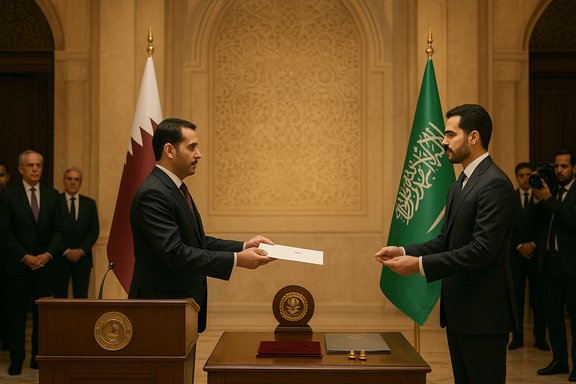
His Excellency Sultan bin Saad Al Muraikhi formally received the credentials of Saudi Arabia’s newly appointed ambassador to Qatar, HRH Prince Saad bin Mansour bin Saad bin Saud bin Abdulaziz Al Saud, in a diplomatic ceremony that underscores a continuing phase of normalization and deepening cooperation between Doha and Riyadh.
On 4 December 2025, the Qatari Ministry of Foreign Affairs reported that Minister of State for Foreign Affairs Sultan bin Saad Al Muraikhi received a copy of the credentials of the Saudi ambassador to Qatar, Prince Saad bin Mansour. The formal reception was presented as a routine—but symbolically meaningful—step in bilateral diplomacy, with Qatar’s foreign ministry wishing the ambassador success and pledging cooperation to strengthen ties across political, economic and cultural fields. The appointment of Prince Saad follows a formal oath-taking ceremony for a slate of Saudi envoys presided over by Crown Prince Mohammed bin Salman, where Prince Saad’s posting to Doha was confirmed. Saudi state media and press reports listed Prince Saad among a cohort of ambassadors who took the oath of office earlier in December 2025. This exchange of credentials arrives against the backdrop of a post‑blockade era in Gulf politics that began to visibly shift in 2021 with the Al-Ula reconciliation. Since then, diplomatic ties between Qatar and Saudi Arabia have steadily warmed, marked by resumed ambassadorial postings, ministerial visits and new bilateral agreements across energy, trade and transport. The credential presentation is the latest, concentrated sign that both capitals are moving beyond episodic engagement toward normalized, predictable diplomacy.
The ultimate measure of success will be the translation of ceremonial exchanges into tangible policies and agreements — in energy coordination, trade flows, transport links and joint regional initiatives. Stakeholders in government, business and civil society should watch for concrete MOUs, ministerial visits and institutionalised mechanisms that move the relationship from symbolic normalization to sustained, measurable partnership. Until then, the credentials ceremony stands as an important, carefully calibrated step in an ongoing diplomatic process.
Source: Qatar Tribune https://www.qatar-tribune.com/artic...receives-credentials-of-saudi-ambassador/amp/
 Background: what happened and when
On 4 December 2025, the Qatari Ministry of Foreign Affairs reported that Minister of State for Foreign Affairs Sultan bin Saad Al Muraikhi received a copy of the credentials of the Saudi ambassador to Qatar, Prince Saad bin Mansour. The formal reception was presented as a routine—but symbolically meaningful—step in bilateral diplomacy, with Qatar’s foreign ministry wishing the ambassador success and pledging cooperation to strengthen ties across political, economic and cultural fields. The appointment of Prince Saad follows a formal oath-taking ceremony for a slate of Saudi envoys presided over by Crown Prince Mohammed bin Salman, where Prince Saad’s posting to Doha was confirmed. Saudi state media and press reports listed Prince Saad among a cohort of ambassadors who took the oath of office earlier in December 2025. This exchange of credentials arrives against the backdrop of a post‑blockade era in Gulf politics that began to visibly shift in 2021 with the Al-Ula reconciliation. Since then, diplomatic ties between Qatar and Saudi Arabia have steadily warmed, marked by resumed ambassadorial postings, ministerial visits and new bilateral agreements across energy, trade and transport. The credential presentation is the latest, concentrated sign that both capitals are moving beyond episodic engagement toward normalized, predictable diplomacy. Overview: who are the key players?
Sultan bin Saad Al Muraikhi — Qatar’s diplomatic steward
Sultan bin Saad Al Muraikhi serves as Minister of State for Foreign Affairs and has been a senior figure in Qatar’s diplomatic corps for many years. His portfolio includes overseeing ministry affairs and representing Doha in bilateral and multilateral contacts. His role in receiving credentials is ceremonial but also operational, signaling the Qatari government’s endorsement and readiness to work with the new Saudi mission.Prince Saad bin Mansour bin Saad bin Saud bin Abdulaziz Al Saud — a royal envoy
Prince Saad’s appointment as ambassador to Qatar reflects Saudi Arabia’s continued practice of sending high-profile royal or senior diplomatic figures to key regional posts. Crown-prince level endorsement of senior diplomatic appointments underscores the priority Riyadh places on its relationship with Doha. The prince’s formal presentation of credentials marks the start of his official duties in Doha, during which he will coordinate Riyadh’s diplomatic agenda in Qatar and serve as the primary channel for bilateral matters.Why this matters: diplomatic symbolism and practical significance
The act of presenting credentials is a routine diplomatic formality, but in the Gulf context—where relationships are often closely tied to ruling families and personal diplomacy—it carries heightened significance. Several practical reasons explain why this credentialing matters now:- Full restoration of diplomatic channels. The exchange formalizes resident ambassadorial contact after years of tension, ensuring continuous, on-the-ground diplomatic engagement.
- Signal of political normalization. A royal appointment and a ceremonial reception together convey political intent to anchor relations in a long-term framework.
- Enabler for policy coordination. Resident embassies facilitate faster negotiation on trade, energy, security and transport — from urgent crisis management to long-range planning.
- A platform for economic and commercial ties. Ambassadorial presence helps push forward investment deals, cross-border infrastructure projects and tourism/aviation cooperation.
Historical context: from blockade to rapprochement
The diplomatic rupture of 2017 — when Saudi Arabia, the UAE, Bahrain and Egypt severed ties with Qatar — reshaped Gulf geopolitics for years. The 2021 Al‑Ula Declaration initiated a phased rapprochement that has since yielded the return of ambassadors, reopening of borders, and a resumption of joint meetings within GCC forums.- The return of ambassadors and the naming of envoys has been staggered and symbolic: each posting has been read as an incremental step toward normalizing relations.
- Doha’s own ambassadorial exchanges have mirrored this pattern; Qatar’s appointment of an ambassador to Saudi Arabia earlier in 2025 and his presentation of credentials were important reciprocal gestures.
Strategic dimensions: energy, trade, security and mediation
Energy and economic coordination
Qatar and Saudi Arabia are both major energy players in the Gulf. While Qatar’s strength is liquefied natural gas (LNG), Saudi Arabia remains a dominant crude oil exporter and a leading proponent within OPEC+. Deeper diplomatic channels can yield practical coordination in global energy markets, investment flows and infrastructure projects.- Energy markets: A resident ambassador supports sustained dialogue on pricing, supply stability and shared regional interests in the energy transition.
- Investment and trade: Ambassadors facilitate private-sector matchmaking, public-private partnership (PPP) frameworks, and cross-border investment promotion that can accelerate infrastructure, tourism and technology deals.
Security and defense cooperation
Security ties between Gulf states are shaped by shared concerns — including maritime security, counterterrorism, and regional conflicts that risk spillover. Having a senior Saudi ambassador resident in Doha makes routine consultations on security faster and more candid.- Crisis management: Embassies are vital when rapid deconfliction is required, for instance in airspace incidents or maritime emergencies.
- Intelligence and counterterrorism: Permanent missions improve information flow and joint planning.
- GCC defense architecture: Diplomatic normalization strengthens collective decision-making in GCC meetings and aligns defense procurement and interoperability planning.
Mediation and diplomacy
Qatar has cultivated a role as a mediator in regional conflicts; its diplomatic networks are frequently used to host talks or facilitate back-channel negotiations. A formal Saudi embassy in Doha expands channels for Qatar and Saudi Arabia to coordinate mediation efforts — whether regarding Yemen, Lebanese dynamics, or other regional issues where Gulf influence can be decisive.- Joint mediation initiatives may benefit from aligned diplomatic presence, but they also create the need for clear division of labour and impartiality safeguards, given that different actors may approach conflicts with varied strategic goals.
Opportunities unlocked by the appointment
The ambassadorial exchange opens several immediate opportunities for concrete progress:- Faster processing of bilateral agreements on trade, taxation and investment protections.
- Enhanced air, maritime and land transport coordination to support tourism and commerce.
- Easier consular services for citizens and businesses, reducing friction in travel and cross-border services.
- A diplomatic platform for structured cooperation on climate resilience, infrastructure and healthcare — areas where both states have large-scale plans and overlapping interests.
Risks and caveats: what could complicate progress
Diplomatic normalization does not erase strategic differences, and several risks could temper the pace or depth of cooperation:- Geopolitical rivalry and external alignments. The Gulf’s strategic environment is affected by relationships with major powers. Divergent external partnerships could create friction in policy coordination.
- Policy misalignment on regional conflicts. Differences over approaches to Yemen, Iran, or regional political actors could produce episodic tensions despite formal diplomacy.
- Economic competition. Both Saudi Arabia and Qatar are investing heavily in tourism, aviation, and non-oil sectors — areas where commercial competition can interact awkwardly with political cooperation.
- Domestic political optics. Any bilateral initiatives perceived as conceding too much on sovereignty or national priorities could become politically sensitive for either leadership.
- Public and civil society concerns. Human-rights issues, labor reforms, and governance standards can be sources of international scrutiny that complicate pragmatic cooperation if not managed transparently.
What to watch next: near‑term signals of deeper engagement
- Bilateral visit schedule: Dates for visits by Qatar’s Emir to Riyadh or Saudi Crown Prince to Doha will be a leading indicator of the relationship’s trajectory.
- Trade and investment agreements: Look for MOUs on aviation, energy projects, or a joint investment fund targeting non‑oil sectors.
- Transport and aviation pacts: Expanded air routes, new airline codeshares or joint tourism promotions will signal commercial integration.
- Security and defense meetings: Formalised defence dialogues, joint exercises or intelligence-sharing frameworks will indicate deeper strategic alignment.
- Public statements of coordinated diplomacy: Joint communiqués at GCC or Arab League summits showing aligned positions on regional crises.
Assessing the appointment: strengths and limitations
Strengths
- Political clarity: A royal appointment conveys explicit political intent and senior-level attention from Riyadh.
- Operational capacity: Resident embassies enable constant engagement, faster problem-solving, and improved consular services.
- Economic facilitation: Diplomatic presence accelerates business-to-government interfaces and investment facilitation.
- Regional stabilisation: Steady state-to-state relations reduce the risk of miscalculation during crises.
Limitations
- Symbolism vs. substance: Diplomatic symbolism must be matched by institutional mechanisms to deliver measurable outcomes.
- External constraints: Regional alignments and global power dynamics can limit the scope for independent bilateral moves.
- Speed of change: Institutional reforms, trade agreements and defense cooperation take time; the appointment is the start, not the finish, of a process.
Practical implications for businesses and citizens
For companies and citizens with interests spanning Qatar and Saudi Arabia, the ambassadorial appointment translates into practical benefits and considerations:- Faster dispute resolution channels: Resident embassies often reduce friction in commercial and consular disputes.
- Streamlined visa and travel procedures: Expect improved coordination that can make travel and relocation simpler over time.
- Opportunity windows for joint ventures: Firms eyeing regional expansion should prioritise monitoring MOFA announcements and embassy business desks for tenders and matchmaking events.
- Regulatory harmonisation: Over time there may be moves toward mutual recognition of certifications, standards and professional credentials; businesses should prepare for both opportunities and transitional compliance costs.
Verification notes and caution on unverified claims
The core facts of the credential presentation — the date, the participants (Sultan bin Saad Al Muraikhi and Prince Saad bin Mansour) and the official goodwill statements — are confirmed by Qatar’s Ministry of Foreign Affairs and multiple regional news outlets. Where biographical claims about Prince Saad’s prior postings or detailed private agenda items are not published by official gazettes or ministry bios, those specifics remain tentative until ministries or royal courts publish official CVs or backgrounders. Any analysis that projects specific deals or security arrangements should be treated as informed forecasting rather than established fact; follow-up announcements and formal agreements will be needed to convert expectations into verified outcomes.Conclusion: a practical reading of the ceremony
The credential presentation for Saudi Arabia’s new ambassador to Qatar is an emblematic moment in a diplomatic restoration process that has been underway since 2021. It formalises a permanent channel for political dialogue, economic cooperation and security coordination between two of the Gulf’s most consequential states. The appointment is both a political signal and an operational tool: it opens the door to faster diplomacy and practical cooperation, while also leaving room for the complexities inherent in Gulf geopolitics.The ultimate measure of success will be the translation of ceremonial exchanges into tangible policies and agreements — in energy coordination, trade flows, transport links and joint regional initiatives. Stakeholders in government, business and civil society should watch for concrete MOUs, ministerial visits and institutionalised mechanisms that move the relationship from symbolic normalization to sustained, measurable partnership. Until then, the credentials ceremony stands as an important, carefully calibrated step in an ongoing diplomatic process.
Source: Qatar Tribune https://www.qatar-tribune.com/artic...receives-credentials-of-saudi-ambassador/amp/
