

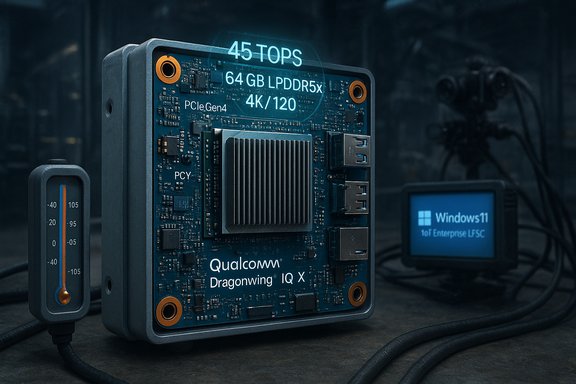
Qualcomm’s new Dragonwing IQ‑X family marks a deliberate push into ruggedized industrial Windows PCs, packing Oryon CPU cores, an Adreno GPU and a mid‑range Hexagon NPU rated up to 45 TOPS into COM/SOM‑friendly packages built for prolonged field use and long product lifecycles.
Background / Overview
Qualcomm has been expanding the Dragonwing brand across networking, edge and industrial segments; the IQ‑X line targets industrial PCs, HMIs, robotics and edge‑AI appliances that require wide operating temperatures, long availability and native Windows IoT support. The two announced SKUs—IQ‑X7181 (12 Oryon cores) and IQ‑X5181 (8 Oryon cores)—are positioned as ruggedized variants of Qualcomm’s higher‑volume Snapdragon X family, with factory‑grade packaging, extended I/O and an emphasis on on‑device inference. Qualcomm and partner announcements emphasize three industrial needs:- Deterministic local inference to cut cloud dependence and latency,
- Long‑life availability and rugged thermal specs for factory and outdoor deployments,
- Windows IoT Enterprise LTSC compatibility to ease migration for users of existing Windows‑based SCADA, HMI and automation stacks.
What's in the IQ‑X family: headline specifications
The public briefings and press summaries list an extensive set of features for both SKUs. The most important load‑bearing claims—CPU configuration, NPU TOPS, memory ceiling, I/O and thermal rating—are summarized below and are corroborated by multiple independent reports.- CPU: IQ‑X5181 — Custom Qualcomm Oryon 8‑core (Armv8) up to 3.4 GHz; IQ‑X7181 — Custom Qualcomm Oryon 12‑core up to 3.4 GHz.
- GPU: Qualcomm Adreno integrated GPU (clock up to ~1.1–1.3 GHz depending on SKU).
- AI performance: Up to 45 TOPS (aggregate of CPU, GPU and Hexagon NPUs) for typical IQ‑X configurations.
- Memory: Up to 64 GB LPDDR5x (8 × 16‑bit channels @ 4.2 GHz); the platform notes ~36 GB addressable with inline ECC in certain configurations.
- Storage: UFS 4.0 (gear 5) lanes for onboard storage and SD 3.0 support; reserved 8‑bit SD port on the IQ‑X7181.
- Display & Video: eDP1.4b, DisplayPort v1.4a over USB‑C, AV1/VP9 decode and encode capabilities to 4K/120 depending on SKU.
- Camera: Qualcomm Spectra 780 ISP with support for multiple simultaneous camera lanes (up to 6 cameras on IQ‑X7181).
- I/O: PCIe Gen4 lanes (varies by SKU), 3× USB4 Type‑C, multiple USB 3.1 Gen2 ports, 221 GPIOs, broad UART/SPI/I2C support and companion QPS615 for Ethernet/PCIe expansion.
- Rugged specs: Operating range −40 °C to +105 °C, 1747‑ball BGA package (58.0 × 58.0 mm), and a stated 10+ year product longevity commitment.
Technical breakdown: CPU, GPU, NPU and memory
CPU: Oryon cores tuned for industrial throughput
The IQ‑X family uses Qualcomm’s Oryon CPU microarchitecture in 8‑ and 12‑core configurations with a maximum clock of 3.4 GHz reported for both SKUs. For industrial workloads—multithreaded control, HMI rendering and edge analytics—Qualcomm emphasizes sustained multi‑core throughput and embedded power profiles rather than purely chasing smartphone burst clocks. This aligns with the industry expectation that industrial SoCs must deliver predictable performance under extended duty cycles and high ambient temperatures.GPU and VPU: integrated Adreno and AV1 support
An integrated Adreno GPU provides system graphics and some AI acceleration, while the video engine supports modern codecs (AV1, VP9) for high‑resolution capture and streaming—important for surveillance, multi‑camera inspection and analytics pipelines. The IQ‑X7181 advertises higher decode/encode ceilings (e.g., 4K@120 decode) compared with the IQ‑X5181.NPU: interpreting the 45 TOPS claim
The combined NPU throughput is quoted at 45 TOPS. It’s essential to understand that TOPS is a peak integer throughput metric (typically INT8 math) and not a direct measure of an application’s real‑world performance. Practical inference throughput depends on:- Model precision (INT8 vs FP16/FP32),
- Memory bandwidth and on‑chip SRAM size,
- Kernel and runtime support (ONNX Runtime, vendor Hexagon SDKs),
- Thermal and power limits that determine sustained TOPS under load.
Memory: capacity and ECC nuances
The platform supports LPDDR5x across 8 channels for a theoretical 64 GB maximum. Notably, documentation referenced by Qualcomm and reporting outlets mentions “up to 36 GB addressable memory with inline ECC” in certain modes—an important detail for integrators that expect traditional addressability and ECC behavior. This suggests ECC and memory mapping choices may reduce the directly usable addressable window in specific configurations; vendors should confirm the exact memory map for their SKU and module.I/O, expansion and real‑world connectivity
IQ‑X targets industrial systems that must integrate many sensors, cameras and network media. Key capabilities:- PCIe Gen4 lanes sufficient for NVMe storage, discrete Ethernet controllers or accelerator cards (lane counts vary by SKU).
- Companion QPS615 (described as a PCIe switch) to provide Ethernet offload and expandability.
- Wi‑Fi 7 / Wi‑Fi 6E and external 5G (Snapdragon X65/SX65 family) support via M.2 modules and companion chips.
- Comprehensive USB (USB4, USB 3.1 Gen2, eUSB) and 221 GPIO pins to talk to PLCs, motion controllers and legacy field I/O.
- High‑bandwidth local storage and data capture pipelines (NVMe over PCIe Gen4),
- Flexible networking for cloud/edge hybrid topologies,
- Native camera connectivity for multi‑stream CV workloads.
Ruggedization, longevity and thermal realities
One of the IQ‑X family’s most marketable attributes is the industrial temperature rating (−40 °C to +105 °C) and the explicit longevity promise (10+ year availability). These characteristics are essential for customers building equipment with expected decade‑long lifecycles and for deployments in harsh environments (outdoor cabinets, chemical plants, hot factory floors).Practical caveats:
- Achieving reliable operation at +105 °C typically imposes system‑level tradeoffs—package derating, careful PMIC profiles, and stricter sustained TDP ceilings. In plain terms, peak CPU/GPU/NPU clocks may be achievable at lower ambients, but sustained throughput at the upper thermal limit will be reduced. Independent thermal characterization is required for production designs.
- Rugged BGA packaging and industrial PCBs require supply‑chain planning; BOM stability and long‑term component sourcing should be confirmed with module vendors.
Software, runtimes and OS support
Qualcomm highlights Windows 11 IoT Enterprise LTSC support for IQ‑X modules, and the ecosystem emphasis includes middleware and industrial toolchains such as Qt, CODESYS and EtherCAT—a pragmatic alignment for factories deeply invested in Windows‑based control software. Several module vendors note pre‑validation of Windows IoT images and evaluation kits for developers.Two important notes for integrators:
- Vendor press materials are explicit about Windows IoT Enterprise LTSC support, but module‑level images, drivers (GPU, NPU/Hexagon) and vendor BIOS/UEFI firmware remain critical deliverables—OEMs should require validated, white‑box images and driver support SLAs.
- Public messaging so far focuses on Windows; Linux mentions are less consistent in initial marketing pullouts. If your product roadmap depends on Linux distributions or specific kernel features, verify vendor Linux support and long‑term maintenance commitments before locking designs.
Ecosystem and early partners
Qualcomm’s strategy for Dragonwing has been partner‑centric: module and system vendors produce COM/SOM modules, evaluation kits and reference designs to accelerate OEM adoption. The IQ‑X announcement lists early partners expected to ship IQ‑X‑based commercial devices in the coming months, including Advantech, congatec, NEXCOM, Portwell, Tria and SECO.Advantech, for example, has been an active Dragonwing partner across multiple IQ and higher‑end Dragonwing SKUs and has publicized edge AI systems that leverage Dragonwing processors—an indicator that the partner pipeline for industrial modules and appliances is moving quickly.
Practical applications and target markets
Qualcomm positions IQ‑X for a broad set of industrial edge use cases:- Factory automation & robotics: local inference for defect detection, part‑presence checks and safety monitoring.
- Industrial HMI and operator stations: Windows IoT LTSC compatibility simplifies migration of legacy HMI software.
- Edge AI vision and surveillance: multi‑camera capture with on‑device AV1 decode and localized analytics.
- Smart transportation & energy/utility edge nodes: rugged operating range and long‑life availability for outdoor or distributed infrastructure.
Strengths — what IQ‑X brings to industrial OEMs
- Ruggedized SoC with extended temperature rating reduces the need for heavy thermal shielding and specialized enclosures in many deployments.
- Integrated NPU (45 TOPS) and modern video codecs enable on‑device vision AI, inference for predictive maintenance and privacy‑sensitive analytics without continuous cloud connectivity.
- COM/SOM module alignment and partner ecosystem (Advantech, SECO, congatec, Tria, etc. shortens time to market—OEMs can adopt modules rather than redesign entire carrier boards.
- Native Windows IoT LTSC compatibility lowers the migration barrier for industrial customers with large investments in Windows‑based control software.
Risks, limitations and critical questions
While the IQ‑X family addresses key industrial requirements, several risk areas require careful evaluation before production commitment:- TOPS is not a guaranteed application throughput metric. Use vendor TOPS figures as a comparative ceiling; demand application‑level benchmarks (your model, resolution, precision) as the decisive data. Real inference speed depends on memory bandwidth, runtime support and thermal throttling.
- Sustained performance at high ambient temperatures is uncertain. Achieving operation at +105 °C will likely require conservative sustained power envelopes. Validate sustained NPU/CPU throughput at targeted ambient conditions with the module vendor.
- Driver and runtime maturity for Windows on Arm remains a gating factor. Industrial software stacks often rely on third‑party ISVs; ensure ISV compatibility and a stable Hexagon SDK/runtime on Windows IoT for your target models and frameworks.
- Memory addressability and ECC nuances (the “36 GB addressable with inline ECC” point) must be confirmed for the intended OS image and application workload. This is not a simple marketing footnote—memory mapping affects how large models and frame buffers can be handled.
- Data sheet and thermal characterization availability. Early articles rely on vendor briefings and partner slides. Integrators should insist on full SoC/module datasheets, thermal curves and long‑term availability commitments before entering production.
Integration checklist for OEMs and system integrators
- Request the official SoC and module datasheets (thermal curves, sustained TDP, memory map).
- Obtain vendor‑validated Windows IoT Enterprise LTSC images and a driver support SLAs (GPU, NPU, audio, network).
- Run application‑level benchmarks with your models (quantization level, resolution, concurrency) to measure FPS, latency and energy per inference.
- Validate sustained performance across the full environmental range (−40 °C to +105 °C) under realistic duty cycles.
- Check lifecycle and availability guarantees for the selected module SKU and BOM components.
Where IQ‑X sits in the Dragonwing roadmap
Dragonwing IQ‑X is a middle‑to‑upper tier piece in Qualcomm’s industrial lineup: it offers stronger local AI than earlier IQ parts while trading off against higher‑end Dragonwing SKUs like the IQ‑9075 (which partners have cited at ~100 TOPS) for workloads that demand larger NPU budgets. This creates a clear SKU ladder OEMs can choose from depending on performance cost and thermal headroom. Qualcomm’s partner ecosystem—Advantech’s IQ‑9075 products are an example—shows the range of Dragonwing family targets from gateway and surveillance to heavy AI inference appliances.Availability and timing
Qualcomm and module partners state commercial IQ‑X‑powered devices will appear in the coming months, with evaluation kits and COM Express modules already being shown to integrators. That partner pipeline (Advantech, SECO, congatec, NEXCOM, Portwell, Tria) is the practical path from SOC announcement to deployable industrial hardware. OEMs should plan time for module testing and Windows IoT image validation before production.Final assessment and recommendations
Qualcomm’s Dragonwing IQ‑X family is a pragmatic, ecosystem‑oriented entry that squarely addresses industrial integrator needs: rugged packaging, Windows IoT compatibility, and a usable on‑device AI capability for many vision and inference use cases. For buyers balancing cost, resilience and on‑device inference, IQ‑X will be an attractive option—but only after the usual industrial due diligence.Key recommendations:
- Treat the 45 TOPS number as an indicator, not a guarantee; require application‑level benchmarks for your models and workloads.
- Validate sustained performance across the intended ambient range and request vendor thermal characterization data.
- Secure module images and driver SLAs for Windows 11 IoT Enterprise LTSC and confirm Linux support if required.
- Confirm lifecycle commitments and BOM stability with your module vendor to match industrial product timelines.
Conclusion
For industrial OEMs and integrators, Qualcomm’s Dragonwing IQ‑X series delivers an appealing balance of compute, I/O and ruggedization while embracing the Windows IoT ecosystem that many facilities rely on. The platform’s success will depend on proven sustained performance, mature driver and runtime stacks on Windows, and clear datasheets from Qualcomm and module partners—requirements that savvy integrators should insist on before scaling to production.
Source: CNX Software Qualcomm launches Dragonwing IQ-X SoCs for industrial Windows PCs - CNX Software
