

Quest’s latest update to Security Guardian and its wider AI-enabled push for identity and data tooling mark a notable escalation in the vendor’s Microsoft-aligned strategy — one that promises faster, AI-guided identity threat detection and a single-console approach to migration, audit, and non‑human identity governance, while also raising important questions about reliance on generative AI for security decision-making and the expanding attack surface of agentic identities.
Quest Software used Microsoft Ignite 2025 as the launch pad for a set of AI-driven product updates spanning identity security, migration, and data governance. The headlines centre on enhancements to Security Guardian — Quest’s identity threat detection and response (ITDR) platform for hybrid Active Directory and Microsoft Entra ID environments — plus a newly named set of Identity Modernisation Suites, expanded On Demand Migration capabilities for Microsoft Power Platform workloads, and fresh GenAI functionality inside Quest’s erwin Data Management Platform. These announcements were published in Quest’s newsroom and distributed via major wire services and regional tech outlets. In parallel, Microsoft’s expanding Security Copilot and new security agent/store initiatives create a natural integration surface for third-party identity security tools; Quest’s announcement explicitly positions Security Guardian to interoperate with Microsoft Security Copilot, Microsoft Sentinel and Defender for Identity. That integration is a strategic play to let security teams move from detection and triage into automated, context-rich remediation workflows.
Quest’s announcements are an important marker of how identity security and migration tooling is evolving to meet the realities of hybrid Microsoft estates and agentic AI. For Windows and Microsoft identity teams, the practical opportunity is to adopt these capabilities selectively, insist on strong logging and governance, and build migration and NHI programs that reduce rather than multiply risk.
Source: SecurityBrief Australia Quest unveils AI-driven tools for Microsoft identity security
 Background
Quest Software used Microsoft Ignite 2025 as the launch pad for a set of AI-driven product updates spanning identity security, migration, and data governance. The headlines centre on enhancements to Security Guardian — Quest’s identity threat detection and response (ITDR) platform for hybrid Active Directory and Microsoft Entra ID environments — plus a newly named set of Identity Modernisation Suites, expanded On Demand Migration capabilities for Microsoft Power Platform workloads, and fresh GenAI functionality inside Quest’s erwin Data Management Platform. These announcements were published in Quest’s newsroom and distributed via major wire services and regional tech outlets. In parallel, Microsoft’s expanding Security Copilot and new security agent/store initiatives create a natural integration surface for third-party identity security tools; Quest’s announcement explicitly positions Security Guardian to interoperate with Microsoft Security Copilot, Microsoft Sentinel and Defender for Identity. That integration is a strategic play to let security teams move from detection and triage into automated, context-rich remediation workflows. What Quest announced — the essentials
Security Guardian: AI summaries, agent and audit
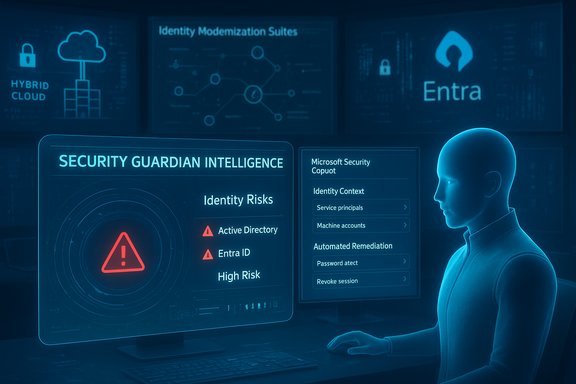
- AI-powered security assessment summaries: Security Guardian Intelligence now produces AI-written, one‑page executive summaries that highlight critical identity gaps and prioritise remediation steps for Active Directory and Entra ID exposures. The stated aim is to accelerate decision-making and make findings consumable for non-specialist stakeholders.
- Security Guardian Agent for Microsoft Security Copilot: Quest made an agent available via Microsoft’s Security Store to feed identity context into Security Copilot, enabling identity-aware responses inside Sentinel, Defender for Identity and the Copilot environment. Quest positions this as a way to close the loop from detection to prevention using Microsoft’s tooling plus Quest machine‑speed prevention.
- Security Guardian Audit: A cloud-native audit and compliance capability intended to replace or complement legacy on‑premises audit tooling, simplifying long-term retention and compliance workflows.
- Support for non‑human workload identities: New detection and audit features for workload identities (service principals, managed identities and other machine/agent accounts) in Microsoft Entra ID, to help find over‑privileged or exposed non-human accounts. Quest cites an industry estimate that non‑human identities outnumber human accounts by very large margins and explicitly frames this as a growing attack surface.
Identity Modernisation Suites and On Demand Migration
- Identity Modernisation Suites: Marketed as an end‑to‑end Microsoft identity modernisation platform combining migration, security, audit, backup, and recovery into a single offering available in three tiers. The goal is to reduce risk for large migrations to cloud‑native identity models and to provide pre‑migration risk assessments and secure backup/recovery.
- On Demand Migration coverage for Power Platform: Quest expanded discovery for Power Apps and previewed Power Automate discovery to help customers assess and migrate workloads inside Microsoft 365 tenants — consolidating migration tooling for tenant-wide workload moves.
erwin Data Management Platform: GenAI and data products
- GenAI-enabled erwin platform: Quest’s erwin Data Management Platform now includes generative-AI features (erwinAI and model-certification capabilities) to accelerate data stewardship, classification, and creation of trusted data products for downstream AI consumption. The messaging positions erwin as the “data product factory” to support AI initiatives and compliance at scale.
Why this matters: strengths and practical benefits
1. Reducing time-to-action for identity incidents
Security teams routinely face overwhelming alert volumes and limited windows for containment. Quest’s AI summaries and contextualisation aim to:- Convert raw alerts into business‑level, prioritised remediation steps so ticket queues, vulnerability fixes, and budget requests can be actioned more quickly.
- Allow teams without deep Active Directory expertise to understand the business impact of identity issues, which is central to organisations that struggle to hire specialist AD talent.
2. Tighter Microsoft ecosystem integration
By shipping a Security Guardian Agent to the Microsoft Security Store and integrating with Security Copilot and Sentinel, Quest makes it easier for customers already invested in Microsoft tooling to:- Ingest identity signals into a single investigation and response timeline.
- Use Copilot‑style AI to surface identity context inside Microsoft’s consoles without switching to multiple vendor UIs.
3. Addressing the non-human identity gap
Quest’s focus on workload identities — service principals, app registrations and agent identities — aligns with a major industry pain point. Vendors and practitioners now estimate that machine identities dramatically outnumber human ones (estimates commonly cited range up to 80:1), and these accounts often lack lifecycle controls. Visibility and detection for these identities is therefore essential to reduce privilege sprawl and secret sprawl. Quest’s new workload identity auditing directly targets this.4. Consolidated migration and recovery for Microsoft 365/Entra
The Identity Modernisation Suites promise a single vendor experience for migration plus backup and disaster recovery for identity — valuable where complex tenant moves, mergers, or large-scale modernisation projects create both migration risk and extended downtime exposure. Quest points to substantial migration credentials (billions of chat messages, hundreds of petabytes moved) to assert operational scale and experience.Critical analysis: risks, limits and questions
A. Generative AI is an assistant, not an oracle
AI-written executive summaries and remediation steps are useful time-savers, but they carry three operational caveats:- Hallucination and error risk: Generative models can produce plausible but incorrect recommendations. Security playbooks must validate AI suggestions via telemetry and human review before automated changes are applied.
- Over-reliance: Teams that accept AI output without cross-checks can propagate misconfigurations rapidly — particularly dangerous when the suggested remediation changes permissions or access controls.
- Auditability: Organisations will need to capture model inputs, prompts and decision logs for compliance and incident forensics. Quest’s product pages and press materials highlight integration with audit trails, but buyers should verify that model decisions are logged in traceable, tamper‑evident formats.
B. Integration is powerful — but increases trust dependencies
Tighter coupling with Microsoft Copilot, Sentinel and Defender for Identity makes the workflow seamless, but it also:- Increases vendor dependency: Customers who rely on a combined Quest+Microsoft stack may face higher switching costs or complex multi‑vendor troubleshooting.
- Expands the attack surface: Providing identity context to agents and copilots means more systems hold sensitive identity telemetry. Controls around who or what can access those contexts are essential. Microsoft itself is evolving agent governance (Agent 365 and Security Store governance) to mitigate these risks, but customers must validate agent identity lifecycle policies and conditional access constraints.
C. Non‑human identity coverage is necessary but incomplete by itself
Workload identity discovery/audit is a high‑value capability — but it must be coupled with:- Lifecycle controls (provisioning/deprovisioning),
- Just‑in‑time credential issuance and rotation,
- Secrets detection in code and CI/CD pipelines,
- Continuous entitlement review and role‑minimisation.
D. Compliance and evidence capture for AI-informed actions
Regulated industries will demand precise records of:- What AI recommended,
- Who accepted and executed the recommendation,
- Time-stamped audit trails and rollback capability.
How trustworthy are the claims? Verification and caveats
Key public claims were verified against Quest’s official press release and product pages, and corroborated with independent regional coverage. Highlights verified include:- The addition of AI-generated executive summaries in Security Guardian Intelligence and the availability of a Security Guardian Agent for Security Copilot in Microsoft Security Store. These appear in the Quest press release and product pages.
- The launch of Identity Modernisation Suites and Power Platform discovery previews were announced in the same release and echoed by press distributions.
- Quest’s erwin platform GenAI capability and erwinAI previews are described in Quest's erwin roadmap and press materials.
- Some quantitative claims (for example where Quest cites "non-human identities outnumber humans by as much as 80:1" or migration totals like "more than 200 petabytes moved") come from Quest or industry summaries and while plausible, should be treated as company‑reported figures or industry estimates that may vary by environment and reporting methodology. Multiple independent industry vendors repeat similar NHI ratios, but there is no single universally authoritative public dataset confirming an exact global ratio — treat the figure as directional.
What IT teams should ask when evaluating these capabilities
- Model provenance and safety
- Which language models power the AI summaries? Are they hosted by Quest, Microsoft, or third‑party cloud services? Is the model fine‑tuned on customer telemetry or only general corpora?
- Audit and traceability
- Can the product export immutable decision logs (prompts, model outputs, timestamps, and actor approvals) for legal and compliance review?
- Remediation guardrails
- Are automated remediation actions gated (approval, staged rollouts, canary changes)? What rollback mechanisms exist?
- Data protection
- How is identity telemetry protected in transit and at rest between Quest, Microsoft Copilot, and Sentinel? Which tenancy models are used for multi‑customer isolation?
- Non‑human identity lifecycle
- Beyond discovery, does the offering provide automated rotation, short‑lived credentials, or tight integration with secret managers and CI/CD tools?
- Operational support and SLAs
- What are the response SLAs for fingerprinting critical identity threats and for disaster recovery of Entra/AD objects via Quest Disaster Recovery for Identity?
Practical deployment checklist for Windows and Microsoft identity administrators
- Prioritise environments for phased rollout:
- Start with non‑production tenants to validate AI guidance and logging.
- Move to high‑value, low‑risk business units (e.g., internal dev/test) before enterprise‑critical production domains.
- Validate logging and retention:
- Ensure all AI interactions, recommendations, and automated actions are logged to an off‑platform SIEM/Immutable store to meet compliance demands.
- Enforce human‑in‑the‑loop for high‑risk actions:
- Require multi‑person approvals for changes to Tier‑0 / Domain Admin / Break‑glass accounts.
- Integrate secrets management and CI/CD governance:
- Extend the discovery findings to developer pipelines, enforce secret scanning and short‑lived credentials for service accounts.
- Use conditional access and just‑in‑time (JIT) elevation:
- Where possible, replace persistent high‑privilege credentials with ephemeral access and enforce conditional access policies for agents. Microsoft’s agent governance initiatives and Entra capabilities can help here.
The broader picture: market implications and competitive context
Quest’s announcements are consistent with industry momentum: security vendors are embedding generative AI into detection, triage and remediation workflows while cloud platform vendors (notably Microsoft) are building agent governance and marketplaces to control and scale AI agents safely. The convergence of:- platform vendors (Microsoft Security Copilot, Security Store, Agent 365),
- traditional identity and migration specialists (Quest, specialised IAM vendors),
- and emergent NHI governance startups,
Bottom line
Quest’s AI-enabled enhancements to Security Guardian, alongside Identity Modernisation Suites and GenAI advances in erwin, deliver tangible operational capabilities: faster triage, identity context inside Microsoft’s security fabric, and improved coverage for workload identities. These are pragmatic, immediately useful advancements for organisations wrestling with hybrid AD and Entra complexity. However, the same innovations amplify governance, audit and trust requirements. Generative AI can speed response, but it must be constrained with auditable decision trails, human oversight for sensitive changes, and a broader program to control non‑human identities, secrets and agent behaviour. Treat Quest’s new features as powerful tools that must be paired with policy, process and the right architecture to avoid creating new blind spots even as they eliminate old ones.Quick reference: verified claims and where they come from
- Quest announced the AI‑summary capability and Security Guardian Agent for Microsoft Security Copilot at Microsoft Ignite 2025.
- The same features and Identity Modernisation Suites were distributed via global press wires and product pages.
- Quest and several industry sources estimate that non‑human identities (service accounts, agents, API keys) represent a rapidly expanding attack surface, with vendor/analyst estimates commonly cited up to ~80:1 (directional industry estimate). Treat this as an important indicator rather than a single authoritative statistic.
Quest’s announcements are an important marker of how identity security and migration tooling is evolving to meet the realities of hybrid Microsoft estates and agentic AI. For Windows and Microsoft identity teams, the practical opportunity is to adopt these capabilities selectively, insist on strong logging and governance, and build migration and NHI programs that reduce rather than multiply risk.
Source: SecurityBrief Australia Quest unveils AI-driven tools for Microsoft identity security
