

Qure.ai’s decision to place its FDA‑cleared lung cancer detection, measurement, and management suite onto Microsoft’s Precision Imaging Network marks a significant push to scale AI‑assisted radiology across U.S. hospitals — a step that promises faster incidental nodule detection, tighter care coordination, and simpler integration for health systems, while also raising familiar questions about validation, governance, and operational risk as clinical AI moves from pilot to routine care.
Qure.ai, a global developer of AI for medical imaging, announced a collaboration with Microsoft to onboard its lung cancer workflow suite — including chest X‑ray nodule detection (qXR‑LN), CT nodule quantification (qCT‑LN Quant), patient tracking and management (qTrack), and emergency triage capabilities (qER variants) — onto Microsoft’s Precision Imaging Network (PIN). The move is intended to streamline deployment to U.S. hospitals by offering a single integration and contracting point, leveraging Microsoft’s cloud, data governance tooling, and existing clinical connectors. Qure.ai’s public materials state the company is deployed across thousands of sites worldwide and that its portfolio now carries multiple FDA 510(k) clearances for lung and neurocritical use cases. This collaboration sits squarely in a broader industry trend: platform vendors (Microsoft, Nuance/PowerScribe, and others) assembling curated catalogs of vetted imaging AI models and offering one‑stop integration to reduce friction for hospitals. The Precision Imaging Network explicitly markets a single‑contract approach, prebuilt clinical integrations, and monitoring tools — features designed to shorten adoption timelines for third‑party imaging AI.
At the same time, this is not a “plug‑and‑play” cure for late‑stage lung cancer mortality. Realizing benefit requires disciplined local validation, robust governance, clinician education, and continuous monitoring. Trustworthy deployment must be built on transparent performance data, clearly defined clinical pathways, and contractual safeguards that preserve patient privacy, data portability, and clinician accountability.
Hospitals and radiology groups evaluating Qure.ai through Microsoft’s Precision Imaging Network should prioritize a staged rollout: rigorous predeployment testing on local cases, well‑defined KPIs tied to clinical outcomes (not just detection metrics), human‑in‑the‑loop workflows for high‑risk decisions, and an oversight committee that meets regularly to review telemetry and drift. When those guardrails are in place, the combination of validated AI models and platform‑led integration can deliver meaningful improvements in early lung cancer detection — but only if leaders remain clear‑eyed about the technical and operational realities that decide whether AI aids patients or merely adds noise.
Qure.ai and Microsoft have outlined an ambitious pathway to scale AI‑driven lung nodule detection and management across the U.S. The announcement is backed by vendor regulatory filings, corporate press releases and the technical infrastructure of Microsoft’s Precision Imaging Network; independent radiology literature supports the core concept that AI can raise chest X‑ray sensitivity when correctly trained and deployed. Still, the ultimate value of this collaboration will depend on how rigorously hospitals and vendors validate performance in local practice, how transparently they report outcomes, and how carefully they govern model usage and data flows — the operational work that determines whether scalable AI realizes its promise in everyday clinical care.
Source: Inside Precision Medicine Qure.ai and Microsoft Collaborate on Lung Cancer Detection
 Background / Overview
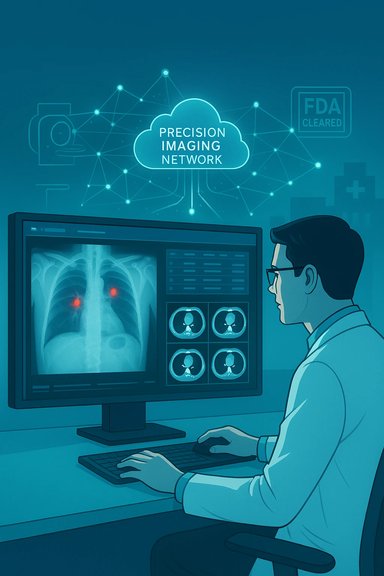
Qure.ai, a global developer of AI for medical imaging, announced a collaboration with Microsoft to onboard its lung cancer workflow suite — including chest X‑ray nodule detection (qXR‑LN), CT nodule quantification (qCT‑LN Quant), patient tracking and management (qTrack), and emergency triage capabilities (qER variants) — onto Microsoft’s Precision Imaging Network (PIN). The move is intended to streamline deployment to U.S. hospitals by offering a single integration and contracting point, leveraging Microsoft’s cloud, data governance tooling, and existing clinical connectors. Qure.ai’s public materials state the company is deployed across thousands of sites worldwide and that its portfolio now carries multiple FDA 510(k) clearances for lung and neurocritical use cases. This collaboration sits squarely in a broader industry trend: platform vendors (Microsoft, Nuance/PowerScribe, and others) assembling curated catalogs of vetted imaging AI models and offering one‑stop integration to reduce friction for hospitals. The Precision Imaging Network explicitly markets a single‑contract approach, prebuilt clinical integrations, and monitoring tools — features designed to shorten adoption timelines for third‑party imaging AI. What Qure.ai Is Bringing: Product set and regulatory posture
The components (what hospitals will see)
- qXR‑LN (Chest X‑ray lung nodule detection): A computer‑aided detection (CAD) model that flags and localizes suspected pulmonary nodules on frontal chest radiographs, designed as an aid for radiologists, pulmonologists and ER physicians. Qure.ai reports pivotal studies showing AUCs that meet predefined targets in multi‑reader settings.
- qCT‑LN Quant (CT nodule quantification): A volumetric measurement and tracking tool for solid lung nodules on chest CT. It reports automatic diameters, volumes, estimated volume‑doubling time, 2D/3D reconstructions, and guideline‑based management suggestions (Brock score, Fleischner guidance). Qure.ai lists potential reimbursement pathways for CT quantification (specific CPT considerations cited by the vendor).
- qTrack (Management & longitudinal tracking): A multi‑modality nodule management platform that integrates imaging measurements with EMR data to automate tracking, prioritize follow‑up, and coordinate care between radiology, pulmonology, and thoracic surgery teams.
- qER family (Neurocritical triage): Separate from the lung continuum but part of Qure.ai’s cleared portfolio, qER triages acute intracranial findings on head CT to accelerate intervention and specialist notification. Qure.ai reports multiple clearances in neurocritical care as part of its broader regulatory roster.
Regulatory status and deployments
Qure.ai’s public regulatory statements confirm multiple FDA 510(k) clearances across chest X‑ray‑ and CT‑based products; the qXR‑LN and qCT LN Quant clearances are documented on the company’s site and in vendor press releases. The company reports global deployment in thousands of sites across 100+ countries and has been highlighted in industry lists and trade coverage for its scale and adoption. Those numbers vary slightly across company pages and media articles, but the underlying fact is consistent: Qure.ai operates at large scale and holds multiple FDA clearances for imaging AI tools.Why this matters clinically: chest X‑ray, CT, and the AI inflection point
The clinical gap Qure.ai targets
Chest radiography remains the most commonly performed thoracic imaging exam, frequently capturing incidental nodules that are later worked up with CT. However, plain radiography historically detects a fraction of malignant nodules compared with CT — sensitivity varies widely by lesion size, location and reader experience. Multiple radiology studies and systematic reviews put chest X‑ray sensitivity for symptomatic lung cancer in the 70–80% range in the highest‑quality primary‑care cohorts, but sensitivity per nodule is substantially lower, particularly for small lesions and difficult anatomic locations. Deep learning models trained with CT‑referenced labels can improve detection and localization on radiographs, boosting sensitivity and sometimes preserving specificity, but real‑world performance varies with training data, labelling quality, and clinical workflow. The practical implication: if a validated AI model can reliably flag nodules on routine chest X‑rays, it can expand the “net” for early identification, drive earlier CT follow‑up, and surface patients who would otherwise remain undetected until later stages. That is the clinical opportunity Qure.ai and its Microsoft integration headline.What the literature shows about AI augmentation
Clinical and multi‑reader studies show that AI can improve radiologist sensitivity for pulmonary nodules on chest radiographs — several multicenter studies reported single‑digit to double‑digit percentage improvements in sensitivity with AI assistance. AI has also been shown to increase detection of actionable nodules with acceptable false‑referral rates in large retrospective analyses. However, study designs differ (reader studies vs real‑world rollout), and AI performance often depends on high‑quality CT‑referenced labels and representative training data to reduce biases and blind spots. In short: AI can move the needle, but outcomes depend on implementation, dataset representativeness, and ongoing monitoring.The Microsoft factor: Precision Imaging Network and why it changes deployment economics
Microsoft’s Precision Imaging Network (PIN) — the evolution of Nuance’s Precision Imaging Network under Microsoft’s healthcare umbrella — offers third‑party AI vendors a single way to connect into hospital radiology workflows, reporting solutions (PowerScribe), PACS, and EMRs, all while leveraging Azure’s compliance and identity capabilities. PIN advocates a single contracting model (BAA/MSA) and provides tooling for deployment, monitoring, and performance evaluation. For vendors and health systems, that reduces integration cycles, security reviews, and the need to build custom connectors for every partner. For Qure.ai, listing its lung continuum in PIN allows hospitals already connected to PowerScribe/PowerShare/PowerShare Image Exchange to evaluate and enable the Qure.ai stack without a long point‑to‑point integration project — an operational accelerant that matters when the goal is national scale. Multiple integrators and radiology vendors are similarly listing models on PIN, which moves the market away from bespoke integrations toward platform aggregation.Strengths: Why this partnership could deliver value quickly
- Regulatory readiness: Qure.ai’s lung and neurocritical products hold FDA 510(k) clearances for multiple findings and use cases, reducing the regulatory friction for U.S. deployments relative to unapproved research models. The company’s public filings document pivotal studies and multi‑reader validations supporting performance claims.
- From detection to care coordination: Qure.ai’s suite is designed as a continuum (detection on X‑ray → quantification on CT → automated tracking and care coordination), which is more valuable than a single detection box because it addresses clinically meaningful downstream failure modes (missed follow‑up, fragmented tracking). The added emphasis on integrating EMR data into qTrack acknowledges that detection without follow‑through creates limited clinical value.
- Reduced integration friction via PIN: Because PIN provides prebuilt connectors, a BAA framework, and a vetted model catalog, health systems can add third‑party imaging AI faster and with fewer legal and technical barriers. This is a practical advantage for large systems with diverse PACS/RIS/EHR stacks.
- Scale and real‑world footprint: Qure.ai’s deployments across thousands of sites and multiple countries, as well as the AstraZeneca/EDISON Alliance initiative that reportedly processed millions of chest X‑rays, indicate the company has operational experience at scale — an important factor in onboarding large American health systems. Large, heterogeneous deployments also provide a data feedback loop for continued model validation and improvement.
Risks and caveats: what radiology leaders and IT must watch for
No matter the vendor pedigree, clinical AI introduces a set of persistent, high‑impact risks. The following analysis highlights the most important considerations and why they matter operationally and ethically.1) False negatives and false positives — and clinical accountability
AI improves sensitivity in many studies, but sensitivity gains often trade off with false positives. False alarms can create follow‑up cascades — extra CTs, patient anxiety, and cost — while false negatives can produce dangerous missed diagnoses. Hospitals must define acceptable operating points, measure the net clinical impact (not just detection metrics), and preserve clinician sign‑off. Vendor‑quoted AUCs and study results are an important starting point, but they are not a substitute for site‑specific performance monitoring. Independent validation in a local case mix is essential.2) Generalizability and dataset bias
Models trained on one set of imaging equipment, patient demographics, or image qualities do not always generalize to another. Chest X‑rays from low‑resource clinics, older CR systems, or different population mixes can produce distribution shifts that degrade performance. Robust predeployment testing on representative local data plus post‑deployment drift monitoring must be mandatory.3) LLM and “agentic” claims: treat with caution
Qure.ai’s press materials describe lung cancer algorithms built from LLMs and agentic AI. While LLMs can assist with triage, report drafting, and workflow orchestration, they also introduce hallucination risk when used to generate clinical text or recommendations. Any LLM‑derived outputs must be presented with provenance and uncertainty markers and must be subject to clinician review. Company claims regarding LLMs should be treated as vendor assertions until independently validated; do not equate “LLM‑based” with clinical efficacy without published evidence.4) Vendor concentration and integration lock‑in
Platform aggregation (PIN) reduces integration friction but increases dependency on a single cloud/vetting/contract surface. That raises negotiating leverage for the platform owner and complicates migration plans if hospitals later choose different vendors. Contracts should include data portability, model‑export terms, and clear SLAs for uptime and updates. Independent exit and rollback plans must be contractual requirements.5) Regulatory labeling and clinical claims
Hospitals must confirm the intended use language in each vendor’s FDA 510(k) to ensure proposed clinical workflows match cleared uses. Using a cleared model outside its intended indication or without appropriate oversight increases regulatory and liability risk. Vendors sometimes highlight “guideline‑based suggestions” — these are advisory and should not replace clinician decision‑making without appropriate validation.6) Data governance, privacy, and BAAs
Even when PIN provides a preexisting BAA framework, local health systems retain responsibility for patient privacy and for ensuring that image and metadata flows meet state, federal, and contractual requirements. Cross‑border data residency, telemetry retention, and model training rights should be explicitly documented. Contracts must prohibit undisclosed training on patient images unless there is explicit, regulatory‑compliant consent and controls.Practical playbook for IT, radiology, and clinical leaders
Operationalizing AI safely is the recurring challenge. The following sequence draws on vendor guidance and industry best practices to help health systems make an evidence‑based decision.- Define clinical goals and KPIs up front.
- Time‑to‑diagnosis, added CTs per positive AI flag, false‑positive rate, time‑to‑followup, and patient outcome metrics (stage shift at diagnosis) are typical KPIs. Set numeric thresholds before pilot launch.
- Run a staged pilot on representative local data.
- Test the model on retrospective local cases that mirror daily practice. Compare AI‑aided reads to historical CT‑confirmed ground truth and measure per‑lesion and per‑patient metrics.
- Insist on independent validation and transparent performance reporting.
- Ask vendors for the pivotal study design, reader study results, AUCs broken down by nodule size/location, and false‑positive burden. Demand model cards and documented limitations.
- Integrate with human‑in‑the‑loop workflows.
- Use AI to prioritize and suggest, not to replace. Make clinician verification mandatory for high‑risk categories and embed decision support rather than auto‑ordering of invasive tests.
- Set governance and monitoring processes.
- Establish a cross‑functional AI oversight committee (radiology, pulmonology, IT, compliance) with scheduled reviews of drift, alert volume, and clinical impact metrics. Instrument telemetry to detect changes in sensitivity/specificity over time.
- Protect data and contractual rights.
- Verify BAAs, audit logs, data retention policies, and explicit prohibitions on unauthorized model retraining with patient data. Insist on data portability and exit clauses.
- Plan for reimbursement and coding workflows (CT quant).
- If using CT quantification, involve revenue cycle teams early to confirm payer eligibility and documentation requirements for CPT codes referenced by vendors. Qure.ai has indicated certain CT quantification CPT pathways are potentially available; confirm locally with payers.
- Train and set expectations for clinicians.
- Provide short‑form guidance on when to trust the AI, typical failure modes, and how to escalate ambiguous cases. Include examples of false positives and false negatives in training materials.
How to interpret vendor claims (a note on verification)
Vendor press materials will naturally highlight positive outcomes, milestones, and business milestones (e.g., millions of processed scans, TIME recognition, and country/site counts). These are useful signals of traction, but organizations should verify clinical performance claims independently:- Request raw or de‑identified test sets for local evaluation.
- Ask for peer‑reviewed publications or external audits of pivotal studies.
- Require clearly documented performance stratified by device type, patient demographics, and clinical setting.
Market and strategic implications for hospitals and health systems
- Faster adoption curve for imaging AI: Aggregation via platforms such as PIN accelerates evaluation and procurement cycles. That reduces upfront technical costs for hospitals but increases the importance of contract governance.
- Clinical workflow redesign: The real value of detection models comes when they are coupled to follow‑up pathways and care coordination. Tools that stop at detection risk creating alert noise; tools integrated end‑to‑end (detection → CT quant → tracking) are more likely to move clinical outcomes. Qure.ai’s product set intentionally spans that continuum.
- Payer and reimbursement dynamics: As CT quantification and structured reporting become more common, revenue cycle teams and compliance officers will need to reconcile new codes and documentation workflows. Hospitals should engage payers early if they expect quantification to be a billable service.
- Competition and consolidation: Platform aggregation favors vendors that can land listings on large, trusted networks; smaller AI labs will need to either partner or niche‑specialize to remain competitive. At the same time, aggregation raises the stakes for the platform operator (Microsoft) to maintain impartial validation processes and transparent model governance.
Final assessment: measured optimism with strict guardrails
The Qure.ai–Microsoft collaboration is an important milestone in imaging AI commercialization. It pairs a vendor that has amassed regulatory clearances and global deployments with a platform designed to remove the technical and contractual barriers that have historically slowed U.S. hospital AI adoption. In the best case, this combination will increase incidental nodule detection rates, reduce time to diagnosis, and help close care gaps by connecting detection with follow‑up workflows — outcomes that would materially benefit patients and health systems.At the same time, this is not a “plug‑and‑play” cure for late‑stage lung cancer mortality. Realizing benefit requires disciplined local validation, robust governance, clinician education, and continuous monitoring. Trustworthy deployment must be built on transparent performance data, clearly defined clinical pathways, and contractual safeguards that preserve patient privacy, data portability, and clinician accountability.
Hospitals and radiology groups evaluating Qure.ai through Microsoft’s Precision Imaging Network should prioritize a staged rollout: rigorous predeployment testing on local cases, well‑defined KPIs tied to clinical outcomes (not just detection metrics), human‑in‑the‑loop workflows for high‑risk decisions, and an oversight committee that meets regularly to review telemetry and drift. When those guardrails are in place, the combination of validated AI models and platform‑led integration can deliver meaningful improvements in early lung cancer detection — but only if leaders remain clear‑eyed about the technical and operational realities that decide whether AI aids patients or merely adds noise.
Qure.ai and Microsoft have outlined an ambitious pathway to scale AI‑driven lung nodule detection and management across the U.S. The announcement is backed by vendor regulatory filings, corporate press releases and the technical infrastructure of Microsoft’s Precision Imaging Network; independent radiology literature supports the core concept that AI can raise chest X‑ray sensitivity when correctly trained and deployed. Still, the ultimate value of this collaboration will depend on how rigorously hospitals and vendors validate performance in local practice, how transparently they report outcomes, and how carefully they govern model usage and data flows — the operational work that determines whether scalable AI realizes its promise in everyday clinical care.
Source: Inside Precision Medicine Qure.ai and Microsoft Collaborate on Lung Cancer Detection
