

RAAPID’s latest financing move is more than another healthcare AI funding round. With Healthworx now joining M12 and UPMC Enterprises, the company is positioning itself as a rare vendor that can speak credibly to payers, providers, and the cloud platform layer all at once. That matters because Medicare Advantage risk adjustment is becoming less forgiving, more audited, and far less tolerant of opaque coding workflows. In a market where defensibility is starting to matter as much as capture rate, RAAPID is trying to turn regulatory pressure into a platform advantage.
The timing of this announcement reflects a deeper shift in how health plans think about risk adjustment. For years, the category was dominated by tools that promised to surface missed HCCs, accelerate chart review, and maximize coding yield. That approach worked when the market rewarded volume and when audit intensity lagged behind operational ambition. Today, CMS scrutiny is tighter, recovery expectations are more aggressive, and the center of gravity has moved from how many codes can you find? to how many codes can you defend?
That distinction is the heart of RAAPID’s pitch. The company says its neuro-symbolic AI creates an encounter-linked evidence trail, not merely a coded output, so plans can show why a diagnosis should stand up under review. In a Medicare Advantage environment where unsupported diagnoses can become liabilities, that kind of auditability is not a nice-to-have feature; it is the product. The market has been moving in that direction for months, and CMS’s RADV posture has made the consequences of getting it wrong very real.
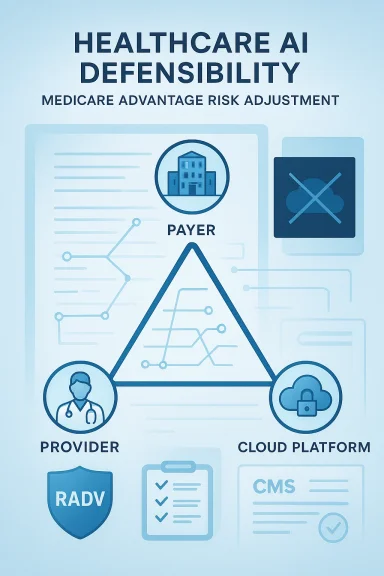
The broader investment structure is also notable. RAAPID previously announced a Series A from M12, Microsoft’s venture fund, and later positioned itself as a Microsoft Marketplace and Azure-native partner with deployment options in customers’ environments. UPMC Enterprises then added another layer of validation from a health-system commercialization arm, while Healthworx introduces payer-side capital and a CareFirst connection that reinforces the company’s claim that it understands the buyer’s regulatory anxiety as well as the clinician’s workflow. That combination creates a validation triangle that many startups can only imitate, not replicate.
The market context matters as much as the press release itself. CMS has already said the RADV program is its primary mechanism for addressing overpayments to Medicare Advantage organizations, and its recent actions show a clear desire to accelerate audits and sharpen the review process. A company selling “defensible accuracy” is therefore not just selling software; it is selling a compliance strategy that acknowledges the audit environment as permanent rather than cyclical. That is a very different value proposition from the legacy promise of simply finding more codes.
RAAPID’s messaging reflects that change directly. Its language about “audit-first AI” and “defensible accuracy” is not just branding; it is an admission that the market is increasingly intolerant of black-box outputs. That is a subtle but important shift. In healthcare IT, explainability is often treated as a trust feature. In RADV-sensitive workflows, it is becoming a revenue protection requirement.
A useful way to think about this transition is to compare the old and new procurement questions:
For payers, this is especially relevant because the stakes are enterprise-wide. A coding error can ripple into revenue forecasting, compliance reporting, provider relations, and actuarial assumptions. In that environment, a tool that narrows the gap between operational speed and evidentiary rigor has a stronger pitch than one that merely accelerates abstraction.
The payer lens is especially valuable because payers are the ones closest to the regulatory fire. They see the cost of audit findings, the friction of provider abrasion, and the operational burden of manual review. If an investment arm tied to a major Blues plan decides to participate, it suggests that the product speaks to a pain point that is not theoretical. It is embedded in the economics of the business.
There is also a strategic signaling effect. Payer capital often implies that a vendor is no longer only promising future category leadership; it is being evaluated as part of the infrastructure needed to manage current obligations. That is a major distinction. Many startup products are “interesting.” Fewer become operationally necessary. Healthworx’s involvement nudges RAAPID closer to the second category.
The “audit-first” framing also aligns with how payers increasingly think about vendor selection. A clean implementation is not enough if the downstream workflow still depends on human reviewers rebuilding the evidentiary chain. The real win is when the vendor can help produce an auditable trail as part of the workflow, not as a cleanup exercise after the fact.
This matters because healthcare buyers are often caught between two desires: they want the security and operational convenience of a standard platform, but they also want control over PHI handling, contractual boundaries, and deployment location. By speaking both languages, RAAPID is trying to remove a common objection before it appears in the RFP.
The Microsoft Marketplace angle is also important. Products that can be purchased and deployed through familiar enterprise channels often face less friction than ones requiring special vendor onboarding and bespoke infrastructure planning. In healthcare, where procurement cycles are already long, distribution can be as valuable as model quality.
That matters because risk adjustment tools have historically struggled with trust. Clinicians dislike tooling that feels extractive, while compliance teams dislike tooling that feels vague. A health-system-backed company can help bridge that divide by forcing product design to answer to real operational constraints, not just investor narratives.
The company’s claimed reduction in review time from 40 minutes to under 8 minutes is notable, but speed alone is not the breakthrough. The more meaningful claim is that the system can preserve or improve precision while dramatically reducing reviewer burden. If that holds in production, it could redefine what good risk adjustment software is supposed to accomplish.
The phrase defensible accuracy is therefore doing a lot of work. It suggests that the winning platform is no longer the one with the largest list of suggestions, but the one with the strongest evidence chain. That is a more mature framing for the category, and it may be the reason the company is drawing interest from multiple types of strategic investors.
The “10:1 operational ROI” claim is the kind of phrase that gets attention in procurement, but buyers will want to understand the denominator. Is the ROI driven by labor savings, better capture, lower audit risk, or some combination? The company will need to keep proving that its gains are not just pilot-friendly but repeatable at scale.
A strong enterprise risk adjustment platform has to do three things at once:
That is another reason the Healthworx investment matters. It reinforces the idea that the company is not just building for the abstract AI market, but for the realities of healthcare governance. In enterprise healthcare, the difference between “interesting” and “procure-able” often comes down to those governance details.
That will likely benefit companies that can unify coding, compliance, and audit support in one platform. It may also favor vendors with deep payer relationships and strong clinician-facing workflow design. The days when a tool could win simply by surfacing more diagnoses are ending.
The resulting competitive dynamic is likely to look less like a feature war and more like a credibility war. Who can prove the strongest compliance story? Who can reduce operational burden without increasing audit risk? Who can integrate into enterprise systems without creating another fragile silo? Those are the questions buyers will ask, and RAAPID is clearly trying to define the answer before its competitors do.
The company’s strategic investor mix is also unusually strong. Microsoft brings platform credibility, UPMC brings clinical legitimacy, and Healthworx adds payer-side conviction. Together, they create a story that is easier for enterprise buyers to trust than a standard venture-backed pitch deck.
There is also a category risk. The more a vendor emphasizes compliance, the more it must prove it can keep pace with changing CMS guidance, audit methodology, and payer workflows. If the rules move faster than the product can adapt, the defensibility promise weakens quickly. That is especially true in an area where even small documentation changes can affect payment outcomes.
CMS will also remain a critical external force. As audit schedules, extrapolation practices, and appeals processes continue to evolve, vendors that can adapt quickly will gain an advantage. In a market where regulatory certainty is limited, products built around traceability and documented logic are likely to fare better than those built around opaque score generation.
A few watch items stand out:
Source: 01net https://www.01net.it/raapid-complet...es-to-standardize-defensible-risk-adjustment/
 Background
The timing of this announcement reflects a deeper shift in how health plans think about risk adjustment. For years, the category was dominated by tools that promised to surface missed HCCs, accelerate chart review, and maximize coding yield. That approach worked when the market rewarded volume and when audit intensity lagged behind operational ambition. Today, CMS scrutiny is tighter, recovery expectations are more aggressive, and the center of gravity has moved from how many codes can you find? to how many codes can you defend?That distinction is the heart of RAAPID’s pitch. The company says its neuro-symbolic AI creates an encounter-linked evidence trail, not merely a coded output, so plans can show why a diagnosis should stand up under review. In a Medicare Advantage environment where unsupported diagnoses can become liabilities, that kind of auditability is not a nice-to-have feature; it is the product. The market has been moving in that direction for months, and CMS’s RADV posture has made the consequences of getting it wrong very real.
The broader investment structure is also notable. RAAPID previously announced a Series A from M12, Microsoft’s venture fund, and later positioned itself as a Microsoft Marketplace and Azure-native partner with deployment options in customers’ environments. UPMC Enterprises then added another layer of validation from a health-system commercialization arm, while Healthworx introduces payer-side capital and a CareFirst connection that reinforces the company’s claim that it understands the buyer’s regulatory anxiety as well as the clinician’s workflow. That combination creates a validation triangle that many startups can only imitate, not replicate.
The market context matters as much as the press release itself. CMS has already said the RADV program is its primary mechanism for addressing overpayments to Medicare Advantage organizations, and its recent actions show a clear desire to accelerate audits and sharpen the review process. A company selling “defensible accuracy” is therefore not just selling software; it is selling a compliance strategy that acknowledges the audit environment as permanent rather than cyclical. That is a very different value proposition from the legacy promise of simply finding more codes.
The New Risk Adjustment Reality
Risk adjustment used to be treated as a revenue optimization function with compliance attached. That framing no longer holds. CMS’s RADV program is now central to Medicare Advantage payment integrity, and the agency’s public messaging makes clear that unsupported diagnoses can lead to recoupment. When the upside of aggressive coding gets smaller and the downside gets more punitive, the winning products are the ones that reduce uncertainty rather than amplify throughput.From capture to defensibility
The old playbook rewarded scale. More chart reviews, more extracted diagnoses, more suspect records routed into coder queues. The new playbook rewards confidence. Plans now need to know whether a diagnosis is supported by documentation, whether the evidence is clearly linked to the encounter, and whether the workflow can survive post-payment review without creating a paper trail problem.RAAPID’s messaging reflects that change directly. Its language about “audit-first AI” and “defensible accuracy” is not just branding; it is an admission that the market is increasingly intolerant of black-box outputs. That is a subtle but important shift. In healthcare IT, explainability is often treated as a trust feature. In RADV-sensitive workflows, it is becoming a revenue protection requirement.
A useful way to think about this transition is to compare the old and new procurement questions:
- Can the tool find more diagnoses?
- Can it do so without creating unsupported risk?
- Can it show the evidence behind every recommendation?
- Can it fit into existing compliance and coding workflows?
- Can it reduce review time without lowering audit confidence?
Why CMS pressure changes buying behavior
CMS pressure changes the ROI equation for buyers. A system that saves a few minutes per chart is useful, but a system that helps avoid extrapolated audit losses can be strategically decisive. That is why vendors in this space are increasingly speaking in the language of compliance resilience and not just productivity.For payers, this is especially relevant because the stakes are enterprise-wide. A coding error can ripple into revenue forecasting, compliance reporting, provider relations, and actuarial assumptions. In that environment, a tool that narrows the gap between operational speed and evidentiary rigor has a stronger pitch than one that merely accelerates abstraction.
Why the Healthworx Investment Matters
Healthworx is not just another financial backer. As the investment arm of CareFirst, it represents payer-side judgment from people who live inside the reimbursement and administrative reality RAAPID is trying to solve. That gives the investment a kind of buyer-native credibility that is hard to fake and even harder to manufacture through marketing alone.Payer validation is different from tech validation
Microsoft backing says the platform can scale. UPMC Enterprises backing says it can matter in a clinically grounded environment. Healthworx backing says a payer believes the workflow has enough practical value to justify strategic capital. Those are related but distinct signals, and together they reduce the risk that RAAPID is just a compelling demo with no real-world purchase intent behind it.The payer lens is especially valuable because payers are the ones closest to the regulatory fire. They see the cost of audit findings, the friction of provider abrasion, and the operational burden of manual review. If an investment arm tied to a major Blues plan decides to participate, it suggests that the product speaks to a pain point that is not theoretical. It is embedded in the economics of the business.
There is also a strategic signaling effect. Payer capital often implies that a vendor is no longer only promising future category leadership; it is being evaluated as part of the infrastructure needed to manage current obligations. That is a major distinction. Many startup products are “interesting.” Fewer become operationally necessary. Healthworx’s involvement nudges RAAPID closer to the second category.
What CareFirst may be buying into
CareFirst’s investment arm is likely seeing more than just a software vendor. It is seeing a platform that could help reduce manual chart review costs, improve compliance defensibility, and potentially lower the operational drag associated with retrospective risk adjustment. That kind of value can matter across payer organizations, especially where coding teams are stretched and audit preparation remains labor-intensive.The “audit-first” framing also aligns with how payers increasingly think about vendor selection. A clean implementation is not enough if the downstream workflow still depends on human reviewers rebuilding the evidentiary chain. The real win is when the vendor can help produce an auditable trail as part of the workflow, not as a cleanup exercise after the fact.
Microsoft, UPMC, and the Power of Platform Legitimacy
RAAPID’s story gets stronger because it is not just a point solution claiming to be smart. It is being validated by organizations with different, complementary forms of credibility. M12 brings enterprise software and Microsoft ecosystem legitimacy. UPMC Enterprises brings clinical and health-system pragmatism. Healthworx brings payer realism. That combination forms a broader moat than most startups can build on technology alone.Azure-native, but cloud agnostic
RAAPID says it is cloud agnostic while also being a native Microsoft Azure solution, with deployment options in customer environments and references to data sovereignty. That dual posture is smart. It lets the company appeal to health plans that want Microsoft alignment and procurement comfort without forcing them into a one-cloud-only narrative that might create governance concerns.This matters because healthcare buyers are often caught between two desires: they want the security and operational convenience of a standard platform, but they also want control over PHI handling, contractual boundaries, and deployment location. By speaking both languages, RAAPID is trying to remove a common objection before it appears in the RFP.
Why the Microsoft connection is strategically useful
Microsoft has spent years building trust in enterprise AI, cloud, security, and healthcare-adjacent workflows. For a company like RAAPID, that association can lower perceived risk, especially among large payer and provider organizations that already operate heavily in the Microsoft stack. It also signals that the product is intended to fit into enterprise procurement, not live as a boutique AI science project.The Microsoft Marketplace angle is also important. Products that can be purchased and deployed through familiar enterprise channels often face less friction than ones requiring special vendor onboarding and bespoke infrastructure planning. In healthcare, where procurement cycles are already long, distribution can be as valuable as model quality.
UPMC as clinical credibility
UPMC Enterprises adds a different kind of legitimacy. Health systems do not invest in startup technology lightly, and their participation often reflects a belief that the product can touch real workflows, not just abstract analytics. RAAPID’s challenge is not merely to find codes, but to do so in a way that clinical organizations can respect. UPMC’s involvement helps anchor that claim.That matters because risk adjustment tools have historically struggled with trust. Clinicians dislike tooling that feels extractive, while compliance teams dislike tooling that feels vague. A health-system-backed company can help bridge that divide by forcing product design to answer to real operational constraints, not just investor narratives.
Neuro-Symbolic AI and the Audit-First Thesis
RAAPID’s technical differentiation is built around neuro-symbolic AI, a phrase that has become popular because it promises the best of both worlds: pattern recognition from machine learning and rule-based traceability from symbolic logic. In the risk adjustment context, that is a compelling architecture because the job is not merely to classify a record, but to prove why a given diagnosis is supported.Why explainability matters here
Explainability in healthcare AI often gets reduced to a PR talking point. In RADV workflows, it is operational. If a chart review output cannot be traced to documentation, encounter context, and a defensible clinical rationale, then the output may be commercially useful but strategically fragile. That is why RAAPID’s emphasis on MEAT criteria and encounter-linked evidence is so central to the pitch.The company’s claimed reduction in review time from 40 minutes to under 8 minutes is notable, but speed alone is not the breakthrough. The more meaningful claim is that the system can preserve or improve precision while dramatically reducing reviewer burden. If that holds in production, it could redefine what good risk adjustment software is supposed to accomplish.
Why “black box” tools are losing appeal
Legacy NLP tools were often very good at surfacing candidate codes, but much weaker at proving downstream defensibility. That is the “compliance chasm” RAAPID is trying to exploit. The more CMS leans into audits and extrapolation, the less attractive it becomes to buy a tool that can generate revenue lift today but create audit exposure tomorrow.The phrase defensible accuracy is therefore doing a lot of work. It suggests that the winning platform is no longer the one with the largest list of suggestions, but the one with the strongest evidence chain. That is a more mature framing for the category, and it may be the reason the company is drawing interest from multiple types of strategic investors.
The operational tradeoff
There is, however, an important tradeoff. Systems that emphasize evidence and traceability can be harder to tune and may require more workflow discipline than less structured alternatives. That means RAAPID’s promise depends not only on model quality, but on adoption quality: good data, good integration, and good process governance. In healthcare, the best model in the world still loses if the surrounding workflow is chaotic.Enterprise Impact Versus Consumer-Like Simplicity
Healthcare technology vendors often talk about simplicity, but enterprise buyers rarely buy simplicity for its own sake. They buy certainty, control, and reduced liability. RAAPID’s messaging is aimed squarely at that reality, even when it uses consumer-friendly language like “operational alpha” or “massive market shift.” The underlying audience is the C-suite, the compliance team, and the coding organization.What payers care about
Payers care about audit readiness, provider abrasion, and return on investment. If a tool can shorten chart review, surface unsupported codes earlier, and reduce the probability of a bad audit outcome, it has a straightforward business case. That is why RAAPID is leaning so hard into metrics like precision, productivity, and review time.The “10:1 operational ROI” claim is the kind of phrase that gets attention in procurement, but buyers will want to understand the denominator. Is the ROI driven by labor savings, better capture, lower audit risk, or some combination? The company will need to keep proving that its gains are not just pilot-friendly but repeatable at scale.
What providers care about
Providers, by contrast, care about abrasion. If payer-side tools overwhelm clinicians with requests, corrections, or documentation pressure, adoption will stall. RAAPID’s promise to surface actionable gaps at the point of care is therefore important because it suggests the product is trying to improve data quality without turning clinicians into coding clerks. That is the right ambition, though it is also a hard one to execute.A strong enterprise risk adjustment platform has to do three things at once:
- preserve audit defensibility
- reduce manual review burden
- avoid burdening clinicians with needless workflow noise
What IT and security teams care about
IT teams care about deployment, sovereignty, integration, and compliance certifications. RAAPID’s HITRUST and SOC 2 posture, plus its Azure alignment, are clearly meant to reassure those stakeholders. In a sector where PHI handling is central, these controls are often part of the buying decision long before a pilot begins.That is another reason the Healthworx investment matters. It reinforces the idea that the company is not just building for the abstract AI market, but for the realities of healthcare governance. In enterprise healthcare, the difference between “interesting” and “procure-able” often comes down to those governance details.
Competitive Implications
RAAPID’s move signals a wider shift in the risk adjustment market. Vendors are being pushed toward defensible automation, and the ones that cannot articulate a clear audit story are likely to face more skepticism from payer buyers. That creates pressure not only on niche startups, but on larger incumbents that have historically competed by offering scale, workflow breadth, or legacy integration.The pressure on incumbents
Incumbent vendors now have to prove more than operational throughput. They need to show how their systems support RADV evidence, documentation lineage, and compliance consistency across retrospective and prospective workflows. In other words, the market is shifting from “risk adjustment software” to “risk adjustment evidence infrastructure.”That will likely benefit companies that can unify coding, compliance, and audit support in one platform. It may also favor vendors with deep payer relationships and strong clinician-facing workflow design. The days when a tool could win simply by surfacing more diagnoses are ending.
Why the market may consolidate around trust
In regulated categories, trust tends to compound. Once a company has Microsoft, a health system, and a payer-linked investor in its corner, rivals must explain why they are better, not just why they are cheaper or faster. That is a difficult position to attack from, especially when audit exposure is rising and procurement teams are becoming more conservative.The resulting competitive dynamic is likely to look less like a feature war and more like a credibility war. Who can prove the strongest compliance story? Who can reduce operational burden without increasing audit risk? Who can integrate into enterprise systems without creating another fragile silo? Those are the questions buyers will ask, and RAAPID is clearly trying to define the answer before its competitors do.
Strengths and Opportunities
RAAPID’s biggest strength is that it is aligning product design with the market’s new regulatory reality. That sounds obvious, but many vendors still behave as if risk adjustment is primarily a capture problem. RAAPID is instead treating it as a proof problem, and that may be exactly what large buyers want in 2026.The company’s strategic investor mix is also unusually strong. Microsoft brings platform credibility, UPMC brings clinical legitimacy, and Healthworx adds payer-side conviction. Together, they create a story that is easier for enterprise buyers to trust than a standard venture-backed pitch deck.
- Audit-first positioning matches current CMS scrutiny.
- Neuro-symbolic AI is better suited to evidence-based workflows than opaque NLP alone.
- Payer validation via Healthworx should resonate with buying committees.
- Clinical validation via UPMC Enterprises adds workflow credibility.
- Microsoft ecosystem alignment should reduce procurement friction in Azure-heavy environments.
- Cloud sovereignty messaging may help in regulated deployment scenarios.
- Operational time savings could translate into measurable staffing relief if validated at scale.
Risks and Concerns
The biggest risk is that the company’s claims outpace its reproducibility. Metrics like 98% precision and sub-8-minute review time are powerful marketing statements, but large healthcare organizations will want evidence under their own data conditions. Healthcare AI has a long history of looking excellent in controlled demos and more ordinary in the wild.There is also a category risk. The more a vendor emphasizes compliance, the more it must prove it can keep pace with changing CMS guidance, audit methodology, and payer workflows. If the rules move faster than the product can adapt, the defensibility promise weakens quickly. That is especially true in an area where even small documentation changes can affect payment outcomes.
- Performance claims may vary by customer environment.
- Workflow friction could limit clinician acceptance.
- Implementation complexity may rise as evidence requirements deepen.
- Regulatory change could alter product requirements quickly.
- Competitive response from incumbents may compress differentiation.
- Dependence on strategic investors can create expectation pressure. That is not a flaw by itself, but it does raise the bar.
- Audit-first positioning may be compelling, but it can also limit the market if buyers still prioritize raw capture lift in some segments.
Looking Ahead
The next phase will likely be defined by proof. Health plans will want to see whether RAAPID can maintain its promised precision, speed, and audit readiness across diverse datasets, coding teams, and plan designs. If the company can show that its evidence trail survives real-world review cycles, its investor trifecta will look less like a press-release flourish and more like a category signal.CMS will also remain a critical external force. As audit schedules, extrapolation practices, and appeals processes continue to evolve, vendors that can adapt quickly will gain an advantage. In a market where regulatory certainty is limited, products built around traceability and documented logic are likely to fare better than those built around opaque score generation.
A few watch items stand out:
- whether RAAPID expands further into Medicare Advantage audit workflows
- whether additional payer partners follow Healthworx’s lead
- whether enterprise adoption accelerates through Microsoft channels
- whether the company can demonstrate consistent ROI outside pilot settings
- whether rivals respond by adding more evidence-focused features of their own
Source: 01net https://www.01net.it/raapid-complet...es-to-standardize-defensible-risk-adjustment/
