

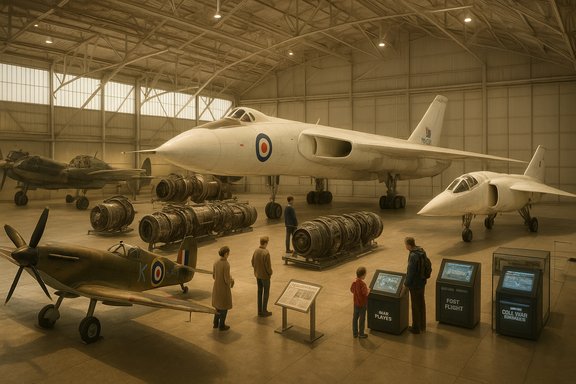
The Royal Air Force Museum at Cosford is a concentrated, compelling catalogue of British aviation ambition — a place where delta-winged Cold War icons sit within arm’s reach of fragile First World War biplanes, and where the raw engineering of jet and piston propulsion is displayed alongside the weapons and engines that defined aerial combat for a century. This feature walks through the museum’s most arresting jets and propeller aircraft, explains why Cosford’s collection matters to historians and enthusiasts, and assesses what to look out for — from the world’s oldest Spitfire Mk I to the experimental prototypes that never entered service but shaped modern flight.
Cosford began life as an aerospace museum with a strong emphasis on research and development aircraft, a curatorial focus that makes it stand apart from many other military collections. The site has evolved into the RAF Museum Midlands and is one of two public RAF Museum locations, the other being in London. Cosford’s strength is the breadth and rarity of its holdings: research prototypes, Cold War V-bombers, complete wartime fighters, transport giants, and an internationally significant collection of aero engines and missiles. This mixture gives the gallery a layered story-telling capability — technological progress, operational history, and the human narratives around aircrew and engineers. Admission to the Cosford site is free, and several of the public hangars are configured to let visitors move chronologically through aviation history — Test Flight for early flight and prototypes, War Planes for the piston and early-jet era, and the National Cold War Exhibition for strategic deterrence aircraft and Cold War paraphernalia. Each hangar is curated to emphasize both individual airframes and the systems (engines, avionics, weapons) that made them work.
For enthusiasts planning a visit: treat Cosford as a technical museum as much as a historical one. Read the hangar labels, take time with the engine displays, and if possible, follow up with the museum’s online collections portal or contact the conservation team for deeper archival enquiries. Cosford doesn’t just show aircraft; it reveals the engineering choices, policy decisions, and human labor that created them — and that narrative is essential to understanding modern air power. Caveat on inventory claims: museum holdings and loan statuses change regularly. Some widely circulated counts of "how many aircraft" Cosford holds differ between sources (figures range and collections are often reorganized between the Midlands and London sites). When precise, current inventory numbers are required — for research, publication, or planning — confirm with the museum’s collections pages or contact their curatorial staff directly. The RAF Museum Cosford remains one of the United Kingdom’s most consequential aviation collections for anyone interested in the mechanical core of flight, the strategic dramas of the Cold War, and the often messy, politically charged process that turns prototypes into service aircraft. Its jets and props are not relics frozen in time but artifacts that continue to inform engineering, history, and public understanding of flight.
Source: Super Nowości https://supernowosci24.pl/eeeedxsho...-props-of-the-royal-air-force-museum-cosford/
 Background and overview
Cosford began life as an aerospace museum with a strong emphasis on research and development aircraft, a curatorial focus that makes it stand apart from many other military collections. The site has evolved into the RAF Museum Midlands and is one of two public RAF Museum locations, the other being in London. Cosford’s strength is the breadth and rarity of its holdings: research prototypes, Cold War V-bombers, complete wartime fighters, transport giants, and an internationally significant collection of aero engines and missiles. This mixture gives the gallery a layered story-telling capability — technological progress, operational history, and the human narratives around aircrew and engineers. Admission to the Cosford site is free, and several of the public hangars are configured to let visitors move chronologically through aviation history — Test Flight for early flight and prototypes, War Planes for the piston and early-jet era, and the National Cold War Exhibition for strategic deterrence aircraft and Cold War paraphernalia. Each hangar is curated to emphasize both individual airframes and the systems (engines, avionics, weapons) that made them work. The headline props — propeller-driven fighters and transports
Supermarine Spitfire Mk I (K9942) — the oldest surviving example
At Cosford sits Spitfire Mk I K9942, widely recognized as the oldest surviving Spitfire and a textbook example of aircraft preservation that bridges museum narrative and operational reality. K9942 first flew in 1939 and served operationally before being preserved for posterity; its presence at Cosford makes the museum a vital stop for anyone studying the Battle of Britain or early RAF fighter doctrine. The Spitfire’s graceful elliptical wing and Merlin-engine lineage encapsulate the leap in piston-engine fighter performance that dominated the 1930s and 1940s. Why it matters: the Spitfire isn’t just a poster plane. As a Mk I, K9942 reflects the design compromises and wartime realities of 1939–1940 — armament, structure, and limitations that historians use to compare to later marks and enemy types.Wartime oddities and rarities — Me 410, Ju 88, Japanese types
Cosford’s War Planes display includes rare Axis types and lesser-known Allied types that highlight global air warfare’s diversity. The museum houses one of only a handful of surviving Messerschmitt Me 410 examples and a complete Junkers Ju 88, among other rarities. These are invaluable for scholars because surviving Axis examples are far less numerous and often incomplete; a complete Ju 88 or Me 410 gives a fuller picture of wartime manufacturing, design philosophies, and multi-role capability than fragments or photographs alone.Transport and multi-role props
Cosford also preserves historically significant transport types: Bristol Britannia 312, Armstrong Whitworth Argosy, and classic transatlantic workhorses. These airframes document how logistics, long-range patient evacuation, and strategic airlift developed in the RAF after WWII — often an overlooked but vital part of air power history. The presence of such transports alongside fighters and bombers allows visitors to contextualize operational support networks and the RAF’s global reach.The rocket-age and Cold War: jets, V‑bombers and the National Cold War Exhibition
Avro Vulcan B.2 XM598 — delta-wing strategic power
The Avro Vulcan XM598 is a focal point of Cosford’s Cold War story. As one of the UK’s iconic V‑bombers, the Vulcan represents the shift from piston-era strategic bombers to high-speed, high-altitude jet non‑proliferation deterrents. XM598 on display carries the physical evidence of the era — weapon hardpoints, ECM pods, and structural scale — that make abstract Cold War doctrines suddenly tangible. The National Cold War Exhibition explicitly showcases Britain’s V-bombers (Vulcan, Victor, Valiant), along with immersive exhibits that explain the political and technical context of nuclear deterrence. Key specs to remember: the B2 Vulcan’s delta wing and Olympus powerplants allowed long-range high-altitude performance; later low-level roles required radical operational changes and new avionics. These exact technical shifts are visible in the museum displays and help explain the Vulcan’s design trade-offs.McDonnell Douglas Phantom FG.1 (nose section, XV591) and Cold War interceptors
Cosford preserves the nose section of a McDonnell Douglas Phantom FG.1 (serial XV591), a symbol of the interceptor era and NATO air defence interoperability. Although only the forward fuselage is displayed, it exposes the cockpit layout and front-end avionics that were central to supersonic interception — radar, HUD sighting, and air-to-air missile integration. Several other Cold War jet types and testbeds (Gloster Meteor variants, English Electric prototypes) create a layered narrative of rising speeds, avionics complexity, and missile-based lethality through the 1950s–1970s.R&D and prototype aircraft — where ideas became aircraft
BAC TSR-2 XR220 — cancelled promise, preserved engineering
Cosford is famous for housing BAC TSR‑2 XR220, the second prototype of Britain’s ill-fated mid-1960s strike/reconnaissance project. The TSR‑2 embodied advanced aerodynamics, high-speed low-level penetration capability, and complex avionics; its cancellation remains a pivotal policy moment in British aerospace history. XR220’s preservation matters because it captures both extraordinary technical promise and the political-economic pressures that shape defence procurement. Airframe photos and museum displays show the TSR‑2’s slender fuselage and long internal bays — a clear demonstration of the design’s intended performance envelope.Short SB.5, Fairey Delta 2 and other testbeds
Cosford’s Research & Development collection includes rarities such as the Short SB.5 and Fairey FD.2, aircraft designed explicitly to test wing shapes, control systems, and high-speed aerodynamics. The FD.2, for instance, was an experimental delta-wing aircraft that preceded later supersonic types; the SB.5 allowed engineers to evaluate tailplane effects on slender wings. These machines were not mass-produced; they were one-off or limited-run test platforms whose engineering data fed directly into production designs. Seeing them in sequence highlights the pipeline from concept to operational capability.Engines and missiles — the hardware behind flight and force
An extraordinary aero-engine collection
Hangar 1 at Cosford is effectively an aero-engine museum within a museum. Rolls-Royce Merlins, Olympus turbojets, Conway turbofans, and rare powerplants such as the Junkers Jumo 004 and the early Power Jets units sit on detailed plinths or wall racks. This concentration lets visitors compare propeller-era radial engines to axial-flow turbofans side-by-side — an educational treat for engineering students and enthusiasts. The museum’s engine exhibits are curated to show manufacturing evolution, materials technology, and changes in thermal and thrust management across decades. Key engines on display include:- Rolls‑Royce Merlin and Packard‑Merlin variants
- Rolls‑Royce Olympus and Conway families
- Turbo‑Union RB199 (Tornado engine)
- German wartime types like Junkers Jumo 004
Rare missile and rocket weapons collection
Cosford’s missile collection is one of the most comprehensive in Europe, featuring V‑1 and V‑2 examples, Henschel and Rheinmetall guided weapons, and British systems such as Bloodhound and Rapier. The National Cold War Exhibition displays stand-off and defensive weapons alongside V‑bombers, creating an integrated view of strike, sustainment, and defence. The German wartime guided weapons on display are particularly important for scholars of early cruise and ballistic technology because they demonstrate developmental leaps in guidance and propulsion that defined post-war missile programmes.Visitor experience: how the museum builds the narrative
Hangars and interpretation
Cosford organizes its displays into themed hangars that intentionally juxtapose technologies: prototypes in the Research hangar sit beside the operational aircraft in War Planes, while the Test Flight hangar frames early aviation against late-20th-century experimental systems. This curatorial decision emphasizes technological lineage — visitors can trace how a control surface experiment in a Short SB.5 influenced later fighter geometry, or how propulsion advances moved aircraft from piston to jet power. The museum supplements static displays with immersive exhibits: interactive simulators, VR experiences, and the museum’s 4D theatre in certain hangars.Accessibility, events and learning
Cosford’s free admission policy is matched with educational programming, restoration workshops, and rotating temporary exhibitions. The conservation centre on site underscores the museum’s role not only as exhibitor but as a living workshop for airframe restoration and engines research. Periodic special events and air shows have allowed the museum to deepen public engagement and showcase restoration milestones. These activities position Cosford as both a static repository and an active participant in aviation heritage stewardship.Notable highlights: a concise guide for enthusiasts
- Spitfire Mk I K9942 — the Mk I’s historical weight and condition make this a fundamental stop.
- Avro Vulcan B.2 XM598 — head to the National Cold War Exhibition for this delta-wing giant and its Cold War context.
- BAC TSR‑2 XR220 — a rare opportunity to inspect a prototype that represents both technical ambition and political controversy.
- McDonnell Douglas Phantom FG.1 (nose XV591) — the Phantom’s front fuselage reveals cockpit ergonomics and intercept instrumentation.
- Messerschmitt Me 410 & Junkers Ju 88 — Axis rarities with exceptional research value for comparative design studies.
Strengths: what Cosford does exceptionally well
- Depth of R&D collection: Few museums concentrate so many experimental and prototype designs in one place, giving visitors a unique view of aerospace engineering development.
- Integrated engines and weapons displays: The engine and missile collections are curated to support the aircraft exhibits rather than competing with them, making technical comparisons straightforward and educational.
- Free admission and public programming: The museum’s accessibility policy broadens its audience and supports educational outreach, restoration visibility, and community engagement.
- Conservation capability on site: Having a dedicated conservation center allows Cosford to maintain, restore, and research large airframes that many other museums cannot accommodate.
Risks and limits: what to watch for
- Display vs. flyable examples: Many headline aircraft at Cosford are static exhibits; airworthiness is rare. For enthusiasts seeking airshows of historic types, Cosford’s static displays won’t substitute for living flightworthy examples. Visitors should check conservation and loan statuses before assuming a particular aircraft will be present.
- Changing inventories and loans: Museum inventories change — aircraft are occasionally swapped between RAF Museum London and Cosford, loaned for restoration, or rotated into storage. Claims about a permanent lineup should be treated cautiously and confirmed with the museum’s current collections pages. Where possible, verify specific aircraft availability before planning a trip.
- Interpretation depth vs. technical specificity: While engine and weapons displays are extensive, highly technical researchers may still require access to archives, original technical manuals, or the conservation centre’s files — resources that often need appointment or academic access. The museum’s public displays are designed for broad audiences and may compress complex technical narratives.
Practical visiting advice and high-value looks
- Arrive early — hangars are spacious and free admission encourages heavy mid-day traffic. Peak times can make close inspection of cockpit areas and engine exhibits challenging.
- Prioritize hangars: plan to start in Test Flight for experimental and early aviation, move to War Planes for WWII and piston types, and finish at the National Cold War Exhibition for the Vulcan and strategic story. This sequencing gives the clearest technological narrative.
- Use the conservation centre’s viewing windows (where available) and look for temporary exhibits to catch recently restored items before they go back into storage or loan.
- Photographers should note that some wartime and Axis examples have tight display footprints; bring a wide-angle lens for interior hangar shots and plan for mixed lighting conditions.
How Cosford fits into broader aviation heritage and research
Cosford functions as both public museum and research hub. Its collection strategy — prioritizing prototypes, rare wartime types, and propulsion systems — complements larger national and international holdings by providing depth rather than breadth. The RAF Museum’s stewardship model, which includes the conservation centre and national exhibitions, positions Cosford as a long-term repository for aircraft that are either too rare for regular rotation or too large for other institutions. For aviation historians and engineers, Cosford therefore acts as a vital node in a distributed network of preservation, restoration, and scholarship.Final assessment: why Cosford matters to enthusiasts and researchers
The RAF Museum Cosford translates aviation’s technical evolution into physical encounters. Whether you are drawn to the slender prototype lines of the TSR‑2, the sweeping delta of the Vulcan, the intimate cockpit of a Phantom, or the rattling history of a Merlin engine, Cosford offers authentic artifacts that combine operational history with engineering insight. Its particular value lies in concentrating research and development aircraft alongside operational types — a juxtaposition that tells the fuller story of how ideas became serviceable machines.For enthusiasts planning a visit: treat Cosford as a technical museum as much as a historical one. Read the hangar labels, take time with the engine displays, and if possible, follow up with the museum’s online collections portal or contact the conservation team for deeper archival enquiries. Cosford doesn’t just show aircraft; it reveals the engineering choices, policy decisions, and human labor that created them — and that narrative is essential to understanding modern air power. Caveat on inventory claims: museum holdings and loan statuses change regularly. Some widely circulated counts of "how many aircraft" Cosford holds differ between sources (figures range and collections are often reorganized between the Midlands and London sites). When precise, current inventory numbers are required — for research, publication, or planning — confirm with the museum’s collections pages or contact their curatorial staff directly. The RAF Museum Cosford remains one of the United Kingdom’s most consequential aviation collections for anyone interested in the mechanical core of flight, the strategic dramas of the Cold War, and the often messy, politically charged process that turns prototypes into service aircraft. Its jets and props are not relics frozen in time but artifacts that continue to inform engineering, history, and public understanding of flight.
Source: Super Nowości https://supernowosci24.pl/eeeedxsho...-props-of-the-royal-air-force-museum-cosford/

