

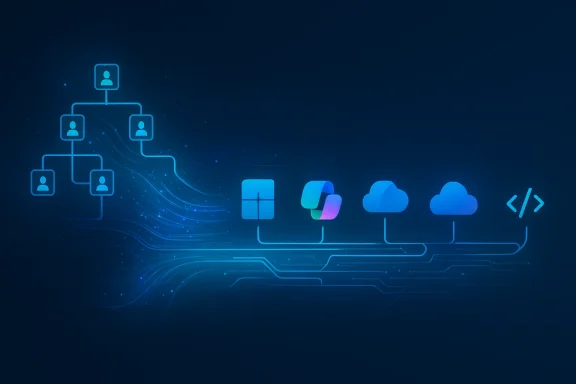
Microsoft is in the middle of another significant leadership transition, and this one reaches straight into the company’s identity as a developer platform. The reported retirement of Rajesh Jha, who has overseen major parts of Microsoft’s Experiences + Devices organization, is not just a personnel change; it is a signal that Microsoft continues to flatten its org chart while pushing harder into an AI-first operating model. The timing is important because this move comes alongside a broader set of 2026 leadership shifts that are reshaping Windows, Office, Copilot, and the company’s developer posture in parallel. Microsoft’s own blog describes Jha’s transition as part of a planned succession, with him moving into retirement on July 1, 2026 after more than 35 years at the company
Microsoft has spent the last several years re-engineering itself around AI, cloud scale, and tighter product integration. That effort has touched everything from GitHub and Visual Studio Code to Azure AI Foundry, Microsoft 365 Copilot, and the Windows experience itself. The company’s January 2025 CoreAI announcement was especially revealing: Microsoft said it was bringing together Dev Div, AI Platform, and selected Office of the CTO teams to build an end-to-end Copilot and AI stack for both first-party and third-party customers
That restructuring was not a one-off. In 2026, Microsoft kept going. It announced leadership changes in Experiences + Devices, Copilot, Gaming, and Security, each one framed as a way to align the company more tightly around faster execution and clearer ownership. In the Copilot update, Microsoft explicitly said it was unifying consumer and commercial Copilot work under one effort and refining the relationship between product, platform, and model-building teams
The retirement of a senior executive in the development-tools orbit matters because Microsoft is no longer simply a software vendor. It is trying to be the place where AI applications are built, distributed, governed, and monetized. That puts unusual pressure on the company’s developer tools organization, which must serve both enterprise buyers and individual developers while staying relevant in a market moving quickly toward AI-assisted and agentic workflows
Microsoft also has history here. It has repeatedly used executive transitions to mark strategic inflection points, from the old Server and Tools era to the GitHub acquisition and now the AI platform era. The company’s 50-year anniversary post made the point bluntly: Microsoft began as a developer tools company, and today it wants to be a platform where everyone can be a developer
The current wave of changes therefore looks less like a routine retirement and more like a reallocation of power. Microsoft is handing more responsibility to fewer, broader leaders, while moving the product surface closer to AI, Copilot, and platform orchestration. That is strategically coherent, but it also raises questions about whether developer tools will remain a distinct center of gravity or become a supporting layer inside a larger AI machine.
That matters because Microsoft’s developer story is no longer just Visual Studio, .NET, or GitHub. It now spans AI model access, app platform tooling, observability, security, and agent orchestration. The company has said as much in its CoreAI messaging, which describes a vertically integrated AI stack spanning Azure AI Foundry, GitHub, and VS Code
A few implications stand out:
That same month, Microsoft also issued a Copilot leadership update that unified consumer and commercial Copilot under a shared framework. The company said the new structure would include four connected pillars: Copilot experience, Copilot platform, Microsoft 365 apps, and AI models
This is not a coincidence. Microsoft is clearly trying to reduce fragmentation. The old model — separate teams, separate surfaces, separate storylines — works poorly when customers expect one assistant that spans work, consumer, devices, and the model layer underneath.
The downside is that reorganizations can also become a substitute for product discipline. If every major AI shift triggers a new reporting line, the company risks spending too much energy managing itself. Microsoft’s challenge is to make the changes feel like acceleration, not churn.
Key takeaways from the broader reorg:
But the market has changed around it. Developers increasingly expect low-friction setup, simple defaults, and AI-native workflows that feel natural rather than bolted on. Microsoft knows this, which is why its public messaging now emphasizes “modern software development is moving fast” and positions AI as a practical part of everyday engineering work
If it fails, developers may still use Microsoft tools, but only piecemeal. That is a weaker position because it gives competitors room to own the first impression, the editing layer, or the deployment path. In AI-era development, small frictions matter more than they used to.
A few things developers care about most:
That makes leadership decisions around related teams more important than they would have been five years ago. If Copilot is the public face of Microsoft AI, then any executive shift that affects product, platform, or tooling can alter how the company presents its entire AI story.
Microsoft’s own language about “system architecture” and “coherent and competitive experiences” shows the company understands the problem. It wants the model layer, the product layer, and the workflow layer to move in sync
The implications are significant:
For enterprise buyers, the key issue is control. They want assurance that Microsoft’s AI stack will support compliance, policy enforcement, and manageable deployment. Microsoft’s recent messaging around AI governance, security, and unified product organization suggests it is trying to answer that need directly
Consumers, by contrast, are judging whether Copilot and adjacent tools are actually useful in daily life. They will not care who retired unless the change leads to a clearer product or a better experience. That is why Microsoft has been tightening the consumer-facing Copilot story and moving toward more integrated interactions.
This leads to a familiar Microsoft problem with a new twist:
Microsoft’s answer has been to own the stack. The CoreAI announcement was explicit about that goal, describing a vertically integrated AI platform built to create agents and change SaaS categories
Microsoft’s challenge is that competitors are attacking from multiple directions:
If Microsoft can keep its developer tools strong while integrating them more closely with Copilot and Azure AI, it may preserve a unique advantage: a full-stack AI environment with enterprise legitimacy. That is still a formidable position.
The company’s own history reinforces the point. On its 50th anniversary, Microsoft reminded the world that it began as a developer tools company and built its identity around enabling others to create software
What has changed is the tempo. Microsoft is no longer making one huge bet and waiting years for the market to respond. It is making a series of related moves, each one reinforcing the next. That creates momentum, but it also means the company has less room for error.
Why the historical pattern matters:
What matters now is whether Microsoft can turn all of this into a cleaner product experience. If the result is less confusion, better AI integration, and a more coherent path from development to deployment, the retirement of a veteran executive may look like the right moment for the company to reset. If the result is more complexity, then the reorg will be remembered as administrative motion rather than strategic progress.
Source: Intellectia AI https://intellectia.ai/news/stock/microsoft-development-tools-executive-retires/
 Background
Microsoft has spent the last several years re-engineering itself around AI, cloud scale, and tighter product integration. That effort has touched everything from GitHub and Visual Studio Code to Azure AI Foundry, Microsoft 365 Copilot, and the Windows experience itself. The company’s January 2025 CoreAI announcement was especially revealing: Microsoft said it was bringing together Dev Div, AI Platform, and selected Office of the CTO teams to build an end-to-end Copilot and AI stack for both first-party and third-party customersThat restructuring was not a one-off. In 2026, Microsoft kept going. It announced leadership changes in Experiences + Devices, Copilot, Gaming, and Security, each one framed as a way to align the company more tightly around faster execution and clearer ownership. In the Copilot update, Microsoft explicitly said it was unifying consumer and commercial Copilot work under one effort and refining the relationship between product, platform, and model-building teams
The retirement of a senior executive in the development-tools orbit matters because Microsoft is no longer simply a software vendor. It is trying to be the place where AI applications are built, distributed, governed, and monetized. That puts unusual pressure on the company’s developer tools organization, which must serve both enterprise buyers and individual developers while staying relevant in a market moving quickly toward AI-assisted and agentic workflows
Microsoft also has history here. It has repeatedly used executive transitions to mark strategic inflection points, from the old Server and Tools era to the GitHub acquisition and now the AI platform era. The company’s 50-year anniversary post made the point bluntly: Microsoft began as a developer tools company, and today it wants to be a platform where everyone can be a developer
The current wave of changes therefore looks less like a routine retirement and more like a reallocation of power. Microsoft is handing more responsibility to fewer, broader leaders, while moving the product surface closer to AI, Copilot, and platform orchestration. That is strategically coherent, but it also raises questions about whether developer tools will remain a distinct center of gravity or become a supporting layer inside a larger AI machine.
Why This Retirement Matters
The simplest reading is that a veteran executive is stepping aside after a long career. The more consequential reading is that Microsoft is continuing a deliberate transition from product silos to system-level leadership. In a company where org design now reflects product architecture, a retirement in the development-tools chain can ripple into Windows, Office, Copilot, Azure, and the IDE stack all at once.That matters because Microsoft’s developer story is no longer just Visual Studio, .NET, or GitHub. It now spans AI model access, app platform tooling, observability, security, and agent orchestration. The company has said as much in its CoreAI messaging, which describes a vertically integrated AI stack spanning Azure AI Foundry, GitHub, and VS Code
A leadership change with platform implications
When a company consolidates power at the top, it can speed decisions. It can also reduce specialization. Microsoft appears to be choosing speed, coherence, and AI integration over narrower functional boundaries. That may help it ship more unified experiences, but it also means the developer organization must justify itself in a much more competitive ecosystem.A few implications stand out:
- Developer tooling is becoming strategic infrastructure, not a standalone product line.
- AI product alignment now outweighs org tradition inside Microsoft.
- Windows, Office, and cloud workflows are being tied together more tightly than before.
- Leadership continuity matters, but strategic clarity matters more.
- The company is optimizing for platform leverage, not departmental autonomy.
The Bigger Microsoft Reorganization
The retirement report should be understood in the context of Microsoft’s broader 2026 restructuring. In March, the company announced that Rajesh Jha would transition out of his role, and that several senior leaders would report directly to Satya Nadella. Microsoft described the change as planned and said the leadership team would finalize the cascade of details over the following monthsThat same month, Microsoft also issued a Copilot leadership update that unified consumer and commercial Copilot under a shared framework. The company said the new structure would include four connected pillars: Copilot experience, Copilot platform, Microsoft 365 apps, and AI models
This is not a coincidence. Microsoft is clearly trying to reduce fragmentation. The old model — separate teams, separate surfaces, separate storylines — works poorly when customers expect one assistant that spans work, consumer, devices, and the model layer underneath.
From org charts to execution
The value of a reorganization depends on whether it improves execution. In Microsoft’s case, that means faster shipping, clearer product ownership, and fewer disconnects between what the model can do and what the product should expose. That is why the company keeps emphasizing “system architecture” language in its internal and external communicationsThe downside is that reorganizations can also become a substitute for product discipline. If every major AI shift triggers a new reporting line, the company risks spending too much energy managing itself. Microsoft’s challenge is to make the changes feel like acceleration, not churn.
Key takeaways from the broader reorg:
- Copilot is now treated as a system, not a single app
- Microsoft wants tighter model-to-product feedback loops
- The company is compressing decision-making around AI
- Developer tools are being folded into a larger platform story
- Executive succession is being used to reinforce strategic priorities
What It Means for Developers
For developers, the practical question is not who retires. It is whether Microsoft’s tools remain the easiest path for building modern software. On that front, the company is still strong. The Microsoft for Developers blog continues to showcase AI-assisted workflows, JavaScript/TypeScript modernization, Azure Functions improvements, and MCP-related integrations, which shows that Microsoft is still actively investing in the day-to-day experience of buildersBut the market has changed around it. Developers increasingly expect low-friction setup, simple defaults, and AI-native workflows that feel natural rather than bolted on. Microsoft knows this, which is why its public messaging now emphasizes “modern software development is moving fast” and positions AI as a practical part of everyday engineering work
Visual Studio, VS Code, and the AI-era workflow
Microsoft’s developer stack is no longer just about an IDE. It is about a continuum: code editor, cloud backend, AI assistance, version control, deployment, governance, and enterprise monitoring. The company’s challenge is to make that continuum feel seamless. If it succeeds, it can keep developers inside its orbit from prototype to production.If it fails, developers may still use Microsoft tools, but only piecemeal. That is a weaker position because it gives competitors room to own the first impression, the editing layer, or the deployment path. In AI-era development, small frictions matter more than they used to.
A few things developers care about most:
- Fast onboarding
- Consistent tooling across languages
- Good AI assistance without clutter
- Simple cloud integration
- Clear support for agents and workflow automation
- Predictable updates and documentation
Copilot and the New Product Model
Microsoft’s current AI strategy is best understood through Copilot. The company is no longer treating Copilot as a single branded feature. It is treating it as a product family, a platform layer, and a distribution mechanism for model capability across work and consumer contextsThat makes leadership decisions around related teams more important than they would have been five years ago. If Copilot is the public face of Microsoft AI, then any executive shift that affects product, platform, or tooling can alter how the company presents its entire AI story.
Why the unification matters
Unifying Copilot leadership reduces internal ambiguity. It also makes it easier for Microsoft to decide which features belong in the core experience and which should stay behind the curtain. That is especially important in a market where users are now comparing Microsoft Copilot not just with Google Gemini, but with broader AI assistants that want to own the desktop and the browser.Microsoft’s own language about “system architecture” and “coherent and competitive experiences” shows the company understands the problem. It wants the model layer, the product layer, and the workflow layer to move in sync
The implications are significant:
- Copilot must feel simple to users
- The platform must be configurable for enterprise admins
- The model layer must remain flexible and cost-aware
- The product layer must avoid feature sprawl
- Microsoft must defend its customer relationship, not just its infrastructure share
Enterprise vs Consumer Impact
The retirement and related reorgs will affect enterprise customers differently from consumers. Enterprises care about governance, management, identity, security, and predictable road maps. Consumers care more about convenience, visible value, and whether the product feels intuitive enough to keep using. Microsoft has to satisfy both, and those needs are not always aligned.For enterprise buyers, the key issue is control. They want assurance that Microsoft’s AI stack will support compliance, policy enforcement, and manageable deployment. Microsoft’s recent messaging around AI governance, security, and unified product organization suggests it is trying to answer that need directly
Consumers, by contrast, are judging whether Copilot and adjacent tools are actually useful in daily life. They will not care who retired unless the change leads to a clearer product or a better experience. That is why Microsoft has been tightening the consumer-facing Copilot story and moving toward more integrated interactions.
Two markets, two standards
Enterprise users reward reliability and consistency. Consumer users reward speed and delight. Microsoft has long balanced those worlds, but AI compresses the timeline. If an enterprise rollout is too conservative, users may bypass it. If a consumer feature is too ambitious, it may feel intrusive or confusing.This leads to a familiar Microsoft problem with a new twist:
- Enterprises want more control over AI
- Consumers want less friction and fewer decisions
- Developers want stable APIs and predictable behavior
- Microsoft wants one platform story that serves all three
- The more universal the product, the harder the governance becomes
Competitive Pressure From Rivals
Microsoft is not reorganizing in a vacuum. Google, OpenAI, Amazon, and others are all trying to control more of the AI workflow. Google is pushing Gemini deeper into its own ecosystem. OpenAI is increasingly seen as a desktop-era platform contender. Amazon remains focused on infrastructure and enterprise AI services, while also trying to avoid being boxed in by Microsoft’s momentum.Microsoft’s answer has been to own the stack. The CoreAI announcement was explicit about that goal, describing a vertically integrated AI platform built to create agents and change SaaS categories
The platform war is moving upward
The current competition is no longer just about models. It is about where work starts, where the user relationship lives, and which company becomes the default interface for action. That is why developer tools matter so much. Whoever owns the tools often owns the habits, and whoever owns the habits often owns the economics.Microsoft’s challenge is that competitors are attacking from multiple directions:
- Google owns search, browser distribution, and consumer context
- OpenAI is building a strong product identity around ChatGPT
- Amazon remains powerful in cloud infrastructure and enterprise procurement
- Apple influences device-level habits and ecosystem expectations
- Niche AI builders are moving quickly with specialized workflows
If Microsoft can keep its developer tools strong while integrating them more closely with Copilot and Azure AI, it may preserve a unique advantage: a full-stack AI environment with enterprise legitimacy. That is still a formidable position.
Historical Context and Microsoft’s Pattern
Microsoft has always been a company that remakes itself around major platform transitions. It moved from operating systems to productivity software, then to enterprise infrastructure, then to cloud, and now to AI. Every phase has involved leadership changes, but the current cycle feels faster and more compressed than earlier ones.The company’s own history reinforces the point. On its 50th anniversary, Microsoft reminded the world that it began as a developer tools company and built its identity around enabling others to create software
From tools company to platform company
That evolution matters because retirement announcements inside Microsoft are rarely just about the individual leaving. They often mark the end of one operating model and the start of another. The transition from Jeff Raikes to a different business structure in 2008 is one example; the GitHub acquisition in 2018 is another; the CoreAI reorganization in 2025 and the Copilot leadership update in 2026 are the latest examplesWhat has changed is the tempo. Microsoft is no longer making one huge bet and waiting years for the market to respond. It is making a series of related moves, each one reinforcing the next. That creates momentum, but it also means the company has less room for error.
Why the historical pattern matters:
- Microsoft reinvents itself through structural change
- Leadership shifts often accompany platform shifts
- Developer tools have always been central to its identity
- AI is now the newest reason to reorganize
- Each transition raises the bar for execution
Strengths and Opportunities
Microsoft still has several advantages in this transition. It has scale, talent, distribution, enterprise trust, and a deep developer ecosystem. More importantly, it has shown a willingness to make structural changes when the market changes underneath it. That gives it a real shot at turning leadership turnover into strategic advantage.- Broad platform reach across Windows, Azure, GitHub, and Microsoft 365
- Strong enterprise relationships and procurement credibility
- A large and loyal developer audience
- AI infrastructure depth that rivals can’t easily match
- A clearer Copilot strategy than it had a year ago
- The ability to integrate tools, models, and workflows
- A history of adapting to new platform eras
Risks and Concerns
The risk is that Microsoft’s ambition outpaces the user experience. Reorganizations can clarify strategy, but they can also hide execution problems. If the company keeps changing structure faster than customers can absorb the resulting product shifts, it may create confusion rather than confidence.- Too many overlapping AI initiatives can blur the message
- Org changes can disrupt continuity if succession is weak
- Copilot could become cluttered if Microsoft overextends it
- Developer trust can erode if tooling feels fragmented
- Enterprise buyers may worry about governance complexity
- Rivals could seize mindshare with simpler product stories
- A focus on structure could distract from usability
Looking Ahead
The next few months should make Microsoft’s intent clearer. The company has already said it will finalize the details of the current transition over the coming months, which means more names, more reporting changes, and probably more explanation of how the developer, Copilot, and device organizations fit togetherWhat matters now is whether Microsoft can turn all of this into a cleaner product experience. If the result is less confusion, better AI integration, and a more coherent path from development to deployment, the retirement of a veteran executive may look like the right moment for the company to reset. If the result is more complexity, then the reorg will be remembered as administrative motion rather than strategic progress.
- Watch for additional leadership announcements tied to developer tools and AI
- Track whether Copilot becomes simpler or more fragmented
- Monitor how Microsoft positions Visual Studio, VS Code, and GitHub together
- Pay attention to enterprise governance features for AI and agents
- Look for signs that Windows is becoming more AI-native without becoming noisier
- See whether Microsoft can keep developer loyalty while reshaping the stack
Source: Intellectia AI https://intellectia.ai/news/stock/microsoft-development-tools-executive-retires/