

Thirty years is a long time to sustain a volunteer-driven project that aims to be a drop-in, open-source alternative to Microsoft Windows, and ReactOS has spent those decades pursuing the audacious goal of delivering your favorite Windows apps and drivers in an open-source environment you can trust. What began as the FreeWin95 discussions in the mid-1990s has evolved through messy early bootloader work, legal audits, architectural rewrites, and periodic leaps forward — most recently the March 2025 0.4.15 release and the project’s own January 22, 2026 reflection marking “30 years since the first commit to the ReactOS source tree.” This feature examines ReactOS’s history, its engineering approach, the technical state of the project today, the strengths that keep the community invested, and the practical and legal risks that will determine whether ReactOS can ever move beyond niche, experimental use into broader, sustainable reality.
The project’s timeline is complex: ReactOS’s own 30-year retrospective marks three decades since the earliest commit in the project’s source history, while other historic accounts note the shift to the ReactOS identity and NT-focused development in 1998. That difference is worth flagging — the public record shows a lineage from mid-1990s experiments to formal ReactOS efforts in the late 1990s and early 2000s.
This is a technically demanding, long-running reverse-engineering project. ReactOS is not a generic Unix-like operating system with a Windows-like skin; it attempts to reconstruct Windows internals with enough fidelity that standard Windows binaries will execute. Over 88,000 commits and nearly 15 million lines of code attest to that sustained effort.
Recent engineering activity has included synchronizing MSVCRT with Wine 10.0 and experimenting with dynamic DLL export/versioning mechanisms to let applications request newer runtime behavior. These are incremental yet strategic moves toward running a broader set of modern applications.
The March 2025 0.4.15 release emphasized Plug & Play (PnP) subsystem rewrites that improved third-party driver support and added USB booting and broader controller compatibility (EHCI/OHCI/UHCI). Importing open-source Windows Driver Kit (WDK) drivers — such as the FAT and AC’97 audio drivers — improved stability and functionality in virtualized and older physical hardware contexts.
However, it’s not a clean break toward a production-ready Windows alternative. Audio, drivers, and modern application compatibility remain partial; many contemporary applications simply won’t run because of missing NT6+ exports, WoW64, or modern kernel behavior. The release is a strong technical progress marker, not a transformation into a full Windows replacement.
Yet the project faces existential engineering scale problems. Emulating and re-implementing Windows internals to the degree required for modern app and driver compatibility is a resource-hungry enterprise. That gap between aspiration and scale explains why ReactOS remains an Alpha project after three decades: not because of lack of competence, but because the target is enormous and the investment model modest.
There is, however, a path to incremental success: focus on high-impact compatibility layers (e.g., stabilizing a small, commonly used driver stack, finishing WoW64, enabling robust LiveUSB and UEFI booting), and build a sustainable funding model to hire core maintainers for multi-year work. If ReactOS continues to prioritize pragmatic wins that expand real-world testing while protecting legal cleanliness, it will keep an essential place in the open-source and Windows-interoperability ecosystem.
For Windows enthusiasts, systems developers, and preservationists, ReactOS remains a project worth following, contributing to, and learning from. Its successes are technical and cultural: an open-source community persisting in the face of a daunting engineering problem, producing a codebase that invites study and experimentation. Its future will be shaped by whether the community can translate technical milestones into a sustainable funding and development model that tackles the largest remaining compatibility challenges with focused, long-term investment.
ReactOS’s story is not finished; after thirty years it still reads like a long-form engineering experiment — messy, sometimes frustrating, occasionally triumphant, and abundantly instructive. The next decade will tell whether those 30 years were simply the first chapter or the hard, creative groundwork for mainstream viability.
Source: Neowin https://www.neowin.net/news/open-source-windows-reactos-is-now-30-years-old/
 Background
Origins: FreeWin95, a pivot to NT compatibility
ReactOS traces its roots to the FreeWin95 initiative, an early open-source attempt to clone Windows 95. The original FreeWin95 effort stalled on design debates. In response, a renewed project emerged with different ambitions: rather than cloning Windows 95, the team targeted the Windows NT family. The name ReactOS — coined in IRC discussions — signified a “reaction” to Microsoft’s dominance and a commitment to creating an open Windows-compatible environment.The project’s timeline is complex: ReactOS’s own 30-year retrospective marks three decades since the earliest commit in the project’s source history, while other historic accounts note the shift to the ReactOS identity and NT-focused development in 1998. That difference is worth flagging — the public record shows a lineage from mid-1990s experiments to formal ReactOS efforts in the late 1990s and early 2000s.
Mission and methodology
From its inception, ReactOS aimed at binary compatibility with the Windows NT family: the ability to run Windows applications and, crucially, Windows device drivers without modification. That compatibility goal defines the project’s engineering method: a clean-room reverse-engineering approach that re-implements Windows APIs, kernel interfaces, system DLLs, and driver-support subsystems rather than copying Microsoft’s proprietary code.This is a technically demanding, long-running reverse-engineering project. ReactOS is not a generic Unix-like operating system with a Windows-like skin; it attempts to reconstruct Windows internals with enough fidelity that standard Windows binaries will execute. Over 88,000 commits and nearly 15 million lines of code attest to that sustained effort.
The technical arc: what ReactOS has built — and what remains
Kernel, subsystems, and the Windows model
ReactOS implements a hybrid kernel inspired by Windows NT, plus user-mode subsystems including Win32 server components (win32ss), core system DLLs, and a shell modeled after Windows Explorer. Key engineering milestones have included:- A working NT-like kernel capable of booting and running basic processes and services.
- A graphical shell and Explorer-like desktop introduced and refined across the 0.2.x to 0.4.x series.
- Networking, early package management (Download! → RAPPS), and progressive driver support, including SATA via UniATA in older branches.
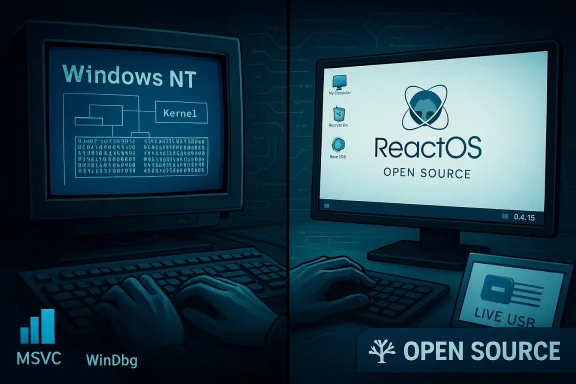
- Support for building with MSVC and WinDbg-based kernel debugging support — a pragmatic step that lets developers use mainstream Windows tooling to track kernel bugs.
Architecture targets: NT5 vs NT6 and the path forward
Historically ReactOS focused on compatibility with the NT5 family (Windows Server 2003 and contemporaries). That target simplified the early scope and made Wine-derived testbeds and API imports more tractable. However, the Windows ecosystem moved on: most modern apps are built against NT6+ (Vista, 7, 8, 10, 11). Recognizing this, recent work has focused on creating infrastructure that can export NT6-style APIs and user-mode compatibility layers, with kernel-side NT6 compatibility kept as a longer-term goal.Recent engineering activity has included synchronizing MSVCRT with Wine 10.0 and experimenting with dynamic DLL export/versioning mechanisms to let applications request newer runtime behavior. These are incremental yet strategic moves toward running a broader set of modern applications.
64-bit and WoW64 status
ReactOS has made significant strides on the x86_64 front: the project now builds and boots in 64-bit contexts far enough to reach the desktop in some configurations. However, ReactOS lacks a functional WoW64 subsystem that would allow 64-bit ReactOS to run legacy 32-bit Windows applications. Practically, that means:- 32-bit builds remain the most usable and extensively tested line for running older Windows software.
- 64-bit builds demonstrate architectural progress but are not yet a drop-in replacement for everyday 32-bit Windows workloads.
Drivers, Plug & Play, and storage
A distinctive ReactOS capability is its effort to support Windows drivers. This is both the project’s strength and its Achilles’ heel: driver compatibility requires faithful kernel and driver model behavior, precise IRP handling, and hardware-specific support that varies wildly across vendors.The March 2025 0.4.15 release emphasized Plug & Play (PnP) subsystem rewrites that improved third-party driver support and added USB booting and broader controller compatibility (EHCI/OHCI/UHCI). Importing open-source Windows Driver Kit (WDK) drivers — such as the FAT and AC’97 audio drivers — improved stability and functionality in virtualized and older physical hardware contexts.
Filesystems, Registry, and stability work
Recent work addressed the filesystem and registry subsystems: ReactOS adopted an improved FAT implementation from WDK sources, introduced registry caching, registry healing and flushing, and tightened aspects of the security subsystem. Those are pragmatic improvements with real-world impact: better registry behavior reduces corruption risks during power loss; a modern cache controller and improved memory manager yield performance and stability wins.The 0.4.15 release in context
What 0.4.15 delivered
0.4.15, released in spring 2025, is the largest official release in several years and bundles many cumulative advances:- Plug & Play manager rewrites enabling more driver compatibility and USB/LiveUSB boot support.
- Import and port of WDK FAT filesystem and AC’97 audio driver for better storage and basic sound hardware behavior.
- Memory manager and cache improvements for performance and stability.
- Registry healing and flushing to reduce corruption risk and improve durability.
- Improvements to accessories (Notepad, Paint), RAPPS package manager, and shell polish (ZIP support, taskbar icons).
Why the release matters — but with caveats
0.4.15 is meaningful because it integrates deep kernel-level changes into a distributable, official release — something that helps testers and curious users get a more cohesive experience than piecemeal nightlies. It also shows the project can both add modern conveniences and integrate open-source driver components to bootstrap hardware support.However, it’s not a clean break toward a production-ready Windows alternative. Audio, drivers, and modern application compatibility remain partial; many contemporary applications simply won’t run because of missing NT6+ exports, WoW64, or modern kernel behavior. The release is a strong technical progress marker, not a transformation into a full Windows replacement.
Strengths and why ReactOS matters
1. A unique technical ambition
There are few open-source projects with ReactOS’s explicit aim: to run standard Windows executables and drivers unmodified. That ambition drives unique engineering work that benefits other compatibility projects, informs academic reverse-engineering discussions, and preserves a form of OS engineering practice that is otherwise rare in the open-source ecosystem.2. Clean-room reverse engineering ethos
ReactOS has been careful (and cautious) about intellectual property. Past audits and contribution freezes (notably in 2006) underscored the legal sensitivity. The project’s clean-room approach and renewed auditing practices are strengths: they help maintain a defensible codebase and encourage adoption by contributors who care about legal hygiene.3. Community longevity and real code volume
Nearly 90,000 commits, over 300 unique contributors, and almost 15 million lines of code represent real, sustained engineering. That depth matters: many exploratory projects stall; ReactOS’s continued momentum, intermittent funding, and paid contributors indicate a resilient community.4. Educational and preservation value
ReactOS is an invaluable learning repository for anyone studying OS internals, driver architectures, and Windows internals through re-implementation. It is also a form of software preservation for legacy Windows-era applications and drivers.Risks, limitations, and practical concerns
1. Compatibility is a scale problem
The core challenge for ReactOS is not a single missing feature but the sheer breadth of Windows compatibility. Modern Windows is a massive, evolving target: kernel behavior, undocumented APIs, signatures, driver interfaces, security mitigations, and runtime libraries all diverge between NT5 and NT6+. Achieving convincing parity across that surface area is a multi-decade project that requires far more sustained engineering resources than volunteer bandwidth typically provides.2. Driver support remains fragile
Supporting Windows drivers is both a unique selling point and a liability. Drivers are low-level, often hardware-specific, and can trigger subtle timing and synchronization bugs. Without broad vendor-produced drivers or standardization, ReactOS may always be constrained to older or commonly used driver models. The lack of modern WDDM GPU driver support and full SMP / modern kernel features limits the system’s viability for contemporary desktop and gaming workloads.3. Legal and IP exposure (historical but persistent)
While ReactOS has tightened contribution and audit policies in the past, the project’s long history includes periods of IP concern that led to freezes and audits. The legal landscape around clean-room reverse engineering is nuanced and varies across jurisdictions. Although the project has taken steps to minimize risk, any future incorporation of code with unclear provenance could revive legal challenges. For contributors and downstream packagers this remains an operational risk.4. Funding and human-resource constraints
Long-term viability depends on steady funding and full-time developers. ReactOS has had intermittent paid positions and donations, but small open-source projects face chronic resource volatility. Without a stable base of paid engineers to handle urgent kernel-level work, progress can be slow and brittle — precisely the problem the project has weathered for decades.5. Usability and security
ReactOS’s Alpha status is not only a feature gap but a safety concern: installing on real hardware risks data corruption. Security hardening, mitigations like ASLR and modern driver signing checks, and hardened filesystems are in progress but incomplete. For the project to be a practical alternative for cautious users or institutions, it will need demonstrable security engineering and a track record of hardening.How to think about ReactOS in 2026: practical use cases
ReactOS in its current form should be seen through the lens of specific, narrow use cases where its unique characteristics are advantageous:- Legacy application preservation: running older business software or games that are no longer supported on modern Windows versions, particularly in virtualized environments where hardware risk is minimized.
- Driver research and education: studying driver behavior and portable compatibility layers in a Windows-like kernel without relying on proprietary source code.
- Experimental tinkering: hobbyists, researchers, and developers who want to explore OS internals and participate in a rare reverse-engineering project.
- Community and open-source advocacy: as an example of pursuing a freedom-respecting, open alternative to a mainstream proprietary stack.
Roadmap signals and realistic expectations
What to watch for next
Key technical areas to monitor for meaningful progress:- NT6+ compatibility exports and kernel behavior parity: user-mode compatibility has seen initial steps; kernel-mode parity is a harder, long-term target.
- WoW64 implementation: bringing 32-bit support to 64-bit builds would materially raise the utility of amd64 ReactOS images.
- SMP and UEFI class 3 boot support: practical hardware compatibility improvements that will broaden device support, including modern laptops and ARM/UEFI-based devices where applicable.
- WDDM and modern GPU driver frameworks: long horizon but essential for any credible desktop experience.
- Continued integration of high-quality open-source WDK drivers: the more ReactOS can benefit from mature, already open drivers, the quicker it can reach practical hardware compatibility.
Realistic timescales
Estimating timelines for broad Windows feature parity is inherently speculative. Past history shows long stretches of incremental progress punctuated by larger integration events (for example, the multi-year development leading to 0.4.15). Given the volunteer-and-donations model, expect decades rather than months for large, sweeping compatibility goals. That reality is not a critique of the contributors’ expertise but a sober view of scope versus available resources.Contribution, governance, and the ecosystem
Community structure and governance
ReactOS is a community-driven project with formal organizational arms in the form of regional and national associations that have hired contributors or managed fundraising. Governance combines voluntary contributor decision-making with some project-maintainer structures for releases and audits.How contributors can make the most impact
Because ReactOS has a clear, narrow technical mission, contributions can be extremely high-leverage. Practical ways to contribute include:- Low-level driver and kernel work (requires deep systems expertise).
- Reverse-engineering of specific APIs or creating clean-room reference behaviors.
- Testing, bug reporting, and regression triage — especially on varied physical hardware and virtualized environments.
- Documentation, packaging, and build-environment work (RosBE) to lower the barrier for new developers.
Critical analysis: why ReactOS is still worth watching
ReactOS is not merely a curiosity; it is a technically credible, carefully managed attempt to provide an open alternative that runs Windows binaries and drivers. Its achievements are nontrivial: decades of collected engineering, a litany of subsystem rebuilds, integration of critical open drivers, and active work toward NT6 compatibility mark it as a living, evolving project.Yet the project faces existential engineering scale problems. Emulating and re-implementing Windows internals to the degree required for modern app and driver compatibility is a resource-hungry enterprise. That gap between aspiration and scale explains why ReactOS remains an Alpha project after three decades: not because of lack of competence, but because the target is enormous and the investment model modest.
There is, however, a path to incremental success: focus on high-impact compatibility layers (e.g., stabilizing a small, commonly used driver stack, finishing WoW64, enabling robust LiveUSB and UEFI booting), and build a sustainable funding model to hire core maintainers for multi-year work. If ReactOS continues to prioritize pragmatic wins that expand real-world testing while protecting legal cleanliness, it will keep an essential place in the open-source and Windows-interoperability ecosystem.
Conclusion
ReactOS at 30 is the story of an ambitious reverse-engineering marathon: a volunteer community that has persisted through legal audits, technological shifts, and long development cycles to produce a living, breathing platform that — in carefully chosen contexts — runs real Windows software and drivers. The 0.4.15 release and the project’s renewed focus on tests, compatibility layers, and driver infrastructure show meaningful progress. At the same time, the gap to a robust, modern Windows drop-in replacement remains wide, framed by driver complexity, NT6+ divergences, resource constraints, and security hardening needs.For Windows enthusiasts, systems developers, and preservationists, ReactOS remains a project worth following, contributing to, and learning from. Its successes are technical and cultural: an open-source community persisting in the face of a daunting engineering problem, producing a codebase that invites study and experimentation. Its future will be shaped by whether the community can translate technical milestones into a sustainable funding and development model that tackles the largest remaining compatibility challenges with focused, long-term investment.
ReactOS’s story is not finished; after thirty years it still reads like a long-form engineering experiment — messy, sometimes frustrating, occasionally triumphant, and abundantly instructive. The next decade will tell whether those 30 years were simply the first chapter or the hard, creative groundwork for mainstream viability.
Source: Neowin https://www.neowin.net/news/open-source-windows-reactos-is-now-30-years-old/
