

The Washington Center for Equitable Growth’s recent convening, “Reimagining the Federal Government: Building Capacity for a Democratic Future,” made clear that rebuilding the U.S. administrative state is not an abstract reform project—it is an urgent democratic and economic imperative. Leading scholars and practitioners framed the crisis as a tri-fold breakdown—dismantling, weaponization, and personalization of federal power—and moved quickly from diagnosis to actionable strategies: rebuilding institutional capacity, modernizing civil service hiring and pay, and creating robust, democratic public participation mechanisms that restore trust and deliver results. The conversation ranged from the technical (permitting reform, procurement rules, and personnel pay scales) to the constitutional (checks and balances and statutory authority), offering a practical roadmap for policymakers, advocates, and scholars who want to rebuild a federal government capable of meeting 21st‑century challenges.
At the same time, new governance tools and civic technology experiments—paired with renewed interest in public administration scholarship—create an opening to redesign how the federal state governs, hires, and engages. The Equitable Growth event crystallized an argument that many reformers have been making: capacity is a policy lever. If the government can acquire better personnel, modern systems, and smarter procedural design, it can respond faster, more fairly, and more democratically.
Optimism is warranted, but conditional. There are practical, proven ways to reduce red tape, recruit talent, and design deliberative public engagement at scale. Implementing them will require patience, legal foresight, and an explicit effort to include those most affected by policy choices.
If the United States intends to meet major national challenges—climate adaptation, economic inequality, technological concentration, and veterans’ care—it must make rebuilding administrative capacity a policy priority. The path laid out by scholars and practitioners at Equitable Growth is a pragmatic blueprint: start small, measure everything, protect the workforce, invest in talent, and scale what works. In doing so, the federal government can renew its capacity to deliver, restore public trust, and make democratic governance once again a reliable engine for broadly shared economic growth.
Source: Equitable Growth Equitable Growth event highlights the path forward to rebuild the U.S. administrative state
 Background
Why the administrative state matters now
Over recent years, multiple forces have combined to weaken the federal government’s ability to execute policy reliably. Budget cuts, mass civil‑service churn, coordinated efforts to stretch or overturn regulatory authority in the courts, and the politicization of enforcement and surveillance have produced tangible gaps in program delivery. These are not merely bureaucratic problems: they affect veterans’ benefits, consumer protections, environmental enforcement, infrastructure projects, and the day‑to‑day interactions between citizens and the state.At the same time, new governance tools and civic technology experiments—paired with renewed interest in public administration scholarship—create an opening to redesign how the federal state governs, hires, and engages. The Equitable Growth event crystallized an argument that many reformers have been making: capacity is a policy lever. If the government can acquire better personnel, modern systems, and smarter procedural design, it can respond faster, more fairly, and more democratically.
Diagnosing the governance crisis
Three structural threats: dismantling, weaponization, personalization
Speakers at the event described the current governance crisis along three interlocking dimensions.- Dismantling: Legislative and executive moves to reduce agency budgets, remove professional staff, and roll back regulatory investments have hollowed out the public bureaucracy. These cuts reduce institutional memory, technical expertise, and the capacity to manage large, complex public projects such as climate adaptation and nationwide infrastructure modernization.
- Weaponization: State power is being repurposed for political ends in ways that undermine neutral enforcement—ranging from selective enforcement actions to expanded surveillance capacities. This trend erodes public trust and transforms ordinary administrative functions into arenas for political conflict.
- Personalization: Power is increasingly concentrated at the apex of the executive branch, weakening independent agency function and checks and balances. When authority becomes personalized, administrative decisions risk becoming arbitrary and less anchored in deliberative processes.
Legal and judicial constraints
A separate fault line in this diagnosis is the growing role of the federal judiciary in delimiting agency authority. Recent high‑profile decisions have narrowed certain administrative tools and shifted significant policy choices away from agencies to Congress or the courts, reducing the flexibility of federal regulators to act swiftly and at scale. This legal environment increases the cost and complexity of administrative initiatives and raises the stakes for preemptive, legally robust design.From vision to implementation: concrete pathways to rebuild state capacity
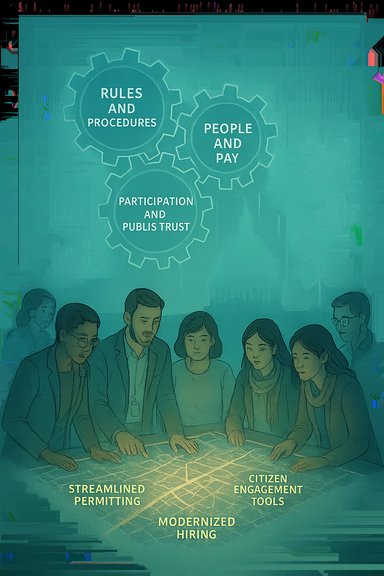
The most valuable part of the Equitable Growth conversation was the explicit focus on implementation. The panelists moved beyond lofty principles to identify concrete reforms across three interdependent domains: rules and procedures, people and pay, and participation and public trust.1) Cut the unnecessary procedural drag
Excessive procedure—well‑meaning rules that produce unintended cost and delay—was a recurring theme. Complex procurement rules, overlapping permitting regimes, and a culture of risk aversion can turn routine projects into multi‑year, multi‑million‑dollar ordeals.- Example remedies:
- Streamline permitting and environmental review for clearly defined public‑interest infrastructure while preserving environmental safeguards.
- Create standardized, modular procurement contracts to reduce bid complexity and transaction costs.
- Pilot expedited tracks for projects with strong community buy‑in and proven technical readiness.
2) Invest in talent: hiring, pay, and career pathways
One of the clearest lessons from recent public‑sector successes is that talent matters. Hiring top technical staff, reducing bureaucratic friction in recruitment, and offering competitive wages for critical roles (including engineers, project managers, and data scientists) both raises capacity and delivers better outcomes.- Key proposals:
- Create streamlined hiring authorities for mission‑critical positions with competitive compensation tied to market benchmarks.
- Expand fellowship and rotational programs that bring top private‑sector and academic talent into government for multiyear stints.
- Strengthen midcareer training to update skills for long‑term civil servants and facilitate integration of new hires with institutional memory.
3) Reimagine public participation and democratic policymaking
Rebuilding trust means rebuilding channels for genuine public input. The example of California’s Engaged California platform—an online deliberative tool designed to gather input at scale from everyday residents—illustrates how governments can systematically listen to citizens beyond town halls and polls.- Elements of participatory modernization:
- Use deliberative digital platforms to gather structured, representative input on policy designs.
- Embed stakeholder feedback early in the regulatory process to avoid late‑stage legal challenges and increase legitimacy.
- Create permanent public‑engagement units within agencies to translate input into policy options and implementation plans.
Implementation examples: what works in practice
State and municipal experiments
- Massachusetts’ Green Line light‑rail improvements and Pennsylvania’s permitting reforms demonstrate how executive action and targeted recruitment of high‑quality staff can unstick long‑running projects. Simplified designs plus seasoned management shortened timelines and reduced costs.
- California’s Engaged California shows how a state can institutionalize deliberative engagement as part of ordinary governance—providing a replicable model for federal agencies seeking to connect policy design to lived experience.
Federal case studies and cautionary lessons
- The Federal Trade Commission’s effort to ban noncompete agreements is instructive on two fronts: policy scope and legal risk. The 2024 rule attempted a sweeping national fix to curb noncompetes but faced immediate legal challenges; district courts blocked the rule, and the agency later halted appeals. The episode illustrates both the potential of aggressive administrative action to address concentrated economic power and the legal vulnerabilities of broad, front‑loaded regulatory gambits. It underscores the need for legally robust design and complementary legislative or state actions to back agency reforms.
Key risks and trade‑offs
Rebuilding the administrative state is not risk‑free. The panelists acknowledged, and the evidence supports, several possible pitfalls.- Union dynamics and workplace fairness: Strengthening the civil‑service by recruiting external high‑quality talent can provoke tensions with public‑sector unions. Collective bargaining protects workers from arbitrary dismissal and preserves benefits, but overly rigid terms can make creative recruitment or performance management difficult. Any reform must be crafted to respect collective bargaining while designing exceptions or flexible pathways for mission‑critical hires.
- Privacy, technology, and civic platforms: Digital deliberation platforms expand participation but bring privacy and equity risks. Platforms must protect personal data, avoid algorithmic bias, and ensure accessibility to marginalized communities. Failure to do so risks deepening exclusion or inviting disinformation into policy deliberations.
- Legal exposure and the Major Questions problem: Bold administrative reforms that change market rules or upend entrenched practices will face judicial scrutiny. The legal strategy must be central: agencies should build impeccable administrative records, tailor remedies to statutory authority, and coordinate legislative backstops when feasible. Otherwise, hard‑won regulatory advances can be undone in court.
- Political backlash and weaponization: Genuine efforts to rebuild capacity may become politicized. Where agencies expand enforcement or take on concentrated private power, backlash can manifest through budget cuts, hostile appointments, or legislative constraints. Resilience requires diversified coalitions and transparent, evidence‑based communication.
- Unverifiable long‑term gains: Some claims about the magnitude of economic gains from specific reforms—such as headline estimates of hundreds of billions in wage gains from removing noncompetes—rely on complex modeling and contested assumptions. Policymakers should treat point estimates cautiously and prioritize robust monitoring and evaluation to produce verifiable, iterated evidence in real time.
Practical, prioritized steps for the next governing moment
Panelists closed the discussion with a consensus on the most important first moves. These form a tactical playbook for immediate action:- Launch listening tours and structured public engagement across regions to surface how government services are actually experienced—feed those inputs into rule design and project scoping.
- Target hiring authorities and pilot pay scales for mission‑critical roles (e.g., permitting engineers, IT modernization teams, regulatory economists) to demonstrate early wins on delivery.
- Streamline procedural chokepoints in procurement and permitting with narrowly tailored executive reforms and model legislation for states to adapt.
- Protect and modernize the workforce—defend current civil‑service protections while creating lateral entry and fellowship programs to refresh expertise.
- Design legally robust rulemaking: build airtight administrative records, coordinate cross‑agency strategies, and, where necessary, seek statutory authorization to immunize high‑impact reforms from judicial reversal.
- Invest in measurable evaluation: require project metrics, timely audits, and public dashboards so success and failure are transparent and lessons are learned quickly.
The role of scholarship and the research agenda
The panelists implored academics to produce research that is both rigorous and actionable. That means:- Producing implementation‑focused studies that test specific administrative choices (e.g., hiring flexibilities, procurement templates, or permitting schedules).
- Publishing accessible summaries and operational playbooks that agency leaders can use.
- Pairing empirical evidence with compelling narratives that connect institutional reforms to everyday outcomes—shorter wait times, faster benefit approvals, fewer cost overruns—so the public can see and feel the benefits.
Conclusion: rebuilding capacity is a political and technical project
The Equitable Growth convening highlighted a central truth: rebuilding the administrative state is simultaneously an engineering challenge and a political project. The technical fixes—simpler rules, focused hiring, better IT, and participatory platforms—are necessary. But they are not sufficient without political strategies that defend independent institutions, articulate a clear democratic vision, and build coalitions that sustain reform through electoral cycles and judicial review.Optimism is warranted, but conditional. There are practical, proven ways to reduce red tape, recruit talent, and design deliberative public engagement at scale. Implementing them will require patience, legal foresight, and an explicit effort to include those most affected by policy choices.
If the United States intends to meet major national challenges—climate adaptation, economic inequality, technological concentration, and veterans’ care—it must make rebuilding administrative capacity a policy priority. The path laid out by scholars and practitioners at Equitable Growth is a pragmatic blueprint: start small, measure everything, protect the workforce, invest in talent, and scale what works. In doing so, the federal government can renew its capacity to deliver, restore public trust, and make democratic governance once again a reliable engine for broadly shared economic growth.
Source: Equitable Growth Equitable Growth event highlights the path forward to rebuild the U.S. administrative state
