

Red Bull Basement 2026 has officially opened for applications, sharpening its focus on AI and offering first-time founders and students worldwide a fast lane from idea to MVP — complete with Microsoft Copilot access, AMD AI hardware, cloud credits, mentorship, and a shot at USD 100,000 in equity-free funding at a World Final in Silicon Valley.
Red Bull Basement began as an innovation initiative aimed at empowering young founders and students to transform creative tech ideas into tangible products. For 2026 the programme explicitly leans into AI: applicants can use built-in AI mentors during the ideation phase, national winners receive AI-optimised hardware and cloud credits to develop minimum viable products (MVPs), and finalists will present AI-enabled prototypes at a global World Final in Silicon Valley.
The structure is simple but deliberately scaffolded: an open application round for individuals or two-person teams over 18, local judging and national finals, a development phase where winners receive hardware, cloud and mentoring resources, and a World Final where one team receives major equity-free funding and other development support. The initiative is positioned as accessible — no prior tech degree, prototype, or founder experience is required — and partners include major platform companies, reflecting an ecosystem approach to early-stage AI acceleration.
Applicants should approach the competition with a pragmatic mindset: keep ideas focused, design for portability and privacy, and use the programme’s resources to validate real user demand before scaling. The equity-free prize and high-profile exposure are genuine assets — but they come with practical trade-offs around platform dependence and legal fine print.
For developers on Windows and makers working with Copilot+ and AMD AI platforms, Red Bull Basement offers a concrete path to test hybrid AI architectures and instrument your stack for both on-device and cloud-first scenarios. Thoughtful architecture and clear data governance will pay off long after the event ends.
Red Bull Basement 2026 is open for applications; teams have a rare combination of brand-scale visibility and practical developer resources at their fingertips. For first-time founders and students with a sharp, real-world AI problem to solve, it’s a programme worth serious consideration — just be disciplined about IP, privacy, and long-term architecture choices as you build toward the Silicon Valley stage.
Source: htxt.co.za Red Bull Basement 2026 now open, with a focus on AI - Hypertext
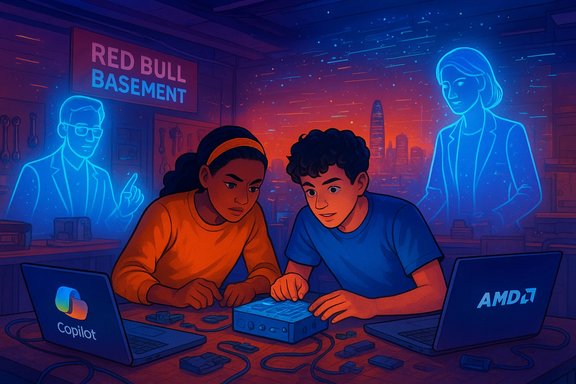 Background / Overview
Red Bull Basement began as an innovation initiative aimed at empowering young founders and students to transform creative tech ideas into tangible products. For 2026 the programme explicitly leans into AI: applicants can use built-in AI mentors during the ideation phase, national winners receive AI-optimised hardware and cloud credits to develop minimum viable products (MVPs), and finalists will present AI-enabled prototypes at a global World Final in Silicon Valley.The structure is simple but deliberately scaffolded: an open application round for individuals or two-person teams over 18, local judging and national finals, a development phase where winners receive hardware, cloud and mentoring resources, and a World Final where one team receives major equity-free funding and other development support. The initiative is positioned as accessible — no prior tech degree, prototype, or founder experience is required — and partners include major platform companies, reflecting an ecosystem approach to early-stage AI acceleration.
What’s new for 2026: a clear AI push
AI mentors, Copilot access and platform partners
Red Bull Basement 2026 introduces or expands several AI-focused features designed to lower barriers for non-technical founders:- AI mentors during the application phase that help applicants brainstorm and sharpen concepts if they don’t yet have a fully formed idea.
- Free access to Microsoft 365 Copilot for applicants to help refine proof-of-concept materials and pitch content during the early stages.
- Development support that includes an AMD AI laptop for national winners plus additional Microsoft Azure and Replit AI credits to help build an MVP.
Prize economics and support
At the World Final, the Global Winner receives:- USD 100,000 in equity-free funding from Red Bull;
- USD 25,000 in Microsoft Azure credits to scale infrastructure and AI services;
- USD 5,000 in Replit AI credits for rapid prototyping and iteration;
- Mentorship from Red Bull Ventures and invitations to developer community events.
Who can apply and important dates
Eligibility and format
- Open to individuals or two-person teams.
- Applicants must be 18 or older and reside in the participating country (Red Bull runs national streams).
- No prototype, company registration, or prior startup experience is required — an idea and the drive to build are enough.
- The programme welcomes ideas from broad sectors: AI, sustainability, education, health, agriculture, and more.
Key 2026 windows
- The general application window for many national streams runs early in the year (a common range listed is January 19 – March 29, 2026, though national dates may vary).
- The timeline follows four core phases: Application → National Finals → Development Phase → World Final (three-day immersive experience in Silicon Valley).
The phases explained: what to expect at each step
Phase 1 — Application: idea + AI-assisted refinement
The application is deliberately lightweight: applicants answer short prompts about the problem they want to solve, their target users, and how they imagine their solution. If you’re still searching for a direction, AI mentors offered by the programme can help shape the idea.- Applicants also receive Copilot access to improve pitch language, create rough wireframes, or draft short business sketches.
- Selected teams are asked to produce a short, one-minute video pitch for local judging.
Phase 2 — National Finals: build a basic prototype, pitch locally
National finalists are expected to deliver a basic prototype and present a concise pitch to a panel of local industry judges.- The emphasis here is on viability and clarity rather than polish: a working demo or convincing product flow is more important than production-grade code.
- One national team is selected to represent the country at the World Final.
Phase 3 — Development: MVP tooling and mentorship
National winners enter a focused development window where Red Bull provides concrete resources:- AMD AI laptop (for on-device AI development and testing).
- Microsoft Azure credits to deploy cloud services, host models, and handle backend scaling.
- Replit AI credits for fast prototyping, collaborative coding, and demoing functionality.
- Ongoing mentorship from subject-matter experts and Red Bull Ventures.
Phase 4 — World Final: Silicon Valley immersion and pitching
The World Final is a three-day in-person event in Silicon Valley where teams pitch their MVPs to international judges, investors, and industry leaders. Benefits include:- Intensive mentoring and pitch coaching.
- Investor and media exposure.
- A global visibility boost and a USD 100,000 equity-free prize for the Global Winner.
What winners and alumni tell us — outcomes matter
Red Bull Basement has generated notable alumni outcomes that help validate the format:- Teams that reached the World Final in recent cycles have gone on to win or place highly in other competitions and incubators — the experience appears to accelerate both product maturity and founder readiness.
- Examples include university teams that gained technical partnerships, mentorship, or additional prize money after Red Bull Basement exposure.
What this means for Windows and PC developers
Copilot, AMD AI hardware, and the Copilot+ PC wave
The programme’s explicit integration with Microsoft Copilot and AMD AI hardware fits within a larger industry movement toward Copilot+ PCs and on-device AI. For Windows developers and makers:- Expect to prototype on Copilot-enabled workflows and AMD Ryzen AI-capable devices; optimising for both cloud and edge inference workflows will be important.
- Teams should design for hybrid architectures: lightweight on-device models for fast responsiveness and cloud-based models for heavy compute or model training.
Compatibility, portability and vendor considerations
Relying heavily on proprietary platform credits and hardware can accelerate development, but it introduces potential lock-in and portability challenges:- Teams should build modular backends and avoid hard-coding dependencies on a single cloud provider or SDK.
- Consider multi-cloud or containerised approaches where possible to ease migration if you scale beyond the provided credits.
Strengths of the 2026 programme
- Accessibility: No prior startup credentials or prototypes required — the programme intentionally welcomes first-time founders and students.
- Practical resources: The combination of AI mentors, Copilot access, AMD hardware and cloud credits addresses the typical resource gap founders face early on.
- Equity-free funding: USD 100,000 with no equity taken is a rare prize in accelerator-like programmes and preserves founders’ long-term control.
- High-profile partners: Microsoft and AMD involvement brings technical legitimacy, tooling, and potential industry introductions.
- Global visibility: World Final in Silicon Valley and accompanying mentorships create meaningful exposure to investors and partners.
Risks, caveats and critical considerations
1) Platform dependence and vendor lock-in
Accepting large blocks of Microsoft Azure and Replit credits and developing on AMD AI hardware accelerate early testing — but they can shape architectural decisions in ways that are costly to reverse. Teams should:- Design APIs and abstractions to decouple core logic from provider-specific tools.
- Use open formats and containerisation to ensure portability.
2) Data privacy and model risk
Many AI-enabled products require user data. Early-stage teams should be cautious:- Implement privacy-by-design from the prototype stage and document data flows.
- Ensure compliance with local and target-market regulations (e.g., data residency, consent).
- Avoid training on sensitive personal data without clear legal and ethical frameworks.
3) IP, ownership and legal details
Red Bull states winners retain ownership, but the legal fine print matters. Applicants should be aware of:- Submission terms in the national and World Final participation agreements.
- Any IP assignment clauses attached to mentorship, prize acceptance, or partner support.
- Tax obligations associated with cross-border awards and hardware.
4) Equity-free ≠ friction-free
Equity-free funding is attractive, but teams must still manage taxes, accounting, and effective use of funds. USD 100,000 goes quickly if product-market fit hasn’t been validated. Plan budgets around key milestones and seek matching investors or grants for follow-on runway.5) PR and narrative risk
Being a Red Bull-backed team brings media attention. That’s valuable, but it can also create pressure to overpromise. Responsible messaging about product capabilities and timelines will prevent early reputational risk with users and potential partners.Practical preparation checklist for applicants
If you plan to apply, use this checklist to maximise your chances:- Clarify the problem and value proposition in one sentence — who benefits, how, and why now.
- Draft a 60–90 second pitch that explains the user journey and the core demo.
- Prepare basic visuals: sketches, flow diagrams, or a low-fidelity prototype.
- Identify any sensitive data needs and sketch an initial privacy and compliance approach.
- Create a short technical plan: minimal stack, where AI runs (edge vs cloud), and what you’ll need from Azure or Replit.
- Protect your IP enough to speak publicly — file provisional applications if the idea is patentable and disclosure would harm your position.
- Practice a crisp one-minute video pitch; clarity beats fancy production.
Best practices during the development phase (post-selection)
- Prioritise a single user story and build an MVP that demonstrates product-market fit for that story.
- Use Azure credits for scalable services but rely on open standards for data and model serialization.
- Optimise models for inference performance on AMD hardware; benchmark on-device latency and power.
- Log and measure meaningful usage metrics early; investors and judges respond to evidence of real engagement.
- Use mentorship actively: bring focused questions and concrete asks, not just general progress reports.
How Red Bull Basement fits into the wider startup and AI ecosystem
Red Bull Basement sits in a growing category of brand-backed innovation programmes that combine community, hardware, and cloud credits to accelerate early-stage teams. It has several advantages over pure hackathons or marketing contests:- It’s intentionally multi-stage and includes development support beyond a single weekend.
- The equity-free funding reduces pressure to give up large ownership stakes in early deals.
- Partner ecosystem access (platforms and venture mentors) provides practical, industry-specific help.
Final thoughts and strategic recommendation for entrants
Red Bull Basement 2026 is a high-quality, well-resourced opportunity for first-time founders and students to move from idea to MVP with substantive AI tooling and partnership backing. The emphasis on AI mentors, Copilot access, and AMD/Azure/Replit resources is particularly relevant in 2026: it aligns programme benefits with the tooling that many modern AI startups need to iterate quickly.Applicants should approach the competition with a pragmatic mindset: keep ideas focused, design for portability and privacy, and use the programme’s resources to validate real user demand before scaling. The equity-free prize and high-profile exposure are genuine assets — but they come with practical trade-offs around platform dependence and legal fine print.
For developers on Windows and makers working with Copilot+ and AMD AI platforms, Red Bull Basement offers a concrete path to test hybrid AI architectures and instrument your stack for both on-device and cloud-first scenarios. Thoughtful architecture and clear data governance will pay off long after the event ends.
Red Bull Basement 2026 is open for applications; teams have a rare combination of brand-scale visibility and practical developer resources at their fingertips. For first-time founders and students with a sharp, real-world AI problem to solve, it’s a programme worth serious consideration — just be disciplined about IP, privacy, and long-term architecture choices as you build toward the Silicon Valley stage.
Source: htxt.co.za Red Bull Basement 2026 now open, with a focus on AI - Hypertext
