

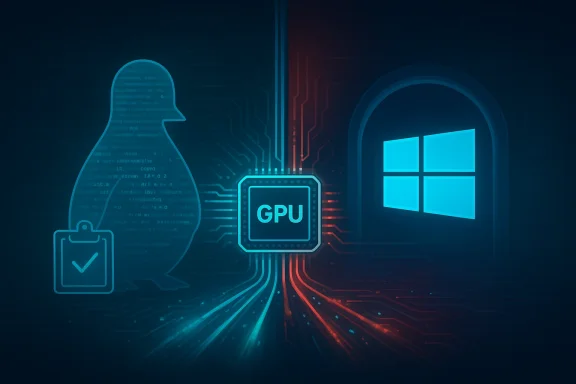
Microsoft’s refreshed DXGKRNL work for Linux is less a simple driver update than a revealing sign of how far Windows Subsystem for Linux has evolved, and how much harder it has become to keep GPU plumbing both useful and acceptable to the broader kernel community. The core idea is straightforward: let Linux workloads inside Microsoft’s virtualization stack reach the GPU without conventional emulation, while preserving host-side control and performance. But the real story is the tension between Microsoft’s WSL-first goals and the Linux kernel’s insistence on maintainable, upstream-friendly design. As the recent coverage notes, the code has seen “many changes after four years,” which strongly suggests architectural cleanup rather than a routine bug-fix cycle.
DXGKRNL sits at the center of a long-running engineering compromise. Microsoft wants Linux guests to behave as if they have near-native graphics access inside WSL2-style environments, while keeping the actual graphics stack anchored in Windows and vendor drivers. That design avoids the complexity of full GPU emulation and helps make Linux-in-Windows workflows viable for machine learning, graphics development, and other acceleration-heavy use cases. At the same time, the arrangement is intentionally specialized, which makes kernel reviewers ask whether the code belongs upstream at all.
The recent patch activity matters because kernel code ages quickly in practice, even when the underlying problem stays the same. Linux graphics, memory management, and virtualization have all moved forward since the early WSL2 GPU work first appeared, so a driver that was once plausible may now be badly aligned with current expectations. In that sense, the “four years” gap is not trivia; it signals a reset in assumptions.
Microsoft’s broader Linux posture has also changed. WSL went open source in 2025, Azure Linux continues to be actively maintained, and Microsoft has become more comfortable publishing Linux-facing work in public. That does not guarantee acceptance from maintainers, but it does soften the political backdrop compared with earlier years, when private Microsoft-specific plumbing would have faced even sharper skepticism.
The broader significance is bigger than one driver. If Microsoft can make this work cleaner, more reviewable, and less dependent on opaque host behavior, it improves the credibility of Windows as a serious developer workstation for Linux-native workloads. If it cannot, the project risks becoming another useful but isolated internal bridge, valuable to Microsoft and frustrating to everyone else.
The DXGKRNL approach is built around paravirtualization rather than emulation. Instead of trying to fake a GPU in software, the guest asks the host to service graphics requests using the host’s real hardware and drivers. That is more efficient, more realistic, and far more useful for demanding workloads, but it also means Linux is not really controlling its own graphics destiny in the normal way.
That control point is exactly why the Linux community is cautious. Mainline kernel maintainers care not only about whether something works, but about whether it can be supported, reviewed, and maintained over time without binding the kernel to a single vendor’s closed ecosystem. A bridge that only functions well inside Microsoft’s virtualization environment can be technically impressive and still remain structurally suspect.
There is also a historical pattern here that stretches beyond graphics. Microsoft has repeatedly tried to make Windows-hosted Linux environments more practical, whether through WSL, Android guest support, or tighter host-guest integration. Each time, the same trade-off reappears: convenience and performance on one side, portability and upstream acceptance on the other.
For developers, the immediate attraction is obvious. GPU acceleration in WSL2 reduces friction for local AI experimentation, graphics debugging, compute-heavy toolchains, and mixed Windows/Linux workflows. For enterprises, the attraction is more indirect but just as real: fewer separate machines, less special-case hardware, and a tighter story for standardizing on Windows without abandoning Linux tooling.
The result is a classic cross-platform dilemma: the more Microsoft optimizes for WSL, the more it risks being seen as building for itself rather than for Linux. Yet the more generic it tries to become, the harder it may be to preserve the tight host control that makes the design attractive in the first place. That tension is the entire story.
The upside is practical and immediate. WSL users get better support for GPU-accelerated Linux workloads, and Microsoft avoids forcing Windows users to juggle a full separate Linux GPU driver model. The downside is structural: dependency chains become longer, review gets harder, and the code can start looking like a private protocol rather than a clean kernel subsystem.
That skepticism is especially important in 2026 because upstream expectations are high and patience for bespoke plumbing is lower than it used to be. If the code still depends heavily on Microsoft-only assumptions, the community will likely see it as functional but narrow rather than truly kernel-worthy.
Microsoft’s own WSL base has also shifted over time, making older assumptions even less reliable. A solution that once made sense inside a specific Microsoft-maintained fork can become awkward when the goal is to align more closely with modern upstream expectations. That is not a bug; it is the cost of moving targets.
That distinction matters because not all rewrites are created equal. Some are merely rushed repairs; others are the cost of changing the architecture so it can survive the next phase of platform evolution. DXGKRNL looks much closer to the second category.
That is an important signal for developers. It means Microsoft is not abandoning the WSL graphics story; it is trying to rescue it from the awkwardness of its own earlier implementation. In the long run, that may matter more than the immediate patch count.
Microsoft’s openness around WSL also matters culturally. Open sourcing the project in 2025 changed the optics and the mechanics of contribution, making it easier to argue that Windows and Linux interoperability is no longer purely a private Microsoft affair. That does not erase suspicion, but it does create a better foundation for trust.
For IT departments, the attraction is consolidation. If more developers can stay on Windows while still using Linux-heavy toolchains, organizations may avoid maintaining separate Linux workstations or specialized dual-boot fleets. That can lower hardware sprawl and simplify endpoint management, even if it does not eliminate the need for real Linux systems entirely.
That matters because the modern developer workstation market is increasingly fluid. Many teams care less about ideology and more about whether their tools run quickly, reliably, and with minimal friction. If Windows can offer a stronger Linux workload story, it can win back practical users even without winning the philosophical argument.
This is also where Microsoft’s hybrid strategy becomes commercially smart. By making Windows an acceptable host for Linux-native work, Microsoft can capture more developer mindshare without forcing a winner-takes-all platform war. That is a very Microsoft-style move: reduce switching friction, not by persuasion alone, but by engineering.
There is also a talent angle. Teams increasingly expect flexibility, and a Windows laptop that can support serious Linux workflows may feel less restrictive to engineers who would otherwise demand a Linux machine. That is not a trivial selling point in competitive hiring markets.
That said, most consumers do not care whether the underlying architecture is elegant. They care whether apps launch, models run, and graphics-heavy tasks do not stutter. If Microsoft gets the invisible plumbing right, the user benefit can be substantial even if the code remains controversial in kernel circles.
This is why wording like “many changes after four years” matters so much. It implies Microsoft knows the old version was not enough for the modern review environment. If the rewrite is cleaner, better abstracted, and less tied to opaque host behavior, it has a much better chance of being taken seriously.
That will not guarantee upstream adoption, but it would reduce the odds that the project is dismissed as a permanent out-of-tree curiosity. It would also signal that Microsoft understands the difference between shipping code and earning trust.
That makes DXGKRNL an important symbol for Microsoft. It is not just about enabling Linux on Windows; it is about deciding how much of the modern developer stack the Windows host should own. The answer, for Microsoft, appears to be as much as possible without making the experience feel constrained.
It also reinforces a broader truth about modern desktop computing: the winning platform is often the one that disappears into the background. Users do not want to think about where the host stops and the guest begins. They want the workload to run.
The other thing to watch is whether Microsoft connects this work to a broader Linux graphics effort, whether in WSL, Mesa-adjacent collaboration, or related guest acceleration paths. If it stays isolated, the work may still be important, but it will feel like a narrow cleanup. If it becomes part of a bigger pattern, it could mark a genuine shift in how Microsoft approaches Linux interoperability.
Source: Fathom Journal Fathom - For a deeper understanding of Israel, the region, and global antisemitism
 Overview
DXGKRNL sits at the center of a long-running engineering compromise. Microsoft wants Linux guests to behave as if they have near-native graphics access inside WSL2-style environments, while keeping the actual graphics stack anchored in Windows and vendor drivers. That design avoids the complexity of full GPU emulation and helps make Linux-in-Windows workflows viable for machine learning, graphics development, and other acceleration-heavy use cases. At the same time, the arrangement is intentionally specialized, which makes kernel reviewers ask whether the code belongs upstream at all.The recent patch activity matters because kernel code ages quickly in practice, even when the underlying problem stays the same. Linux graphics, memory management, and virtualization have all moved forward since the early WSL2 GPU work first appeared, so a driver that was once plausible may now be badly aligned with current expectations. In that sense, the “four years” gap is not trivia; it signals a reset in assumptions.
Microsoft’s broader Linux posture has also changed. WSL went open source in 2025, Azure Linux continues to be actively maintained, and Microsoft has become more comfortable publishing Linux-facing work in public. That does not guarantee acceptance from maintainers, but it does soften the political backdrop compared with earlier years, when private Microsoft-specific plumbing would have faced even sharper skepticism.
The broader significance is bigger than one driver. If Microsoft can make this work cleaner, more reviewable, and less dependent on opaque host behavior, it improves the credibility of Windows as a serious developer workstation for Linux-native workloads. If it cannot, the project risks becoming another useful but isolated internal bridge, valuable to Microsoft and frustrating to everyone else.
Background
WSL began life as a convenience layer, but it has become a strategic platform in its own right. What started as a way to run Linux command-line tools on Windows now supports serious development workflows, container-adjacent tooling, and GPU-assisted workloads. That progression is why GPU plumbing stopped being a niche concern and became a core architectural issue.The DXGKRNL approach is built around paravirtualization rather than emulation. Instead of trying to fake a GPU in software, the guest asks the host to service graphics requests using the host’s real hardware and drivers. That is more efficient, more realistic, and far more useful for demanding workloads, but it also means Linux is not really controlling its own graphics destiny in the normal way.
That control point is exactly why the Linux community is cautious. Mainline kernel maintainers care not only about whether something works, but about whether it can be supported, reviewed, and maintained over time without binding the kernel to a single vendor’s closed ecosystem. A bridge that only functions well inside Microsoft’s virtualization environment can be technically impressive and still remain structurally suspect.
There is also a historical pattern here that stretches beyond graphics. Microsoft has repeatedly tried to make Windows-hosted Linux environments more practical, whether through WSL, Android guest support, or tighter host-guest integration. Each time, the same trade-off reappears: convenience and performance on one side, portability and upstream acceptance on the other.
For developers, the immediate attraction is obvious. GPU acceleration in WSL2 reduces friction for local AI experimentation, graphics debugging, compute-heavy toolchains, and mixed Windows/Linux workflows. For enterprises, the attraction is more indirect but just as real: fewer separate machines, less special-case hardware, and a tighter story for standardizing on Windows without abandoning Linux tooling.
Why this driver matters now
The current round of changes suggests Microsoft is not merely polishing old code. It is trying to adapt a once-promising design to a newer kernel reality and, possibly, to a more realistic path toward review. That is important because the Linux kernel has become less tolerant of awkward special cases and more demanding about clear interfaces and long-term maintenance.The result is a classic cross-platform dilemma: the more Microsoft optimizes for WSL, the more it risks being seen as building for itself rather than for Linux. Yet the more generic it tries to become, the harder it may be to preserve the tight host control that makes the design attractive in the first place. That tension is the entire story.
What DXGKRNL Is Actually Trying to Solve
At a technical level, DXGKRNL exists to move GPU work across the Windows/Linux boundary without forcing the guest to pretend the hardware is something it is not. That is a pragmatic answer to a hard problem because modern graphics and machine-learning workloads are too heavy for naive emulation. Microsoft’s strategy is to let Linux get “native enough” access through a specialized bridge.Paravirtualization over emulation
Paravirtualization is the key design choice. The Linux guest does not independently own the GPU stack in the traditional sense; instead, it cooperates with the host, which retains control over vendor-specific graphics behavior. That preserves performance and reduces duplication, but it also means the guest is partially dependent on host behavior it cannot fully control.The upside is practical and immediate. WSL users get better support for GPU-accelerated Linux workloads, and Microsoft avoids forcing Windows users to juggle a full separate Linux GPU driver model. The downside is structural: dependency chains become longer, review gets harder, and the code can start looking like a private protocol rather than a clean kernel subsystem.
Why reviewers care
Kernel maintainers are not being obstructive for sport. They are thinking about whether a driver will survive ABI changes, security scrutiny, and long-term maintenance without turning into a burden for everyone else. That is why an environment-specific bridge, even a clever one, can run into resistance as soon as it appears too tied to a single vendor’s virtualization stack.That skepticism is especially important in 2026 because upstream expectations are high and patience for bespoke plumbing is lower than it used to be. If the code still depends heavily on Microsoft-only assumptions, the community will likely see it as functional but narrow rather than truly kernel-worthy.
- It reduces the need for full GPU emulation.
- It preserves host control of graphics behavior.
- It improves WSL performance for heavy workloads.
- It increases coupling between Linux and Windows internals.
- It makes upstream acceptance harder.
Why the Four-Year Gap Matters
A four-year gap between visible revisions is not normal housekeeping. In kernel development, it usually means assumptions changed, code was rethought, or the original shape of the driver no longer fit the target environment. That is exactly the impression the recent DXGKRNL work gives off.The kernel moved
Linux 6.x is not Linux 5.x, and that difference matters more than casual observers often realize. Graphics, memory management, and virtualization paths have all evolved, which means a driver conceived around older WSL-era kernels may now need serious restructuring just to stay plausible. In effect, the kernel matured faster than the bridge did.Microsoft’s own WSL base has also shifted over time, making older assumptions even less reliable. A solution that once made sense inside a specific Microsoft-maintained fork can become awkward when the goal is to align more closely with modern upstream expectations. That is not a bug; it is the cost of moving targets.
Cleanup versus reinvention
The recent patch wave likely reflects both cleanup and reinvention. The cleanup part is obvious: interface adjustments, compatibility work, and maintainability improvements. The reinvention part is subtler but more important, because it may be aimed at making the code reviewable in a world where reviewability is itself a form of technical legitimacy.That distinction matters because not all rewrites are created equal. Some are merely rushed repairs; others are the cost of changing the architecture so it can survive the next phase of platform evolution. DXGKRNL looks much closer to the second category.
- Kernel interfaces changed substantially since the early WSL2 GPU work.
- Microsoft’s own Linux strategy has become more public.
- The old design may have been too tied to legacy assumptions.
- A long pause often signals deeper architectural work.
- The goal may be reviewability, not just functionality.
What this says about Microsoft
The fact that Microsoft returned to this code after years suggests the company still sees value in Linux GPU acceleration under Windows. It also suggests Microsoft believes the old shape of the project was not good enough for the future, whether that future is mainline acceptance or simply a more maintainable internal stack.That is an important signal for developers. It means Microsoft is not abandoning the WSL graphics story; it is trying to rescue it from the awkwardness of its own earlier implementation. In the long run, that may matter more than the immediate patch count.
Microsoft’s Broader Linux Strategy
DXGKRNL should be read as part of a wider pattern, not in isolation. Microsoft has spent several years steadily reducing the weirdness of its Linux story, moving from grudging support to active participation in pieces of the ecosystem that matter to developers and cloud operators.WSL as a strategic platform
WSL is no longer just a developer convenience. It is part of the pitch for Windows as a modern workstation OS that can satisfy people who need Linux tools without surrendering the benefits of the Windows desktop, enterprise management, and hardware ecosystem. GPU acceleration strengthens that pitch because it removes one of the last obvious blockers to serious Linux-native work inside Windows.Microsoft’s openness around WSL also matters culturally. Open sourcing the project in 2025 changed the optics and the mechanics of contribution, making it easier to argue that Windows and Linux interoperability is no longer purely a private Microsoft affair. That does not erase suspicion, but it does create a better foundation for trust.
Azure Linux and enterprise strategy
The enterprise angle is often overlooked. Microsoft’s Linux work on Azure, including Azure Linux maintenance and broader open-source posture, supports a world where Microsoft is not merely tolerating Linux but actively monetizing interoperability. In that world, smoother Linux graphics inside Windows is not just a convenience; it is a recruitment tool for developers and a retention tool for enterprises.For IT departments, the attraction is consolidation. If more developers can stay on Windows while still using Linux-heavy toolchains, organizations may avoid maintaining separate Linux workstations or specialized dual-boot fleets. That can lower hardware sprawl and simplify endpoint management, even if it does not eliminate the need for real Linux systems entirely.
- WSL has become a strategic part of Windows.
- Open sourcing improves credibility and contribution potential.
- Azure Linux reinforces Microsoft’s Linux legitimacy.
- Enterprises benefit from workstation consolidation.
- Developers benefit from fewer platform compromises.
The credibility problem
Still, credibility is fragile. If Microsoft’s Linux work appears to be permanently optimized for Microsoft’s own convenience, the goodwill can evaporate quickly. That is why upstream-minded design matters so much here: it is not only about code quality, but about demonstrating that Microsoft can coexist with the norms of the Linux ecosystem.Competitive Implications
The most obvious competitor here is not another Linux distro or virtualization layer. It is any environment that makes Linux development easier than Windows does. If Microsoft can make WSL graphics smoother, it narrows one of the remaining reasons to keep separate Linux-first hardware or hosts around.Windows versus Linux-first workflows
Linux-first machines still have their advantages, especially when users want direct control over the graphics stack, compositing, kernel behavior, and update cadence. But Microsoft is clearly trying to make those advantages less decisive for the average developer. The goal is not to turn Windows into Linux; it is to make leaving Windows less necessary.That matters because the modern developer workstation market is increasingly fluid. Many teams care less about ideology and more about whether their tools run quickly, reliably, and with minimal friction. If Windows can offer a stronger Linux workload story, it can win back practical users even without winning the philosophical argument.
Implications for rivals and ecosystem players
For workstation OEMs, better WSL GPU support makes Windows laptops more attractive to developers who previously insisted on Linux installs. For cloud and AI vendors, it could reduce the need to tell customers to go elsewhere for heavy local experimentation. And for Linux distros, it keeps the pressure on to provide a compelling native desktop experience, not just a technically pure one.This is also where Microsoft’s hybrid strategy becomes commercially smart. By making Windows an acceptable host for Linux-native work, Microsoft can capture more developer mindshare without forcing a winner-takes-all platform war. That is a very Microsoft-style move: reduce switching friction, not by persuasion alone, but by engineering.
The real competitive stakes
The race is not “Windows versus Linux” in the old sense. The race is between friction and convenience. If WSL can deliver high-end Linux capabilities without forcing a separate machine or OS install, the convenience side grows stronger, and Microsoft’s ecosystem becomes harder to leave.- Stronger WSL reduces the appeal of separate Linux desktops.
- Developer workflows become more host-agnostic.
- OEM Windows laptops gain a practical advantage.
- Linux distros face more pressure to justify native installs.
- Microsoft can compete by lowering switching costs.
Enterprise Versus Consumer Impact
The enterprise and consumer stories overlap, but they are not identical. Enterprises care about standardization, manageability, compliance, and reducing endpoint complexity. Consumers and power users care more about convenience, performance, and whether their tools simply work. DXGKRNL touches both, but in different ways.Enterprise value
For enterprises, the most attractive outcome is workstation consolidation. If developers can run Linux-heavy tooling inside Windows with reliable GPU acceleration, organizations may need fewer specialized Linux laptops or dual-purpose devices. That can reduce support overhead and fit better with existing Windows management practices.There is also a talent angle. Teams increasingly expect flexibility, and a Windows laptop that can support serious Linux workflows may feel less restrictive to engineers who would otherwise demand a Linux machine. That is not a trivial selling point in competitive hiring markets.
Consumer and enthusiast value
For consumers and enthusiasts, the story is more experiential. They want WSL to feel smooth, fast, and dependable, especially if they are using local AI tools, graphics utilities, or Linux-native developer environments on a daily basis. A visible improvement in GPU behavior can make the whole Windows-Linux boundary feel less artificial.That said, most consumers do not care whether the underlying architecture is elegant. They care whether apps launch, models run, and graphics-heavy tasks do not stutter. If Microsoft gets the invisible plumbing right, the user benefit can be substantial even if the code remains controversial in kernel circles.
The shared dependency
Both groups also share a common risk: overpromising. If Microsoft frames the work as a near-native breakthrough and the actual stability lags, trust can erode quickly. A silent, durable improvement is usually better than a flashy but fragile one. In infrastructure, boring is often beautiful.How the Linux Community Is Likely to Read This
Linux maintainers tend to judge projects by what they cost the ecosystem, not just by what they enable. That is why a Microsoft-controlled graphics bridge, however competent, will still be scrutinized for hidden dependency chains and maintenance burden. The question is not merely “does it work?” but “who owns the pain when it breaks?”Upstream suspicion is rational
The caution is not ideological reflex; it is institutional memory. Kernel maintainers have seen plenty of vendor-specific code that starts out useful and ends up expensive, brittle, or impossible to evolve cleanly. A Microsoft-specific layer that only really matters in one virtualization scenario raises those concerns almost immediately.This is why wording like “many changes after four years” matters so much. It implies Microsoft knows the old version was not enough for the modern review environment. If the rewrite is cleaner, better abstracted, and less tied to opaque host behavior, it has a much better chance of being taken seriously.
What would improve acceptance
The most convincing path forward would include clearer abstractions, better documentation, and fewer hidden assumptions about the Windows side of the bridge. If Microsoft can make the guest-side driver look like a maintainable Linux component rather than a stub for proprietary host logic, the conversation changes substantially.That will not guarantee upstream adoption, but it would reduce the odds that the project is dismissed as a permanent out-of-tree curiosity. It would also signal that Microsoft understands the difference between shipping code and earning trust.
- Linux maintainers will focus on long-term supportability.
- Hidden host dependencies remain a major concern.
- Clearer abstractions would strengthen the case.
- Documentation is part of the technical argument.
- Trust matters as much as performance.
Why this could still succeed
Even skeptical communities can be won over when code demonstrates restraint and discipline. Microsoft has already shown, in other areas, that it can participate meaningfully in open-source ecosystems when the incentives align. DXGKRNL may be a test of whether that discipline extends to one of the hardest parts of the stack: cross-OS graphics plumbing.Technical Stakes Beyond Graphics
Although DXGKRNL is framed as a graphics issue, it really reflects a broader pattern in modern computing: the abstraction boundaries between host and guest are getting thinner. That matters not only for WSL, but for virtualization, remote development, local AI tooling, and any workflow that depends on accelerated compute in a constrained environment.The broader plumbing problem
Once users expect GPU-heavy workloads to work smoothly inside a guest OS, everything below the UI layer becomes strategic. Memory sharing, scheduling, device mediation, and error recovery all start to matter more than they once did. A graphics bridge is therefore also a statement about where platform control should live.That makes DXGKRNL an important symbol for Microsoft. It is not just about enabling Linux on Windows; it is about deciding how much of the modern developer stack the Windows host should own. The answer, for Microsoft, appears to be as much as possible without making the experience feel constrained.
Why this matters for local AI and dev workflows
Local AI experiments increasingly depend on predictable GPU access, and WSL has become part of that story for many power users. If the bridge becomes more stable, it can make Windows more attractive to developers who want to prototype in Linux while staying on mainstream hardware and management tools. That is a real commercial and technical advantage.It also reinforces a broader truth about modern desktop computing: the winning platform is often the one that disappears into the background. Users do not want to think about where the host stops and the guest begins. They want the workload to run.
Strengths and Opportunities
The biggest opportunity in Microsoft’s refreshed DXGKRNL work is that it aligns a real user need with a platform-level advantage. WSL already matters to developers, and smoother GPU support could make it meaningfully more useful for serious workloads. The engineering effort also shows Microsoft is willing to revisit older designs rather than leaving them to rot.- Stronger GPU support improves WSL’s practical value.
- Microsoft can keep developers on Windows without forcing compromises.
- Cleaner code could reduce internal maintenance costs.
- Enterprise workstation consolidation becomes easier.
- Better Linux integration strengthens Windows’ developer story.
- Microsoft’s open-source posture gives the project more legitimacy.
- A successful rewrite could influence future host-guest graphics work.
Risks and Concerns
The largest risk is that DXGKRNL remains too Microsoft-specific to ever feel truly upstream-worthy. If the driver depends too heavily on hidden Windows-side behavior, it may remain useful only inside Microsoft’s own ecosystem, which limits both trust and long-term sustainability. Security review is another concern because any host-guest graphics bridge can enlarge the attack surface in ways that are difficult to audit cleanly.- Upstream rejection remains a serious possibility.
- Hidden host dependencies complicate security analysis.
- A private fork can become expensive to maintain.
- User expectations may outrun actual stability.
- Over-specialization could limit broader Linux relevance.
- Any regression could hurt confidence in WSL graphics.
- The project could become a useful but isolated Microsoft-only layer.
Looking Ahead
The next phase is likely to be about review, not marketing. If Microsoft wants DXGKRNL to matter beyond WSL folklore, it will need to show that the driver is becoming more standard, more transparent, and more maintainable under modern kernel norms. That means clearer abstractions, stronger documentation, and evidence that the Windows side is not hiding too much of the logic the Linux side depends on.The other thing to watch is whether Microsoft connects this work to a broader Linux graphics effort, whether in WSL, Mesa-adjacent collaboration, or related guest acceleration paths. If it stays isolated, the work may still be important, but it will feel like a narrow cleanup. If it becomes part of a bigger pattern, it could mark a genuine shift in how Microsoft approaches Linux interoperability.
- Watch for a new patch cadence and reviewer response.
- Watch for clearer dependency documentation.
- Watch whether the host-guest coupling becomes less opaque.
- Watch for links to broader WSL or Hyper-V scenarios.
- Watch for signs of external developer pressure to adopt the work.
Source: Fathom Journal Fathom - For a deeper understanding of Israel, the region, and global antisemitism
