

A relentless March snowstorm slammed into Minnesota over the weekend, burying towns in heavy snow, triggering sweeping travel warnings across the southern half of the state, grounding hundreds of flights at Minneapolis–Saint Paul International Airport and prompting Governor Tim Walz to activate the Minnesota National Guard for emergency response support.
The system that moved across the Upper Midwest intensified rapidly over the weekend, producing bands of heavy, wet snow, strong winds and localized whiteout conditions. Forecasters warned that this late-season storm had the potential to be one of the largest accumulation events of the winter for parts of Minnesota — a forecast that shifted repeatedly as radar and observations showed intense, narrow bands of heavy snowfall setting up across the region. The National Weather Service and local meteorologists repeatedly updated maps and impact statements as the storm evolved.
This story examines what happened, how state and local agencies responded, what the verified measurements show, where reporting diverges, and what the event reveals about emergency coordination and infrastructure resilience going into spring.
Local law enforcement logged dozens to hundreds of spinouts, road departures and multi-vehicle incidents in the storm’s peak as roads converted to raw snow and slush faster than plows could treat and clear them. In some corridors MnDOT reported plow crews encountering snowfall rates that overwhelmed their clearing cycles — a common challenge when intense bands set up.
The Guard presence was largely precautionary and targeted: staging at armories in southern and central Minnesota allowed units to react quickly to requests from county sheriffs and local emergency managers, supplementing state and county resources rather than replacing them. That posture is in keeping with how most state-level military assets are employed during severe winter events.
The most reliable, independently verifiable reporting from recognized local outlets described a high volume of cancellations and delays rather than a single definitive breakdown matching every number published in early aggregator stories. Local airport authorities and individual carriers emphasized flight rebooking and waivers, and the Metropolitan Airports Commission highlighted ongoing snow removal work at MSP while warning passengers that operations would remain disrupted.
Key verified measurements and observations included:
What remains less settled in the immediate aftermath are exact tallies that vary across early reports — for instance, precise airline cancellation breakdowns by arrivals vs departures and the exact per-site snowfall totals reported in early aggregator stories. Those figures are often updated as carriers and agencies reconcile operations and as NWS compiles final station summaries. For readers and decision-makers, the responsible approach is to rely on primary, official post-event reports for exact counts and to treat initial, single-source numbers as provisional.
This storm was a reminder that late-winter systems can still produce high-impact, fast-moving hazards. Operational coordination among state agencies, local emergency managers, utilities and transportation authorities appeared to function under pressure, but the event also exposed persistent constraints — plow capacity against intense banded snowfall, the vulnerability of above-ground infrastructure to wet-heavy snow and wind, and the persistent challenge of clear, unified public messaging when numbers and impacts are still being reconciled.
For residents and travelers: heed official no-travel advisories, expect airport disruptions during major late-season storms, and prioritize safety over schedules when visibility collapses and road surfaces vanish under accelerating snowfall. The safest action during the next band of heavy snow is to stay put and wait for official “all clear” messaging once crews have had time to clear and assess routes.
Conclusion: Minnesota’s emergency apparatus moved quickly as a thick and banded March storm intensified — and while the central facts of travel paralysis, airport disruption and National Guard readiness are confirmed, many of the granular totals circulating in the immediate aftermath require careful reconciliation with official NWS and agency post-event reports before they should be treated as final.
Source: USA Herald Major March Snowstorm Paralyzes Minnesota as Travel Warnings Spread - USA Herald
 Background / Overview
The system that moved across the Upper Midwest intensified rapidly over the weekend, producing bands of heavy, wet snow, strong winds and localized whiteout conditions. Forecasters warned that this late-season storm had the potential to be one of the largest accumulation events of the winter for parts of Minnesota — a forecast that shifted repeatedly as radar and observations showed intense, narrow bands of heavy snowfall setting up across the region. The National Weather Service and local meteorologists repeatedly updated maps and impact statements as the storm evolved.This story examines what happened, how state and local agencies responded, what the verified measurements show, where reporting diverges, and what the event reveals about emergency coordination and infrastructure resilience going into spring.
How the storm formed and why it intensified
The meteorological setup
The storm was driven by a deepening mid-latitude cyclone that tapped Gulf and Great Lakes moisture while moving across a favorable temperature gradient. That produced banded heavy snowfall — narrow, intense corridors where snowfall rates briefly surged, producing rapid accumulation and plow-challenging conditions. Meteorologists described the setup as one where small track or timing shifts could produce large differences in localized totals, which is why forecasts evolved from “significant” to “potentially exceptional” within a short window.Why winter storms are tricky late in the season
Late-season storms often ride near the rain/snow temperature boundary; slight warmer layers or mixing can dramatically alter accumulations and road impacts. When bands set up and snowfall rates exceed what road crews can clear between runs, conditions move from slow to dangerous in under an hour. That dynamic was central to the advisory posture state officials adopted as the system strengthened.Timeline: from forecasts to a state response
- Late Friday–overnight: Models and observations converged on a solution indicating bands of heavy snow would set up across central and southern Minnesota.
- Saturday into Sunday: Intense snowbands developed; visibility collapsed in places and accumulations climbed rapidly.
- Early Sunday morning: MnDOT and local agencies began issuing no-travel and travel-advisory guidance for large portions of southern Minnesota as whiteout conditions emerged.
- Sunday (same weekend): Governor Tim Walz issued an executive order authorizing Minnesota National Guard assistance; Guard units were placed on standby at regional armories to support potential rescues and logistics.
Roads and highways: where travel was restricted and why
No-travel advisories and locations affected
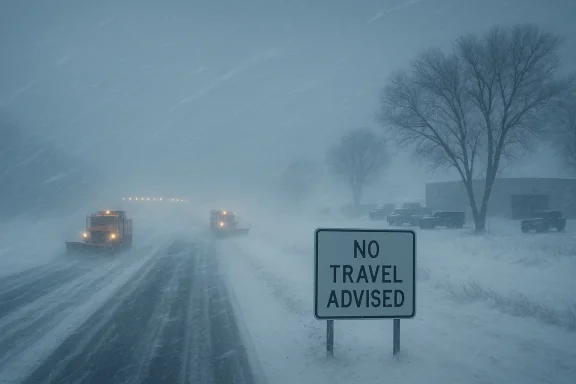
State and local officials issued no-travel advisories for numerous counties in southern Minnesota, explicitly naming many of the counties that saw the worst road and visibility issues. MnDOT’s operational messages and local press coverage identified southeastern and southern counties where travel was strongly discouraged or effectively closed until conditions improved. These advisories covered multiple counties along and south of Interstate 90 and across stretches of I‑35 where whiteout conditions developed.Local law enforcement logged dozens to hundreds of spinouts, road departures and multi-vehicle incidents in the storm’s peak as roads converted to raw snow and slush faster than plows could treat and clear them. In some corridors MnDOT reported plow crews encountering snowfall rates that overwhelmed their clearing cycles — a common challenge when intense bands set up.
Practicalities on the roads
- Visibility: Whiteout conditions made driving effectively impossible in places where wind-driven snow reduced sight lines to near zero.
- Plow operations: Even with continuous plow cycles on major routes, snowfall rates in concentrated bands covered lanes faster than plows could clear them, increasing the risk of multi-car crashes and stranded vehicles.
- Closures: Portions of Interstate 90 and other state routes were reported closed for safety in the storm’s worst areas until crews could restore a safe operational surface.
National Guard activation and emergency staging
Governor Tim Walz signed an executive order authorizing Minnesota National Guard support for storm-related emergency operations. The Guard’s role was explicitly framed as support to civilian authorities — personnel, vehicles and resources poised to assist stranded motorists, deliver supplies, or support local responders if calls for assistance outstripped local capacity. The governor’s order and follow-up media coverage both indicate the Guard was put on standby at armories positioned to enable rapid response in the hardest-hit southern counties.The Guard presence was largely precautionary and targeted: staging at armories in southern and central Minnesota allowed units to react quickly to requests from county sheriffs and local emergency managers, supplementing state and county resources rather than replacing them. That posture is in keeping with how most state-level military assets are employed during severe winter events.
Airports and air travel: MSP and the ripple effects
Hundreds of flights disrupted
Minneapolis–St. Paul International Airport (MSP) experienced widespread disruptions as the storm delivered heavy snow and gusty winds. Regional coverage and aviation trackers reported hundreds of canceled or delayed flights as airlines proactively reduced schedules and operations were constrained by weather and airport resource demands. Local broadcasters and aviation outlets documented major cancellations and urged travelers to delay travel and confirm plans.The most reliable, independently verifiable reporting from recognized local outlets described a high volume of cancellations and delays rather than a single definitive breakdown matching every number published in early aggregator stories. Local airport authorities and individual carriers emphasized flight rebooking and waivers, and the Metropolitan Airports Commission highlighted ongoing snow removal work at MSP while warning passengers that operations would remain disrupted.
On numbers: what is verified and what is not
- Verified: Multiple reputable local outlets and flight-tracking summaries confirmed hundreds of flights were canceled or delayed during the peak of the storm and that MSP operations were significantly curtailed.
- Unverified/Conflicting: Some early aggregator posts provided specific tallies (for example, precise counts of canceled arrivals vs departures and counts of “only X arrivals operating on schedule”). Independent, authoritative sources (airport statements, major local media or FAA/airport operations summaries) did not consistently corroborate those exact figures at time of reporting. Where precise tallies matter — for example, to quantify economic impact — readers should treat single-source counts with caution until airport or FAA final reports are released.
Snowfall totals: what was measured and where
Snowfall reports came in from community observers, CoCoRaHS volunteers, automated airport stations, and National Weather Service (NWS) stations. Totals varied geographically, consistent with the banded nature of the storm.Key verified measurements and observations included:
- Multiple NWS station reports and consolidated local tallies showed widespread accumulations across southern and central Minnesota, with many locations reporting single-digit to low-double-digit totals in the 6–13 inch range and some localized reports higher. Official NWS public information statements and local weather offices listed a number of sample totals representative of the pattern.
- Local radio and news aggregators published lists of NWS-sourced snowfall reports showing Lakeville and other southern suburbs with totals in the range of roughly 9–12 inches at many reporting sites, and Cannon Falls and other southeast communities similarly in the 9–12 inch band in NWS lists. Those compilations were drawn from official NWS reports and community observers.
- The Minneapolis–St. Paul airport’s reporting station recorded measurable accumulations in the neighborhood of roughly 7–9 inches depending on the time snapshot referenced on the busiest morning, while the NWS office at Chanhassen reported station values in the mid-to-upper single digits on their event summaries. Published station values can differ slightly depending on observation time and sensor siting.
Emergency operations: what worked and what strained
Strengths in the response
- Rapid pre-positioning and advisory messaging. MnDOT and local county authorities issued travel guidance quickly as observations verified the worst-case banding, and the governor’s office pre-authorized National Guard support to ensure resources were available if requested by counties. This quick authorization simplifies legal and logistical channels for resource deployment.
- Airport snow-removal protocols in action. MSP’s snow-removal teams worked extended shifts to keep runways and taxiways operable; airport officials communicated the work and warned travelers about delays and cancellations. That kept critical infrastructure functional even as service levels dipped.
Stress points and risks
- Plow capacity vs. extreme snowfall rates. When narrow bands produced intense hourly rates, plow cycles on secondary and tertiary routes could not keep up. The result: roads covered faster than crews could reopen them — increasing the risk of crashes, pileups and long vehicle entrapments. This is an operational reality in any snow-heavy banding event, but it exposes resource limitations for rural or lightly populated corridors.
- Information flux and public confusion. Rapidly changing forecasts and conflicting counts in early reports can confuse the public (for instance, divergent flight cancellation tallies reported in different outlets). In high-impact weather, clear, centralized updates from MnDOT, NWS and the Metropolitan Airports Commission are essential to reduce dangerous travel decisions.
- Power and critical infrastructure threats. Wet, heavy snow combined with strong gusts increases risk to overhead power lines and tree limbs. Energy utilities staged crews in advance and reported outages in places, but the combination of heavy snow and wind remains a persistent vulnerability during late-season storms.
The media and data probers in breaking weather
During this event a variety of outlets and aggregators published raw totals and flight-count tallies that sometimes disagreed. That’s not unique to this storm: in breaking weather, counts are fluid. Two practical rules for readers and decision-makers:- Prioritize primary, authoritative sources (NWS for forecasts and station totals; MnDOT for road advisories and closures; official airport/airline or FAA updates for flight operations).
- Treat single-source tallies reported in the first wave of stories as provisional until reconciled against official statements or post-event reports.
Community reporting and social media: what local observers saw
Community-sourced tallies and social platforms played a role in providing hyper-local observations — driveway totals, stranded vehicle photos, and rapidly updated county road conditions. Those inputs were valuable for situational awareness but also varied in quality and timing. For aggregated snapshots of community reports and forum discussion, internal forum and thread compilations documented public reaction and local impacts in near-real time. Those threads serve as a complementary record to official logs but should be treated as eyewitness snapshots rather than authoritative measurement.What this storm tells us about preparedness and resilience
Short-term lessons
- Public messaging must emphasize that even short trips can be life-threatening when bands produce rapid accumulation and whiteouts. Clear no-travel advisories save lives.
- Pre-staging resources — plows, emergency personnel, utility crews — matters, but so does capacity scaling for intense banded events that outpace routine plow cycles.
- Airports and airlines should continue to cement coordination protocols for weather-driven surges in cancellations so passengers receive timely, consistent guidance.
Long-term considerations
- Infrastructure investments that reduce vulnerability (buried utilities where feasible, roadside tree trimming programs, additional plow capacity or mutual aid agreements) can lower societal costs from late-season storms.
- Communication systems that provide consolidated, authoritative situational awareness (official NWS/MnDOT/MSP updates combined with county emergency managers) decrease confusion and harmful decisions.
- Climate variability and a pattern of late-winter extremes underscore the need for seasonal readiness much later into spring than traditional planning windows might assume.
How people should prepare for similar events going forward
- Stay informed from the primary sources — monitor NWS, MnDOT, county sheriff/EMA and airport official statements during winter storms.
- Avoid travel during warnings and no-travel advisories. If travel is essential, share your route and ETA with someone and carry emergency supplies.
- Charge devices and prepare for outages. Even short outages complicate situations when roads are impassable.
- Help vulnerable neighbors. Seniors and residents with mobility challenges are often most at risk during emergency weather events.
- If stranded, stay with your vehicle if safe to do so. Keep exhaust clear of snow, run the engine only intermittently to conserve fuel, supplement ventilation and signaling. Emergency responders prioritize life-saving calls; being prepared reduces risk while help is mobilized.
Final assessment: verified facts, open questions, and a caution
What is well-documented and corroborated across multiple primary sources is this: a potent March storm produced banded heavy snow across southern and central Minnesota, created whiteout conditions that prompted no-travel advisories across many counties, disrupted highway operations and led to significant flight cancellations at MSP, and caused state officials to stand up National Guard support as a precautionary measure. Those central operational facts are validated by official state releases, National Weather Service station reports and local media coverage.What remains less settled in the immediate aftermath are exact tallies that vary across early reports — for instance, precise airline cancellation breakdowns by arrivals vs departures and the exact per-site snowfall totals reported in early aggregator stories. Those figures are often updated as carriers and agencies reconcile operations and as NWS compiles final station summaries. For readers and decision-makers, the responsible approach is to rely on primary, official post-event reports for exact counts and to treat initial, single-source numbers as provisional.
This storm was a reminder that late-winter systems can still produce high-impact, fast-moving hazards. Operational coordination among state agencies, local emergency managers, utilities and transportation authorities appeared to function under pressure, but the event also exposed persistent constraints — plow capacity against intense banded snowfall, the vulnerability of above-ground infrastructure to wet-heavy snow and wind, and the persistent challenge of clear, unified public messaging when numbers and impacts are still being reconciled.
For residents and travelers: heed official no-travel advisories, expect airport disruptions during major late-season storms, and prioritize safety over schedules when visibility collapses and road surfaces vanish under accelerating snowfall. The safest action during the next band of heavy snow is to stay put and wait for official “all clear” messaging once crews have had time to clear and assess routes.
Conclusion: Minnesota’s emergency apparatus moved quickly as a thick and banded March storm intensified — and while the central facts of travel paralysis, airport disruption and National Guard readiness are confirmed, many of the granular totals circulating in the immediate aftermath require careful reconciliation with official NWS and agency post-event reports before they should be treated as final.
Source: USA Herald Major March Snowstorm Paralyzes Minnesota as Travel Warnings Spread - USA Herald