

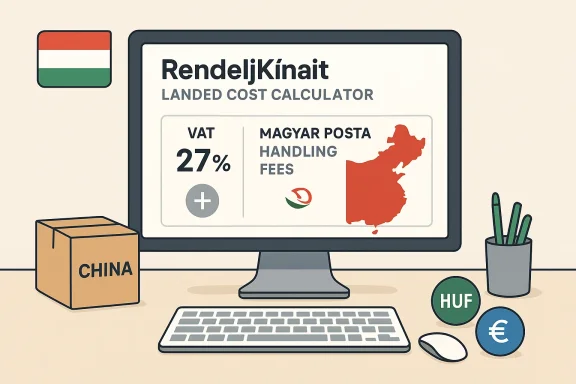
RendeljKínait’s latest promotion pairs eye‑catching, “unbeatable” software discounts with a practical tool: a Hungary‑focused import‑cost calculator that promises to show the real landed cost for goods shipped from China. On the surface, that combination — cheap software plus a transparent landed‑cost estimate — looks like a consumer win; dig deeper, and the reality is more nuanced. This feature unpacks how the calculator works, verifies the legal and procedural assumptions behind it, and gives Hungarian buyers concrete, evidence‑based guidance to avoid unpleasant surprises when ordering from non‑EU sellers. Along the way we assess the calculator’s strengths, its blind spots, and the particular risks that matter when buying heavily discounted software across borders.
RendeljKínait advertises deep discounts on software and points buyers to an on‑site VAT/import calculator intended to estimate the sum of VAT plus postal/customs handling costs for packages arriving from China. The calculator explicitly models three clearance scenarios — IOSS, SA (Special Arrangement), and normal customs clearance — and reports the end result as VAT + customs administration costs, regardless of whether VAT was already paid at checkout. RendeljKínait also states the calculator uses Magyar Posta’s administrative fees and converts package values using an MNB exchange rate published monthly, with the customs thresholds taken from NAV (the Hungarian tax and customs authority).
Those design choices reflect the practical reality of EU and Hungarian rules after the 2021 e‑commerce VAT reform: import VAT is due on all goods imported into the EU, and special simplifications exist for low‑value consignments handled using IOSS or other “special arrangements”. The EU’s Import One‑Stop Shop (IOSS) and the broader VAT e‑commerce package are the legal framework behind these changes.
Before recommending the calculator as a planning tool, however, we verified its assumptions, validated the official sources it references (Magyar Posta, NAV, MNB), and tested where the tool’s outputs are solid — and where they are necessarily provisional.
For practical guidance on how IOSS operates in daily logistics (monthly returns, intermediary obligations for non‑EU sellers, consequences of missing or incorrect IOSS IDs), independent tax service explainers and logistics providers provide consistent descriptions: sellers registered under IOSS charge the VAT at checkout and include the IOSS ID in the customs data so parcels clear quickly; if the IOSS ID is missing, customs will require VAT on delivery and postal operators will collect it (or require the recipient to pay) — exactly the scenario RendeljKínait models.
Important caveat: RendeljKínait’s statement that the conversion uses the MNB rate published “on the penultimate Wednesday of the previous month” is documented on its site, but we were unable to locate an explicit NAV or MNB rule phrasing that conversion timing exactly that way in the public law or the central bank’s standard materials. The broader legal text permits the use of an MNB official rate for conversions, and Posta and practitioners describe monthly conversion mechanics, but the specific timing phrase appears to be a practical convention stated by RendeljKínait rather than a directly quoted MNB policy we could find. Treat that precise timing as a plausible operational rule reported by RendeljKínait, but flag it as a detail users should verify against the Posta or NAV notices for the exact month in question.
However, the calculator deliberately excludes customs duties and depends on assumptions about exchange‑rate conversion timing and the delivering carrier. Those factors — plus software‑specific risks around licensing and activation — mean buyers should treat the calculator as a planning aid, not a guarantee. Confirm IOSS status with the seller, prefer online payment of handling fees where available, retain invoices and proof of payment, and always verify licensing legitimacy when buying discounted software keys from third parties. Forum reports demonstrate real losses when keys fail or are revoked; low landed cost cannot compensate for an invalid license.
RendeljKínait’s combination of steep software offers and an on‑site landed‑cost calculator is useful and rooted in the real mechanics of post‑import handling in Hungary. The calculator is honest about its scope and errs on the side of not overpromising about unpredictable duties — a professional choice that improves the tool’s reliability for the predictable portion of landed costs. Still, when the stakes are activation‑sensitive software purchases or borderline high‑value electronics, buyers should combine the calculator’s output with seller verification, proof retention, and a conservative margin for duties and license problems. That prudent approach turns a useful online calculator into a dependable part of the decision process rather than the sole basis for it.
Source: RendeljKínait Unbeatable software offers for efficiency
 Background / Overview
RendeljKínait advertises deep discounts on software and points buyers to an on‑site VAT/import calculator intended to estimate the sum of VAT plus postal/customs handling costs for packages arriving from China. The calculator explicitly models three clearance scenarios — IOSS, SA (Special Arrangement), and normal customs clearance — and reports the end result as VAT + customs administration costs, regardless of whether VAT was already paid at checkout. RendeljKínait also states the calculator uses Magyar Posta’s administrative fees and converts package values using an MNB exchange rate published monthly, with the customs thresholds taken from NAV (the Hungarian tax and customs authority).Those design choices reflect the practical reality of EU and Hungarian rules after the 2021 e‑commerce VAT reform: import VAT is due on all goods imported into the EU, and special simplifications exist for low‑value consignments handled using IOSS or other “special arrangements”. The EU’s Import One‑Stop Shop (IOSS) and the broader VAT e‑commerce package are the legal framework behind these changes.
Before recommending the calculator as a planning tool, however, we verified its assumptions, validated the official sources it references (Magyar Posta, NAV, MNB), and tested where the tool’s outputs are solid — and where they are necessarily provisional.
How the RendeljKínait calculator works (and what it deliberately includes)
The three modeled clearance routes: IOSS, SA, normal clearance
- IOSS (Import One‑Stop Shop): When the seller (or a marketplace) is registered for IOSS and correctly transmits the IOSS VAT identification number with the shipment data, the import VAT is collected at the point of sale. The package should pass through customs without VAT being due at delivery; the recipient typically pays only the postal handling fee. RendeljKínait’s calculator models the remaining administrative charge in that scenario. This is consistent with EU guidance on IOSS simplifications.
- SA (Special Arrangement): Labeled by Magyar Posta as Special Arrangement, SA is a simplified postal handling method where the postal operator collects VAT from the recipient on behalf of customs for consignments under €150 if the seller did not use IOSS. The Posta submits a reduced‑data customs declaration and then collects VAT + handling fees. RendeljKínait’s calculator models the recipient‑paid VAT plus the Posta’s SA handling fee. The Posta’s own guidance describes this flow and the fee structure used for its automatic procedures.
- Normal customs clearance: For packages above the simplified threshold or where simplified procedures are inapplicable, standard customs procedures apply: import VAT, potential customs duties, and higher postal or broker handling fees. RendeljKínait’s calculator intentionally does not attempt to predict customs duties, which depend on HS codes, origin rules, shipping and insurance, and other variables; instead it flags whether duties are likely based on value and product type. RendeljKínait explicitly states the calculator returns VAT + customs administration only, and will indicate when duties may apply.
Inputs, exchange‑rate logic and administrative fees
- The calculator asks for the net product value (excluding VAT) and the shipping cost, and then applies VAT to the forint‑converted total where appropriate. RendeljKínait says it converts the package value monthly using an MNB exchange rate published on “the penultimate Wednesday of the previous month” and uses Magyar Posta’s current administrative fee schedule when computing handling charges. Those are the same data points the Posta itself uses when it processes packages delivered through its network, and NAV publishes the thresholds that trigger different procedures.
- Importantly, the calculator treats phones and tablets as duty‑free (which reflects typical tariff treatments) and treats other goods over €150 as in principle duty‑liable while noting that in practice duties often do not materialize for many small shipments — a cautious, realistic approach.
Verifying the legal and procedural assumptions
To evaluate the calculator’s accuracy we cross‑checked the underlying claims against official authorities and independent explainers.IOSS, the legal baseline
The EU’s VAT e‑commerce package created IOSS to ease VAT collection on distance sales up to €150 and to remove the previous €22 import VAT exemption. That framework — introduced from 1 July 2021 — is the reason sellers can now collect VAT at checkout and declare it centrally via IOSS, which speeds customs clearance for properly labeled shipments. This is the authoritative legal fact driving RendeljKínait’s distinction between IOSS and non‑IOSS flows.For practical guidance on how IOSS operates in daily logistics (monthly returns, intermediary obligations for non‑EU sellers, consequences of missing or incorrect IOSS IDs), independent tax service explainers and logistics providers provide consistent descriptions: sellers registered under IOSS charge the VAT at checkout and include the IOSS ID in the customs data so parcels clear quickly; if the IOSS ID is missing, customs will require VAT on delivery and postal operators will collect it (or require the recipient to pay) — exactly the scenario RendeljKínait models.
Magyar Posta’s fees and automatic handling
Magyar Posta details the automatic vs. manual customs handling paths and publishes the fee tiers it charges when it acts as the postal customs agent. RendeljKínait states it uses those Magyar Posta fees in its calculator — a defensible implementation decision since the Posta handles most postal imports to Hungary, and its published fee table is the right basis for estimating postal handling charges. Magyar Posta also confirms that automatic handling (which underlies the SA and IOSS flows) applies when the consignment value does not exceed €150 and the consignment is eligible.NAV thresholds and exchange‑rate rules
NAV publishes the legal value thresholds for different customs treatments (e.g., 150‑euro threshold for simplified declarations, smaller thresholds for gifts or private transfers), and Hungarian practice converts euro thresholds into forints for the relevant year. The Hungarian authorities and practitioner guides confirm that those forint equivalents are updated periodically and used by postal and customs systems to decide which regime applies. RendeljKínait cites NAV for the thresholds and says it uses the MNB monthly exchange rate for conversion. That mirrors the real process used by the Posta and customs actors: thresholds are fixed in euros in EU law but applied in forints in practice, using a published exchange rate.Important caveat: RendeljKínait’s statement that the conversion uses the MNB rate published “on the penultimate Wednesday of the previous month” is documented on its site, but we were unable to locate an explicit NAV or MNB rule phrasing that conversion timing exactly that way in the public law or the central bank’s standard materials. The broader legal text permits the use of an MNB official rate for conversions, and Posta and practitioners describe monthly conversion mechanics, but the specific timing phrase appears to be a practical convention stated by RendeljKínait rather than a directly quoted MNB policy we could find. Treat that precise timing as a plausible operational rule reported by RendeljKínait, but flag it as a detail users should verify against the Posta or NAV notices for the exact month in question.
Critical analysis: strengths and limits of the calculator
What RendeljKínait gets right (notable strengths)
- Transparent scope: The calculator explicitly computes VAT + customs administration fees and states it does not attempt to forecast customs duties. That’s honest and helpful: predicting duty reliably requires HS codes, origin verification, and shipping details that consumers rarely have at order time. RendeljKínait’s conservative scope focuses on the predictable elements of landed cost.
- Use of current postal fees: Modelling Magyar Posta’s published handling fees gives realistic numbers for the majority of parcels processed through the national postal system. That makes its handling‑fee estimates pragmatically useful for consumers who receive parcels via Posta.
- IOSS vs SA distinction: Presenting all three real‑world paths (IOSS, SA, normal clearance) helps buyers compare scenarios and plan seller selection (e.g., preferring an IOSS‑registered seller to reduce uncertainty). This side‑by‑side comparison is valuable and actionable.
Where the calculator is necessarily limited (and why)
- Customs duties omitted: The calculator deliberately excludes duties because duties depend on product classification, origin, and sometimes complex preferential‑origin rules. For many buyers the omission is acceptable (duties often run to 0% for many consumer goods), but for higher‑value orders or goods in duty‑sensitive categories the omission can understate total landed cost. RendeljKínait flags this, but buyers must understand the gap.
- Assumes Magyar Posta delivery: The calculator uses Posta fees, so it’s accurate only when Posta is the delivering carrier. Many commercial express carriers (DHL, FedEx, GLS, Packeta, etc.) have different handling models and fees; some consolidate VAT differently or charge brokerage fees that differ materially. RendeljKínait’s results are specific to the Posta pathway.
- Exchange‑rate timing nuance: As noted, the specific MNB timing RendeljKínait uses (penultimate Wednesday of previous month) is reported on the website; however, the public legal basis is that MNB official rates may be used and that conversions happen on relevant dates. Because exchange‑rate moves can swing the forint price across a threshold (especially in volatile markets), that timing choice can change whether a parcel sits below or above €150 in forint terms. Users should confirm the exact conversion rule used in the current month with the Posta or NAV if they plan high‑value purchases.
The software angle: discounted keys and activation risks
Beyond customs math, there’s a separate but crucial risk when deals advertise deeply discounted Windows or Office product keys shipped from non‑EU sellers: software authenticity and activation. Forum threads and practical reports show buyers sometimes receive keys that fail activation, are revoked later, or lack legitimate entitlement for updates and support. RendeljKínait’s marketing pairs software offers with the calculator to help buyers evaluate the landed cost, but cheap landed cost does not guarantee legal licensing or working activation. Our review of consumer threads and marketplace reports flagged this as a real buyer risk tied to cross‑border software offers. Buyers should treat software keys from third‑party resellers with caution: check activation guarantees, refund policies, and whether the seller is an authorized reseller.Practical, step‑by‑step guidance for Hungarian buyers
If you plan to use RendeljKínait’s calculator to evaluate a purchase from China (software or otherwise), follow these steps to keep risk and surprise low:- Identify IOSS status before you buy. Ask the seller or marketplace whether the sale is processed under IOSS and request the IOSS identification number (or check the invoice). If IOSS is used and correctly declared, you’ll avoid VAT at delivery and usually only pay the Posta handling fee. Confirm they will include the IOSS ID in the customs data.
- Use the calculator but treat customs duties as separate risk. Run RendeljKínait’s calculator to estimate VAT + Posta handling. Then consider whether duties might apply: is the product a tariff‑sensitive good? Are you buying more than €150 in other items from the same shipper? If in doubt, assume duties could apply and add a buffer.
- Prefer online pre‑payment of handling fees where possible. Magyar Posta applies lower handling fees for online payment versus cash‑on‑delivery. If the Posta or seller offers online settlement for the customs handling fee, use it to save costs and speed delivery.
- Collect and keep proof of payment and the invoice. If the seller wrongly collects VAT at checkout or mis‑declares values, you may need the invoice to claim a refund from the seller. Keep order confirmations, payment receipts, and shipping documentation. Posta and NAV will expect documentation for value verification in contested cases.
- Check the product classification and provenance for duty risk. For higher‑value purchases, ask the seller for the HS/tariff code and the country of origin. That information is needed to estimate customs duty and to check for preferential origin that could reduce duty. RendeljKínait’s calculator won’t do this for you.
- For software specifically: verify licensing and activation terms. Ask if the software key is an OEM, retail, volume, or “global” key. Verify that the seller is an authorized reseller or offers a clear activation/refund policy. Remember that a working activation today is no guarantee of long‑term entitlement; keys sold cheaply from dubious sources can be revoked. Forum reporting shows this is an ongoing problem in bargain software markets.
- When in doubt, choose EU‑based sellers or local resellers. The landed cost may be higher, but guaranteed legal licensing, warranty support, and predictable handling often justify the premium for software and electronics.
A quick worked example (illustrative)
- Product net price at checkout: €50
- Shipping: €5
- Seller did not use IOSS; Posta will handle (SA path).
- VAT rate: 27% (Hungary’s standard rate for most goods)
- Posta SA handling fee (online payment band for €50 total): use Posta’s published band (RendeljKínait’s calculator uses those exact bands).
- Convert €55 to forints using the monthly MNB rate it applies,
- Calculate 27% VAT on the converted amount,
- Add the Posta’s SA handling fee for the appropriate value band,
- Display VAT + handling as the landed cost; if duties were expected (e.g., product belongs in a dutiable tariff category), it would flag that possibility but not estimate the duty.
Policy and consumer‑protection context — what the government and postal operator say
- The EU changed the rules on 1 July 2021, abolishing the €22 exemption and creating IOSS for consignments up to €150 to ensure VAT is paid. This is the legal backbone of why sellers now charge VAT at checkout for low‑value consignments and why IOSS exists to simplify cross‑border online sales. RendeljKínait’s explanations align with the EU intent.
- Magyar Posta is explicit that for packages under €150 automatic customs handling is typical and that in automatic handling cases the Posta will collect VAT either under SA (when the VAT is paid at delivery) or not collect VAT at delivery if a valid IOSS ID is present; Posta also lists the fee bands and the online vs COD fee differences. These published rules are the correct operational reference the calculator uses.
- NAV publishes the value thresholds and the legal basis for applying MNB official rates, and practitioners summarize the annual forint equivalents used in practice. This is where the legal thresholds originate; RendeljKínait and Posta implement them operationally. Buyers should monitor NAV or Posta notices if they plan purchases near threshold boundaries.
Final verdict — when the calculator helps, and when you still need human judgment
RendeljKínait’s calculator is a practical, transparent tool for estimating the predictable part of landed cost: VAT plus postal handling. Its reliance on Magyar Posta fees and NAV thresholds makes its outputs realistic when the Posta handles delivery and when duties aren’t expected. For many low‑value consumer purchases, that will be the dominant cost and the calculator will give a useful approximation.However, the calculator deliberately excludes customs duties and depends on assumptions about exchange‑rate conversion timing and the delivering carrier. Those factors — plus software‑specific risks around licensing and activation — mean buyers should treat the calculator as a planning aid, not a guarantee. Confirm IOSS status with the seller, prefer online payment of handling fees where available, retain invoices and proof of payment, and always verify licensing legitimacy when buying discounted software keys from third parties. Forum reports demonstrate real losses when keys fail or are revoked; low landed cost cannot compensate for an invalid license.
Key takeaways and practical checklist
- Use the calculator to estimate VAT + Magyar Posta handling fees — it’s doing the right, verifiable math for those elements.
- Verify IOSS: if the seller uses IOSS and declares it correctly, you’ll likely only pay the handling fee on delivery.
- Expect duties for certain goods and above €150: the calculator flags likely duty exposure but won’t estimate duty amounts. Add a conservative buffer when ordering goods near or above thresholds.
- Prefer online settlement to save on handling fees and speed delivery.
- For software: insist on proof of authorized resale or a robust refund/activation guarantee. Deep discounts for perpetual licenses can hide legitimacy and activation risks.
- Confirm exchange‑rate/timing for borderline purchases. If a small currency movement could push your package above a threshold in forint terms, check the month’s conversion rule with Posta or NAV because that timing can change which clearance path applies.
RendeljKínait’s combination of steep software offers and an on‑site landed‑cost calculator is useful and rooted in the real mechanics of post‑import handling in Hungary. The calculator is honest about its scope and errs on the side of not overpromising about unpredictable duties — a professional choice that improves the tool’s reliability for the predictable portion of landed costs. Still, when the stakes are activation‑sensitive software purchases or borderline high‑value electronics, buyers should combine the calculator’s output with seller verification, proof retention, and a conservative margin for duties and license problems. That prudent approach turns a useful online calculator into a dependable part of the decision process rather than the sole basis for it.
Source: RendeljKínait Unbeatable software offers for efficiency
