

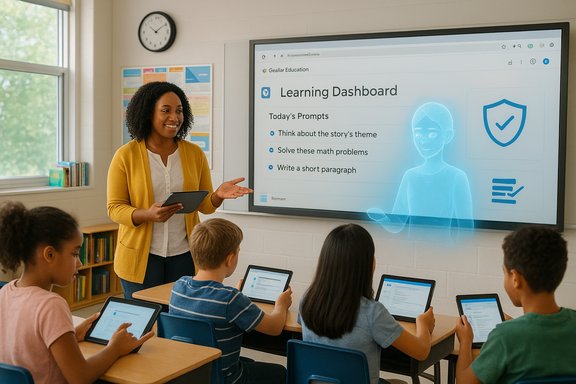
Renfrew County’s school boards have quietly crossed a threshold many districts only talk about: they are actively integrating generative artificial intelligence into everyday classroom workflows while building policies, training and technical guardrails to shape how students and teachers use it.
Artificial intelligence (AI) — especially generative AI such as large language models and multimodal assistants — has rapidly moved from novel online tools into mainstream productivity suites and classroom services. School districts across North America are now deciding whether to ban, limit, or embrace these tools; Renfrew County’s public and Catholic boards have chosen a measured, board-led integration model that leans on their existing Google Workspace environment and on local teacher-led pilots. At the same time, vendors have released education-specific versions of their models with contractual and technical protections meant to address student-data concerns. Google’s Gemini rollout for Google Workspace for Education is an example of this approach: the product includes added data protection when accessed with school accounts and administrative controls for domain admins, and Google positions Gemini as a tool for teachers and students that should be managed and taught rather than simply handed to learners without guardrails. The Ontario Ministry of Education has signalled awareness and the need for provincial planning: Artificial Intelligence was named as one topic for mandatory Professional Activity (PA) Days for 2025–26, placing AI on the provincial professional learning agenda even as local boards continue to develop implementation plans. This creates a distinct patchwork: boards are experimenting now, supported by ministry-level encouragement to educate about AI, but there is not yet a single, prescriptive province-wide deployment rule that dictates how every classroom must use these tools.
The immediate policy takeaway is pragmatic: boards must pair technology adoption with enforceable contracts, teacher training and assessment redesign. The provincial government has placed AI on the professional learning agenda, but the operational and legal work falls to boards now. For parents, teachers and IT leaders, the task is to ensure that AI augments learning without hollowing out the intellectual work schools are meant to cultivate.
Source: 96.1 Renfrew Today Renfrew County’s school boards have started integrating artificial intelligence in the classroom
 Background
Artificial intelligence (AI) — especially generative AI such as large language models and multimodal assistants — has rapidly moved from novel online tools into mainstream productivity suites and classroom services. School districts across North America are now deciding whether to ban, limit, or embrace these tools; Renfrew County’s public and Catholic boards have chosen a measured, board-led integration model that leans on their existing Google Workspace environment and on local teacher-led pilots. At the same time, vendors have released education-specific versions of their models with contractual and technical protections meant to address student-data concerns. Google’s Gemini rollout for Google Workspace for Education is an example of this approach: the product includes added data protection when accessed with school accounts and administrative controls for domain admins, and Google positions Gemini as a tool for teachers and students that should be managed and taught rather than simply handed to learners without guardrails. The Ontario Ministry of Education has signalled awareness and the need for provincial planning: Artificial Intelligence was named as one topic for mandatory Professional Activity (PA) Days for 2025–26, placing AI on the provincial professional learning agenda even as local boards continue to develop implementation plans. This creates a distinct patchwork: boards are experimenting now, supported by ministry-level encouragement to educate about AI, but there is not yet a single, prescriptive province-wide deployment rule that dictates how every classroom must use these tools. What Renfrew County is doing now
Two boards, two parallel paths
Renfrew County District School Board (RCDSB) and Renfrew County Catholic District School Board (RCCDSB) have both begun deliberate steps to bring AI into the classroom. RCDSB formed a study committee earlier in the year to evaluate classroom use, and the superintendent of education, Scott Nichol, has described the board’s priority as ensuring that student learning remains human-centred even as AI becomes ubiquitous in educational tools. RCCDSB has been working on a multi-year plan and assembled working groups that include technology and curriculum leads; the board’s experiential learning and technology coordinator, Tyson Holly, has been cited as a key voice in shaping that rollout. Both boards have evaluated Google’s Gemini because they already use Google Workspace extensively, making integration straightforward for IT teams and teachers.Why Gemini was chosen (and what “education” editions mean)
Gemini for Google Workspace for Education is available to districts that already use Google Classroom, Drive, Docs and other Workspace services. Google offers additional contractual protections and administrative controls for Workspace for Education customers that mitigate — but do not remove — data-use and privacy risks: chats and prompts using a qualifying Workspace education tenancy are covered by terms stating that student inputs will not be used to train Google’s public models, and administrators can manage access and audit usage through admin consoles and Vault. These features make Gemini an attractive choice for boards already embedded in the Google ecosystem.How boards are deploying AI in classrooms
Phased, teacher-led rollout
Renfrew County’s boards are using a phased approach that mirrors best practices emerging across other Ontario and North American boards:- Phase 1: Teacher pilot and professional learning — give educators time-limited, controlled access so they can understand opportunities and pitfalls, and collect feedback.
- Phase 2: Targeted student access — extend AI tools to older students (commonly Grades 9–12 first) with explicit classroom rules.
- Phase 3: Policy, assessment redesign and scale — update academic integrity rules, assessment methods, and parent/guardian communications before broad rollout.
Practical classroom use cases already in play
Teachers and boards report immediate, low-risk uses that can free up educator time and provide targeted student support:- Rapid draft generation for lesson planning, rubric creation and formative checks.
- Adaptation and differentiation (reading-level simplification, translation, scaffolding for English-language learners).
- Practice quizzes, study guides and personalized revision plans for students.
- Administrative tasks: summarizing meetings, drafting parent communications, and creating accessible materials.
Strengths and educational opportunities
1. Teacher productivity and differentiated instruction
AI can dramatically reduce time spent on routine tasks: lesson templating, multi-level materials and translation can be produced quickly and then tailored by teachers. This time savings can be reallocated to individualized instruction, interventions and in-person support — the kinds of tasks that research shows matter most for student outcomes. District case studies across North America report measurable gains in teacher hours reclaimed when AI is used judiciously.2. On-ramp to workforce‑relevant literacy
AI literacy — the ability to understand how to prompt models, verify outputs, identify hallucinations and reason about bias — is already a workplace expectation in many industries. Integrating AI into K–12 curricula prepares students for the realities of digital workplaces and higher education where AI-savvy graduates are increasingly in demand. Official vendor resources and third-party lesson plans make it practical to scaffold AI concepts across grade levels.3. Opportunities for differentiated learning
Generative AI can adapt explanations and practice to different ability levels, provide immediate feedback loops for mastery learning, and support students with diverse needs (e.g., special education, ESL) by creating alternate representations of content on demand. Several boards, including Ottawa Catholic, report that Gemini has helped create scaffolded materials for learners with distinct needs. Cross-district collaboration on templates and rubrics multiplies that value.Key risks, trade-offs and governance challenges
No large-scale classroom AI integration is risk-free. The Renfrew County experience highlights a series of practical and ethical risks that districts — and the Ministry — must address.Student data privacy and vendor commitments
Vendors provide contractual promises (for example, Google’s statement that Gemini inputs from qualifying education accounts are not used to train public models), but those protections are only as strong as the procurement contracts, the specific Workspace edition purchased, and the technical configuration of the domain. Boards must demand clear contract language on:- Whether prompts and student work can be accessed for troubleshooting or research.
- Retention schedules and deletion capabilities for student data.
- Audit, compliance and the ability to revoke or change vendor terms.
Academic integrity, assessment design and learning outcomes
Generative AI can produce polished essays or code with little visible process, complicating traditional assessment models. The response from many forward-leaning boards is to redesign assessments to value process as much as product:- Stage submissions and require iterative work logs.
- Use viva voce (oral defenses), in-class supervised tasks or live presentations for summative assessment.
- Require AI-disclosure statements (short, standardized statements appended to student submissions describing tool use).
Hallucinations and factual reliability
Generative models can hallucinate — produce plausible-sounding but false facts. When students or teachers use AI outputs uncritically, misinformation can propagate through lessons and assessments. Districts must teach verification skills and require human-in-the-loop validation for any content used in graded assignments or publicly distributed materials. Google’s Gemini includes “double-check” features that link outputs to web sources, but such technical mitigations are not foolproof and must be paired with literacy training.Equity and access
Not every student has the same device, connectivity or home support to benefit equally from AI-augmented learning. Boards adopting AI must measure equity impacts and provide alternatives. Multimodal AI features can also be more resource-intensive, favouring richer devices; boards with limited device budgets risk exacerbating digital inequities unless they design parity strategies.Policy landscape in Ontario — what’s in place and what’s missing
The Ontario Ministry of Education has placed Artificial Intelligence on the list of mandatory Professional Activity Day topics for 2025–26, signalling that teacher professional learning on AI is a provincial priority. This is an important step: it encourages boards to make AI part of teacher development and acknowledges the urgency of the issue. However, the ministry’s action so far is targeted toward professional learning rather than a one-size-fits-all operational mandate forcing specific classroom implementations or prohibitions. That leaves boards with discretion — and responsibility — to develop local policies consistent with provincial guidance. Several boards — most notably the Ottawa Catholic School Board — have produced their own AI guiding principles, certification programs and local privacy frameworks. These board-level policies are emerging templates for others to emulate, and they demonstrate that district leadership can produce robust, context-aware approaches faster than a single centralized mandate. Renfrew County’s boards are part of this local governance trend, collaborating with neighbouring boards and regional partners to align approaches. Caution: reports that “the ministry has not provided any guidance” are incomplete. The province is engaged (PA day topics and other advisory resources), but the practical, enforceable rules that IT departments and classroom teachers need — standardized procurement clauses, mandatory model transparency requirements, or a provincewide data-use contract — remain a patchwork of local decisions, vendor promises, and ad hoc IT configurations. Boards must therefore fill those gaps proactively.Technical verification: what vendors actually promise
It is essential to verify vendor claims against published contractual terms and product documentation, not only vendor marketing. For Gemini and Google Workspace for Education:- Google publicly states that Gemini for Workspace for Education and related education editions include added data protection where user inputs for qualifying education accounts are not used to train public models and are not reviewed by human annotators. Admins have controls to manage access, audit, and Vault-based retention. These protections vary across licensing tiers and depend on correct admin configuration.
- Third‑party reports and education press coverage confirm that many school districts have adopted Gemini as a managed, tenant-bound service precisely because the admin and contractual controls reduce the risk surface compared with unmanaged consumer accounts. But independent audits or contract copies should be obtained to confirm the exact legal commitment in each case. Vendor marketing should never be the final legal verification.
Practical checklist for boards and IT leaders
Boards taking the Renfrew County approach will need to operationalize policy in several domains. The following checklist synthesizes best practice from boards, vendor guidance and education reporting:- Governance and policy
- Convene an AI steering group with teachers, IT, legal, and parent representatives.
- Publish clear acceptable-use policies for students and staff including disclosure requirements for AI usage.
- Procurement and contracts
- Insist on explicit non-use-of-data-for-training clauses for student prompts, deletion and retention rights, and audit provisions.
- Require security certifications and local data-residency clauses as applicable.
- Technical controls
- Use enterprise education tenants, restrict consumer accounts, and enforce DLP and retention policies.
- Ensure admin access to logs and Vault search for oversight.
- Pedagogy and assessment
- Redesign high-stakes assessments to include process evidence, staged submissions and oral defenses.
- Create standard syllabus language about acceptable AI use and require students to document AI assistance.
- Training and literacy
- Make AI literacy mandatory for staff as part of PA Day/PD programming.
- Provide modular student AI literacy curricula: provenance, verification, prompt craft and ethical use.
- Equity and access
- Monitor usage and outcomes across demographic groups; provide device parity and opt-out alternatives.
- Communications
- Communicate to parents and guardians how AI will be used, what data is collected, and how to request deletions or opt-outs.
Cross-referencing and verification notes
Key claims in this article were cross-checked against multiple sources:- Renfrew County boards’ local decisions and quotes were reported by local outlet Renfrew Today and regional news reporting about RCDSB and RCCDSB implementations.
- Google’s official product and privacy pages describe Gemini’s education editions, admin controls and “added data protection” features for education tenants; these pages were used to verify vendor claims about student-data handling.
- Ontario provincial-level direction (PA Day topics including “Artificial Intelligence”) confirms the Ministry has placed AI on the professional-learning agenda for 2025–26, which supports the claim that the ministry recognizes AI’s classroom arrival while leaving operational detail to boards.
- Ottawa Catholic School Board’s AI certification program and Gemini adoption were reported across national and education trade outlets and used as an independent example of board-level policy development.
What Renfrew County’s move means for other districts
Renfrew’s pragmatic, teacher-centred approach is instructive for other small and mid-sized districts:- Use your incumbent ecosystem. If a district already runs Google Workspace (or Microsoft 365), starting with the vendor’s education edition simplifies identity, single sign-on and admin control, reducing integration risk.
- Prioritize teacher training. Professional learning days are the logical locus for early adoption and risk mitigation; Ontario’s choice to highlight AI on PA Days is a sensible nudge in that direction.
- Expect a policy gap. Provincial encouragement and vendor products do not replace careful procurement and agreement review; districts must translate guidance into enforceable local policy.
- Collaborate regionally. Renfrew’s conversations with neighbouring boards and the Ottawa Catholic Board’s open resources demonstrate how neighbouring districts can accelerate each other’s learning curve.
Conclusion
Renfrew County’s school boards have stepped into a critical, formative stage in K–12 education: moving from if to how AI should be used in classrooms. Their approach — a teacher-first, phased rollout using Gemini because of Workspace alignment, coupled with working groups and local policy development — reflects an emerging consensus among cautious early adopters. The strengths are clear: teacher time saved, tailored learning supports and a chance to teach students essential AI literacy. The risks are equally real: data governance, assessment integrity, equity and the need for vigilant human oversight.The immediate policy takeaway is pragmatic: boards must pair technology adoption with enforceable contracts, teacher training and assessment redesign. The provincial government has placed AI on the professional learning agenda, but the operational and legal work falls to boards now. For parents, teachers and IT leaders, the task is to ensure that AI augments learning without hollowing out the intellectual work schools are meant to cultivate.
Source: 96.1 Renfrew Today Renfrew County’s school boards have started integrating artificial intelligence in the classroom
