

Reply used its Microsoft Ignite floor presence to make a clear, practical argument: Copilot has moved from a curiosity to a procurement problem—partners must turn Microsoft’s agent primitives into repeatable, governed, industry-ready products that deliver measurable business outcomes.
Microsoft positioned Ignite 2025 as an “AI-first” moment for enterprise IT, rolling out a suite of platform primitives—Copilot Studio, Microsoft/Azure Foundry, Model Context Protocol (MCP), Entra Agent ID and an Agent 365 control plane—explicitly designed to make AI agents auditable, identity-bound and operable at scale. These platform changes shift the buyer question away from “what can AI do?” toward “how do we deploy, govern and pay for it?” Microsoft’s Book of News and product blogs document these capabilities and their preview/GA statuses. Reply’s presence at Ignite (booth #4535) and its public session, “Enable intelligent enterprises with Copilot and custom AI agents” (Nov 20, 2:00 PM PT), were explicitly built to answer that second question: how to operationalise Copilot and agentic AI in production environments. The company showcased immersive experiences (the Copilot AI‑Scape Room and an AI Digital Frame), vertical demos, governance artefacts and adoption playbooks designed to accelerate real deployments.
Key claims verified in this article:
Source: Technology Record Reply showcases real-world AI innovation at Ignite
 Background / Overview
Microsoft positioned Ignite 2025 as an “AI-first” moment for enterprise IT, rolling out a suite of platform primitives—Copilot Studio, Microsoft/Azure Foundry, Model Context Protocol (MCP), Entra Agent ID and an Agent 365 control plane—explicitly designed to make AI agents auditable, identity-bound and operable at scale. These platform changes shift the buyer question away from “what can AI do?” toward “how do we deploy, govern and pay for it?” Microsoft’s Book of News and product blogs document these capabilities and their preview/GA statuses. Reply’s presence at Ignite (booth #4535) and its public session, “Enable intelligent enterprises with Copilot and custom AI agents” (Nov 20, 2:00 PM PT), were explicitly built to answer that second question: how to operationalise Copilot and agentic AI in production environments. The company showcased immersive experiences (the Copilot AI‑Scape Room and an AI Digital Frame), vertical demos, governance artefacts and adoption playbooks designed to accelerate real deployments. What Reply showed on the floor
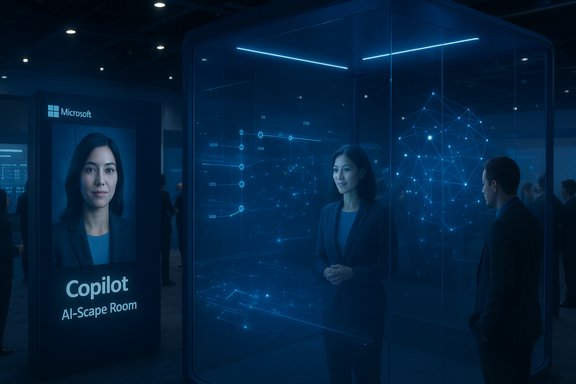
The Copilot AI‑Scape Room: gamified learning for enterprise adoption
Reply’s headline on-floor attraction, the Copilot AI‑Scape Room, is a gamified, hands-on experience where attendees solve staged, time-travel-style missions using Microsoft 365 Copilot prompts, Copilot Studio scenarios and multi-agent flows. Participants reportedly complete puzzles, restore “timelines,” and receive AI-generated avatars as part of the engagement—an approach designed to accelerate user literacy and demonstrate how agents can work inside business processes. Multiple press releases and Reply’s own event materials document the experience as part of their Ignite program. Why this matters: gamified, experiential training reduces adoption friction. Rather than watching a vendor demo, users practice with the exact interaction model they will later rely on—helping procurement and learning teams validate UX, human-in-the-loop gates, and persona-specific prompts in close-to-real environments.AI Digital Frame and interactive installations
Reply also exhibited a lifelike digital human in an interactive frame that answers questions about Reply’s offerings—showcasing multimodal interaction, continuous context, and customer-engagement scenarios that can be deployed across channels. The installation is intended to illustrate conversational continuity, handoffs between chat and agent workflows, and the perceived maturity of multimodal UIs.Vertical demos and production-focused patterns
Beyond experiences, Reply emphasized repeatable solution patterns for manufacturing, financial services, retail and healthcare. Demos mapped Copilot Studio authoring, Azure AI Foundry hosting, Dynamics 365 and Power Platform integration, and tenant‑scoped governance (Purview, Entra) into concrete use cases such as:- Simplified HR and IT support via Copilot agents that triage, summarize and escalate requests.
- Multi-agent orchestration for heavy‑intent recognition across contact centers.
- A “factory model” for building, testing and scaling fleets of AI agents inside enterprise tenant boundaries.
Verifiable claims and independent checks
The most load‑bearing, actionable claims from Reply’s Ignite messaging were verified against public sources as follows.- Reply’s on‑floor presence, booth number (#4535), and the session time (Thu Nov 20, 2:00 PM PT) are documented in Reply’s official newsroom and the Business Wire release.
- Reply’s claim of “more than 2,000 Microsoft certifications across its network of companies” is stated in Reply’s Business Wire release and appears in multiple syndications of that release. This figure is presented as a network‑wide inventory across Reply’s group companies and is supported by Reply’s press materials.
- Microsoft’s platform primitives—Copilot Studio, Azure AI Foundry/Foundry IQ, Entra Agent ID, Agent 365 governance, Model Context Protocol (MCP), and Windows 365 for Agents—are described in Microsoft’s Ignite Book of News and follow-up product posts; those documents explain the intended capabilities (agent identity, observability, policy enforcement and the ability to author agents that can create Office files and operate against tenant data). These are primary sources for the platform features Reply demos rely on.
- Claims of high-profile customer engagements mentioned on the floor (examples cited in materials and sessions include work with telecoms and utilities customers) are supported by partner case studies and corporate communications (LinkedIn posts and partner write-ups point to deployments at Vodafone and Lumen). Where specific contract details (scope, SLAs, cost, architecture) are claimed, those should be validated with customer references.
Critical analysis: strengths, practical value, and company positioning
Strengths — what Reply brings to the table
- Go‑to‑production framing: Reply’s messaging focused on repeatable patterns (templates, connectors, governance playbooks) rather than one‑off demos. In enterprise procurement, reproducibility and documented runbooks matter more than bespoke PoCs; Reply’s assets are intentionally packaged to reduce that friction.
- Microsoft alignment: The demos map directly to Copilot Studio, Azure AI Foundry, Entra and Purview controls. For customers already invested in Microsoft 365 and Azure, that decreases integration risk and simplifies procurement and co‑sell mechanics. Microsoft’s platform announcements provide the technical primitives Reply leverages.
- Adoption and change management emphasis: The Copilot AI‑Scape Room is not just theatre—it’s a training and alignment mechanism designed to show business users how agents act, where human checks must be placed, and how responsibilities change when agents automate tasks. This addresses a common gap: technology deployment without people‑level readiness.
- Commercial signals: Recent partner awards (e.g., Valorem Reply being recognized in Microsoft partner awards) and packageable IP increase Reply’s credibility in co‑selling scenarios and marketplace procurement channels. These accolades are useful signals when shortlisting partners.
Weaknesses & risks — what enterprises must watch for
- Cost and FinOps uncertainty at scale: Agent fleets change consumption patterns—compute, model‑token usage, auxiliary orchestration and observability costs add up. Public previews and partner anecdotes do not yet provide reliable, long‑term TCO models for tens or hundreds of production agents. Buyers should require cost modeling and early FinOps guardrails from vendors.
- Explainability and lineage for complex multimodal actions: Microsoft Foundry and Foundry IQ introduce retrieval, tracing and observability, but user‑facing explainability for complex, multi‑agent chains remains immature. Enterprises in regulated industries will need more robust provenance and audit traces than previews currently guarantee.
- Interoperability outside Microsoft stacks: Many companies have multi‑cloud or heterogeneous toolchains. While Microsoft’s MCP and Agent2Agent model aim for interoperability, non‑Microsoft orchestrators and custom RAG pipelines vary in compatibility. Confirm third‑party tool compatibility and test integration points early.
- Operational security and identity controls: Agents move from “assistive” to “actioning” roles, elevating requirements for identity lifecycle, short‑lived credentials, and incident playbooks. Microsoft’s Entra Agent ID and Foundry control plane are designed to help, but organizations must treat agent identity as a live operational surface in access reviews and incident response.
- Unverified vendor assertions: Any partner promise framed as a universal guarantee—e.g., fixed ROI, guaranteed time‑to‑deploy across customers—should be treated as a sales projection unless matched by contractual SLAs and referenceable case studies. The specific “1,700 Microsoft specialists” figure could not be independently verified in public press releases at the time of reporting and should be confirmed.
Practical checklist: validating partner readiness for Copilot agent rollouts
Enterprises evaluating Reply (or any Copilot partner) should apply this sequence before signing on for production rollouts:- Define 2–3 pilot use cases with clear KPIs (time saved, error reduction, FTE impact). Tie outcomes to finance owners.
- Require an architecture diagram showing where identity, Purview labeling, and audit traces are enforced end-to-end.
- Ask for tenant‑scoped test artifacts: staging agents, test harnesses, red‑teaming reports and rollback runbooks.
- Demand a FinOps projection and a metered 30‑day pilot report: per‑agent compute, model tokens, orchestration and storage costs.
- Confirm model provenance and residency: which model vendors will be used, and where will the model run (Azure tenant, partner cloud, or third-party provider)?
- Validate interoperability: test connectors to over‑the‑air SaaS apps, custom RAG pipelines, and any planned third‑party orchestrators (LangChain, AutoGen, Semantic Kernel).
- Insist on SLA language for security controls, incident response, and uptime tied to agent actions (not just the platform).
- Verify production references: speak directly to at least two customers with similar scale, industry and regulatory posture.
Industry implications: where this shift matters most
- Large regulated industries (finance, healthcare, telco): These sectors value identity-bound agents, observability and in‑tenant deployments; Microsoft’s Entra Agent ID and Purview integrations make Copilot-centered approaches attractive—if vendors can demonstrate operational controls and audits. Reply’s vertical templates are directly targeted at these regulated use cases.
- Contact centers and knowledge work: Multi-agent orchestration and heavy-intent recognition can materially reduce repetitive workload and triage times. Partners that combine Copilot Studio authoring with Power Platform connectors and Dynamics integrations will lead early ROI conversations.
- IT and operations automation: Agentic automation for deployment, observability and troubleshooting presents a new class of productivity tools for SRE and Ops teams—if trusted isolation, logging, and revocation mechanics are proven in customer pilots. Microsoft’s Windows 365 for Agents and Cloud PC runtime previews show how agents could be granted controlled UI access in cloud runtimes.
What to expect next: field validation vs. marketing claims
We are entering a 12–24 month window where the distinction between marketing and field‑proven will become clearer. Key pressure points to watch:- Actual billing history and cost profiles for multi‑tenant agent fleets.
- Robustness of explainability and lineage across multimodal, chained agent actions.
- Real-world evidence of governance and revocation under simulated incidents.
- Marketplace governance for third‑party agents and partner packaging that includes security attestations and SLAs.
Conclusion
Reply’s Ignite 2025 showcase—centered on the Copilot AI‑Scape Room, an AI Digital Frame and packaged Copilot agent solutions—was a practical, tactical answer to a broad change in enterprise AI: Copilot is no longer only a feature, it’s a platform to be engineered, governed and bought. The company’s offer is compelling for Microsoft‑centric enterprises because it maps directly to Copilot Studio, Azure AI Foundry and the early governance constructs Microsoft declared at Ignite. These alignments give Reply an integration advantage, especially for buyers seeking packaged templates, governance artifacts and adoption playbooks. At the same time, important operational questions remain open—cost at scale, explainability for complex agent chains, interoperability beyond Microsoft stacks, and the need for validated security and incident playbooks. Buyers should treat the current moment as the right time to start disciplined pilots with measurable KPIs, insist on tenant‑scoped proof artifacts, and demand FinOps transparency before scaling. The most credible partners will be those who convert glossy demos into signed runbooks, audited reference deployments, and verifiable SLAs—exactly the gap Reply aimed to close on the Ignite floor.Key claims verified in this article:
- Reply’s Ignite presence, booth #4535, and Nov 20 session details are confirmed in Reply’s newsroom and its Business Wire announcement.
- Microsoft platform primitives (Copilot Studio, Azure AI Foundry/Foundry IQ, Entra Agent ID, Agent 365 control plane, MCP) and preview/GAs are documented in Microsoft’s Ignite Book of News and product blogs.
- Reply’s network certification claim of “more than 2,000 Microsoft certifications” appears in Reply’s public press release; however the specific staff count figure (1,700 Microsoft specialists) referenced in some coverage was not corroborated in official press releases and remains unverified pending confirmation from Reply.
Source: Technology Record Reply showcases real-world AI innovation at Ignite
