

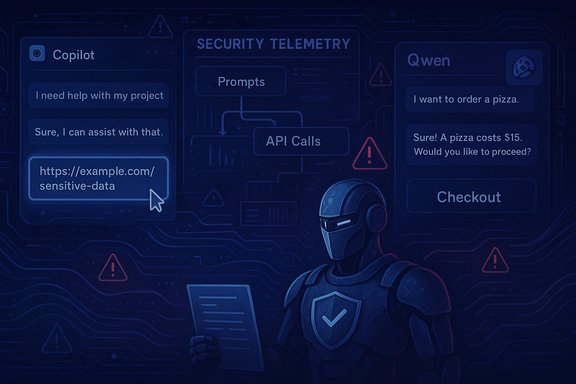
A single click on a Copilot deep link exposed a new class of prompt‑injection exfiltration, security telemetry shows ChatGPT remains the dominant pathway for enterprise generative‑AI data exposure, and Alibaba’s Qwen is pushing conversational commerce from chat into payments — three developments that together illustrate how rapidly useful AI conveniences are colliding with gaps in governance, telemetry and design‑level trust boundaries.
AI assistants and chat models are moving from research curiosities into everyday workflows: they read local files, synthesize context, act as productivity helpers and — increasingly — execute transactions. That shift creates genuine value, but it also amplifies attack surface in predictable and surprising ways. Recent reporting and research converge on three themes:
This was notable for two reasons. First, the attack relied on product UX (prefilled deep links) rather than a classical remote‑code bug; second, much of the exfiltration decision logic ran on vendor‑hosted infrastructure, making detection by local EDR or network egress inspection difficult.
Security teams should act on multiple fronts: patch and verify now, instrument and monitor conversational flows in the near term, and demand design changes (action scoping, intent validation, semantic DLP) from vendors as the default state. Vendors should reciprocate by exposing richer telemetry, enabling enterprise‑grade policy controls on consumer surfaces, and building assistant runtimes that assume no external input is trusted by default.
The technology’s promise is enormous: assistants that reduce friction, automate routine work and even transact on users’ behalf. Realizing that promise without recurring security incidents will require the industry to convert usability‑first conveniences into security‑first primitives — because the next reprompt variant or the next in‑chat commerce exploit will arrive as sure as users keep clicking links and asking assistants to act.
Source: WebProNews https://www.webpronews.com/microsof...Na_VzkRRAIjDcjuFcOPz2-tmM9QzzvNa_H3jWsgoGA==]
 Background / Overview
AI assistants and chat models are moving from research curiosities into everyday workflows: they read local files, synthesize context, act as productivity helpers and — increasingly — execute transactions. That shift creates genuine value, but it also amplifies attack surface in predictable and surprising ways. Recent reporting and research converge on three themes:- A new, composed attack called Reprompt exploited Copilot’s ability to accept prefilled prompts via URL to perform stealthy data exfiltration from Copilot Personal sessions.
- Enterprise telemetry and vendor studies show ChatGPT‑style services are the largest single source of observed generative‑AI data risk in corporate environments, driven by unsanctioned use, clipboard paste habits, and inadequate API governance.
- Consumer AI platforms like Alibaba’s Qwen are accelerating agentic features — in‑chat shopping, payments and bookings — which convert conversation into commerce and raise the stakes for authorization, dispute resolution and fraud controls.
Reprompt: anatomy of a one‑click exfiltration
What Reprompt was (and why it mattered)
Researchers at Varonis Threat Labs demonstrated a composed exploit — dubbed Reprompt — that used a legitimate Copilot deep link containing a prefilled query parameter to inject instructions into an authenticated Copilot Personal session. The proof‑of‑concept combined three relatively small behaviors into a chain that let an attacker harvest profile data, short file summaries and conversational memory with minimal user interaction. Microsoft deployed mitigations for Copilot Personal as part of January 2026 security updates.This was notable for two reasons. First, the attack relied on product UX (prefilled deep links) rather than a classical remote‑code bug; second, much of the exfiltration decision logic ran on vendor‑hosted infrastructure, making detection by local EDR or network egress inspection difficult.
The three building blocks
- Parameter‑to‑Prompt (P2P) injection
Many web assistants accept a query parameter — commonly namedq— that prepopulates the assistant’s input field. Reprompt embeds natural‑language instructions in that parameter so the assistant ingests them as if the user typed them. An authenticated victim clicking a Microsoft‑hosted Copilot link was, in essence, executing an attacker prompt inside their own session context. - Double‑request (repetition) bypass
Observers found that client‑side safety logic was often applied to the initial request. By instructing the assistant to “do it again” or “try twice,” an attacker could cause a second invocation to run under different enforcement and return previously blocked content. This simple repetition undermines naive single‑shot redaction strategies. - Chain‑request orchestration (server‑driven follow‑ups)
After the initial response, an attacker‑controlled server can reply with new instructions that drive successive queries. That server‑side control lets the adversary probe for specific fields and encode exfiltrated snippets into many small outbound transfers, evading bulk‑transfer detection. In some product variants the PoC demonstrated persistence of this interaction even after the chat window was closed.
What the PoC could access
In lab conditions, Reprompt was shown capable of extracting:- Display name and profile attributes.
- Location hints from profile or device context.
- Lists and short summaries of recently accessed files.
- Fragments of conversational memory and past chat summaries.
Microsoft’s response and the timeline
Varonis disclosed the research under responsible disclosure; Microsoft implemented mitigations to Copilot Personal in mid‑January 2026 as part of the Patch Tuesday cycle. Multiple independent outlets corroborated the vendor’s action and advised administrators to verify patch deployment across managed endpoints. Reporting indicates Microsoft 365 Copilot (enterprise) workflows — which are subject to tenant governance, Purview auditing and DLP — were not affected in the same manner. Operators must still verify installed client versions and confirm mitigations apply to their configuration.Broader implications from Reprompt
Why this is a design‑level problem, not just a bug
Reprompt is a microcosm of a larger architectural mismatch: assistants are being given helpful privileges (access to files, chat memory and local context) but not being instrumented with the same provenance, permissioning and DLP semantics we expect on classical APIs and file systems. Treating external inputs as implicitly trusted — e.g., prefilled URL parameters — hands attackers an easy remote prompt injection surface that is hard to assess with traditional controls.Telemetry and detection gaps
Because chain orchestration and follow‑on instructions can be delivered from vendor or attacker‑hosted servers, local network monitoring often sees only benign-looking vendor traffic. Endpoint tools that don’t correlate assistant‑level activity with semantic intent and successive conversational steps will miss multi‑stage exfiltration patterns. Security teams require new telemetry that links natural‑language flows to the underlying API calls and external fetches an assistant issues.Shortcomings of one‑shot safety logic
Guardrails that only operate per initial invocation — or that fail to persist enforcement across repeated or refined prompts — create an obvious bypass route (the “do it twice” heuristic). This exposes a systemic weakness: conversational flows require enforcement that persists across the whole session lifecycle and is semantics‑aware.ChatGPT and enterprise generative‑AI data risk
What recent enterprise telemetry shows
Across multiple enterprise studies and vendor reports, unsanctioned ChatGPT usage and similar consumer‑grade assistants are the most common drivers of generative‑AI data exposure. Two patterns dominate:- Clipboard / paste exfiltration: Employees routinely paste sensitive text, PII or code into public chat assistants to get rapid answers. Standard DLP pipelines don’t capture ephemeral, client‑side clipboard events, making this the most frequent leakage vector.
- Unsanctioned or misconfigured connectors: Browser widgets, third‑party extensions, and ad‑hoc integrations that request broad page or system permissions create blind spots and ambiguous “origin” for data sent to a model. API and OAuth grants, when overly permissive, amplify risk.
Why ChatGPT‑style models concentrate risk
- Market share and familiarity: High DAU/MAU for popular consumer LLMs increases the raw exposure surface.
- Ease of use: Zero‑configuration web access and natural language prompts reduce friction for employees to offload work to public models.
- Lack of enterprise DLP on consumer endpoints: Data sent to consumer LLMs often falls outside corporate logging or policy enforcement.
Operational best practices to reduce ChatGPT‑driven risk
Immediate (hours–days)- Inventory ChatGPT and other LLM touchpoints across web, browser extensions, plugins and integrations.
- Enforce SSO, MFA and conditional access for any official AI console or admin panel.
- Block or restrict access to consumer LLMs on managed devices where regulated data is at risk; funnel high‑sensitivity use to tenant‑managed, non‑training enterprise plans.
- Deploy browser‑level nudges and contextual warnings that intercept paste events and warn users before sending sensitive text to public LLMs.
- Integrate runtime guardrails and semantic DLP engines into agent runtimes and API gateways to prevent risky actions at call time.
- Treat models and agents as first‑class identities with least privilege, ephemeral credentials and explicit EXTRACT permissions for sensitive data.
- Standardize audit trails that correlate natural‑language prompts with the precise downstream API calls and data reads the model performed.
Alibaba’s Qwen: into commerce, payments and policy friction
What the Qwen update does
Alibaba updated its consumer Qwen app to extend capability from conversational QA to in‑chat commerce: ordering food, booking travel and completing payments within the conversation flow. This pushes the assistant from advice to action, reducing friction for users and creating a monetizable conversion path for platforms. The upgrade highlights how agentic features — when paired with payments and booking APIs — can dramatically change the trust model around chat.Why in‑chat commerce raises new governance problems
- Authorization semantics: Conversation becomes a UI for financial actions. Systems must validate user intent, consent and transaction authenticity in ways that go beyond a text‑based affirmation.
- Auditability and dispute resolution: If a model misfires and triggers an incorrect booking or payment, responsibility and remediation pathways are complex: is the platform, merchant, or the AI policy engine liable?
- Fraud and social engineering: Agentic assistants that can order goods or transfer value become attractive targets for account takeover and phishing attacks that coax the model into authorizing unauthorized transactions.
Parallels with Reprompt
Both Reprompt and Qwen’s commerce push reveal the same trade‑off: higher utility requires broader privilege. Whether the privilege is the ability to read local files and chat memory (Copilot) or to execute purchases and payment flows (Qwen), the system must prove intent and maintain provable constraints to avoid misuse. Short‑term fixes (patches, blocking consumer features) help, but the durable solution is built around action scoping, intent validation and auditable control planes.Critical analysis: strengths, weaknesses and systemic risk
Notable strengths
- Rapid productivity gains: Integrated assistants deliver real user value — summarizing documents, surfacing context and automating routine tasks. The business ROI from even modest automation can be substantial.
- Platform evolution: Vendors are rapidly deploying guardrails, DLP integrations and enterprise plans; Microsoft’s efforts to embed Copilot into Windows and Microsoft 365 show a clear product pathway for safe, tenant‑governed AI.
- Ecosystem innovation: Consumer features like Qwen’s in‑chat commerce are pushing user experience forward and creating new commercial models that will be important to watch.
Persistent weaknesses and risks
- Trust by default: UX conveniences that implicitly trust external inputs (prefilled prompts, deep links) create high‑impact remote injection surfaces. Reprompt exploited exactly this assumption.
- Enforcement fragility: One‑shot client‑side checks are insufficient. Enforcement must be session‑persistent and semantics‑aware to handle repetition and chained follow‑ups.
- Visibility gaps: Exfiltration orchestrated through cloud‑hosted follow‑ups defeats many legacy egress and endpoint signals. Detection requires model‑aware telemetry that links conversation to executed fetches.
- Human behavior: Employees pasting sensitive content into consumer assistants will continue to be a major leakage vector until tooling and policy align to block or safely capture those flows.
Systemic risk: scale and automation
Generative AI amplifies scale: a single, well‑crafted phishing campaign that directs users to a malicious deep link can target thousands of users. Agentic assistants that can perform financial actions magnify the potential impact of account takeover or prompt‑injection exploits. Without architectural changes to how assistants treat inputs, sessions and actions, these attack classes will persist and likely evolve.Actionable checklist for Windows admins and security teams
Immediate (within 24–72 hours)- Verify that mid‑January 2026 Copilot patches are installed on managed endpoints and confirm client versions.
- Block or restrict Copilot Personal on corporate devices where governance cannot be guaranteed; prefer tenant‑managed Microsoft 365 Copilot for enterprise use cases.
- Educate users and triage email or chat filters to flag Copilot deep links and unknown Copilot URLs.
- Deploy browser‑level paste monitoring and user‑facing warnings for data that matches sensitive patterns before it leaves the endpoint.
- Implement conditional access and SSO/MFA for all enterprise AI consoles and admin panels.
- Integrate semantic DLP into AI runtimes and agent gateways, requiring explicit EXTRACT permissions for any content to be shipped externally.
- Instrument prompt and retrieval paths in logs so incident response can correlate natural‑language prompts with downstream fetches and API calls.
- Treat agents and models as identities: require ephemeral creds, least‑privilege roles, and human confirmation for financial or high‑impact actions.
- Run red‑team exercises that simulate chained prompt‑injection and repetition bypasses; ensure enforcement persists across repeated interactions.
Design patterns the industry should adopt
- Immutable instruction hierarchy: system‑level constraints that cannot be overridden by user or external content. This prevents arbitrary prompt overrides during agent execution.
- Action scoping and intent validation: define narrow action primitives (book‑flight, charge‑card) with explicit intent confirmation, human approval options and auditable API calls.
- Semantic DLP and session persistence: guardrails that analyze conversational flows, detect multi‑stage exfiltration patterns, and maintain enforcement across all repeats and follow‑ups.
- Runtime guardrails and observable outputs: combine pre‑deployment vetting with in‑flight decision engines that can block risky outputs and produce machine‑readable audit trails.
Conclusion
The recent Copilot Reprompt disclosure, enterprise telemetry around ChatGPT‑style data risk, and Alibaba’s Qwen push into commerce form a coherent narrative: assistants are now powerful, but product convenience without durable, semantics‑aware trust boundaries is an open invitation to abuse. Short‑term patches and vendor hardenings are necessary and must be deployed immediately; longer‑term safety requires architectural changes that treat external inputs as untrusted, enforce persistent safety across conversational lifecycles, and bind agent actions to auditable, least‑privilege control planes.Security teams should act on multiple fronts: patch and verify now, instrument and monitor conversational flows in the near term, and demand design changes (action scoping, intent validation, semantic DLP) from vendors as the default state. Vendors should reciprocate by exposing richer telemetry, enabling enterprise‑grade policy controls on consumer surfaces, and building assistant runtimes that assume no external input is trusted by default.
The technology’s promise is enormous: assistants that reduce friction, automate routine work and even transact on users’ behalf. Realizing that promise without recurring security incidents will require the industry to convert usability‑first conveniences into security‑first primitives — because the next reprompt variant or the next in‑chat commerce exploit will arrive as sure as users keep clicking links and asking assistants to act.
Source: WebProNews https://www.webpronews.com/microsof...Na_VzkRRAIjDcjuFcOPz2-tmM9QzzvNa_H3jWsgoGA==]
