

Enterprise IT teams woke up this week to two uncomfortable truths: a single-click prompt trick can siphon sensitive data from a consumer Copilot session, and independent telemetry shows a handful of public chatbots — led by ChatGPT — now account for the lion’s share of generative‑AI data exposures inside organizations.
Two distinct but related developments converged in mid‑January 2026 and together sharpen the operational risk picture for teams deploying AI at scale. First, security researchers published a practical proof‑of‑concept called Reprompt that chains ordinary UX conveniences in Microsoft Copilot Personal into a stealthy exfiltration flow that can be triggered by a single deep link. Second, vendor telemetry analyses of millions of prompts in 2025 show that a very small set of consumer GenAI tools account for the majority of observed sensitive‑data exposure events — with ChatGPT disproportionately represented.
Both stories are symptoms of the same structural issue: convenience features that expand an assistant’s privileges without concurrent, persistent governance or telemetry. The combination of high popularity, unmanaged personal accounts, clipboard/paste habits, browser extensions, and agentic features (in‑chat commerce or automation) creates multiple low‑visibility rails through which high‑value data can leave a corporate environment.
Key mechanics of the Reprompt chain:
Operational drivers behind this skew:
The good news is that many of the immediate exposures are addressable by focused governance: controlling a small number of high‑impact consumer applications, forcing enterprise‑grade account controls, and embedding runtime enforcement where agents actually act. The harder work — redesigning trust boundaries so convenience features don’t imply privilege without consent — will take longer and require coordinated product, security, and legal effort.
Enterprises that treat models and agents as production identities, instrument every read/write path with auditable policy checks, and accept the operational work required to shift sensitive tasks into managed pipelines will be best positioned to preserve AI’s benefits while materially reducing data exposure risk.
Technical patches will close the immediate Reprompt vector, but the underlying architectural gaps — untrusted input handling, ephemeral client‑side events, and agentic privileges — are systemic. The next phase of enterprise AI security must be less about single patches and more about making AI a first‑class, governed platform with identity, least privilege, and auditability baked into every interaction.
Source: digit.fyi https://www.digit.fyi/chatgpt-security-risk/]
 Background: what changed and why it matters
Two distinct but related developments converged in mid‑January 2026 and together sharpen the operational risk picture for teams deploying AI at scale. First, security researchers published a practical proof‑of‑concept called Reprompt that chains ordinary UX conveniences in Microsoft Copilot Personal into a stealthy exfiltration flow that can be triggered by a single deep link. Second, vendor telemetry analyses of millions of prompts in 2025 show that a very small set of consumer GenAI tools account for the majority of observed sensitive‑data exposure events — with ChatGPT disproportionately represented.Both stories are symptoms of the same structural issue: convenience features that expand an assistant’s privileges without concurrent, persistent governance or telemetry. The combination of high popularity, unmanaged personal accounts, clipboard/paste habits, browser extensions, and agentic features (in‑chat commerce or automation) creates multiple low‑visibility rails through which high‑value data can leave a corporate environment.
Overview of the technical findings
The Reprompt proof‑of‑concept: a one‑click exfiltration chain
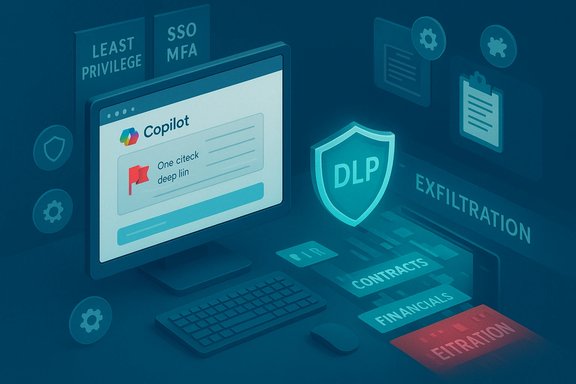
Researchers at a threat lab demonstrated that a Copilot deep link — a legitimate Microsoft URL that prepopulates the assistant’s input box — can be crafted to carry attacker instructions. By combining three simple behaviors, the attacker can orchestrate a multistage data‑exfiltration pipeline that runs largely under the victim’s authenticated session and which can be difficult for local network monitoring to detect.Key mechanics of the Reprompt chain:
- Parameter‑to‑Prompt (P2P) injection: the deep link’s query parameter is used to inject a prompt into Copilot as if the user had typed it.
- Double‑request (repetition) bypass: some client‑side redaction or safety checks apply only to the initial invocation; asking the assistant to “do it again” or to retry can produce outputs that evade single‑shot enforcement.
- Chain‑request orchestration: follow‑up instructions hosted on attacker‑controlled servers can probe for different fields and exfiltrate small fragments across multiple benign‑looking outbound requests, fragmenting the theft to stay under volume‑based detection thresholds.
- Extremely low friction for the attacker — a single trusted Microsoft link in an email or chat increases click probability.
- The assistant inherits the calling user’s context and Graph privileges, enabling access to display names, short file summaries or chat memory fragments.
- Much of the orchestration can happen on vendor‑hosted or external servers, leaving only normal vendor egress traffic in local logs and creating blind spots for conventional DLP and network monitoring.
Telemetry: ChatGPT and the “big six” dominate measured risk
Independent analysis of generative‑AI prompt telemetry across 2025 — looking at more than 22 million prompts — shows an extreme skew: roughly six consumer GenAI applications make up over 90% of measured potential data exposure, and ChatGPT alone accounts for more than 70% of those exposures while representing less than half of the total prompts.Operational drivers behind this skew:
- Popularity concentration: a high daily/monthly active user base produces more opportunities for accidental or deliberate sensitive uploads.
- Personal/free account use: many employees use free or personal accounts on corporate devices, creating paths that bypass SSO, audit trails, and enterprise non‑training/retention guarantees.
- Clipboard/paste workflows: employees frequently copy and paste code snippets, contract language, or other unstructured sensitive text into chatboxes; these ephemeral client‑side actions often escape classic DLP instrumentation.
- Browser extensions and embedded widgets: third‑party tools with broad DOM or networking permissions create ambiguous “origins” for data leaving endpoints.
What this means for Windows and enterprise teams
Short‑term emergency actions (hours to days)
- Verify patches and mitigate Reprompt vectors — ensure clients and components that implement Copilot Personal and related web integrations are updated to the vendor‑released mitigations.
- Restrict consumer Copilot on corporate assets — where tenant governance is required, prefer managed Microsoft 365 Copilot configurations tied to enterprise Purview/DLP and block or remove consumer Copilot Personal from managed devices.
- Apply immediate access controls — enforce SSO, MFA, and conditional access for any official AI consoles or admin UIs; block non‑enterprise AI domains in high‑sensitivity groups where practical.
- Treat AI deep links as suspicious — implement URL rewriting, email gateway inspection, and user education for unexpected or unsolicited deep links.
Medium‑term tactical steps (weeks to months)
- Deploy browser‑level warnings and paste‑interception nudges to warn users when they paste potentially sensitive text into an external AI service.
- Integrate semantic DLP into the agent runtime and API gateways that handle AI calls; move beyond simple regex scanning to content‑aware classification and masking.
- Inventory and block or tightly control third‑party browser extensions that request page content or cross‑origin permissions on managed devices.
- Funnel high‑sensitivity AI tasks to tenant‑managed, non‑training enterprise plans or on‑prem/hosted RAG setups where the enterprise controls retention, training exclusions, and telemetry.
Long‑term architectural changes (months to years)
- Treat models and agents as first‑class identities: assign least privilege, ephemeral credentials, and explicit extract permissions for sensitive data.
- Standardize provable audit trails that correlate a natural‑language prompt to the exact downstream reads and API calls that produced the output.
- Build runtime enforcement into agent control planes (pre‑execution webhooks or synchronous policy checks) so that dangerous actions can be blocked before they run.
- Invest in hybrid deployment models that keep sensitive retrieval and reasoning inside enterprise boundaries while leveraging public models for lower‑sensitivity tasks.
Strengths, mitigations and vendor movement
Strengths in the current vendor response
- Security researchers and vendors are disclosing practical attack flows and publishing mitigations quickly, which helps reduce immediate exposure.
- Enterprise features in major AI platforms (tenant‑managed Copilot, Purview DLP, enterprise non‑training plans) provide real levers for governance when organizations adopt them.
- Runtime enforcement integrations — synchronous security webhooks and guardrails in agent platforms — are beginning to appear as a category of solutions, enabling policy checks before an agent performs an action.
Effective mitigations in practice
- Least‑privilege configuration for any agent or assistant that can reach internal systems.
- Segregated AI accounts: force enterprise SSO for any account used for work, and ban or heavily restrict personal AI accounts on corporate devices.
- Endpoint hygiene: remove or restrict browser extensions that are not approved, and monitor extension telemetry for automatic updates that change behavior.
- Semantic DLP and logging: focus on content classification and retention policies that detect and quarantine risky uploads in near real time.
Risks, gaps and residual concerns
Detection blind spots remain
Reprompt and similar flows exploit that much of the exfiltration can look like legitimate vendor traffic; traditional egress monitoring and volume‑based detection can miss low‑volume, fragmentary theft that blends into normal service calls.Human behavior is the hardest control
Clipboard/paste convenience and the impulse to get a quick answer — especially in deadline‑driven contexts — make humans the central failure point. Technical controls can deter or detect, but they cannot fully remove the risk without user behavior change and friction‑aware guardrails.Third‑party telemetry and vendor claims vary
Large telemetry studies are useful for prioritization, but their findings depend on the dataset’s composition, the monitoring points in use, and classification heuristics. A small set of consumer apps dominating measured exposures in one vendor’s telemetry does not mean they are the only source of risk in every environment; security teams should validate risk models against their own organization’s usage patterns.Agentic commerce and transactional assistants raise new liability vectors
When chat assistants move from answers to actions — executing purchases, bookings or payments inside a conversation — the trust model shifts dramatically. Authorization, user intent validation, dispute resolution and fraud prevention must be rethought for an environment where a model can request or push financial transactions.Practical playbook: a prioritized checklist for the next 90 days
- Immediately:
- Confirm January patch deployment for Windows, Edge, and relevant Copilot clients on corporate devices.
- Block consumer Copilot Personal where tenant governance is required; enable enterprise Copilot with Purview auditing for approved users.
- Announce a short, clear policy on using personal AI accounts on corporate devices and begin enforcement.
- Within two weeks:
- Roll out browser paste warnings and require explicit consent for pasting documents or code into external sites for teams that handle sensitive data.
- Audit and remove unapproved browser extensions; add extension‑usage telemetry to endpoint monitoring.
- Within one month:
- Integrate semantic DLP into agent runtimes and API gateways.
- Define and enforce a classification scheme for AI uploads (code, legal, M&A, PII, credentials) and create automatic blocking or redact workflows for the highest‑risk classes.
- Over the next quarter:
- Implement synchronous runtime policy checks for any internal agent platform or Copilot Studio usage.
- Build a trusted RAG (retrieval‑augmented generation) pathway that keeps sensitive retrieval and document processing inside the enterprise boundary.
- Run red‑team exercises that simulate Reprompt‑style exfiltration and agent prompt‑injection attacks to validate detection and response.
A sober look forward
Generative AI is delivering real productivity gains, and enterprises will rightly want to keep using it. But the risk calculus is changing: value is being extracted by assistants that also extend the attack surface into ephemeral, conversational, and agentic channels that legacy tooling was not designed to observe.The good news is that many of the immediate exposures are addressable by focused governance: controlling a small number of high‑impact consumer applications, forcing enterprise‑grade account controls, and embedding runtime enforcement where agents actually act. The harder work — redesigning trust boundaries so convenience features don’t imply privilege without consent — will take longer and require coordinated product, security, and legal effort.
Enterprises that treat models and agents as production identities, instrument every read/write path with auditable policy checks, and accept the operational work required to shift sensitive tasks into managed pipelines will be best positioned to preserve AI’s benefits while materially reducing data exposure risk.
Conclusion
The mid‑January disclosures serve as a practical wake‑up call: a simple UX convenience can be composed into a highly effective exfiltration rail, and the empirical risk landscape shows a small set of public chatbots are responsible for a majority of measured AI data exposures. These two facts should focus enterprise defenders on high‑leverage actions — enforcing enterprise accounts and telemetry, deploying semantic DLP and runtime guardrails, and hardening browser/endpoint controls — rather than attempting indiscriminate blocking that disrupts productivity.Technical patches will close the immediate Reprompt vector, but the underlying architectural gaps — untrusted input handling, ephemeral client‑side events, and agentic privileges — are systemic. The next phase of enterprise AI security must be less about single patches and more about making AI a first‑class, governed platform with identity, least privilege, and auditability baked into every interaction.
Source: digit.fyi https://www.digit.fyi/chatgpt-security-risk/]
