

A coalition-backed analysis now sweeping headlines quietly takes the wind out of one of Big Tech’s most persistent climate narratives: the idea that artificial intelligence will be a near-term savior for global emissions. The report — authored by energy analyst Ketan Joshi and commissioned by nonprofits including Beyond Fossil Fuels and Climate Action Against Disinformation — examined 154 corporate statements and found the evidence base for headline claims thin, inconsistent, and in some cases self-referential, calling into question the oft-repeated assertion that AI could cut 5–10% of global greenhouse gas emissions by 2030.
AI’s climate promise has become a staple of corporate sustainability messaging: vendors and cloud providers routinely point to case studies where machine learning optimizes logistics, reduces energy use in buildings, or improves industrial efficiency. Those use cases are real and, in certain niches, demonstrable. But the new analysis warns that the industry’s public narrative frequently conflates those traditional machine-learning wins with the very different economics and energy dynamics of generative AI — the large language models and multimorollout has driven exponential demand for specialized datacenter capacity.
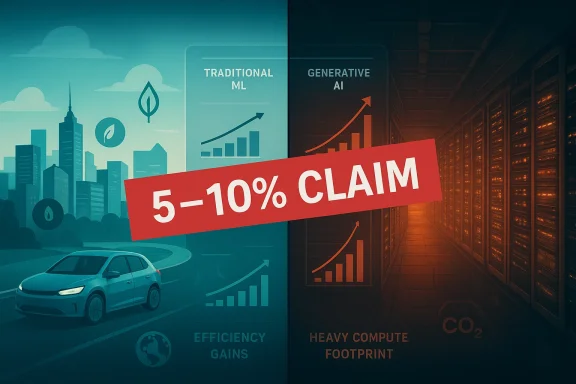
Why this matters: traditional ML workloads (classification, forecasting, predictive maintenance) are often lightweight and yield efficiency gains within specific processes. Generative AI training and inference at scale demand far more compute, specialized chips, and dense datacenter footprints — with distinct energy, supply-chain, and infrastructure implications that can offset, or even exceed, claimed benefits when presented without rigorous, context-specific accounting.
This isn’t merely an academic quibble. When a multi-trillion-dollar technology becomes a public rationale for aggressive infrastructure build-outs, policy changes, investment, and reputational latitude, the provenance of headline claims should be transparent and independently reproducible. The report’s careful tracing of that 5–10% figure exposes how corporate narratives can ossify into received wisdom — even when the empirical scaffolding is thin.
This matters for more than headline accuracy. When companies use these claims to justify accelerated datacenter deployment, shareholder narratives, or public policy positions — including requests for grid prioritization, tax incentives, or fast-tracked permits — independent verification should be the bar. Without it, there’s real risk that investments will lock in emissions that outweigh the claimed benefits.
Where claims were supported, the strongest examples typically shared three features:
Those responses highlight two realities. First, large cloud providers do have internal methodologies and numerous cusowing real efficiency improvements. Second, the scope and transferability of those efficiencies are often limited: a vendor can credibly show savings in a fleet of refrigerated trucks without demonstrating that its broader generative AI services will reduce industrial emissions on a global scale. The debate is therefore less about whether AI can ever reduce emissions and more about where, how much, and who should verify those claims.
For IT leaders and sustainability officers, the report is a call to sharpen procurement practices, demand reproducible baselines, and treat generative AI differently from old-school ML in emissions accounting. For regulators, it is a prompt to accelerate disclosure standards that match the scale of interest and risk. And for the public, it is a reminder that technological optimism must be balanced with empirical rigor — especially when environmental policy and large infrastructure investments hang in the balance.
Ultimately, AI can be part of the decarbonization toolset, but it is not a substitute for rigorous climate policy and proven low-carbon investments. The future will be decided not by slogans about saving the planet, but by the slow, often unglamorous work of measurement, verification, and accountable deployment.
Source: Dagens.com Think AI is saving the planet? New study says think again
 Background
AI’s climate promise has become a staple of corporate sustainability messaging: vendors and cloud providers routinely point to case studies where machine learning optimizes logistics, reduces energy use in buildings, or improves industrial efficiency. Those use cases are real and, in certain niches, demonstrable. But the new analysis warns that the industry’s public narrative frequently conflates those traditional machine-learning wins with the very different economics and energy dynamics of generative AI — the large language models and multimorollout has driven exponential demand for specialized datacenter capacity.Why this matters: traditional ML workloads (classification, forecasting, predictive maintenance) are often lightweight and yield efficiency gains within specific processes. Generative AI training and inference at scale demand far more compute, specialized chips, and dense datacenter footprints — with distinct energy, supply-chain, and infrastructure implications that can offset, or even exceed, claimed benefits when presented without rigorous, context-specific accounting.
Where the “5–10%” figure came from — and why that tracing matters
One of the clearest findings of the review is the origin story of the oft-tweeted “AI could reduce 5–10% of global emissions by 2030” stat. That number traces back to a consultancy report commissioned by Google, which in turn cited a 2021 company blogpost discussing results "from experience with clients." In other words, a headline global estimate has a lineage that runs through corporate case studies and consultancy synthesis rather than independent, peer-reviewed modeling.This isn’t merely an academic quibble. When a multi-trillion-dollar technology becomes a public rationale for aggressive infrastructure build-outs, policy changes, investment, and reputational latitude, the provenance of headline claims should be transparent and independently reproducible. The report’s careful tracing of that 5–10% figure exposes how corporate narratives can ossify into received wisdom — even when the empirical scaffolding is thin.
The review: scope, methods, and headline findings
The Joshi report evaluated 154 distinct public statements from major technology firms, cloud providers, and corporate sustainability com each claim for evidence quality, whether it referenced peer-reviewed work, and whether the claim conflated different AI technologies or workload types. The analysis found:- Only 26% of environmental benefit statements referenced peer-reviewed academic research.
- 36% of claims included no supporting evidence at all.
- No example was identified in which current mainstream generative systems (named in the review as examples such as Google’s Gemini or Microsoft’s Copilot) produced a material, verifiable, and substantial reduction in greenhouse gas emissions.
Datacenter growth and the missing math
Corporate messaging that focuses on efficiency gains often downplays the countervailing trend: the rapid expansion of datacenter electricity demand driven by AI. Several major, independent analyses converge on the same uncomfortable picture.- Datacentres are estimated to consume roughly 1% of global electricity today, but projections show substantial growth tied to AI workloads and hyperscale investments.
- BloombergNEF (BNEF) projects that data centers in the United States alone could account for about 8.6% of U.S. electricity demand by 2035 — more than double their current share. Those figures are part of a broader BNEF forecast that data-center-related power needs will be one of the largest new sources of electricity demand in the coming decade.
- The International Energy Agency (IEA) warns that data centers may drive at least 20% of electricity demand growth in advanced economies by the end of the decade, and that AI-optimized data centers could more than quadruple energy consumption associated with AI services by 2030.
Generative AI vs. “old-school” ML: different animals, different footprints
A recurring theme in the review is conceptual slippage: statements that credit “AI” generically for emission reductions while the supporting evidence applies to very different algorithms.- Traditional ML examples that yield verifiable emissions reductions are commonly optimization tasks: routing trucks more efficiently, predicting wind output to reduce curtailment, or improving heating, ventilation and air-conditioning (HVAC) controls — all useful but bounded in scale.
- Generative AI (large language models, image/video synthesis) demands orders of magnitude more GPU-hours for training and, depending on deployment scale, substantial inference energy — especially when models are served at low latency to millions of users.
Evidence quality: peer review, methodology, and transparency
The report’s coding of claims found that only about a quarter referenced peer-reviewed research. Many statements rested on corporate case studies, consultancy modeling, or internal estimates that are hard or impossible to reproduce externally.This matters for more than headline accuracy. When companies use these claims to justify accelerated datacenter deployment, shareholder narratives, or public policy positions — including requests for grid prioritization, tax incentives, or fast-tracked permits — independent verification should be the bar. Without it, there’s real risk that investments will lock in emissions that outweigh the claimed benefits.
Where claims were supported, the strongest examples typically shared three features:
- Clear baseline and counterfactual definitions (what emissions would have been without the AI intervention).
- Transparent measurement periods and units (kgCO2e saved per year, per process).
- Independent replication or third-party audit.
Industry pushback and the case for nuance
Big Tech does not accept the critique wholesale. Google, for instance, has responded that its emissions-reduction estimates are “based on a robust substantiation process grounded in the best available science,” and says it has transparently shared the principles and methodology behind those claims. Microsoft declined to comment to the reporting outlets cited by the analysis. The IEA did not respond to requests for comment in one of the investigative pieces.Those responses highlight two realities. First, large cloud providers do have internal methodologies and numerous cusowing real efficiency improvements. Second, the scope and transferability of those efficiencies are often limited: a vendor can credibly show savings in a fleet of refrigerated trucks without demonstrating that its broader generative AI services will reduce industrial emissions on a global scale. The debate is therefore less about whether AI can ever reduce emissions and more about where, how much, and who should verify those claims.
Risks: greenwashing, lock-in, and distorted policy
If unchecked, the pattern identified by the report could produce three concrete harms:- Greenwashing: Broad, poorly-evidenced claims can give companies a sustainability halo that masks substantive emissions associated with datacenter expansion, chip manufacturing, and increased electricity consumption. Critics argue this mirrors tactics historically used by fossil-fuel companies — shifting attention from core emissions to marginal efficiency stories.
- Infrastructure lock-in: Large, long-lived datacenter projects and associated grid upgrades can lock regions into particular energy mixes and capital allocations. If these projects are justified on exaggerated climate benefits, communities and regulators may accept worse outcomes than a rigorous accounting would justify.
- Policy distortion: If policymakers accept headline AI-era emission savings without rigorous evidence, they may underinvest in proven decarbonization levers (electrification, energy efficiency at scale, renewables deployment) or fail to apply necessary regulatory guardrails to hyperscale c of these risks is avoidable if transparency and measurement standards improve. The report calls explicitly for stronger evidence practices and clearer distinctions between AI workload types.
Practical guidance for IT leaders, buyers, and regulators
The report and associated analysis produce a practical checklist for decision-makers who must balance AI adoption with credible sustainability commitments.- Demand rigorous baselines: Require vendors to provide clear counterfactuals (what would emissions have been without the AI deployment?) and standard metrics (kgCO2e per unit of service).
- Differentiate workloads: Treat generative AI and predictive/optimization ML as separate categories in procurement, carbon accounting, and regulatory filings.
- Insist on third-party audits: Where claims affect public policy, grid access, or community energy planning, independent verification should be mandatory.
- Include rebound effects in assessments: Model second-order impacts — e.g., AI-enabled increased consumption, new product categories, or faster hardware churn — and factor them into net-benefit calculations.
- Prioritize energy transparency: Request site-level, time-resolved energy and carbon accounting for datacenter operations, not only high-level commitments to renewables.
- Ask for lifecycle accounting: Evaluate not just operational electricity but embodied emissions from hardware manufacturing and chip supply chains.
- Evaluate geographic effects: Assess whether a vendor’s datacenter growth will shift emissions to regions with carbon-intensive electricity mixes.
- Use procurement levers: Tie cloud contracts to transparency, independent verification, and measured KPIs for real-world emissions reductions.
What the numbers actually say: parsing BNEF and IEA forecasts
Two of the most important, independent data points in this debate come from BloombergNEF and the International Energy Agency:- BloombergNEF’s forecasting work predicts substantial growth in data-center electricity demand, with the U.S. share potentially reaching around 8.6% of total electricity demand by 2035 in certain scenarios. That projection underscores the scale of the infrastructure challenge facing grids and regulators.
- The IEA’s Energy and AI analyses conclude that data centers will be among the largest new contributors to electricity demand growth in advanced economies over the coming decade, potentiare than 20% of growth in some baselines. Those projections reinforce the systemic implications of unconstrained datacenter expansion.
Strengths of the new analysis — what it does well
The report’s strengths are concrete and practical:- Transparent methodology: Coding 154 public claims and assessing evidence quality produces an audit trail that journalists, regulators, and researchers can interrogate.
- Focus on conceptual clarity: Drawing a bright line between generative and traditional ML use cases helps clarify where verified emissions reductions have been achieved and where claims are speculative.
- Policy relevance: By identifying the provenance of the widely-cited 5–10% stat, the analysis reshapes how policymakers and procurement officials should treat vendor claims.
Weaknesses and limits of the analysis
No single assessment can answer every question. Important caveats include:- The report focuses on public statements and marketed claims; it does not comprehensively audit every possible project where AI has delivered measurable emissions savings.
- Measurement complexity: Quantifying net emissions impact across supply chains, rebound effects, and grid interactions is extremely difficult. Some genuinely beneficial projects could be undercounted because vendors do not publish the detailed, auditable data the report asks for.
- Temporal scope: The report scrutinizes near-term claims (e.g., reductions by 2030). Longer-horizon systemic effects — for example, if AI accelerates decarbonization in certain industrial sectors over a multi-decade timeline — are outside its immediate scope.
Policy and industry implications: toward audited claims and enforceable standards
The debate now shifts from critique to remedies. Three pragmatic regulatory and industry-level responses could improve signal quality and reduce the risk of greenwashing:- Standardize disclosure: Mandate time-resolved (hourly) energy and emissions reporting for hyperscale datacenters, with independent verification.
- Adopt reporting standards: Extend existing carbon accounting standards to explicitly cover AI-related compute, including training, inference, and model lifecycle emissions.
- Condition incentives: Tie public subsidies, zoning approvals, and grid prioritization to demonstrable, third-party-verified net-emissions outcomes rather than vendor assertions.
Conclusion: sober realism over boosterism
The takeaway is not that AI has no role in climate solutions — it clearly can, in targeted applications. The takeaway is that headline narratives claiming AI will unilaterally solve a large share of global emissions by 2030 are, at best, optimistic and, at worst, rooted in insufficient evidence. The independent analysis commissioned by climate groups serves a necessary purpose: it forces vendors, buyers, and policymakers to translate marketing lines into reproducible, transparent, and auditable claims.For IT leaders and sustainability officers, the report is a call to sharpen procurement practices, demand reproducible baselines, and treat generative AI differently from old-school ML in emissions accounting. For regulators, it is a prompt to accelerate disclosure standards that match the scale of interest and risk. And for the public, it is a reminder that technological optimism must be balanced with empirical rigor — especially when environmental policy and large infrastructure investments hang in the balance.
Ultimately, AI can be part of the decarbonization toolset, but it is not a substitute for rigorous climate policy and proven low-carbon investments. The future will be decided not by slogans about saving the planet, but by the slow, often unglamorous work of measurement, verification, and accountable deployment.
Source: Dagens.com Think AI is saving the planet? New study says think again
