

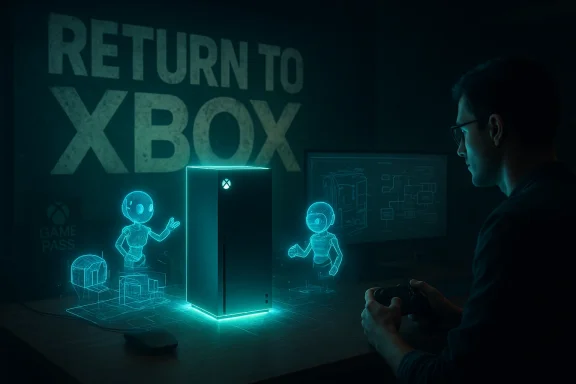
Microsoft’s gaming leadership has flipped the script this week: a senior AI executive is now running Xbox, the longtime face of the division is stepping aside, and the new leaders are promising a “Return to Xbox” that explicitly starts with hardware, culture, and a resistance to what they call the rising tide of mindless AI-driven content. What looks like a tidy memo on paper is, in practice, a high-stakes strategic reset that touches hardware roadmaps, first-party content strategy, developer relationships, and the commercial future of Xbox as a platform.
For nearly two decades, Xbox’s public identity was built around three pillars: a console platform, a set of first-party studios and franchises, and services that connect players across devices. Under its most visible leader over the last decade, the division leaned hard into subscription services, cloud streaming, and cross-platform availability—moves that reshaped Xbox from a hardware-first brand to a service-led platform anchored by Game Pass.
That strategy remade how millions play and how developers ship, but it also left unresolved tensions: hardware sales never matched the PlayStation franchise’s head-to-head momentum, some fans worried Xbox had grown distant from its console roots, and creators flagged concerns about generative AI and how it might be applied to game development and monetization.
This week’s leadership transition is both a signal and a course correction. Asha Sharma, a product and AI leader from Microsoft’s CoreAI organization, has been named CEO of Microsoft Gaming. Matt Booty, long associated with first-party studios and production leadership, has been elevated to Chief Content Officer. Phil Spencer’s departure—after a long run as the public face of Xbox—and the exit of Xbox President Sarah Bond, mark an abrupt recalibration of who decides Xbox strategy and how that strategy will be communicated to players and partners.
There are three headline commitments implicit in that language:
First, as an outsider to the games industry by trade, Sharma brings product discipline and platform thinking—skills Microsoft believes are necessary to reconcile the modern realities of software-defined gaming ecosystems with hardware commitments. Second, her AI pedigree means a leader who understands the technology’s promise as well as its pitfalls; her rhetoric on AI-driven content suggests a deliberate boundary-setting approach rather than a natural rejection of the tech.
Matt Booty’s promotion to Chief Content Officer anchors the creative side. Booty is a proven studio executive with deep relationships across Xbox Game Studios, and his elevation signals that Microsoft intends to keep creative authority close to experienced game makers. That’s important when a leader whose roots are outside game development is promising to defend “human-crafted” art.
Phil Spencer’s role in Xbox’s renaissance over the last decade is undeniable: under his tenure, Xbox embraced services-first economics, spent heavily on studios, and built Game Pass into the industry’s most consequential subscription model. His phased exit—still involving a transition period by some reports—creates both an opening for fresh perspective and a risk of losing a leader uniquely skilled at industry diplomacy.
Flag: Claims that a new Xbox console is already in development or has a release window are currently unverified outside company statements about intent. Readers should treat hardware timelines as aspirational until Microsoft publishes technical and commercial details.
On one hand, Microsoft is deeply invested in AI across its corporate stack; its Azure AI business and internal product teams are prime beneficiaries of generative tooling. On the other, game developers and players have legitimate concerns. Generative models applied to art, narrative, and voice risk trivializing craft and generating low-quality content that undermines player trust.
Sharma’s language suggests a dual approach:
Sharma emphasized that Xbox studios and franchises remain central, and she committed to “not treat those worlds as static IP to milk and monetize.” That sounds like a pledge to preserve the creative integrity and long-term stewardship of franchises rather than turning them into purely extractive revenue engines. It also suggests Xbox will prioritize meaningful exclusivity when it serves player experience and platform differentiation—but is unlikely to re-impose a strict “console-only” doctrine overnight.
For publishers and developers, a few practical changes could follow:
But the plan’s vagueness is purposeful: Microsoft must maintain flexibility across multiple business lines. That’s sensible for a corporation with enormous breadth, but it won’t satisfy fans who want a hard promise of a new, exclusive console generation. Likewise, developers wary of corporate mixed messages will want detail on incentives and tooling.
Key blind spots:
But messaging without measurable actions will quickly lose credibility. The next six to twelve months are therefore decisive: we will be watching for hardware roadmaps, developer tooling and policy documents, and the first tangible ways Xbox channels its renewed console-first identity into unique player experiences. If Microsoft follows up rhetoric with commitments that are clear, timely, and demonstrably supportive of creative craft, the “Return to Xbox” can be a constructive recalibration. If the promises remain mostly rhetorical, the company risks disappointing the same audiences it’s trying to win back.
For now, the new leadership has put down a marker. The question is whether Microsoft will build the path to it—or merely talk about the destination.
Source: TechPowerUp New Xbox Bosses Promise "Return to Xbox" With Hardware and "Renegade" Spirit | TechPowerUp}
 Background
For nearly two decades, Xbox’s public identity was built around three pillars: a console platform, a set of first-party studios and franchises, and services that connect players across devices. Under its most visible leader over the last decade, the division leaned hard into subscription services, cloud streaming, and cross-platform availability—moves that reshaped Xbox from a hardware-first brand to a service-led platform anchored by Game Pass.That strategy remade how millions play and how developers ship, but it also left unresolved tensions: hardware sales never matched the PlayStation franchise’s head-to-head momentum, some fans worried Xbox had grown distant from its console roots, and creators flagged concerns about generative AI and how it might be applied to game development and monetization.
This week’s leadership transition is both a signal and a course correction. Asha Sharma, a product and AI leader from Microsoft’s CoreAI organization, has been named CEO of Microsoft Gaming. Matt Booty, long associated with first-party studios and production leadership, has been elevated to Chief Content Officer. Phil Spencer’s departure—after a long run as the public face of Xbox—and the exit of Xbox President Sarah Bond, mark an abrupt recalibration of who decides Xbox strategy and how that strategy will be communicated to players and partners.
What “Return to Xbox” actually means
Right away, Sharma framed the shift as cultural, creative, and practical. She described the “Return to Xbox” less as a rollback and more as a renewed emphasis on the values fans associate with the brand: surprise, experimentation, renegade spirit, and fun. Practically, she added, that emphasis “starts with the console,” and she pledged to protect the investments players have made in Xbox hardware and communities.There are three headline commitments implicit in that language:
- A console-first reassurance to long-term fans and stakeholders that hardware matters to Xbox’s identity.
- A creative guardrail against overreliance on automations and procedural content that undermine craftsmanship—summed up in her pledge not to “flood our ecosystem with soulless AI slop.”
- A developer-friendly platform posture that aims to reduce friction between devices so studios can “build once and reach players everywhere” without technical or commercial compromise.
The new leadership team: who they are and why it matters
Asha Sharma’s background is not traditional Xbox pedigree. She rose within Microsoft as an AI and product executive and has a history outside gaming at consumer-focused companies. That profile is consequential in two ways.First, as an outsider to the games industry by trade, Sharma brings product discipline and platform thinking—skills Microsoft believes are necessary to reconcile the modern realities of software-defined gaming ecosystems with hardware commitments. Second, her AI pedigree means a leader who understands the technology’s promise as well as its pitfalls; her rhetoric on AI-driven content suggests a deliberate boundary-setting approach rather than a natural rejection of the tech.
Matt Booty’s promotion to Chief Content Officer anchors the creative side. Booty is a proven studio executive with deep relationships across Xbox Game Studios, and his elevation signals that Microsoft intends to keep creative authority close to experienced game makers. That’s important when a leader whose roots are outside game development is promising to defend “human-crafted” art.
Phil Spencer’s role in Xbox’s renaissance over the last decade is undeniable: under his tenure, Xbox embraced services-first economics, spent heavily on studios, and built Game Pass into the industry’s most consequential subscription model. His phased exit—still involving a transition period by some reports—creates both an opening for fresh perspective and a risk of losing a leader uniquely skilled at industry diplomacy.
Hardware: commitment or marketing language?
Sharma’s public lines are simple: “Xbox starts with console” and “I am committed to Xbox, starting with the console.” That phrasing has two immediate and important implications for readers and industry watchers.- It restores hardware to the rhetorical front row. For years Xbox messaging emphasized services and ubiquity; this statement signals that Microsoft will reassert the console as the primary place Xbox invests for certain experiences and as the core locus of the platform’s identity.
- It leaves open the form factor and timing of any future hardware. Sharma indicated that new hardware information would be forthcoming—words that fans naturally translate into a refreshed console cycle or new device categories (handhelds, hybrid PC-console devices, or a "Pro" revision). However, Microsoft has not published a publicly confirmed hardware roadmap, and no firm specs, release dates, component choices, or manufacturing commitments have been announced.
Flag: Claims that a new Xbox console is already in development or has a release window are currently unverified outside company statements about intent. Readers should treat hardware timelines as aspirational until Microsoft publishes technical and commercial details.
The AI stance: guardrails, not a ban
Asha Sharma’s most headline-grabbing line—pledging not to “flood our ecosystem with soulless AI slop”—is emblematic of the balancing act the new leadership faces.On one hand, Microsoft is deeply invested in AI across its corporate stack; its Azure AI business and internal product teams are prime beneficiaries of generative tooling. On the other, game developers and players have legitimate concerns. Generative models applied to art, narrative, and voice risk trivializing craft and generating low-quality content that undermines player trust.
Sharma’s language suggests a dual approach:
- Permissive but principled adoption: use AI where it amplifies creative work, accelerates repetitive or technical tasks, or improves player services—while protecting creative authorship and design integrity.
- Commercial restraint: avoid monetization strategies that substitute cheap automated content for human creativity in ways that extract short-term value but degrade long-term player trust.
Implications for first-party content and exclusivity
One of the most consequential questions for players is whether this leadership change means Xbox will revert to tight exclusivity. The answer, in the near term, looks pragmatic: the new leadership is not promising an immediate about-face on the industry’s recent move toward timed or cross-platform releases.Sharma emphasized that Xbox studios and franchises remain central, and she committed to “not treat those worlds as static IP to milk and monetize.” That sounds like a pledge to preserve the creative integrity and long-term stewardship of franchises rather than turning them into purely extractive revenue engines. It also suggests Xbox will prioritize meaningful exclusivity when it serves player experience and platform differentiation—but is unlikely to re-impose a strict “console-only” doctrine overnight.
For publishers and developers, a few practical changes could follow:
- More focus on console optimization and unique hardware-driven features for first-party releases.
- Selective exclusivity or timed windows for key titles where platform differentiation matters strategically.
- Developer support investments aimed at reducing the cost of multi-platform delivery while preserving platform-specific advantages.
Developer relations: rebuilding trust and clarity
The “Return to Xbox” is as much a relational promise as a product one. Years of platform experiments—aggressive bundling of services, cross-platform deals, and leadership shifts—left many developers uncertain about the future. Asha Sharma’s public messaging emphasizes three commitments that matter to studios:- Predictable platform roadmaps that make hardware and services investments meaningful.
- Clear creative guardrails around AI so studio leads can plan pipelines without fearing sudden mandates to AI-automate content.
- Investment in technical tooling to make cross-device development less costly without imposing uniformity on studio creativity.
Market and business risks
The new strategy carries clear risks that the team will need to manage:- Hardware economics: Developing or refreshing console hardware is capital-intensive and exposes Microsoft to component and manufacturing cycles. If the hardware commitment proves partial or slow, players could view rhetoric as empty.
- Opportunity cost: Reallocating resources to console-first initiatives risks starving cloud, PC, or mobile investments that have been growth engines for Xbox’s services income.
- Brand confusion: Mixed messaging—promising console-first commitments while continuing to push multi-device ubiquity—can confuse customers and partners if not tightly explained and demonstrated.
- Talent and cultural friction: A leader from outside traditional game development culture must navigate studio politics and creative autonomy. Missteps in internal alignment can manifest as delays or cancellations.
- AI backlash if mishandled: The caution about “AI slop” raises expectations. If Xbox later licenses or integrates generative tools in ways perceived as irresponsible—say, cheapening creative labor—players and creators will react strongly.
Opportunities and tactical plays
Despite the risks, the strategic reset presents meaningful opportunities:- Re-energize the core fanbase. Console-first messaging and demonstrable investments in hardware or console-only features could re-engage long-time players who felt sidelined by a services-first narrative.
- Differentiate through hardware-enabled experiences. Microsoft can design hardware features—performance ceilings, low-latency systems, or bespoke peripherals—that enable experiences unique to Xbox without wholly closing off access elsewhere.
- Set AI norms in the industry. By articulating principled standards for how AI should be adopted in games, Xbox can drive an industry conversation that balances innovation with craftsmanship.
- Unify platform engineering to reduce developer friction. Investments in tools that genuinely reduce the cost of cross-platform builds while preserving platform-specific bells and whistles will be attractive to big studios.
- Leverage Game Pass as a funnel to premium hardware. Rather than an either/or, Microsoft can use its subscription base to seed and amplify hardware launches and platform-exclusive experiences.
What to watch next (concrete signals to expect)
If you want to know whether this is words or real strategy, watch for a handful of concrete, time-bound signals:- Hardware roadmapping details. Look for any Microsoft filings, developer documentation, or technical previews that indicate new console development, target performance tiers, or unique hardware capabilities.
- Developer tool releases and documentation. Practical SDKs, optimized build pipelines, or cross-platform APIs that promise “build once” simplicity are material commitments to developers.
- Studio roadmaps and release cadence. Announcements of console-optimized features in first-party titles—especially flagship franchises—will show prioritization.
- AI policy frameworks. Internal and external documentation outlining how generative tools can—and cannot—be used in game creation and monetization.
- Commercial model clarifications. Any changes to Game Pass economics, exclusivity policies, or revenue share that materially alter developer economics.
A critical read: strengths, blind spots, and why nuance matters
There’s a lot to like in the new leadership’s framing. The rhetorical shift to defending creativity and committing to hardware is music to many fans and creatives. Replacing pure growth rhetoric with quality guardrails and platform care is welcome.But the plan’s vagueness is purposeful: Microsoft must maintain flexibility across multiple business lines. That’s sensible for a corporation with enormous breadth, but it won’t satisfy fans who want a hard promise of a new, exclusive console generation. Likewise, developers wary of corporate mixed messages will want detail on incentives and tooling.
Key blind spots:
- No publicly verifiable hardware commitments yet. Words of intention are important; product cycles and manufacturing commitments are the real proof.
- AI rhetoric sets expectations. Promising to avoid “AI slop” raises the bar; failing to deliver concrete policy and tooling will create stronger backlash than if the company had remained neutral.
- Financial trade-offs are unstated. Funding hardware at scale while also maintaining Game Pass economics requires trade-offs that Microsoft hasn’t spelled out.
Final verdict: cautious optimism, contingent on execution
Asha Sharma’s arrival and Matt Booty’s promotion mark a clear attempt to reconcile Xbox’s heritage with Microsoft’s platform ambitions. The rhetoric—returning to the console, protecting craft from lousy AI, and restoring the renegade culture—resonates with core players and creators. It also gives Microsoft a chance to correct the perception that Xbox had drifted away from the fans who built its communities.But messaging without measurable actions will quickly lose credibility. The next six to twelve months are therefore decisive: we will be watching for hardware roadmaps, developer tooling and policy documents, and the first tangible ways Xbox channels its renewed console-first identity into unique player experiences. If Microsoft follows up rhetoric with commitments that are clear, timely, and demonstrably supportive of creative craft, the “Return to Xbox” can be a constructive recalibration. If the promises remain mostly rhetorical, the company risks disappointing the same audiences it’s trying to win back.
For now, the new leadership has put down a marker. The question is whether Microsoft will build the path to it—or merely talk about the destination.
Source: TechPowerUp New Xbox Bosses Promise "Return to Xbox" With Hardware and "Renegade" Spirit | TechPowerUp}
