

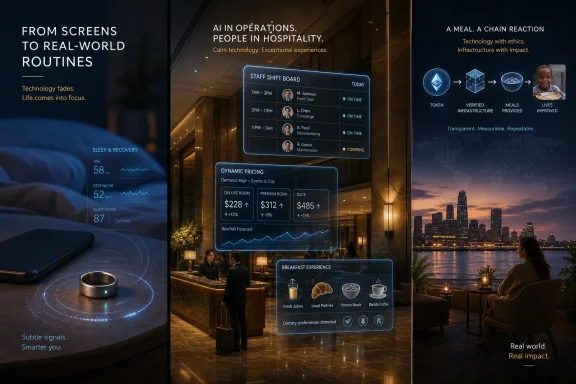
Oura launched the Ring 5 in late May 2026 as a 40 percent smaller smart ring with longer claimed battery life, while the same weekend tech cycle also highlighted crypto-funded hunger relief and AI-driven hotel operations. The common thread is not gadgetry for its own sake. It is the migration of technology away from screens and dashboards into the physical routines of health, food, travel, staffing, and service. The weekend’s real upgrade is not a ring, a token, or a hotel case study; it is the growing expectation that software should quietly change the way real-world systems behave.
The most interesting thing about Oura’s latest ring is not that it is smaller. It is that Oura is still betting the future of consumer health on a device most people are supposed to forget they are wearing.
That is a different proposition from the smartwatch race. Watches want attention. They vibrate, flash, display, nag, and increasingly try to become wrist-mounted phones. Rings succeed only if they do the opposite: disappear into daily life while collecting enough biometric signal to be useful.
A 40 percent reduction in size matters because wearability is not a cosmetic issue in passive health tracking. A device that is too bulky, too visible, or too fussy stops being worn, and a tracker that is not worn becomes a very expensive piece of dead data infrastructure. In that sense, Oura’s hardware story is really a compliance story: make the sensor small enough and comfortable enough that the user keeps generating the longitudinal data the software needs.
The company’s claim that the Ring 5 is the world’s smallest smart ring should be read with the usual caution applied to product-launch superlatives. The more durable claim is that the category is being pulled toward jewelry-like invisibility. The winning wearable may not be the one with the largest screen, but the one that turns health monitoring into background radiation.
But the trade-off is obvious. The more intimate the signal, the more sensitive the data. A ring that knows when you slept badly, when your resting heart rate is elevated, when your stress markers shift, or when your temperature deviates from baseline is not just a fitness accessory. It is a personal telemetry node.
That does not mean users should reject the category. It means the privacy model matters as much as the sensor stack. Health wearables increasingly sit in the gray zone between consumer convenience and quasi-medical insight, and that gray zone is where the industry’s most important policy questions now live.
Oura’s push toward smaller and longer-lasting hardware also tells us something about the market’s maturity. Early wearables sold the novelty of measurement. The next phase sells interpretation. Once everyone can collect biometric data, the differentiator becomes whether the platform can tell a useful story without overclaiming certainty.
The pitch is simple enough. Trading activity becomes a funding engine. Holders become participants in a cause. A percentage of fees is directed toward a verified charitable partner. In the TechBuzz account, 944 holders helped fund 20,000 meals while the token’s price surged sharply.
That last part is the complication. A token that rises 10,000 percent will attract attention, but attention is not the same as sustainable impact. Crypto philanthropy has always faced the same problem: the spectacle of the asset can overshadow the purpose of the project.
Still, the model is worth watching because it reframes charitable giving as embedded infrastructure rather than a separate act of generosity. If a transaction can automatically fund a meal, offset a cost, or support a nonprofit, then impact becomes part of the system design. The ethical test is whether the cause remains protected when the market cycle turns.
That is why hospitality has always been a useful technology preview. Travel is both physical and informational. The room, the bed, the breakfast, and the staff are tangible, but almost everything that gets the guest there is data: search, price comparison, loyalty history, reviews, preferences, timing, booking intent, and post-stay feedback.
AI thrives in that seam. It can compress research, interpret reviews, predict demand, and summarize guest history in ways that feel mundane until you remember how much operational friction exists in a hotel. The front desk, the restaurant, housekeeping, marketing, and revenue management are all different expressions of the same problem: too many small decisions, too much fragmented information, and too little time.
The Beverly Hills Hotel breakfast example works because it is almost embarrassingly practical. Years of reviews reportedly showed that guests cared more about breakfast than the expensive chef-driven dinner strategy, and that most breakfast orders were already being modified. The lesson was not to create a chatbot. It was to redesign the menu around what guests were actually doing.
AI changes that by making memory institutional. A returning guest should not have to re-explain basic preferences to a property that already has the information. A loyalty member who always books early check-in, avoids feather pillows, orders coffee at 6 a.m., and travels with children should not be treated as a blank slate.
This is where the hospitality industry’s AI turn becomes relevant outside travel. Banks, clinics, retailers, software vendors, gyms, universities, and local governments all suffer from the same amnesia. They collect data constantly and then behave as if they know nothing.
The danger, of course, is that personalization can become surveillance wearing a smile. There is a line between service that remembers and service that intrudes. The companies that get this right will use AI to reduce friction without making customers feel profiled, manipulated, or trapped inside a prediction engine.
Hotels have always lived and died by pricing, occupancy, staffing, and purchasing. A resort with the wrong labor plan for a family-heavy weekend burns money and disappoints guests. A property that misprices rooms during a demand spike leaves revenue on the table. A kitchen that forecasts poorly wastes food or disappoints customers.
AI is useful here because hospitality is full of repeating patterns that are visible but hard for humans to synthesize quickly. Booking pace, event calendars, weather, flight disruption, loyalty profiles, school holidays, corporate travel cycles, and review sentiment all interact. A good model does not need to be magical; it just needs to make better decisions than a manager staring at last year’s spreadsheet.
This is why claims of revenue lift from AI-enabled personalization and dynamic pricing should not be dismissed as vendor hype, even if the exact numbers vary by property and implementation. A few percentage points of revenue improvement without adding rooms is a serious business outcome. In an industry with high fixed costs, intelligence can behave like capacity.
That matters because hotels, airlines, restaurants, and attractions have spent two decades optimizing for search engines, online travel agencies, paid ads, review sites, and social platforms. AI agents threaten to rearrange that funnel. If a traveler asks an assistant for a weekend itinerary, the winning answer may be assembled before the customer ever sees a list of blue links.
This will not kill search overnight. Habits are sticky, and users still want maps, photos, prices, cancellation policies, and reviews. But the planning layer is changing from retrieval to delegation. The user is not merely asking where to go; the user is asking the machine to narrow the world.
For businesses, that creates a new visibility problem. Being indexed is not the same as being recommended. The next marketing fight is not just about ranking on a results page, but about becoming legible, trustworthy, and selectable inside an AI-mediated decision flow.
But the underlying pattern is universal. Many businesses still run crucial decisions on intuition, habit, and spreadsheets inherited from an earlier operating model. They have customer data in one system, transaction data in another, staffing data somewhere else, and feedback trapped in email, surveys, reviews, tickets, and call logs.
AI’s first practical job is not to replace the company. It is to connect those fragments well enough that obvious mistakes become harder to make. The hotel that realizes breakfast matters more than dinner is just one example. The retailer that learns returns are driven by sizing confusion, the clinic that learns appointment no-shows correlate with reminder timing, or the software company that learns churn starts with onboarding silence are all playing the same game.
The uncomfortable part is that many organizations already have the evidence they need. They simply have not been reading it. AI’s most disruptive act may be forcing companies to confront what their own data has been saying for years.
The old question was whether the technology was impressive. The new question is whether it changes behavior in the real world. Does the ring get worn longer? Do the token mechanics fund meals without relying on one-off campaigns? Does the hotel make better staffing, pricing, and service decisions before the guest complains?
That is a healthier standard. It punishes theater and rewards integration. It asks technology to become part of the operating model rather than a shiny layer bolted onto the side.
For WindowsForum readers, that lesson should feel familiar. The PC world has lived through decades of features that looked good in demos but mattered only when they changed daily workflows. AI is now entering the same test phase across the physical economy.
 The Smart Ring Is Winning Because the Computer Is Disappearing
The most interesting thing about Oura’s latest ring is not that it is smaller. It is that Oura is still betting the future of consumer health on a device most people are supposed to forget they are wearing.That is a different proposition from the smartwatch race. Watches want attention. They vibrate, flash, display, nag, and increasingly try to become wrist-mounted phones. Rings succeed only if they do the opposite: disappear into daily life while collecting enough biometric signal to be useful.
A 40 percent reduction in size matters because wearability is not a cosmetic issue in passive health tracking. A device that is too bulky, too visible, or too fussy stops being worn, and a tracker that is not worn becomes a very expensive piece of dead data infrastructure. In that sense, Oura’s hardware story is really a compliance story: make the sensor small enough and comfortable enough that the user keeps generating the longitudinal data the software needs.
The company’s claim that the Ring 5 is the world’s smallest smart ring should be read with the usual caution applied to product-launch superlatives. The more durable claim is that the category is being pulled toward jewelry-like invisibility. The winning wearable may not be the one with the largest screen, but the one that turns health monitoring into background radiation.
Smaller Hardware Raises Bigger Questions About Health Data
There is a reason smart rings have become one of the more compelling consumer health form factors. Sleep, recovery, temperature, heart-rate variability, stress signals, and menstrual-cycle insights all benefit from continuous measurement. You do not need a dramatic medical device on your body to learn something useful about your body.But the trade-off is obvious. The more intimate the signal, the more sensitive the data. A ring that knows when you slept badly, when your resting heart rate is elevated, when your stress markers shift, or when your temperature deviates from baseline is not just a fitness accessory. It is a personal telemetry node.
That does not mean users should reject the category. It means the privacy model matters as much as the sensor stack. Health wearables increasingly sit in the gray zone between consumer convenience and quasi-medical insight, and that gray zone is where the industry’s most important policy questions now live.
Oura’s push toward smaller and longer-lasting hardware also tells us something about the market’s maturity. Early wearables sold the novelty of measurement. The next phase sells interpretation. Once everyone can collect biometric data, the differentiator becomes whether the platform can tell a useful story without overclaiming certainty.
Crypto Philanthropy Wants to Turn Speculation Into Plumbing
The Feed the Children and WYDE $EAT token item is stranger, and possibly more revealing. A hunger-relief token that routes a portion of trading fees toward meals sounds like two worlds colliding: the credibility of a long-running nonprofit and the volatility of crypto markets.The pitch is simple enough. Trading activity becomes a funding engine. Holders become participants in a cause. A percentage of fees is directed toward a verified charitable partner. In the TechBuzz account, 944 holders helped fund 20,000 meals while the token’s price surged sharply.
That last part is the complication. A token that rises 10,000 percent will attract attention, but attention is not the same as sustainable impact. Crypto philanthropy has always faced the same problem: the spectacle of the asset can overshadow the purpose of the project.
Still, the model is worth watching because it reframes charitable giving as embedded infrastructure rather than a separate act of generosity. If a transaction can automatically fund a meal, offset a cost, or support a nonprofit, then impact becomes part of the system design. The ethical test is whether the cause remains protected when the market cycle turns.
The Hotel Lobby Is Where AI Stops Being a Demo
The hospitality material is the strongest part of the weekend package because it moves AI out of the abstraction layer. Hotels are not asking whether generative AI can write a poem or pass a benchmark. They are asking whether it can help sell rooms, staff shifts, personalize service, reduce waste, and stop managers from making million-dollar decisions with stale spreadsheets.That is why hospitality has always been a useful technology preview. Travel is both physical and informational. The room, the bed, the breakfast, and the staff are tangible, but almost everything that gets the guest there is data: search, price comparison, loyalty history, reviews, preferences, timing, booking intent, and post-stay feedback.
AI thrives in that seam. It can compress research, interpret reviews, predict demand, and summarize guest history in ways that feel mundane until you remember how much operational friction exists in a hotel. The front desk, the restaurant, housekeeping, marketing, and revenue management are all different expressions of the same problem: too many small decisions, too much fragmented information, and too little time.
The Beverly Hills Hotel breakfast example works because it is almost embarrassingly practical. Years of reviews reportedly showed that guests cared more about breakfast than the expensive chef-driven dinner strategy, and that most breakfast orders were already being modified. The lesson was not to create a chatbot. It was to redesign the menu around what guests were actually doing.
Personalization Is No Longer a Luxury Layer
Hotels have always practiced a form of personalization. A great concierge remembers names, preferences, birthdays, allergies, habits, and complaints. The problem is that traditional personalization is labor-intensive and inconsistent. It depends on who is working, what they remember, and whether the information ever made it from one shift to another.AI changes that by making memory institutional. A returning guest should not have to re-explain basic preferences to a property that already has the information. A loyalty member who always books early check-in, avoids feather pillows, orders coffee at 6 a.m., and travels with children should not be treated as a blank slate.
This is where the hospitality industry’s AI turn becomes relevant outside travel. Banks, clinics, retailers, software vendors, gyms, universities, and local governments all suffer from the same amnesia. They collect data constantly and then behave as if they know nothing.
The danger, of course, is that personalization can become surveillance wearing a smile. There is a line between service that remembers and service that intrudes. The companies that get this right will use AI to reduce friction without making customers feel profiled, manipulated, or trapped inside a prediction engine.
Revenue Management Is the Quiet AI Gold Rush
The glamorous AI stories are usually about front-end experiences: conversational trip planning, guest messaging, automated recommendations, and slick personalization. The money, however, may be in the back office.Hotels have always lived and died by pricing, occupancy, staffing, and purchasing. A resort with the wrong labor plan for a family-heavy weekend burns money and disappoints guests. A property that misprices rooms during a demand spike leaves revenue on the table. A kitchen that forecasts poorly wastes food or disappoints customers.
AI is useful here because hospitality is full of repeating patterns that are visible but hard for humans to synthesize quickly. Booking pace, event calendars, weather, flight disruption, loyalty profiles, school holidays, corporate travel cycles, and review sentiment all interact. A good model does not need to be magical; it just needs to make better decisions than a manager staring at last year’s spreadsheet.
This is why claims of revenue lift from AI-enabled personalization and dynamic pricing should not be dismissed as vendor hype, even if the exact numbers vary by property and implementation. A few percentage points of revenue improvement without adding rooms is a serious business outcome. In an industry with high fixed costs, intelligence can behave like capacity.
Search Is Being Rebuilt Before Most Businesses Notice
One of the most important claims in the TechBuzz material is that travel research is moving from traditional search behavior toward AI-assisted planning. Whether any single forecast proves exact is less important than the direction of travel. The search box is no longer the only front door.That matters because hotels, airlines, restaurants, and attractions have spent two decades optimizing for search engines, online travel agencies, paid ads, review sites, and social platforms. AI agents threaten to rearrange that funnel. If a traveler asks an assistant for a weekend itinerary, the winning answer may be assembled before the customer ever sees a list of blue links.
This will not kill search overnight. Habits are sticky, and users still want maps, photos, prices, cancellation policies, and reviews. But the planning layer is changing from retrieval to delegation. The user is not merely asking where to go; the user is asking the machine to narrow the world.
For businesses, that creates a new visibility problem. Being indexed is not the same as being recommended. The next marketing fight is not just about ranking on a results page, but about becoming legible, trustworthy, and selectable inside an AI-mediated decision flow.
Hospitality Is a Warning to Every Spreadsheet-Run Industry
The hotel example should make other sectors uncomfortable because hospitality is not uniquely messy. It is just unusually exposed. Every guest experience is a public review waiting to happen, every room night is perishable inventory, and every operational mistake is felt immediately.But the underlying pattern is universal. Many businesses still run crucial decisions on intuition, habit, and spreadsheets inherited from an earlier operating model. They have customer data in one system, transaction data in another, staffing data somewhere else, and feedback trapped in email, surveys, reviews, tickets, and call logs.
AI’s first practical job is not to replace the company. It is to connect those fragments well enough that obvious mistakes become harder to make. The hotel that realizes breakfast matters more than dinner is just one example. The retailer that learns returns are driven by sizing confusion, the clinic that learns appointment no-shows correlate with reminder timing, or the software company that learns churn starts with onboarding silence are all playing the same game.
The uncomfortable part is that many organizations already have the evidence they need. They simply have not been reading it. AI’s most disruptive act may be forcing companies to confront what their own data has been saying for years.
The Weekend’s Signal Is Practical, Not Futuristic
The three stories in this bundle could be mistaken for unrelated tech miscellany: a smaller ring, a charity token, and AI hotels. But together they show a broader shift in how technology is being judged.The old question was whether the technology was impressive. The new question is whether it changes behavior in the real world. Does the ring get worn longer? Do the token mechanics fund meals without relying on one-off campaigns? Does the hotel make better staffing, pricing, and service decisions before the guest complains?
That is a healthier standard. It punishes theater and rewards integration. It asks technology to become part of the operating model rather than a shiny layer bolted onto the side.
For WindowsForum readers, that lesson should feel familiar. The PC world has lived through decades of features that looked good in demos but mattered only when they changed daily workflows. AI is now entering the same test phase across the physical economy.
The Upgrade Worth Keeping Is the One That Changes the System
The weekend’s most concrete lessons are not about any one product launch or partnership announcement. They are about where technology is becoming useful enough to disappear into routine.- Oura’s smaller Ring 5 shows that passive health tracking is increasingly a wearability contest, not just a sensor contest.
- The $EAT partnership shows that crypto projects are still searching for durable real-world utility beyond speculation.
- The hospitality examples show that AI becomes valuable when it changes pricing, staffing, menus, marketing, and service design.
- The shift from search-led travel planning to AI-assisted planning should worry any business that depends on being discovered online.
- The most immediate enterprise opportunity is not replacing workers with AI, but giving workers better memory, prediction, and context.
- The businesses most exposed to AI disruption are the ones already rich in data but still governed by instinct and spreadsheets.