

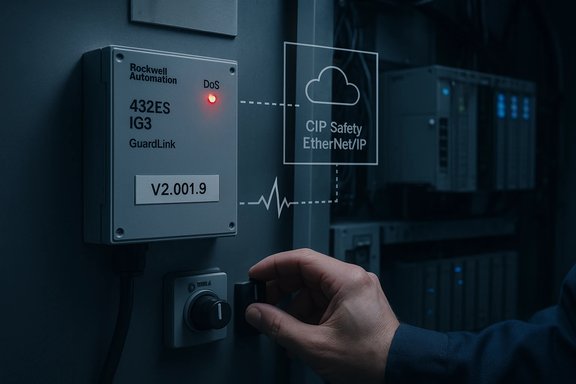
Rockwell Automation has confirmed a high‑severity denial‑of‑service vulnerability in the GuardLink EtherNet/IP interface on its 432ES‑IG3 Series A safety module (CVE‑2025‑9368), a flaw that can render the module unresponsive over the network and requires a manual power cycle to restore service — Rockwell has released corrected firmware (V2.001.9) and federal advisories urge immediate patching or compensating controls for exposed installations.
Recommended next steps for organizations:
Conclusion
This vulnerability highlights a recurring industrial security truth: availability‑only flaws in OT devices can have outsized impact because recovery often requires physical intervention and because these devices sit directly in the safety and control path. The remedy is straightforward — apply the vendor firmware update — but operational constraints mean that defenders must act quickly and pragmatically, using network controls and tested procedures to protect production while patches are validated and deployed.
Source: CISA Rockwell Automation 432ES-IG3 Series A | CISA
 Background
What the advisory says (concise)
Rockwell’s Security Advisory SD1764 describes a vulnerability in the 432ES‑IG3 Series A GuardLink® EtherNet/IP Interface. The company reports the problem was discovered during internal testing and assigned CVE‑2025‑9368. The affected firmware release is 1.001; the vendor’s corrective release is 2.001.9. Rockwell rates the issue with a CVSS 3.1 base score around 7.5 (High) and CVSS 4.0 8.7 (High). Exploitation results in a denial‑of‑service (DoS) condition that requires a manual power cycle of the device to recover. CISA republishes and summarises the vendor advisory and recommends standard industrial control systems (ICS) mitigations: minimize network exposure, isolate control networks behind firewalls, restrict remote access to secure, updated VPNs or other hardened remote access methods, and perform risk/impact analysis prior to mitigation. The CISA notice explicitly states there were no reports of public exploitation at the time of the advisory.Technical classification
- CVE identifier: CVE‑2025‑9368.
- Affected product: Rockwell Automation 432ES‑IG3 Series A (GuardLink EtherNet/IP Interface), firmware 1.001.
- Corrected firmware: 2.001.9 or later.
- Vulnerability type: Allocation of resources without limits or throttling (CWE‑770), i.e., improper handling of network‑facing input that permits exhaustion or a fault leading to an outage.
- Impact: Remote network‑based DoS; no confidentiality or integrity impact reported; availability impact is high and recovery requires manual power cycling.
Why this matters: operational and safety risk
Industrial context
The 432ES‑IG3 is a GuardLink EtherNet/IP on‑machine safety communication module used to monitor up to 96 GuardLink devices and report their safety status to a safety‑rated controller over CIP Safety EtherNet/IP. It sits at the safety and machine‑interface layer — a DoS against this module can interrupt safety signaling, halt production lines, or force manual intervention on safety systems. Because these modules are commonly deployed on manufacturing floors and integrated with safety controllers, the operational impact of losing one or more devices can be immediate and costly.Recovery nuance — manual power cycle
A critical operational detail is the requirement for a manual power cycle. Remote reboots or software resets may not recover the module; an operator must physically remove and restore power. That constraint means:- Outages may persist until on‑site staff can access the module.
- Automated restart schedules or remote management tools cannot mitigate downtime.
- For facilities operating 24/7 or with limited night staffing, the realistic downtime window increases, and so does the operational risk.
Attack surface and prerequisites
The vulnerability is exploitable over the network with low complexity according to the vendor scoring, and it does not require authenticated access or user interaction. That makes it attractive for an attacker who can reach the device on the network — whether that reachability is local, through a misconfigured VPN, exposed management ports, or lateral movement from a compromised host. Several vulnerability trackers and CVE aggregators confirm the network attack vector and the high availability impact.What Rockwell and authorities recommend
Vendor remediation
Rockwell’s fix: upgrade 432ES‑IG3 Series A firmware to V2.001.9 or later. The advisory lists that version as the corrected release and provides downloads via Rockwell’s Trust Center and product compatibility pages. Implementing the vendor firmware update is the definitive remediation.CISA / federal guidance
CISA recommends immediate defensive measures where patching is not yet possible:- Minimize exposure: ensure ICS devices are not reachable from the Internet.
- Network segmentation: place control networks and devices behind firewalls and isolate them from business networks.
- Secure remote access: if remote access is necessary, use updated VPNs or stronger remote solutions — but recognize VPNs themselves can be vulnerable and must be maintained.
- Perform impact analysis before changes: CISA emphasizes evaluating production impact before implementing defensive changes.
Practical mitigation and remediation plan (step‑by‑step)
Below is a pragmatic sequence for ICS engineers, OT/IT integrators, and Windows‑centric support teams charged with remediation.- Inventory and prioritize
- Identify all deployed 432ES‑IG3 Series A units (capture serials and firmware revision from device UIs, engineering workstations, or asset management tools).
- Prioritize modules that are externally reachable, adjacent to corporate networks, or integral to safety/continuous processes.
- Evaluate operational windows
- Coordinate with plant operations to schedule firmware upgrades or maintenance windows; upgrades may require taking equipment offline.
- If on‑site physical access is limited, plan for manual power‑cycle recovery contingencies — ensure local staff can reach and power cycle impacted modules if necessary.
- Test the vendor patch in lab
- Always validate the V2.001.9 firmware in a representative test environment, exercise safety functions, and confirm no regressions with controllers or other GuardLink devices.
- Confirm the update process (tools, version dependencies, rollback methods).
- Apply the patch
- Deploy V2.001.9 to prioritized devices during scheduled windows.
- Use controlled rollouts and verify device health post‑update.
- Compensating controls if immediate patching is impossible
- Segment the device’s Ethernet subnet behind access control lists (ACLs) and a firewall to allow only trusted management hosts.
- Block unnecessary external paths to the control VLAN, especially any Internet‑facing NAT/port forwards and vendor cloud connectivity if not essential.
- Harden VPN and jump‑host access: restrict which endpoints can reach control networks and enforce multi‑factor authentication and endpoint checks.
- Monitoring and detection
- Implement heartbeat and telemetry monitoring for GuardLink devices. Watch for sustained unresponsiveness that might indicate exploitation.
- Correlate network flows: anomalous volumes of malformed CIP or unexpected UDP/TCP sessions to device addresses may be an early signal.
- Log and retain network captures for investigation; capture the time, source IP, and packet patterns leading to any DoS event.
- Incident response and recovery procedures
- Document the manual power‑cycle procedure and designate responsible personnel with clear escalation paths.
- Test the recovery playbook in a controlled manner so teams are ready for a real event.
- Long‑term controls
- Establish a firmware management program for ICS devices, including tracking EOL devices and migration strategies.
- Require change control and safety validation for all firmware updates.
Detection, forensics, and what to look for
- Device symptoms: sudden loss of communications, device LEDs indicating fault states, or controller alarms reporting loss of GuardLink status. Rockwell’s advisory documents availability‑focused symptoms; monitor those fields closely.
- Network indicators: repeated malformed CIP/Safe‑CIP frames, high‑rate traffic to the module from a single host, or protocol anomalies that coincide with device outages. Correlate with network flow logs and packet captures.
- No public exploit detected: public vulnerability trackers and federal notices report no known public exploitation at the time of disclosure, but that does not guarantee absence of targeted abuse; lack of observed exploitation should not delay mitigations.
Critical analysis — strengths, gaps, and operational risk
Strengths in the response
- Vendor transparency: Rockwell publicly assigned a CVE and released a corrected firmware release (2.001.9) in a timely fashion after internal discovery, demonstrating responsible disclosure and remediation processes.
- Clear recovery instruction: the advisory explicitly warns that a manual power cycle is necessary, allowing defenders to prepare physical recovery procedures. That operational clarity is valuable for mitigation planning.
- Federal guidance alignment: CISA’s guidance reiterates standard high‑value ICS controls (segmentation, limiting exposure, secure remote access), providing consistent defensive advice across vendor and government sources.
Gaps and operational challenges
- Manual recovery requirement: requiring a hands‑on power cycle is a significant operational burden. Facilities with difficult physical access, remote sites, or critical continuous processes face longer outages and logistics complexity. This elevates the real world risk beyond what a CVSS number alone conveys.
- No workaround provided: Rockwell’s advisory offers no in‑product workaround; that increases urgency to patch and to apply network‑level mitigations until firmware is deployed.
- Inventory and patch lag: many industrial estates run legacy devices or constrained maintenance windows. Even when a fix exists, actual deployment timelines can be measured in months; this window invites potential exploitation if devices are reachable. Multiple trackers note the EPSS (probability of exploitation) is low but non‑zero — the risk is driven by exposure, not by a lack of public POC today.
Attack scenario analysis
An attacker with network reachability (adjacent network, misconfigured VPN, or an Internet‑visible management interface) could craft traffic that triggers the resource exhaustion or fault condition. Because the vulnerability affects availability only, attackers may aim for disruptive outcomes — causing production stops, inducing safety interlocks, or creating manual intervention needs during critical process windows. Where multiple modules or controllers are reachable, coordinated DoS could cascade into broader process halts.Cross‑verification and data quality
Key facts were cross‑checked against multiple independent sources:- Rockwell’s official advisory SD1764 documents the vulnerability, affected versions, and corrected firmware.
- National and vulnerability databases (NVD, Tenable, CVE aggregators) register CVE‑2025‑9368 and reflect the vendor scores and technical summary, corroborating the vendor’s assessment.
- Federal guidance and public advisories (CISA) reiterate mitigation strategies and note there were no known public exploit reports at the advisory time.
Advice tailored for Windows/IT teams that support ICS environments
- Treat this as an OT first priority: Even though Windows servers and engineering workstations host management software and HMIs, the vulnerability impacts networked industrial devices; apply OT‑centric change management, not a standard Windows push‑update model.
- Coordinate with OT/plant engineering: Patching and testing must respect safety validation and must be scheduled with plant operations to avoid unplanned process interruptions.
- Harden Windows endpoints used for device management:
- Ensure engineering workstations are segmented and use jump boxes to access control networks.
- Maintain up‑to‑date antivirus/EDR and privilege control to prevent lateral movement from Windows hosts into OT subnets.
- Use logging and SIEM correlation to spot suspicious network flows from Windows hosts to ICS devices.
- Establish a maintenance playbook that includes:
- Device inventory and firmware baseline.
- Test plan for firmware updates in a lab mirror.
- Rollout plan with rollback steps and staged validation.
- Documented manual recovery actions and responsible personnel for physical interventions.
Risk‑reduction checklist (quick reference)
- Update 432ES‑IG3 Series A devices to firmware V2.001.9 or later.
- If you cannot patch immediately:
- Isolate affected devices behind firewalls and apply strict ACLs.
- Disable any unnecessary remote or vendor cloud connections that reach the GuardLink interface.
- Restrict which management hosts can reach the control subnet (whitelisting).
- Require multi‑factor authentication and hardened jump hosts for remote maintenance.
- Monitor for signs of DoS and maintain access to on‑site personnel who can perform manual power cycles.
- Validate backup and recovery procedures and confirm spare hardware and power‑cycle capability for remote sites.
Final assessment and next steps
CVE‑2025‑9368 is a high‑impact availability vulnerability in an on‑machine safety interface that deserves rapid organizational attention. The presence of a vendor‑provided patch (V2.001.9) and clear guidance from Rockwell and CISA makes the remediation path straightforward in principle. In practice, the requirement for manual power‑cycle recovery and the realities of industrial maintenance windows complicate deployment and raise the operational stakes.Recommended next steps for organizations:
- Immediately inventory 432ES‑IG3 devices and assess exposure.
- Schedule lab testing of Rockwell’s V2.001.9 firmware and prepare a controlled deployment plan.
- Implement network segmentation and access controls to reduce remote reachability until devices are patched.
- Update incident response playbooks to cover manual recovery and communications with plant operations and safety teams.
Conclusion
This vulnerability highlights a recurring industrial security truth: availability‑only flaws in OT devices can have outsized impact because recovery often requires physical intervention and because these devices sit directly in the safety and control path. The remedy is straightforward — apply the vendor firmware update — but operational constraints mean that defenders must act quickly and pragmatically, using network controls and tested procedures to protect production while patches are validated and deployed.
Source: CISA Rockwell Automation 432ES-IG3 Series A | CISA
