

Asus’ ROG Xbox Ally family has become the testing ground for a new, telling thesis in handheld PC gaming: on the same hardware, a lean, SteamOS‑style Linux image can deliver noticeably smoother gameplay than the Windows 11 image the device ships with — in some cases producing double‑digit percentage gains in average FPS and dramatically cleaner frame‑time behavior.
The ROG Xbox Ally line arrived as a two‑tier strategy that pairs ASUS hardware with Microsoft’s Xbox full‑screen experience layered on top of Windows 11. The range includes a more affordable base model and a premium Ally X that ups the thermal and power envelope with an AMD Ryzen AI Z2 Extreme APU, larger battery, and higher bandwidth LPDDR5X memory — hardware choices intended to push handheld performance beyond prior generations.
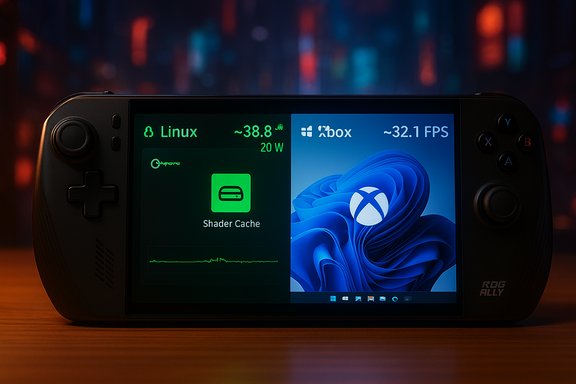
Community testers quickly took one of the oldest questions in PC handhelds and made it concrete: if you swap the factory Windows image for a lightweight, handheld‑focused Linux distribution — in this case Bazzite (a Fedora‑based, SteamOS‑style distro tailored for portable gaming) — what changes in real gameplay? Early hands‑on comparisons, driven by prominent enthusiast creators and reproduced by independent outlets, revealed consistent directional gains in certain workloads: higher sustained averages in shader‑heavy single‑player scenes, better 1% and 0.2% low behavior (fewer severe drops), and faster suspend/resume behavior. The most headline‑grabbing claim — a 38.8 FPS average in Cyberpunk 2077 at a 20 W power cap on Bazzite versus significantly lower averages on Windows 11 with the same cap — crystallizes the debate. That number came from side‑by‑side testing reported in recent coverage and hands‑on videos.
Valve proved the principle with the Steam Deck: pairing purpose‑built hardware with a curated, console‑like OS stack yields consistent frame‑time delivery and an overall “polished” handheld feel. What the Bazzite experiments show is that a similar approach on Ally hardware can sometimes extract more usable performance than the factory Windows image, especially in the mid‑range TDP window where handhelds typically operate.
The specific Cyberpunk figures (38.8 FPS on Bazzite at 20 W vs ~32.1 FPS on Windows at 20 W) were reported in coverage summarizing a well‑viewed hands‑on test and corroborated by other community uploads. Independent outlets reproduced similar deltas in other titles, supporting the core claim that performance differences are real and reproducible under similar conditions. However, because these are community tests rather than controlled lab runs, exact numeric deltas may vary across driver and firmware versions; that caveat is important for readers considering absolute numbers.
That said, the gains arrive with notable costs: ecosystem tradeoffs (Game Pass, anti‑cheat), potential support and warranty implications, and the risk of configuration fragility. For the majority of buyers, optimizing the Windows image and waiting for vendor driver and firmware updates will remain the most practical path. For enthusiasts who prioritize single‑player smoothness and are comfortable with dual‑booting or hacking, Bazzite and SteamOS‑style images represent a real, repeatable route to a better handheld gaming feel — provided they accept the work and tradeoffs involved.
The ROG Xbox Ally experiments are not a verdict against Windows so much as a roadmap: handheld polish requires deliberate OS and driver engineering. Enthusiast images like Bazzite show what lean, handheld‑first software can deliver on high‑end hardware, and that should be a practical brief to Microsoft, OEMs, and driver teams — tighten the shader pipeline, reduce background noise, and the next round of handhelds will feel even closer to console simplicity without sacrificing the openness of Windows.
Conclusion: the GPU and CPU in the Ally are only part of the story — the operating system and driver stack determine how those components translate into a playable, enjoyable handheld experience. The Bazzite results sharpen that lesson into an actionable challenge for the Windows handheld roadmap.
Source: Notebookcheck Asus ROG Xbox Ally with Bazzite hits 38.8 FPS in Cyberpunk 2077, outperforming the Windows 11 version it ships with
 Background / Overview
The ROG Xbox Ally line arrived as a two‑tier strategy that pairs ASUS hardware with Microsoft’s Xbox full‑screen experience layered on top of Windows 11. The range includes a more affordable base model and a premium Ally X that ups the thermal and power envelope with an AMD Ryzen AI Z2 Extreme APU, larger battery, and higher bandwidth LPDDR5X memory — hardware choices intended to push handheld performance beyond prior generations.Community testers quickly took one of the oldest questions in PC handhelds and made it concrete: if you swap the factory Windows image for a lightweight, handheld‑focused Linux distribution — in this case Bazzite (a Fedora‑based, SteamOS‑style distro tailored for portable gaming) — what changes in real gameplay? Early hands‑on comparisons, driven by prominent enthusiast creators and reproduced by independent outlets, revealed consistent directional gains in certain workloads: higher sustained averages in shader‑heavy single‑player scenes, better 1% and 0.2% low behavior (fewer severe drops), and faster suspend/resume behavior. The most headline‑grabbing claim — a 38.8 FPS average in Cyberpunk 2077 at a 20 W power cap on Bazzite versus significantly lower averages on Windows 11 with the same cap — crystallizes the debate. That number came from side‑by‑side testing reported in recent coverage and hands‑on videos.
Why this matters: software posture trumps silicon in handheld limits
Handheld gaming is a study in constrained physics: small chassis, thermal ceilings, and tight battery budgets mean every background thread, shader compile, and scheduler quirk gets magnified into a visible hitch or a measurable FPS delta. A desktop GPU can hide background noise behind cooling and power headroom; a handheld cannot. On the Ally series, that limitation makes the software stack — kernel scheduler, driver behavior, shader cache strategy, and background services — a decisive lever for perceived smoothness.Valve proved the principle with the Steam Deck: pairing purpose‑built hardware with a curated, console‑like OS stack yields consistent frame‑time delivery and an overall “polished” handheld feel. What the Bazzite experiments show is that a similar approach on Ally hardware can sometimes extract more usable performance than the factory Windows image, especially in the mid‑range TDP window where handhelds typically operate.
The tests: what was measured on the Ally X and what the numbers show
Test methodology (what creators did)
Community testers performed hands‑on side‑by‑side runs on the same Ally hardware, keeping power caps and game settings identical while swapping OS images. Key controlled variables included:- Power/TDP caps (commonly 15 W and 20 W mid‑range modes; some runs extended to higher plugged‑in budgets).
- Steam Deck preset or comparable graphical presets to normalize quality.
- Identical scene selections in shader‑heavy, open‑world titles such as Cyberpunk 2077, Kingdom Come: Deliverance II, and Hogwarts Legacy.
- Frame‑time capture for average, 1% low, and 0.2% low metrics to reflect both average throughput and worst‑case hitching.
Headline numbers
- Cyberpunk 2077 (720p, Steam Deck preset) on Bazzite at 20 W: 38.8 FPS average, stable frame times, 1% lows ~31 FPS, 0.2% lows ~30 FPS. Dropping the TDP to 15 W on Bazzite still produced 36.2 FPS average.
- Same Cyberpunk scene on Windows 11 at 20 W: 32.1 FPS average (with deeper frame drops); at 15 W: 29.3 FPS average with 1%/0.2% lows falling below those on Linux.
- Comparable Steam Deck OLED (SteamOS 3.8) at 15 W logged slightly less than Bazzite but still outperformed Windows in frame stability (e.g., ~34.9 FPS average in the same scenario).
Technical reasons behind Linux’s advantage — plausible mechanisms
The community and independent analyses point to several mechanisms that, together, explain why Bazzite (and SteamOS‑style stacks) can often outperform Windows on the same handheld hardware:- Shader cache and runtime compilation handling: Linux (with Proton/Mesa and tuned shader‑caching pipelines) sometimes avoids large, synchronous shader‑compilation hitches that show up on Windows drivers during first‑run scenes. Reduced hitch frequency translates into better 1%/0.2% lows.
- Lower OS background noise: A purpose‑built gaming image defers or avoids many desktop subsystems by default, reclaiming memory and CPU headroom. Windows’ larger background footprint can reintroduce periodic scheduling noise that matters in low‑headroom handheld scenarios.
- Driver stacks and GPU frequency governors: Tuned Mesa builds and handheld‑oriented kernel patches can result in more deterministic GPU frequency behavior (and, in some cases, better watt‑to‑frame efficiency) under Linux. Those adjustments are subtle but cumulative.
- Power governor and scheduler differences: Different defaults for CPU/GPU boosting and thermal headroom management can cause Windows to occasionally favor higher transient clocks that then thermal‑throttle, producing spikes and drops versus a steadier Linux governor. Community reports and internal telemetry hint at this interplay.
Cross‑checks and independent corroboration
This isn’t a lone single‑creator anomaly. NotebookCheck’s write‑up summarized several hands‑on videos and reproduced results showing Bazzite’s advantages in specific scenes. Independent outlets such as Wccftech and broader editorial commentary have also noted SteamOS‑style images can unlock higher sustained frame rates on non‑Deck hardware when power controls and driver stacks are tuned. At the same time, community forums and Reddit threads record a diversity of experiences — from users who replicated the uplift to others who encountered odd TDP behavior, higher temperatures, or lower FPS in certain conditions on Bazzite. Those discordant reports are important: they indicate the uplift is contextual and sometimes fragile, susceptible to configuration or driver mismatches.What this means for buyers and enthusiasts
Practical tradeoffs
Switching to Bazzite (or a SteamOS‑style stack) on an Ally device is not a drop‑in, no‑strings upgrade. The tradeoffs include:- Loss of out‑of‑the‑box Game Pass integration and potential incompatibilities with some store clients and games.
- Anti‑cheat limitations: some kernel‑level anti‑cheat systems do not play nicely with Proton or Linux wrappers, blocking or limiting multiplayer content.
- Potential warranty or support exposure if you alter the factory image and then run into hardware or firmware issues; recovery partitions and factory images must be preserved.
Best pragmatic options
- Dual‑boot: Keep Windows intact for multiplayer, Game Pass, and general‑purpose use; install Bazzite alongside for single‑player, shader‑heavy sessions where you want smoother frame pacing. This preserves factory functionality while letting enthusiasts experiment.
- Tweak Windows aggressively first: For the majority of users, trying to optimize Windows (disable startup apps, use the Xbox full‑screen experience where supported, tune Armoury Crate profiles) can reduce background noise and improve playability without losing ecosystem features.
- Wait for vendor patches: Microsoft, ASUS, and AMD can and likely will iterate on drivers, shader cache tooling, and handheld‑aware power profiles; these could narrow or eliminate the gap without users needing to switch OSes.
Risks, failure modes, and what went wrong for some users
Several community reports reveal where the Linux route can fail or deliver inconsistent results:- TDP / power reporting anomalies: Some users reported that Bazzite appeared to clamp or misreport power usage, or conversely that Windows allowed higher effective sustained power in some scenarios. Those discrepancies produce divergent FPS outcomes.
- Thermal runaway under certain profiles: A subset of reports describe higher temperatures and spikey behavior in specific Bazzite performance profiles, especially when users enabled Turbo or aggressive boost modes. That can produce worse sustained frame rates despite higher peak clocks.
- Compatibility quirks: HDR, VRR, and certain launchers sometimes require manual fixes (flatpaks, gamescope layers, or patched libraries) to behave properly under Linux; these are solvable but require hands‑on work.
Technical verification and specification check
The Ally X hardware profile — including Ryzen AI Z2 Extreme silicon, up to 24 GB LPDDR5X, a 1 TB M.2 2280 NVMe slot, and an 80 Wh battery — is confirmed in OEM materials and independent reviews. The device’s intention as a Windows‑first handheld with an Xbox full‑screen launcher is equally well documented. That context is important: the experiments are about swapping the software layer on the same physical platform, not comparing different hardware generations.The specific Cyberpunk figures (38.8 FPS on Bazzite at 20 W vs ~32.1 FPS on Windows at 20 W) were reported in coverage summarizing a well‑viewed hands‑on test and corroborated by other community uploads. Independent outlets reproduced similar deltas in other titles, supporting the core claim that performance differences are real and reproducible under similar conditions. However, because these are community tests rather than controlled lab runs, exact numeric deltas may vary across driver and firmware versions; that caveat is important for readers considering absolute numbers.
Strategic implications for Microsoft, OEMs, and Valve
- For Microsoft and OEM partners, this episode is a concrete signal: the OS stack matters as much as hardware tuning for handheld polish. The Xbox full‑screen experience already trims some desktop subsystems, but community experiments suggest further optimization or a lighter, more deterministic shader/delivery path could materially improve perceived smoothness on Windows handhelds.
- For OEMs, the mental model shifts slightly: shipping a powerful chassis alone is insufficient; offering a curated, handheld‑aware software posture and robust driver pipelines is critical to realize hardware potential.
- Valve’s approach with SteamOS remains influential: a tightly coupled OS/hardware experience still wins on delivering consistent, console‑like play. The rise of community images like Bazzite shows demand for that approach on non‑Deck hardware, and Valve’s moves to make SteamOS more available to partners would change the long‑term competitive landscape.
Recommendations for journalists and testers
- When comparing OSes on the same hardware, capture and publish:
- Exact driver and kernel versions used.
- Firmware/BIOS build numbers and power settings.
- Full Power/TDP telemetry alongside FPS averages and 1%/0.2% lows.
- Repeat runs across multiple game scenes and multiple cold/warm starts to catch shader‑compile hitching and caching effects.
- In reporting headline numbers, always contextualize them as configuration‑dependent and provide a reproducibility checklist so others can validate results.
Final analysis and takeaway
The ROG Xbox Ally story is a compelling technical parable: powerful handheld hardware can be held back, not by transistors, but by the software and driver delivery model that runs atop it. Community experiments with Bazzite demonstrate that a purpose‑built Linux stack — with tuned Mesa drivers, Proton/Proton‑GE helpers, and handheld power/thermal controls — can extract meaningfully better sustained gameplay in shader‑heavy single‑player workloads and mid‑range TDP modes. At its best, that yields higher average frame rates, fewer micro‑stutters, and a more “console‑like” feel from a device meant to be held in one hand.That said, the gains arrive with notable costs: ecosystem tradeoffs (Game Pass, anti‑cheat), potential support and warranty implications, and the risk of configuration fragility. For the majority of buyers, optimizing the Windows image and waiting for vendor driver and firmware updates will remain the most practical path. For enthusiasts who prioritize single‑player smoothness and are comfortable with dual‑booting or hacking, Bazzite and SteamOS‑style images represent a real, repeatable route to a better handheld gaming feel — provided they accept the work and tradeoffs involved.
Quick reference: what to do if you own an Ally and want to experiment
- Back up your factory recovery image and create a bootable Windows installer before altering the device.
- Try tuning Windows first: enable the Xbox full‑screen experience, disable nonessential startup items, and use Armoury Crate performance profiles.
- If experimenting with Bazzite/SteamOS:
- Keep Windows available (dual‑boot).
- Note driver/kernel versions and keep a recovery plan.
- Measure TDP, temperatures, and frame‑time metrics to verify improvements are real for your configuration.
- Expect variability; follow developer changelogs (kernel, Mesa, Proton, firmware) as they materially affect outcomes.
The ROG Xbox Ally experiments are not a verdict against Windows so much as a roadmap: handheld polish requires deliberate OS and driver engineering. Enthusiast images like Bazzite show what lean, handheld‑first software can deliver on high‑end hardware, and that should be a practical brief to Microsoft, OEMs, and driver teams — tighten the shader pipeline, reduce background noise, and the next round of handhelds will feel even closer to console simplicity without sacrificing the openness of Windows.
Conclusion: the GPU and CPU in the Ally are only part of the story — the operating system and driver stack determine how those components translate into a playable, enjoyable handheld experience. The Bazzite results sharpen that lesson into an actionable challenge for the Windows handheld roadmap.
Source: Notebookcheck Asus ROG Xbox Ally with Bazzite hits 38.8 FPS in Cyberpunk 2077, outperforming the Windows 11 version it ships with
