

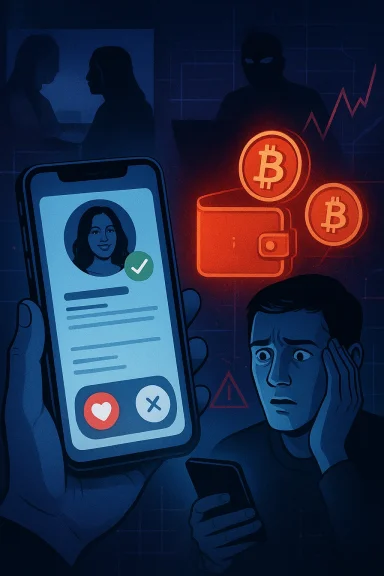
Matrimonial and dating apps are fast becoming a lucrative hunting ground for organised fraudsters who build emotional trust and then convert affection into cash — often through cryptocurrency or fake investment schemes — a trend recently flagged by the Indian Ministry of Home Affairs and visible in rising global loss figures reported by law-enforcement agencies.
Online romance and matrimonial platforms were designed to make introductions easier in a busy world. Over the last decade they have matured into multi-million-user ecosystems where people share highly personal details, photographs, and life plans. That same openness — combined with sophisticated social-engineering techniques and new payment rails such as cryptocurrency — has given criminals a predictable playbook for large-scale fraud.
The Ministry of Home Affairs (MHA), via the National Cybercrime Threat Analytics Unit (NCTAU) under the Indian Cybercrime Coordination Centre (I4C), released an advisory highlighting a sharp increase in scams originating on matrimonial and dating services. The advisory describes how fraudsters use stolen or morphed photographs to build believable profiles, groom victims over weeks or months, then solicit money for emergencies or investment opportunities — frequently cryptocurrency-based — once trust has been established.
This pattern is not restricted to one country. U.S. and global statistics show romance- and investment-style scams are escalating in losses and scale: the FBI’s Internet Crime Complaint Center (IC3) reported record losses in 2024, and specialised analyses by crypto-tracing firms have identified romance-related schemes as a major driver of crypto fraud. These parallel signals point to a problem that combines classic confidence scams with modern payments infrastructure.
If you use matrimonial or dating apps, treat financial requests as a non-starter: never send money to someone you have not verified in person, use reverse-image searches and live video checks, prefer in‑platform messaging until you are certain, and report suspicious activity immediately to the platform and relevant authorities. Collective vigilance — from users, platforms, banks, and regulators — is the only effective defence against a fraud model that thrives on trust, time, and speed.
Stay sceptical. Verify carefully. And if something about a new connection feels engineered rather than authentic, pause — that hesitation could save more than money.
Source: ET Now Matrimonial & dating platform scams: Using these apps? Read this before it’s too late
 Background
Online romance and matrimonial platforms were designed to make introductions easier in a busy world. Over the last decade they have matured into multi-million-user ecosystems where people share highly personal details, photographs, and life plans. That same openness — combined with sophisticated social-engineering techniques and new payment rails such as cryptocurrency — has given criminals a predictable playbook for large-scale fraud.The Ministry of Home Affairs (MHA), via the National Cybercrime Threat Analytics Unit (NCTAU) under the Indian Cybercrime Coordination Centre (I4C), released an advisory highlighting a sharp increase in scams originating on matrimonial and dating services. The advisory describes how fraudsters use stolen or morphed photographs to build believable profiles, groom victims over weeks or months, then solicit money for emergencies or investment opportunities — frequently cryptocurrency-based — once trust has been established.
This pattern is not restricted to one country. U.S. and global statistics show romance- and investment-style scams are escalating in losses and scale: the FBI’s Internet Crime Complaint Center (IC3) reported record losses in 2024, and specialised analyses by crypto-tracing firms have identified romance-related schemes as a major driver of crypto fraud. These parallel signals point to a problem that combines classic confidence scams with modern payments infrastructure.
How these scams work: anatomy of a modern “romance-to-crypto” con
1. The lure: attractive, plausible profiles
Fraudsters begin by creating polished profiles that match the target demographic they intend to exploit — often using age, occupation, location, and income filters on matrimonial sites. Stolen photos, professionally written bios, and narrative details (e.g., “overseas professional,” “defence officer,” “NRI”) establish immediate credibility. Law-enforcement reports and the MHA advisory both note the use of stolen or morphed photographs to create this false sense of intimacy.2. Grooming and emotional investment
Unlike one-off phishing attacks, romance scams rely on time. The scammer invests in repeated conversations, voice calls, and video sessions — sometimes using manipulated backdrops or pre-recorded video to make interactions appear genuine. The objective is psychological: create an emotional dependency so that requests for financial help or investment seem legitimate and urgent.3. The pivot to money: emergency narratives and “investment opportunities”
Once trust is in place, the scammer introduces a reason to transfer money. Two dominant scripts appear:- Emergency narrative: A sudden medical bill, legal trouble, or travel problem that requires immediate funds.
- Investment narrative (“pig butchering”): The scammer claims to trade crypto or forex and invites the victim to “invest” small amounts. Early fabricated returns encourage larger transfers until the victim’s funds are drained.
4. The cut-off and laundering
Once the money is moved — often through crypto exchanges, mixers, or layered transfers — the scammer disappears or constructs further barriers (e.g., “legal freeze,” “verification fee”) to extract still more funds. Reclaiming money becomes difficult because of the cross-border nature of payments and the speed of crypto settlements. Law-enforcement agencies report that recovery rates for crypto-oriented romance scams remain low.Evidence of scale: numbers that matter
- The FBI’s IC3 recorded 859,532 complaints in 2024 with reported losses exceeding $16.6 billion — an increase of roughly 33% from 2023 — and identified investment fraud (a category heavily overlapped by crypto and romance-linked investment pitches) as the costliest attack vector.
- Chainalysis and related industry reporting documented a steep rise in “pig butchering” romance schemes, which accounted for a substantial share of crypto-related scam revenue in recent years. Industry summaries estimate billions in confirmed crypto losses tied to investment‑style scams.
- In India, multiple state and national cyber units — echoed by MHA/I4C warnings — have seen complaints spike on major matrimonial services and dating apps, with investigators flagging NRI/defence officer narratives and video-call tricks as common features.
Tactics and technology: what makes these scams so effective now
Deepfakes, face-morphing, and “props” for authenticity
Criminals increasingly use simple but effective tools to fake authenticity: face morphing, stolen-image galleries, and edited backdrops during video calls. Some even employ low-cost AI tools to refine facial images or to create plausible short videos that pass casual inspection. MHA/I4C reports cite digitally-altered backgrounds and stolen pictures as recurring tactics.The cryptocurrency advantage
Cryptocurrency offers speed and anonymity that traditional rails do not. Once funds are converted to crypto, they may be split, mixed, withdrawn through ATMs or peer-to-peer platforms and moved across exchanges in minutes — all steps that complicate recovery. Chainalysis and financial regulators have linked a growing proportion of romance-related scams to crypto flows.Social-media scraping and data fusion
Profiles and photos scraped from public social media profiles are repackaged into convincing dating or matrimonial personas. Because many people reuse images and details across platforms, criminals can assemble a rich false identity quickly and make their approach look credible. This data fusion is amplified when users link accounts or use the same photos across services.Payment vectors that defeat consumer protection
Scammers encourage transfers through irreversible channels — cryptocurrency wallets, wire transfers, or gift cards — often instructing victims to avoid bank intermediaries precisely because poor traceability helps the fraudster. Consumer-protection agencies consistently emphasise: gifts cards, wire transfers, and crypto are red flags.Why verification features alone are not a silver bullet
Dating platforms have introduced a raft of anti-fraud features — photo-verification, ID checks, liveness tests, and manual moderation — but these tools have limits.- Photo and ID verification can raise the bar for casual scammers but are not foolproof against determined organised groups that use stolen biometric images or synthetic videos. Tinder and other leading platforms document verification features explicitly and caution users that verification is a helpful signal, not a guarantee of identity.
- There are privacy trade-offs. Biometric-based verification involves sensitive personal data, raising legitimate questions about retention, misuse, and legal protections. Privacy advocates warn that broad deployment of liveness checks and face-mapping must be balanced against potential new risks, including biometric data leaks and misuse.
- Platform moderation is reactive and can be overwhelmed by large volumes of sophisticated scams. Regulators in several jurisdictions have criticised banks and platforms for failing to connect the dots quickly enough as romance scams evolve. The UK’s financial watchdog found banks sometimes processed suspicious transactions without sufficient investigation, enabling fraud to continue.
Practical, verifiable steps every user should take right now
Below is a concise, action-oriented checklist designed for everyday users of matrimonial and dating services. These steps synthesise guidance from national and international consumer-protection agencies, law enforcement advisories, and platform safety pages.- Verify profile images using reverse-image search tools. If the same photograph appears on multiple sites under different names, treat it as a red flag.
- Never send money to someone you’ve not met in person. Avoid wire transfers, gift cards, or cryptocurrency transactions to acquaintances made online. These payment methods are commonly used in romance scams.
- Use in-app verification where available and prefer matches with verified badges — but still exercise judgement. Verification signals authenticity of imagery, not of story or motive.
- Ask for real-time, unique proof — a live video call where the person performs a specific action or holds up a recent newspaper or handwritten note with today’s date. Consistent refusal to provide live proof is a red flag.
- Keep sensitive data private: do not share identity documents, bank details, or Aadhaar/SSN numbers via chat or email. If someone pushes for personal ID, insist on meeting or verifying through official channels first.
- Run background checks on conflicting claims. Search for the person’s employer with the word “scam” and verify employment through public company pages when possible. A sudden story of an emergency that requires “quick wire” or “crypto purchase” is a near-certain scam.
- If you paid, immediately contact your bank or payment provider to request a recall or fraud investigation; time matters. File a complaint with the platform and then report the incident to local law enforcement and the national cyber reporting platform in your country (e.g., IC3 in the U.S., National Cybercrime Reporting Portal in India).
- Stop any further transfers immediately.
- Screenshot all communications and payment receipts.
- Contact your bank/payment service and the dating/matrimonial platform.
- File an official complaint with law enforcement and national cyber portals.
What platforms and financial services must do (and where they are failing)
Platforms and banks have a shared duty to reduce the harm of romance-linked frauds, but several gaps persist:- Platforms must continue to improve identity verification while minimising friction for legitimate users. Photo verification, liveness checks, and ID attestations help, but platforms must also use behavioural analytics to flag suspect grooming patterns earlier. Tinder and other apps have invested heavily in verification; yet these investments must be paired with proactive behavioural detection.
- Payment services and banks should adopt stronger transaction-sorting policies to detect unusual transfers to crypto exchanges or repeated small transfers that precede larger withdrawals. The UK regulator found banks often processed suspicious payments without adequate challenge; the same weak spot exists in many markets. Financial institutions must improve staff training and automated detection to stop money flowing out of victims’ accounts.
- Law enforcement needs faster cross-border cooperation and better crypto-asset tracing tools. Agencies like the FBI and national cyber units have made progress, but recovery remains difficult when funds cross multiple jurisdictions quickly. Public-private partnerships with crypto-tracing firms and exchanges can raise recovery prospects.
- Regulators should consider mandatory reporting obligations for platforms and tighter rules on anonymity for high-risk transactions. The rapid rise in losses — billions of dollars a year — argues for policy action that aligns platform responsibility with consumer protection and financial crime prevention.
Case studies and real-world patterns
Multiple policing agencies have published de-identified case summaries demonstrating the classic pattern: a victim meets a convincing profile, engages for weeks via chat and video, is encouraged to start “investing” small sums (often into a trading app or crypto wallet), sees fabricated returns, increases stakes, then loses everything when the platform or scammer vanishes.- In India, state cyber units reported cases where criminals impersonated NRIs and used video-call backdrops to create credible ambience; victims were ultimately directed into crypto platforms and lost significant sums. The MHA advisory collates such patterns and urges public vigilance.
- In the U.S. and Europe, authorities have linked a rise in romance-linked investment scams to organised criminal groups that specialise in “pig butchering” — grooming victims to make large crypto transfers. Law-enforcement notices and industry reports reflect the same lifecycle across geographies.
Red flags that deserve immediate action
- Refusal to meet in person or to provide real-time verification.
- Requests to move the conversation off the platform quickly (to WhatsApp, Telegram, or direct SMS).
- Pressure to transfer funds using wire, gift cards, or cryptocurrency.
- Sob stories or high-pressure “investment” opportunities promising guaranteed returns.
- Photos that appear on multiple unrelated profiles or show different names on reverse-image searches.
What to do if you or someone you know is a victim
- Document every message, screenshot every conversation, and record transaction receipts immediately.
- Contact the payment provider and request a fraud recall; cryptocurrency transfers are often final, but banks and processors may still act on related wire transfers.
- Report to the platform so they can suspend the scammer’s account.
- File an official complaint with national cybercrime portals (for India: the National Cybercrime Reporting Portal and helpline 1930; for the U.S.: IC3/FTC). Early reporting increases the chance of action and helps authorities identify trends.
The policy angle: why this is a public-interest problem
Romance and matrimonial platform frauds are not merely private losses; they have wider societal effects. Scams erode public trust in online services, exacerbate financial insecurity, and create pathways for money laundering and organised crime. The combination of emotional harm and high financial loss demands a policy response that includes:- Clear regulatory standards for platform safety, reporting, and consumer redress.
- Mandatory suspicious-transaction reporting for transfers tied to known scam patterns.
- International cooperation on crypto tracing and exchange compliance.
- Public awareness campaigns that emphasise practical steps and destigmatise reporting.
Conclusion: practical realism, not panic
The MHA’s advisory is a timely reminder that emotional vulnerability and modern financial tools are a dangerous combination when exploited by organised fraud. Verification badges, liveness checks, and platform moderation help — but they do not replace scepticism, fast reporting, and sensible personal safeguards.If you use matrimonial or dating apps, treat financial requests as a non-starter: never send money to someone you have not verified in person, use reverse-image searches and live video checks, prefer in‑platform messaging until you are certain, and report suspicious activity immediately to the platform and relevant authorities. Collective vigilance — from users, platforms, banks, and regulators — is the only effective defence against a fraud model that thrives on trust, time, and speed.
Stay sceptical. Verify carefully. And if something about a new connection feels engineered rather than authentic, pause — that hesitation could save more than money.
Source: ET Now Matrimonial & dating platform scams: Using these apps? Read this before it’s too late


