

Running Windows workloads on AWS just became materially simpler for teams using Red Hat OpenShift Service on AWS (ROSA), because Windows licensing is now integrated into OpenShift Virtualization rather than handled as a separate compliance exercise. That may sound like a billing tweak, but for enterprises running large fleets of Windows VMs, it removes one of the biggest non-technical barriers to cloud migration: the administrative drag of license tracking, entitlement management, and reconciliation across multiple vendors. The change also sharpens ROSA’s pitch as a unified platform for containers and virtual machines, especially for organizations modernizing at different speeds.
The broader significance is that AWS and Red Hat are now bundling Windows licensing into the same per-vCPU consumption model already familiar to AWS customers. That means organizations can move Windows VMs onto bare metal EC2-backed machine pools in ROSA while keeping cost and compliance accounting inside the AWS bill. Red Hat’s documentation confirms that Windows License Included machine pools apply licensing fees to the specific pool, bill the full vCPU allocation of each enabled host, and prevent vCPU over-allocation on virtual machines running there.
The cloud migration problem for Windows workloads has never been purely about infrastructure. Enterprises have long been able to run Windows virtual machines on AWS, but licensing rules, compliance controls, and operational handoffs often made the move feel more complex than the underlying technology warranted. AWS has offered License Included options for Microsoft Windows Server on EC2 for years, and those licenses are billed per vCPU as part of the instance model.
What changed with ROSA is not the existence of Windows licensing on AWS, but the way it is presented to platform teams. Instead of treating OpenShift Virtualization as a special case that needed extra manual coordination, AWS and Red Hat are now folding the entitlement into the managed ROSA experience. That matters because ROSA is already marketed as a fully managed OpenShift environment jointly operated by AWS and Red Hat, which lowers the burden on teams trying to standardize around Kubernetes while still supporting virtual machines.
This is also part of a longer collaboration between the two vendors. Red Hat’s strategic collaboration announcement with AWS explicitly pointed to support for Windows virtualized workloads on OpenShift Virtualization via ROSA, and to OpenShift running on AWS EC2 bare metal for VM and container consolidation. In other words, the integrated Windows licensing is the next logical step in a roadmap that has been moving toward hybrid workload consolidation for some time.
For customers, the pain point has always been the gap between technical feasibility and operational simplicity. The migration toolkit, the VM platform, and the bare metal infrastructure were necessary, but not sufficient. License complexity could still slow projects, because finance, legal, and infrastructure teams often had to sign off separately. The new model narrows that gap by making Windows licensing feel like part of normal cloud consumption rather than a parallel governance track. That distinction is subtle, but it is strategically important.
This is implemented at the machine pool level. That design choice is significant because it gives platform operators a clean boundary for compliance and cost control. A team can dedicate one machine pool to Windows workloads and keep the rest of the cluster on standard compute rules, which is a much more practical model for mixed environments than trying to treat every node identically.
The underlying hosts are AWS x86-64 bare metal EC2 instances, which remain a requirement for these workloads. That aligns with AWS’s own Microsoft licensing guidance, which says EC2 Bare Metal instances include the option to purchase Windows Server as license included from AWS. The bare metal requirement also helps preserve the isolation and resource guarantees that enterprises expect for production Windows workloads.
The practical benefit is not only compliance. It is also budgeting clarity. Finance teams can see Windows licensing show up in the same billing streams they already use for compute, while platform teams can automate configuration through the ROSA console, CLI, Terraform, or GitOps-oriented workflows. That means the feature is not just a licensing SKU; it is an operational simplification layer.
The ROSA model addresses the classic cloud migration headache: how to ensure that every VM is covered without having to track each license through a separate procurement and reconciliation workflow. AWS’s Microsoft FAQ makes clear that license-included options are designed so AWS manages the licensing and customers pay for instance usage, with Windows Server included in the price. This is exactly the kind of abstraction enterprise IT likes when it works well.
This kind of guardrail is particularly valuable in dynamic environments where workloads are resized, shifted, or cloned frequently. The more elasticity an organization wants, the more difficult licensing becomes if it is managed outside the platform. By making the platform understand the license boundary, AWS and Red Hat reduce the odds that operational agility will create legal exposure.
The bundled model also helps when organizations are negotiating committed spend or enterprise agreements with AWS. If Windows licensing becomes part of the same commercial framework as infrastructure, it is easier to reason about the full cost of ownership. That does not make the workload cheap, but it makes it more legible.
The licensing applies to the specific machine pool where it is enabled. That is a clean architecture choice because it lets organizations isolate Windows workloads from other compute pools, which can simplify governance and operational policy. It also lets platform teams decide exactly where the licensing cost should appear, instead of spreading it implicitly across the cluster.
That matters because it allows different pools to serve different workload classes. A Linux-only pool can remain untouched, while a Windows-specific pool can be configured for licensing, compliance, and VM density rules. In practice, this is how hybrid platforms succeed: not by forcing every workload through the same policy, but by giving each workload type a clearly defined lane.
The bare metal requirement also helps explain why this feature is aimed squarely at enterprise migration, not casual VM hosting. Organizations that need Windows VMs on ROSA are usually looking for a platform that can support production workloads with predictable behavior. This is about operational confidence, not just running Windows somewhere in the cloud.
The feature also helps enterprises preserve existing operating patterns while modernizing incrementally. A company does not need to rewrite a Windows application before moving it. It can first relocate the VM to ROSA, then decide later whether to refactor, containerize, or replace it. That staged approach is often the only realistic route for large estates.
This is where integration with tools like Terraform and CAPA becomes more than a convenience. When licensing configuration can be described as code, it can be version-controlled, reviewed, and reproduced across environments. That is much closer to how modern infrastructure teams want to work.
That said, SMBs should not assume the bundled model is automatically the cheapest option. If a workload is small, infrequent, or already well optimized, the per-vCPU cost structure may not be ideal. The value lies more in predictability and simplicity than in raw price reduction.
In that sense, the feature lowers the “activation energy” for migration. The technical work still has to happen, but the commercial overhead no longer feels like a separate project. That can be enough to turn a stalled migration into a funded one.
That strategy is especially important in a market where cloud buyers are under pressure to reduce complexity. Many organizations no longer want one platform for VMs, another for Kubernetes, and another for policy. A converged control plane is easier to justify, particularly when licensing and billing are already integrated.
It also raises the bar for competing hyperscaler offerings. To win workload migrations, providers increasingly need to offer not just VM compatibility, but licensing clarity and platform consistency. The battle is no longer just about where the VM runs; it is about where the enterprise can manage the whole lifecycle with the fewest seams.
The new licensing capability also helps Red Hat answer an old objection: that VM migration into Kubernetes-adjacent platforms is too complicated to be practical. By collapsing the licensing barrier, Red Hat removes one of the last excuses for postponing the move.
But simplification does not mean invisibility. In fact, because Windows LI is now tied so closely to the instance model, teams may need to pay more attention to CPU sizing decisions. The wrong instance shape can create avoidable licensing cost, especially for workloads that need memory or IOPS more than raw CPU. AWS has already been pushing optimization tools that let customers adjust vCPU counts or hyperthreading for license-included workloads, which suggests the company expects buyers to get more sophisticated about this layer.
This creates a subtle but important shift in optimization priorities. Instead of simply asking whether a VM is fast enough, platform teams will have to ask whether it is efficiently licensed. That is a more mature FinOps conversation, but also a more demanding one.
That transparency may also improve executive confidence. Migration projects often stall when nobody can answer simple cost questions cleanly. A bundled licensing model gives leadership a more legible business case.
The OpenShift console and infrastructure-as-code support matter because they let different operating models coexist. Some organizations will prefer GUI-driven cluster management, while others will insist on Terraform and GitOps pipelines. ROSA appears to support both approaches, which is a key part of enterprise adoption.
The docs also suggest that Windows LI enabled machine pools enforce constraints on VM allocation. That enforcement is important because it prevents the platform from being used in ways that undermine the licensing model. In effect, the platform is becoming the licensing governor.
Red Hat’s own messaging frames the platform as a bridge from legacy virtualization to cloud-native modernization. The promise is that teams can begin by lifting and shifting VMs, then gradually refactor applications into containers or AWS-native services as skills and priorities evolve. That is a very familiar, and very practical, enterprise modernization pattern.
The second thing to watch is whether AWS and Red Hat expand the licensing story further. If the company can keep reducing cost and compliance complexity for Microsoft workloads while preserving OpenShift’s hybrid model, that would strengthen the case for ROSA as an enterprise standard. The market is clearly rewarding platforms that collapse operational silos rather than create new ones.
Source: Amazon Web Services Running Windows Workloads on AWS Just Got Easier with ROSA | Amazon Web Services
The broader significance is that AWS and Red Hat are now bundling Windows licensing into the same per-vCPU consumption model already familiar to AWS customers. That means organizations can move Windows VMs onto bare metal EC2-backed machine pools in ROSA while keeping cost and compliance accounting inside the AWS bill. Red Hat’s documentation confirms that Windows License Included machine pools apply licensing fees to the specific pool, bill the full vCPU allocation of each enabled host, and prevent vCPU over-allocation on virtual machines running there.
 Background
The cloud migration problem for Windows workloads has never been purely about infrastructure. Enterprises have long been able to run Windows virtual machines on AWS, but licensing rules, compliance controls, and operational handoffs often made the move feel more complex than the underlying technology warranted. AWS has offered License Included options for Microsoft Windows Server on EC2 for years, and those licenses are billed per vCPU as part of the instance model.What changed with ROSA is not the existence of Windows licensing on AWS, but the way it is presented to platform teams. Instead of treating OpenShift Virtualization as a special case that needed extra manual coordination, AWS and Red Hat are now folding the entitlement into the managed ROSA experience. That matters because ROSA is already marketed as a fully managed OpenShift environment jointly operated by AWS and Red Hat, which lowers the burden on teams trying to standardize around Kubernetes while still supporting virtual machines.
This is also part of a longer collaboration between the two vendors. Red Hat’s strategic collaboration announcement with AWS explicitly pointed to support for Windows virtualized workloads on OpenShift Virtualization via ROSA, and to OpenShift running on AWS EC2 bare metal for VM and container consolidation. In other words, the integrated Windows licensing is the next logical step in a roadmap that has been moving toward hybrid workload consolidation for some time.
For customers, the pain point has always been the gap between technical feasibility and operational simplicity. The migration toolkit, the VM platform, and the bare metal infrastructure were necessary, but not sufficient. License complexity could still slow projects, because finance, legal, and infrastructure teams often had to sign off separately. The new model narrows that gap by making Windows licensing feel like part of normal cloud consumption rather than a parallel governance track. That distinction is subtle, but it is strategically important.
Overview
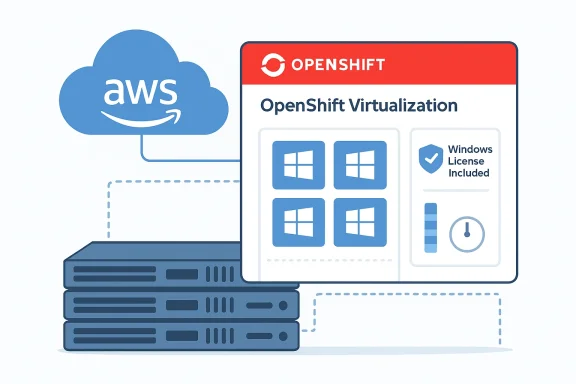
The new capability centers on Windows License Included support for OpenShift Virtualization on ROSA. According to Red Hat’s recent materials, the feature is now generally available and appears in March 2026 documentation as part of the platform’s first-quarter updates. The key promise is simple: when you deploy Windows virtual machines on ROSA, licensing is bundled into AWS billing instead of being managed separately.This is implemented at the machine pool level. That design choice is significant because it gives platform operators a clean boundary for compliance and cost control. A team can dedicate one machine pool to Windows workloads and keep the rest of the cluster on standard compute rules, which is a much more practical model for mixed environments than trying to treat every node identically.
The underlying hosts are AWS x86-64 bare metal EC2 instances, which remain a requirement for these workloads. That aligns with AWS’s own Microsoft licensing guidance, which says EC2 Bare Metal instances include the option to purchase Windows Server as license included from AWS. The bare metal requirement also helps preserve the isolation and resource guarantees that enterprises expect for production Windows workloads.
The practical benefit is not only compliance. It is also budgeting clarity. Finance teams can see Windows licensing show up in the same billing streams they already use for compute, while platform teams can automate configuration through the ROSA console, CLI, Terraform, or GitOps-oriented workflows. That means the feature is not just a licensing SKU; it is an operational simplification layer.
Why Licensing Friction Matters
Licensing is one of those enterprise issues that is invisible until it becomes the blocker. Windows workloads are often critical but old enough to carry complicated entitlements, remote access rules, or legacy support assumptions. When these workloads move into cloud environments, those old assumptions can collide with new consumption models, creating delays that look bureaucratic but have real budget and risk implications. That is why this announcement matters beyond the immediate product feature.The ROSA model addresses the classic cloud migration headache: how to ensure that every VM is covered without having to track each license through a separate procurement and reconciliation workflow. AWS’s Microsoft FAQ makes clear that license-included options are designed so AWS manages the licensing and customers pay for instance usage, with Windows Server included in the price. This is exactly the kind of abstraction enterprise IT likes when it works well.
Compliance as an Operating Model
The important shift is from reactive compliance to policy-driven compliance. Instead of relying on periodic spreadsheet checks or manual true-up processes, ROSA’s Windows LI machine pools create an enforced boundary: if you run Windows VMs there, the licensing rules are already embedded in the platform. Red Hat documentation also notes that Windows LI machine pools deny vCPU over-allocation on OpenShift Virtualization VMs, which reduces the chance of accidentally drifting into a non-compliant configuration.This kind of guardrail is particularly valuable in dynamic environments where workloads are resized, shifted, or cloned frequently. The more elasticity an organization wants, the more difficult licensing becomes if it is managed outside the platform. By making the platform understand the license boundary, AWS and Red Hat reduce the odds that operational agility will create legal exposure.
Budgeting and Chargeback
The second benefit is easier chargeback and showback. Because the licensing is measured per vCPU and tied to the AWS bill, costs can be allocated more cleanly to business units or project teams. That may not sound dramatic, but for larger enterprises it is often the difference between a migration project being funded and one being delayed indefinitely.The bundled model also helps when organizations are negotiating committed spend or enterprise agreements with AWS. If Windows licensing becomes part of the same commercial framework as infrastructure, it is easier to reason about the full cost of ownership. That does not make the workload cheap, but it makes it more legible.
How the New ROSA Model Works
At the technical level, ROSA still depends on OpenShift Virtualization, which allows virtual machines to run on OpenShift alongside containers. The difference now is that Windows VMs on supported bare metal machine pools can use AWS’s Windows LI entitlement without the user having to stitch together separate licensing layers. Red Hat’s documentation explicitly says the hosts running these Windows VMs must be enabled with AWS EC2 Windows License Included.The licensing applies to the specific machine pool where it is enabled. That is a clean architecture choice because it lets organizations isolate Windows workloads from other compute pools, which can simplify governance and operational policy. It also lets platform teams decide exactly where the licensing cost should appear, instead of spreading it implicitly across the cluster.
Machine Pools as Control Points
Machine pools are where ROSA turns policy into infrastructure. They determine the instance type, scaling range, labels, taints, and availability zones for a set of worker nodes. Adding Windows LI to that layer makes the licensing decision part of cluster design, which is where it belongs in a mature platform.That matters because it allows different pools to serve different workload classes. A Linux-only pool can remain untouched, while a Windows-specific pool can be configured for licensing, compliance, and VM density rules. In practice, this is how hybrid platforms succeed: not by forcing every workload through the same policy, but by giving each workload type a clearly defined lane.
Bare Metal and Resource Guarantees
Running on bare metal EC2 is not a minor detail. It is what gives OpenShift Virtualization the physical resource isolation required for serious VM hosting, and it aligns with the licensing model AWS uses for Windows LI. AWS’s own documentation says EC2 Bare Metal instances include the option to purchase Windows Server as license included, reinforcing that this is a supported cloud pattern rather than an improvised workaround.The bare metal requirement also helps explain why this feature is aimed squarely at enterprise migration, not casual VM hosting. Organizations that need Windows VMs on ROSA are usually looking for a platform that can support production workloads with predictable behavior. This is about operational confidence, not just running Windows somewhere in the cloud.
Enterprise Impact
For enterprise IT, the biggest win is the reduction in migration friction. Workloads that have been stuck in legacy virtualization estates can now move to AWS with fewer legal and accounting hurdles. That is especially valuable for organizations that want to consolidate VM and container operations in one place rather than maintain separate virtualization stacks.The feature also helps enterprises preserve existing operating patterns while modernizing incrementally. A company does not need to rewrite a Windows application before moving it. It can first relocate the VM to ROSA, then decide later whether to refactor, containerize, or replace it. That staged approach is often the only realistic route for large estates.
Governance Without the Spreadsheet
From a governance perspective, the most meaningful change is that Windows entitlement becomes embedded in the platform. That reduces the need for manual audits and spreadsheet-based license reconciliation, both of which are easy to get wrong under pressure. It also gives cloud center-of-excellence teams a clearer technical boundary for who can deploy what and where.This is where integration with tools like Terraform and CAPA becomes more than a convenience. When licensing configuration can be described as code, it can be version-controlled, reviewed, and reproduced across environments. That is much closer to how modern infrastructure teams want to work.
Mixed Estates Become Easier to Rationalize
Most large enterprises are not pure Windows or pure Linux shops. They are mixed estates with old applications, modern services, and a lot in between. ROSA’s value proposition improves when it can host both VM and container workloads under a consistent control plane, because it reduces the number of platforms teams must maintain.- Windows VMs can stay online while modernization proceeds gradually.
- Linux workloads can remain in the same operational domain.
- Containers and VMs can share governance and observability patterns.
- Platform teams can standardize on OpenShift APIs instead of juggling multiple virtualization stacks.
- Finance teams get a more unified billing story.
- Security teams get a single policy surface to monitor.
Consumer and SMB Impact
For smaller organizations, the story is different but still relevant. SMBs are less likely to have armies of licensing specialists, so they can benefit from anything that reduces the risk of misconfiguration. A license-included model means the burden of figuring out Windows entitlements is far lower, which makes cloud migration more approachable.That said, SMBs should not assume the bundled model is automatically the cheapest option. If a workload is small, infrequent, or already well optimized, the per-vCPU cost structure may not be ideal. The value lies more in predictability and simplicity than in raw price reduction.
Operational Simplicity for Smaller Teams
Smaller IT teams often have to act as infrastructure, security, and procurement all at once. A bundled Windows licensing model can save enormous time because it reduces the number of moving parts involved in deployment. It also makes it easier to estimate whether a Windows VM migration is realistic before the team commits engineering time.In that sense, the feature lowers the “activation energy” for migration. The technical work still has to happen, but the commercial overhead no longer feels like a separate project. That can be enough to turn a stalled migration into a funded one.
AWS and Red Hat Strategy
This announcement is also a competitive signal. AWS and Red Hat are not merely adding a checkbox feature; they are defending a platform strategy around hybrid application modernization. By unifying VMs and containers on ROSA, they are trying to make OpenShift the place where enterprises manage both legacy and modern workloads.That strategy is especially important in a market where cloud buyers are under pressure to reduce complexity. Many organizations no longer want one platform for VMs, another for Kubernetes, and another for policy. A converged control plane is easier to justify, particularly when licensing and billing are already integrated.
Competitive Pressure on VMware and Other Hybrid Platforms
The most obvious competitive implication is the pressure this places on virtualization incumbents. Enterprises leaving traditional virtualization estates want cloud migration paths that feel operationally safe and commercially understandable. If ROSA can host Windows VMs with license included, it becomes a more credible alternative for organizations that might otherwise stick with familiar virtualization vendors.It also raises the bar for competing hyperscaler offerings. To win workload migrations, providers increasingly need to offer not just VM compatibility, but licensing clarity and platform consistency. The battle is no longer just about where the VM runs; it is about where the enterprise can manage the whole lifecycle with the fewest seams.
Red Hat’s Platform Narrative
For Red Hat, the feature strengthens the case that OpenShift is more than a Kubernetes distribution. It is a platform for application operations across containers, VMs, and hybrid estates. That message is especially powerful when paired with managed service delivery on AWS, because it gives customers the convenience of a cloud service without giving up the governance benefits of OpenShift.The new licensing capability also helps Red Hat answer an old objection: that VM migration into Kubernetes-adjacent platforms is too complicated to be practical. By collapsing the licensing barrier, Red Hat removes one of the last excuses for postponing the move.
Cost, Billing, and FinOps
The billing model is where this announcement becomes concrete. AWS documentation and Red Hat’s guidance both indicate that Windows licensing is attached to the relevant bare metal instance consumption and billed on a per-vCPU basis. For organizations using FinOps practices, that makes the workload more measurable and easier to forecast.But simplification does not mean invisibility. In fact, because Windows LI is now tied so closely to the instance model, teams may need to pay more attention to CPU sizing decisions. The wrong instance shape can create avoidable licensing cost, especially for workloads that need memory or IOPS more than raw CPU. AWS has already been pushing optimization tools that let customers adjust vCPU counts or hyperthreading for license-included workloads, which suggests the company expects buyers to get more sophisticated about this layer.
The New Economics of Right-Sizing
If the licensing charge follows vCPU count, then right-sizing becomes more important than ever. Teams that previously treated CPU as a secondary concern may now need to model vCPU usage alongside memory, storage performance, and application behavior. That is especially true for databases and line-of-business apps that are memory-heavy but not CPU-intensive.This creates a subtle but important shift in optimization priorities. Instead of simply asking whether a VM is fast enough, platform teams will have to ask whether it is efficiently licensed. That is a more mature FinOps conversation, but also a more demanding one.
Billing Transparency as a Feature
The upside is that billing transparency can reduce political friction. When finance can see one line item for compute and licensing rather than a tangle of outside contracts, it is easier to approve migrations. It is also easier to explain variance month to month, because the cost center is tied directly to the infrastructure footprint.That transparency may also improve executive confidence. Migration projects often stall when nobody can answer simple cost questions cleanly. A bundled licensing model gives leadership a more legible business case.
Technical Operations and Day 2 Management
Operationally, ROSA’s appeal is that it does not stop at deployment. The platform is designed for day 2 management, including scaling, updates, access control, and workload isolation. Adding Windows LI to machine pools fits into that philosophy because it treats licensing as an operational attribute rather than a one-time procurement event.The OpenShift console and infrastructure-as-code support matter because they let different operating models coexist. Some organizations will prefer GUI-driven cluster management, while others will insist on Terraform and GitOps pipelines. ROSA appears to support both approaches, which is a key part of enterprise adoption.
Automation and Policy Enforcement
The ability to define Windows licensing in code is not just convenient; it is safer. Policies captured in Terraform or cluster automation are easier to review than ad hoc manual changes, and they reduce the chance that a platform operator will forget to enable the right pool. That is exactly the kind of control modern infrastructure teams want.The docs also suggest that Windows LI enabled machine pools enforce constraints on VM allocation. That enforcement is important because it prevents the platform from being used in ways that undermine the licensing model. In effect, the platform is becoming the licensing governor.
Support Boundaries Matter
A practical note worth emphasizing is that these capabilities are documented in Red Hat’s ROSA guidance, which is where teams should look for exact version and platform constraints. OpenShift Virtualization support depends on matching OpenShift and ROSA versions, and Red Hat has documented compatibility rules for production use. In a feature like this, version discipline is not optional; it is the difference between a stable rollout and a support headache.Migration Path and Modernization
The best way to view this feature is as an enabler of staged modernization, not a final destination. Many organizations will not stop using Windows VMs just because licensing is easier. What they will do is move them to a platform where future transformation becomes more realistic. That is a meaningful first step.Red Hat’s own messaging frames the platform as a bridge from legacy virtualization to cloud-native modernization. The promise is that teams can begin by lifting and shifting VMs, then gradually refactor applications into containers or AWS-native services as skills and priorities evolve. That is a very familiar, and very practical, enterprise modernization pattern.
From Lift-and-Shift to Refactor
A sensible migration sequence now looks like this:- Identify Windows VMs that are suitable for relocation.
- Place them on a Windows LI enabled ROSA machine pool.
- Validate cost, performance, and compliance behavior in production-like conditions.
- Consolidate shared operational controls around OpenShift.
- Decide later whether each workload should be kept as a VM, containerized, or replaced.
A Platform for Mixed-Speed Change
Modernization rarely happens uniformly across a portfolio. Some apps can be containerized quickly, while others may remain VMs for years. ROSA’s combined VM-and-container story, now strengthened by Windows licensing simplification, is tailored to that reality.- Fast-moving teams can pursue container-first delivery.
- Conservative workloads can stay in VMs without being isolated to a separate stack.
- Security teams can standardize controls around one platform.
- Operations teams can reduce tool sprawl.
- Business leaders can sequence modernization according to risk, not ideology.
Strengths and Opportunities
The strongest argument for Windows License Included on ROSA is that it aligns technology, operations, and finance around one platform. That sounds incremental, but in enterprise IT, the ability to remove friction across disciplines is often more valuable than a headline-grabbing technical leap. It turns a complicated migration into a manageable one, and that can unlock backlog items that have been stalled for years.- Simplified licensing reduces administrative overhead and compliance anxiety.
- Unified billing makes forecasting and chargeback easier.
- Machine-pool-level control supports cleaner governance boundaries.
- Bare metal EC2 hosting preserves the performance expectations of VM workloads.
- Mixed VM/container operations reduce platform sprawl.
- Terraform and automation support fit modern infrastructure workflows.
- Incremental modernization lets enterprises move at a realistic pace.
Risks and Concerns
The feature is attractive, but it is not free of tradeoffs. Because Windows licensing is tied to vCPU consumption, some workloads may become more expensive than teams initially expect if they are not carefully right-sized. There is also a risk that buyers interpret “simpler” as “cheaper,” when in reality the primary win may be operational clarity rather than lower total cost.- Per-vCPU billing can increase cost sensitivity for CPU-heavy workloads.
- Bare metal requirements may limit deployment flexibility.
- Version compatibility adds operational discipline requirements.
- Licensing constraints could reduce over-provisioning options.
- Platform complexity remains for teams unfamiliar with OpenShift Virtualization.
- Vendor dependence deepens when both runtime and licensing sit inside the same ecosystem.
- Migration enthusiasm could outrun testing if teams rush into production too quickly.
Looking Ahead
The most important thing to watch is whether customers actually use this capability to migrate meaningful Windows estates, not just pilot a few non-critical VMs. If adoption grows, it will validate the idea that licensing friction has been a larger blocker than many vendors wanted to admit. If adoption is modest, it may still have strategic value as a proof point for the broader ROSA platform.The second thing to watch is whether AWS and Red Hat expand the licensing story further. If the company can keep reducing cost and compliance complexity for Microsoft workloads while preserving OpenShift’s hybrid model, that would strengthen the case for ROSA as an enterprise standard. The market is clearly rewarding platforms that collapse operational silos rather than create new ones.
- Customer adoption patterns across enterprise migration projects.
- Broader version support and any changes to region availability.
- FinOps tooling that helps optimize vCPU-based licensing.
- Competitive reactions from VMware, hyperscalers, and virtualization platforms.
- Further integration between AWS billing, OpenShift automation, and Microsoft workload governance.
Source: Amazon Web Services Running Windows Workloads on AWS Just Got Easier with ROSA | Amazon Web Services
