Microsoft and Amazon’s latest quarterly disclosures have handed nervous investors a new yardstick to worry over: not just whether cloud growth is slowing, but how much future cloud revenue has been booked — and whether those booked promises will ever translate into cash and profit. What looked like reassuring backlogs and triumphant contract wins in press releases have, in several cases, forced markets to reprice some of the biggest tech names because the path from a signed AI or cloud deal to durable earnings is suddenly much less certain than it seemed.
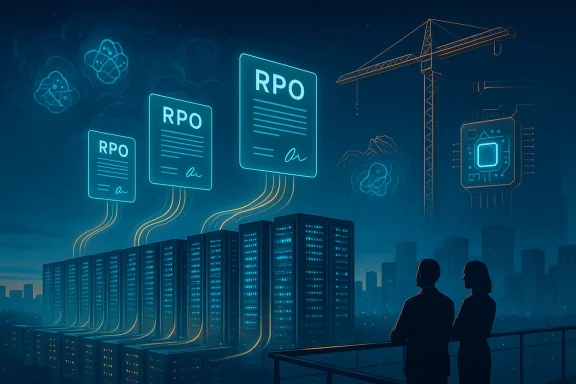
Executives at hyperscalers have been trying to sell a simple narrative: AI demand is enormous, customers are signing long-term commitments for cloud capacity, and that backlog proves the future revenue engine is intact. On its face, a rising backlog — technically called remaining performance obligations (RPO) or deferred-contract revenue — is a favorable signal: it’s a measure of contracted but not-yet-recognized sales that should convert into future reported revenue.
But two dynamics collided to turn that metric from reassurance into a new market risk:
Meanwhile Microsoft and Amazon — each with different business models and accounting details — showed the same tension in other ways: slower-than-expected near-term cloud growth, very large infrastructure spending, and public statements that leaned heavily on future bookings and long-term commitments rather than immediate margin expansion. Those disclosures shifted investor attention away from headline revenue beats and toward the durability, concentration and timing of future sales, renewing broader “AI-capex bubble” fears that had been building through 2025.
Because RPO aggregates long-term commitments, a large RPO can mask three important risks:
Why the alarm bells?
Key investor concerns around Microsoft:
Specific investor questions for AWS:
When RPO reckoning meets capex reality, two things can go wrong:
Oracle’s RPO surge drew precisely this criticism: a large share was associated with a small set of big AI buyers. Investors asked whether those commitments were truly non‑cancelable and whether the company could staff, site, and power all the new capacity on the schedule implied by the contracts.
Examples invoked by analysts have included publicized commitments between model creators and cloud operators that, in aggregate, can look like large markets but in practice are partly internalized flows or contingent commitments. These complex structures raise the bar for transparency: investors have demanded clearer disclosures about who pays whom, when, and under what conditions.
When circularity becomes plausible, markets apply a higher discount to promised revenues — especially if the deals are used to justify heavy debt issuance.
Two broader factors amplify the risk:
In short: booked promises of future cloud sales can be powerful indicators — but in the age of AI hyperscaling, they are also early warning lights. Investors and analysts should treat them as such: valuable for building a forecast, not as a guarantee that a company’s valuation should permanently expand to accommodate distant, capital-dependent revenue streams.
Source: Bloomberg.com https://www.bloomberg.com/news/news...omises-of-future-cloud-sales-spook-investors/
 Background: what changed this week — and why investors flinched
Executives at hyperscalers have been trying to sell a simple narrative: AI demand is enormous, customers are signing long-term commitments for cloud capacity, and that backlog proves the future revenue engine is intact. On its face, a rising backlog — technically called remaining performance obligations (RPO) or deferred-contract revenue — is a favorable signal: it’s a measure of contracted but not-yet-recognized sales that should convert into future reported revenue.But two dynamics collided to turn that metric from reassurance into a new market risk:
- The commitments being booked are unusually large, concentrated, and often tied to multi-year capacity builds that require massive near-term capital spending.
- Companies are simultaneously raising guidance for capital expenditures and turning to bond markets to finance data-center buildouts, so the balance-sheet risk of converting booked promises into profitable cash flows has risen.
Meanwhile Microsoft and Amazon — each with different business models and accounting details — showed the same tension in other ways: slower-than-expected near-term cloud growth, very large infrastructure spending, and public statements that leaned heavily on future bookings and long-term commitments rather than immediate margin expansion. Those disclosures shifted investor attention away from headline revenue beats and toward the durability, concentration and timing of future sales, renewing broader “AI-capex bubble” fears that had been building through 2025.
Overview: RPO, deferred revenue and why those accounting terms matter now
What is Remaining Performance Obligations (RPO)?
RPO is the accounting label used by many cloud and software firms to describe the dollar value of contracts that are signed but not yet recognized as revenue. It typically includes:- Deferred revenue (amounts invoiced or received in advance), and
- Uninvoiced, non‑cancelable contract commitments that the company expects to bill and recognize in future periods.
Because RPO aggregates long-term commitments, a large RPO can mask three important risks:
- Timing risk — revenue recognition may be years away while the vendor incurs costs now.
- Concentration risk — if a few customers account for a large share of the RPO, a renegotiation or cancellation would meaningfully alter the outlook.
- Delivery and financing risk — building data centers and GPU farms requires upfront capital; if cash or credit markets tighten, the vendor could be forced to scale back or carry expensive debt.
Why deferred revenue can be misleading in an AI boom
Cloud vendors historically sold multi-year enterprise software subscriptions with predictable renewal behavior. AI infrastructure sales are different in two ways:- Volume and scale: AI training and inference contracts require sustained, high-density GPU deployments that are capital intensive.
- Demand elasticity and pricing pressure: AI models and supply-chain innovations can rapidly shift the cost structure of compute, meaning customers can shop for cheaper alternatives if rivals undercut pricing.
Case studies: Oracle, Microsoft, Amazon — same problem, different symptoms
Oracle: the RPO rocket and the Capitol-sized question of conversion
Oracle’s December quarter crystallized investor anxiety. Management reported a dramatic jump in RPO into the hundreds of billions, a figure that dwarfs typical backlogs in the cloud market and implied a tidal wave of future cloud revenue. At the same time Oracle raised its capital-expenditure outlook materially to build the data-center capacity needed to fulfill those contracts. The company’s quarter included both a large one‑time gain that helped EPS and explicit guidance calling for tens of billions more in capex to meet demand. The market’s response was volatile: investors cheered the sales but immediately priced the financing and execution risk into Oracle’s valuation.Why the alarm bells?
- A huge portion of the headline RPO was tied to a small set of very large customers; if one of those relationships weakens or if contract terms are more flexible in practice than they appear on the surface, the reality of future revenue could come in far below headline expectations.
- Oracle’s capex plans are front-loaded. Cash outlays to build GPU-dense clusters and new datacenters occur now; revenue recognition follows a usage curve that’s driven by customer consumption. That timing gap creates pressure on free cash flow and leverage.
- Credit markets and bondholders pay attention to capital intensity. Oracle’s large bond and lease commitments — coupled with big RPO — prompted questions about how much debt the company would need to shoulder to satisfy its own bookings. Several reports and filings made those linkages explicit in the weeks after the release.
Microsoft: capacity constraints, capex and the limits of “AI will fix it later”
Microsoft’s situation is subtler but no less serious. Azure growth has been a central investor thesis for years, and expectations are high that AI adoption will accelerate cloud spending. In mid‑2025 and into early 2026, Microsoft signaled that Azure growth had been constrained by capacity shortfalls and that management expected growth to rebound as new capacity came online. At the same time, Microsoft’s capital spending has climbed into the tens of billions to meet AI-related demand. Those two facts together — capacity-constrained growth today, very large capex plans now — mean investors are asking whether the pace of near-term revenue will be sufficient to justify the massive, ongoing investments. The answer matters more when interest rates and valuations have re-priced growth stocks lower.Key investor concerns around Microsoft:
- Execution timing: Are the new data centers and AI acceleration chips coming online fast enough to restore Azure growth without further margin erosion?
- Marginal economics: AI workloads are GPU- and memory-heavy; they carry different margin profiles than traditional cloud services. Investors want to see whether AI workloads will be as profitable per dollar of revenue as older SaaS and PaaS businesses.
- Disclosure differences: Microsoft reports Azure growth and capital spending in ways that require analysts to make assumptions about how much booked demand is truly binding versus contingent on ongoing consumption.
Amazon / AWS: the profit engine that looks increasingly capital-hungry
Amazon’s AWS has long been the profit engine that justified a bigger parent-company valuation. Investors watched AWS results for signs that it could continue to fund itself while Amazon spent on retail and logistics. In recent quarters, however, AWS growth decelerated in some periods and Amazon signaled very large capex expectations, including multi‑quarter spending plans in the tens of billions — numbers that in aggregate rival what entire sectors would spend. Those capex numbers, when combined with modest AWS growth decelerations and the need to support huge AI-specific workloads, have made investors more sensitive to whether AWS can keep margins up while funding massive capacity expansion.Specific investor questions for AWS:
- Will AWS remain the high‑margin cash cow if customers demand cheaper AI compute alternatives?
- How much of Amazon’s CapEx is being directed to non-AWS operations versus cloud infrastructure, and how do investors value those different spends?
- If Amazon needs to borrow heavily to fund the buildout, how does that affect its long-term cash generation profile relative to companies that can fund capex internally?
The mechanics behind investor fear: financing, concentration, and circularity
1. Financing the build vs recognizing the revenue
The crux of the problem is cash flow timing. Building GPU farms and hyperscale datacenters requires big upfront spending: land, construction, power, networking, and most expensive of all, GPU inventory and systems integration. Companies often secure customer commitments before or during construction, creating a sense of forward visibility (RPO). But most of the cash flow benefits only come once the customer consumes capacity and the vendor recognizes revenue over time.When RPO reckoning meets capex reality, two things can go wrong:
- The vendor’s balance sheet or debt markets are stretched, forcing higher-cost financing or slower builds.
- Customers’ usage ramps more slowly than expected — often because they experiment with AI models on less-expensive platforms or delay full-scale deployment — leaving the vendor to carry the fixed costs.
2. Concentration risk — one customer can move a mountain
Some of the biggest RPO jumps have been concentrated in a handful of customers. When a single customer accounts for a very large fraction of a company’s backlog, that’s a leverage other than financial leverage — it’s customer concentration risk. If a major purchaser renegotiates terms, delays deployment, or cancels projects, the headline RPO number looks much less impressive in reality.Oracle’s RPO surge drew precisely this criticism: a large share was associated with a small set of big AI buyers. Investors asked whether those commitments were truly non‑cancelable and whether the company could staff, site, and power all the new capacity on the schedule implied by the contracts.
3. Circular deals and self‑reinforcing hype
A third worry is the emergence of what analysts call circular or interdependent deals: arrangements where AI companies, datacenter builders, chip vendors, and financing partners enter into reciprocal agreements that inflate headline figures without creating equivalent underlying free cash flow.Examples invoked by analysts have included publicized commitments between model creators and cloud operators that, in aggregate, can look like large markets but in practice are partly internalized flows or contingent commitments. These complex structures raise the bar for transparency: investors have demanded clearer disclosures about who pays whom, when, and under what conditions.
When circularity becomes plausible, markets apply a higher discount to promised revenues — especially if the deals are used to justify heavy debt issuance.
How to read the numbers: what investors should and shouldn’t infer
What a rising RPO genuinely tells you
- There is contracted interest in a vendor’s services — customers have signed up for future capacity.
- Management has sales momentum and arguably higher forward revenue visibility than peers with flat backlogs.
- For some companies, a portion of RPO will convert into near-term revenue (companies usually disclose the 12‑month conversion percentage).
What a rising RPO does not guarantee
- Immediate cash flow or margin improvement — RPO is not cash received and recognized as profit.
- Low execution risk — building and scaling cloud infrastructure is complex and capital intensive.
- Customer permanence — contract structures, termination clauses, and practical deliverability matter; not every contract yields full value if customers shift strategies.
Practical red flags to watch in filings and calls
- CapEx vs. conversion timing: When capex is accelerating faster than the company’s guidance for revenue recognition, the timing mismatch is a risk.
- Customer concentration disclosure: If a few customers account for a large chunk of backlog, ask how the company would fare if one scaled back.
- Lease and debt commitments: Large future lease obligations and recent bond issuances can show how the buildout is being financed.
- Definition and conversion rates for RPO: Companies sometimes vary what they include in RPO; check the notes for what portion is expected to convert within 12 months.
The broader market implications: bubble talk, rate sensitivity, and valuation resets
The reaction to SaaS backlogs has some echoes of past market cycles: investors reward durable, cash-producing growth and punish capital-intensive growth that leaves banks and bond markets on the hook.Two broader factors amplify the risk:
- Rate environment and multiple compression. With higher interest rates than the era of cheap money, the present value of far-future revenue drops, and investors are less willing to pay for long stringy RPO growth that doesn’t produce immediate free-cash-flow lift.
- Competition and technological change. Rapid improvements in model efficiency or cheaper alternative suppliers (onshore or offshore) can compress pricing and reduce the expected lifetime value of large customers’ commitments.
What managements can do — and what investors should demand
For vendors:- Be explicit about convertibility. Disclose the proportion of RPO expected to convert within 12, 24 and 36 months and the assumptions behind those percentages.
- Share granular capex plans. Break down how capex maps to contracted vs expected demand and show staged financing that limits the balance-sheet risk if a major customer defers.
- Quantify concentration. If a handful of customers provide most of the backlog, say so and outline contingency plans.
- Show unit economics for AI workloads. Investors want to see that AI compute is not only driving revenue but also delivering acceptable margins.
- Don’t conflate booked contracts with realized profits. RPO is a leading indicator, not a substitute for cash-flow analysis.
- Scrutinize financing sources. Watch bond issuance, lease commitments, and any off‑balance-sheet funding that could raise leverage.
- Stress-test scenarios. Model slower-than-expected conversion and delays in customer consumption to see downside effects on free cash flow.
Conclusion — a new metric, a familiar set of risks
The latest bump in tech market anxiety isn’t just about whether AI demand exists; it’s about how that demand is being quantified, booked and financed. RPO and similar backlog metrics give companies a valuable tool to show forward business, but they are no substitute for cash and profit. When RPO spikes are paired with large, front‑loaded capex and concentrated customers, the headline backlog becomes the very thing that makes investors nervous.In short: booked promises of future cloud sales can be powerful indicators — but in the age of AI hyperscaling, they are also early warning lights. Investors and analysts should treat them as such: valuable for building a forecast, not as a guarantee that a company’s valuation should permanently expand to accommodate distant, capital-dependent revenue streams.
Source: Bloomberg.com https://www.bloomberg.com/news/news...omises-of-future-cloud-sales-spook-investors/