

Microsoft and NVIDIA announced on June 1, 2026, at the Computex-adjacent NVIDIA GTC Taipei cycle, a new class of Windows PCs built around NVIDIA’s RTX Spark platform, with Surface, ASUS, Dell, HP, Lenovo, and MSI devices planned for fall availability. The pitch is simple enough to fit on a keynote slide: Windows laptops and compact desktops should run serious AI, graphics, and development workloads locally rather than treating the cloud as the only place where modern computing happens. The more interesting story is that Microsoft is once again trying to redraw the boundaries of the PC—this time by pairing Windows on Arm with NVIDIA’s CUDA-heavy developer gravity. If it works, RTX Spark could be the first Windows-on-Arm moment that feels less like a compromise and more like a power play.
For years, Windows on Arm has been sold defensively. It was the platform of endurance, instant wake, fanless designs, and theoretical mobility. That was useful, but it also trained buyers to expect trade-offs: fewer native apps, weird driver gaps, occasional emulation penalties, and the quiet suspicion that a “real” Windows PC still meant x86.
RTX Spark changes the framing. Microsoft and NVIDIA are not leading with thinness, silence, or all-day battery life, even if energy efficiency is part of the package. They are leading with local AI performance, RTX graphics, unified memory, and developer workflows that have historically belonged to workstations or cloud instances.
That matters because Windows on Arm needed a reason to exist beyond being Microsoft’s answer to Apple silicon. Qualcomm’s Snapdragon X push helped establish that Windows laptops could compete on battery and responsiveness, but it did not fully settle the question that haunts professional buyers: can this machine run the demanding stuff I actually use? NVIDIA’s answer is to bring the demanding stuff with it.
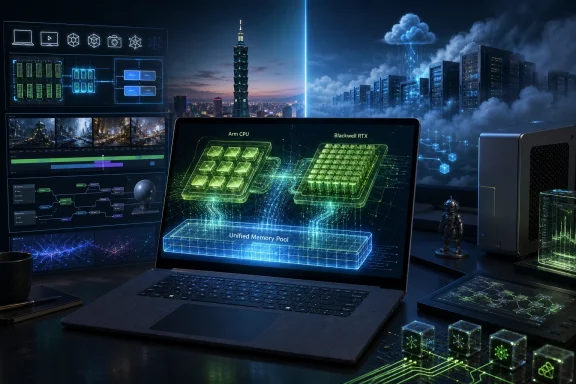
The RTX Spark platform is being described as a superchip-class design with up to 6,144 Blackwell RTX cores, up to 20 power-efficient Arm CPU cores, and up to 128GB of unified memory. Those numbers are not ordinary laptop marketing. They are the language of model size, scene complexity, timeline resolution, and data locality.
A developer building agent workflows does not always need a data-center cluster. A filmmaker testing an AI-assisted color, upscaling, or effects workflow does not always need to rent cloud GPU time for every iteration. A game developer, 3D artist, or robotics engineer often needs local responsiveness before scale-out infrastructure becomes useful.
This is where unified memory becomes more than a spec-sheet flourish. The difference between having a large memory pool available to CPU and GPU workloads and juggling limited discrete GPU VRAM can determine whether a model runs locally, whether a scene fits comfortably, or whether a workflow collapses into waiting, swapping, and compromise. NVIDIA has spent years training developers to think in CUDA, TensorRT, RTX, OptiX, DLSS, and related stacks; RTX Spark tries to shrink that world into a portable Windows machine.
Microsoft’s interest is equally obvious. If AI agents are to become part of everyday Windows computing, the company cannot rely entirely on remote inference. Cloud AI is powerful, but it has latency, cost, privacy, availability, and governance implications. Local AI lets Microsoft argue that Windows PCs remain the natural home for personal computing rather than merely terminals attached to hyperscale services.
Surface has had powerful-ish machines before, including Laptop Studio models with discrete NVIDIA graphics. But Surface Laptop Ultra is different because Microsoft is not just bolting an NVIDIA GPU onto a familiar PC architecture. It is presenting the device as engineered around RTX Spark, Windows, and Arm from the start.
That gives Microsoft a cleaner answer to Apple’s MacBook Pro line than it has had in years. Apple’s advantage has not merely been performance-per-watt; it has been architectural coherence. CPU, GPU, media engines, memory, OS, and pro applications all tell one story. Microsoft and NVIDIA are now trying to tell an equivalent Windows story, but with NVIDIA’s graphics and AI ecosystem as the differentiator.
The risk is that Surface Laptop Ultra will be judged against several different expectations at once. Windows fans will want it to run legacy applications well. Creators will want Adobe, Blender, DaVinci Resolve, Cinema 4D, CapCut, Affinity, and other tools to behave like first-class citizens. Developers will want containers, toolchains, local models, package managers, and GPU acceleration to be boringly reliable. Gamers will want RTX branding to mean games, not just demos.
That is a lot for a first-generation platform to carry.
The native-app list is stronger than it would have been a few years ago. Adobe Photoshop and Premiere Pro, Blender, DaVinci Resolve, Cinema 4D, CapCut, and Affinity represent a broad enough spread to make the platform plausible for many creators. The catch is that “runs natively” does not always mean “matches every workflow.”
Professional creative environments are messy. Plug-ins, codecs, capture hardware, color panels, audio interfaces, fonts, asset managers, scripting extensions, render farms, and old project dependencies can matter as much as the headline application. A native Premiere Pro build is good news; a specific third-party effect that fails on Arm can still stop a job.
Developers face a similar split. The modern software stack is more Arm-friendly than ever because cloud infrastructure, containers, Apple silicon, and Linux development have pushed the ecosystem in that direction. But Windows developers still live with a long tail of dependencies, SDKs, debuggers, drivers, virtualization layers, and enterprise tooling that may assume x86 in subtle ways.
This is why RTX Spark’s first year will be less about benchmark wins and more about friction. If the platform feels fast but occasionally strange, it will remain an enthusiast story. If it feels fast and predictable, Microsoft gets something it has chased for more than a decade: a credible high-end Windows-on-Arm workstation class.
NVIDIA’s involvement helps because gamers trust RTX in a way they do not yet trust Arm Windows gaming. DLSS, Reflex, RTX ray tracing, and NVIDIA’s driver reputation carry weight. But a platform can have excellent graphics hardware and still stumble if anti-cheat systems, launchers, kernel-level drivers, input utilities, overlays, mods, and game engines do not cooperate.
Riot’s titles matter because VALORANT in particular has been a difficult case for compatibility layers due to its anti-cheat architecture. If major anti-cheat vendors and game developers actively support Windows on Arm, the platform’s perceived ceiling rises. If support remains selective, RTX Spark laptops may be seen as creator/developer machines that can game, not gaming machines in the traditional PC sense.
That distinction may be acceptable. Microsoft does not need RTX Spark to replace every GeForce laptop. It needs the platform to avoid the embarrassment of an RTX-branded Windows PC that cannot run the games people expect to run on Windows. For a company that owns Xbox and Windows, gaming compatibility is not a side quest; it is part of the credibility test.
That does not mean NVIDIA is suddenly becoming Intel overnight. But a superchip with Arm CPU cores, Blackwell RTX graphics, unified memory, and a full AI software stack is a very different proposition from a discrete GPU inside someone else’s laptop design. It gives NVIDIA more control over the performance story, the developer story, and the AI story.
Intel and AMD will not enjoy that framing. Both companies have been racing to add NPUs, improve integrated graphics, and position x86 PCs as AI-ready without abandoning the enormous compatibility base that made Windows dominant. Qualcomm, meanwhile, has worked hard to make Windows on Arm credible in the first place, only to see NVIDIA arrive with a platform that may instantly become more attractive to developers who care about CUDA.
Apple is the unavoidable comparison. The MacBook Pro became the professional laptop benchmark because Apple silicon delivered performance, thermals, battery life, and software integration in a package that made the old Intel Mac era look tired. Microsoft and NVIDIA are trying to exploit the one area where Apple is vulnerable: CUDA and the broader NVIDIA developer ecosystem.
For AI researchers, machine-learning engineers, 3D professionals, and certain technical creators, NVIDIA compatibility is not a nice-to-have. It is infrastructure. If Windows can offer that in a portable Arm system, Microsoft may finally have a professional laptop story that is not merely “like a Mac, but Windows.”
But the pendulum had swung too far toward assuming that serious AI is always remote. That creates costs for users and administrators. Cloud GPU bills are unpredictable, data governance can be complicated, and latency-sensitive interactions feel different when every request leaves the device.
Local AI also changes experimentation. Developers can iterate privately, cheaply, and offline before deciding what needs to scale. Creators can use AI-assisted tools without turning every intermediate asset into a network transaction. Enterprises can test sensitive workflows in a more controlled environment, even if production eventually moves to managed infrastructure.
Microsoft has an additional reason to want this balance. If Windows becomes the place where AI agents observe user context, manipulate local files, automate workflows, and interact with installed applications, then local compute is not optional. The more personal the agent, the stronger the case for processing at least some of its work on the machine in front of the user.
That is why NVIDIA’s comment about agents being the future of personal computing is more than a slogan. The agentic PC is a hardware argument disguised as a software vision. If the PC is to become a collaborator rather than a launcher, it needs memory, acceleration, sensors, security boundaries, and platform APIs that can support that role.
Bringing Windows to that class of machine tells us how Microsoft and NVIDIA want the ladder to look. RTX Spark handles portable and compact local AI. DGX Station for Windows handles heavier models and enterprise-grade development. Azure remains the scale-out destination. The strategy is to make Windows feel present across the workflow rather than confined to the front-end laptop.
For enterprise IT, that could be compelling. Many organizations already have Windows-centric endpoint management, identity, security, and developer practices. If high-end AI workstations can slot into that world more naturally, Microsoft gains a way to keep AI development inside its ecosystem without forcing every workload immediately into Azure.
But this also raises practical questions. High-memory AI workstations are expensive, power-hungry, and operationally different from ordinary desktops. They need governance, scheduling, security policies, model management, and clear cost justification. The Windows logo does not magically make a deskside AI supercomputer easy to administer.
Still, the direction is clear. Microsoft does not want Windows to be perceived as the operating system for office productivity while Linux owns serious AI development. DGX Station for Windows is a statement that the company intends to contest that territory from the laptop to the workstation.
Driver maturity will matter. Firmware updates will matter. Endpoint security tools will matter. VPN clients, EDR agents, disk encryption, privileged access systems, and device-management policies must all behave properly on Arm Windows. A beautiful AI laptop that breaks a corporate security agent is not a corporate laptop.
There is also procurement ambiguity. Is an RTX Spark device a developer workstation, a creator laptop, a gaming-capable premium PC, or an AI endpoint? Different departments budget those categories differently. The first wave may be expensive enough that organizations buy them selectively for high-value users rather than refresh fleets around them.
Support teams will also need to understand where local AI data goes. If agents can inspect files, summarize meetings, automate actions, or run models locally, governance does not disappear just because the workload avoids the cloud. Local processing may reduce some privacy risks while introducing others around logs, model artifacts, local caches, and user consent.
The best enterprise deployments will treat RTX Spark as a new endpoint class, not merely a faster laptop. That means pilot groups, app validation, security baselines, workload guidance, and clear rules for when local AI is preferred over cloud AI. The worst deployments will hand these devices to power users and discover the policy questions later.
But the platform will live or die on boring things. Sleep and resume. Thermals under sustained load. External display behavior. Docking. Battery life during real AI and creative workloads. Plug-in compatibility. Driver updates. Windows Update reliability. Native installers. Game launchers. The quiet machinery of the PC experience will decide whether RTX Spark feels revolutionary or merely ambitious.
Microsoft has learned this lesson the hard way. Windows users are tolerant of complexity when the payoff is clear, but they are ruthless about broken promises. A machine advertised for creators cannot stumble on color workflows. A machine advertised for developers cannot make GPU setup feel like a scavenger hunt. A machine advertised for AI cannot require users to become infrastructure engineers.
NVIDIA faces its own challenge. Its developer ecosystem is a strength, but expectations around NVIDIA hardware are high. If RTX Spark performance falls into an awkward gap—too expensive for mainstream buyers, not powerful enough for serious local AI, and too compatibility-constrained for gamers—it could become a niche curiosity. If it lands well, it becomes a wedge into the future PC platform.
The fall launch window will therefore be unusually important. The first devices from Surface, ASUS, Dell, HP, Lenovo, and MSI will not just compete with one another. They will collectively define whether RTX Spark is perceived as a category or a campaign.
The most concrete early signals are already visible:
 Microsoft Finally Found a Windows-on-Arm Story That Is Not About Battery Life
For years, Windows on Arm has been sold defensively. It was the platform of endurance, instant wake, fanless designs, and theoretical mobility. That was useful, but it also trained buyers to expect trade-offs: fewer native apps, weird driver gaps, occasional emulation penalties, and the quiet suspicion that a “real” Windows PC still meant x86.RTX Spark changes the framing. Microsoft and NVIDIA are not leading with thinness, silence, or all-day battery life, even if energy efficiency is part of the package. They are leading with local AI performance, RTX graphics, unified memory, and developer workflows that have historically belonged to workstations or cloud instances.
That matters because Windows on Arm needed a reason to exist beyond being Microsoft’s answer to Apple silicon. Qualcomm’s Snapdragon X push helped establish that Windows laptops could compete on battery and responsiveness, but it did not fully settle the question that haunts professional buyers: can this machine run the demanding stuff I actually use? NVIDIA’s answer is to bring the demanding stuff with it.
The RTX Spark platform is being described as a superchip-class design with up to 6,144 Blackwell RTX cores, up to 20 power-efficient Arm CPU cores, and up to 128GB of unified memory. Those numbers are not ordinary laptop marketing. They are the language of model size, scene complexity, timeline resolution, and data locality.
The Real Product Is Not the Laptop, It Is the Local AI Workstation
Microsoft’s announcement reads like a PC launch, but the strategic product is a new tier of personal compute. RTX Spark is meant to sit between today’s AI-capable laptops and the expensive deskside AI systems that NVIDIA sells to enterprises, labs, and developers who have outgrown consumer hardware. That middle layer is where a lot of practical AI work is likely to happen.A developer building agent workflows does not always need a data-center cluster. A filmmaker testing an AI-assisted color, upscaling, or effects workflow does not always need to rent cloud GPU time for every iteration. A game developer, 3D artist, or robotics engineer often needs local responsiveness before scale-out infrastructure becomes useful.
This is where unified memory becomes more than a spec-sheet flourish. The difference between having a large memory pool available to CPU and GPU workloads and juggling limited discrete GPU VRAM can determine whether a model runs locally, whether a scene fits comfortably, or whether a workflow collapses into waiting, swapping, and compromise. NVIDIA has spent years training developers to think in CUDA, TensorRT, RTX, OptiX, DLSS, and related stacks; RTX Spark tries to shrink that world into a portable Windows machine.
Microsoft’s interest is equally obvious. If AI agents are to become part of everyday Windows computing, the company cannot rely entirely on remote inference. Cloud AI is powerful, but it has latency, cost, privacy, availability, and governance implications. Local AI lets Microsoft argue that Windows PCs remain the natural home for personal computing rather than merely terminals attached to hyperscale services.
Surface Laptop Ultra Is Microsoft’s Flag in the Ground
The most symbolic machine in the first wave is Surface Laptop Ultra. Microsoft is positioning it as a high-performance laptop for creators, developers, engineers, and professionals who need more compute than the existing Surface lineup offers. That alone is a meaningful shift for Surface, a brand that has often been strongest as a design statement and weakest as a raw performance contender.Surface has had powerful-ish machines before, including Laptop Studio models with discrete NVIDIA graphics. But Surface Laptop Ultra is different because Microsoft is not just bolting an NVIDIA GPU onto a familiar PC architecture. It is presenting the device as engineered around RTX Spark, Windows, and Arm from the start.
That gives Microsoft a cleaner answer to Apple’s MacBook Pro line than it has had in years. Apple’s advantage has not merely been performance-per-watt; it has been architectural coherence. CPU, GPU, media engines, memory, OS, and pro applications all tell one story. Microsoft and NVIDIA are now trying to tell an equivalent Windows story, but with NVIDIA’s graphics and AI ecosystem as the differentiator.
The risk is that Surface Laptop Ultra will be judged against several different expectations at once. Windows fans will want it to run legacy applications well. Creators will want Adobe, Blender, DaVinci Resolve, Cinema 4D, CapCut, Affinity, and other tools to behave like first-class citizens. Developers will want containers, toolchains, local models, package managers, and GPU acceleration to be boringly reliable. Gamers will want RTX branding to mean games, not just demos.
That is a lot for a first-generation platform to carry.
Native Apps Are the Difference Between Ambition and Adoption
Microsoft’s claim that major creative applications already run natively on Arm-based Windows devices is central to the announcement. It is not enough for a platform to be technically impressive if the user spends the day inside emulated software, unsupported plug-ins, or drivers that lag behind their x86 counterparts. Creative professionals and developers are not buying an architecture; they are buying fewer interruptions.The native-app list is stronger than it would have been a few years ago. Adobe Photoshop and Premiere Pro, Blender, DaVinci Resolve, Cinema 4D, CapCut, and Affinity represent a broad enough spread to make the platform plausible for many creators. The catch is that “runs natively” does not always mean “matches every workflow.”
Professional creative environments are messy. Plug-ins, codecs, capture hardware, color panels, audio interfaces, fonts, asset managers, scripting extensions, render farms, and old project dependencies can matter as much as the headline application. A native Premiere Pro build is good news; a specific third-party effect that fails on Arm can still stop a job.
Developers face a similar split. The modern software stack is more Arm-friendly than ever because cloud infrastructure, containers, Apple silicon, and Linux development have pushed the ecosystem in that direction. But Windows developers still live with a long tail of dependencies, SDKs, debuggers, drivers, virtualization layers, and enterprise tooling that may assume x86 in subtle ways.
This is why RTX Spark’s first year will be less about benchmark wins and more about friction. If the platform feels fast but occasionally strange, it will remain an enthusiast story. If it feels fast and predictable, Microsoft gets something it has chased for more than a decade: a credible high-end Windows-on-Arm workstation class.
Gaming Is the Platform’s Most Awkward Test
The gaming claim is both necessary and dangerous. Microsoft says support from anti-cheat providers and game developers will help RTX Spark systems access a broad PC game catalog, with titles such as League of Legends and VALORANT called out. That is a direct acknowledgement of one of Windows on Arm’s most stubborn problems: PC gaming is not just rendering, it is compatibility.NVIDIA’s involvement helps because gamers trust RTX in a way they do not yet trust Arm Windows gaming. DLSS, Reflex, RTX ray tracing, and NVIDIA’s driver reputation carry weight. But a platform can have excellent graphics hardware and still stumble if anti-cheat systems, launchers, kernel-level drivers, input utilities, overlays, mods, and game engines do not cooperate.
Riot’s titles matter because VALORANT in particular has been a difficult case for compatibility layers due to its anti-cheat architecture. If major anti-cheat vendors and game developers actively support Windows on Arm, the platform’s perceived ceiling rises. If support remains selective, RTX Spark laptops may be seen as creator/developer machines that can game, not gaming machines in the traditional PC sense.
That distinction may be acceptable. Microsoft does not need RTX Spark to replace every GeForce laptop. It needs the platform to avoid the embarrassment of an RTX-branded Windows PC that cannot run the games people expect to run on Windows. For a company that owns Xbox and Windows, gaming compatibility is not a side quest; it is part of the credibility test.
NVIDIA Is Walking Directly Into Intel, AMD, Qualcomm, and Apple’s Territory
RTX Spark is not just a Microsoft story. It is NVIDIA signaling that the PC’s center of gravity is up for grabs. For decades, NVIDIA’s role in the Windows PC market was primarily as the graphics accelerator vendor. With RTX Spark, NVIDIA is moving closer to platform ownership.That does not mean NVIDIA is suddenly becoming Intel overnight. But a superchip with Arm CPU cores, Blackwell RTX graphics, unified memory, and a full AI software stack is a very different proposition from a discrete GPU inside someone else’s laptop design. It gives NVIDIA more control over the performance story, the developer story, and the AI story.
Intel and AMD will not enjoy that framing. Both companies have been racing to add NPUs, improve integrated graphics, and position x86 PCs as AI-ready without abandoning the enormous compatibility base that made Windows dominant. Qualcomm, meanwhile, has worked hard to make Windows on Arm credible in the first place, only to see NVIDIA arrive with a platform that may instantly become more attractive to developers who care about CUDA.
Apple is the unavoidable comparison. The MacBook Pro became the professional laptop benchmark because Apple silicon delivered performance, thermals, battery life, and software integration in a package that made the old Intel Mac era look tired. Microsoft and NVIDIA are trying to exploit the one area where Apple is vulnerable: CUDA and the broader NVIDIA developer ecosystem.
For AI researchers, machine-learning engineers, 3D professionals, and certain technical creators, NVIDIA compatibility is not a nice-to-have. It is infrastructure. If Windows can offer that in a portable Arm system, Microsoft may finally have a professional laptop story that is not merely “like a Mac, but Windows.”
The Cloud Was Never Going Away, But It Needed a Counterweight
The local-versus-cloud framing can become simplistic. Large-scale training, enterprise deployment, massive inference fleets, and collaboration-heavy workflows will still live in data centers. Nobody should mistake a thin-and-light RTX Spark laptop for an H100 cluster or a GB300 workstation built for trillion-parameter experiments.But the pendulum had swung too far toward assuming that serious AI is always remote. That creates costs for users and administrators. Cloud GPU bills are unpredictable, data governance can be complicated, and latency-sensitive interactions feel different when every request leaves the device.
Local AI also changes experimentation. Developers can iterate privately, cheaply, and offline before deciding what needs to scale. Creators can use AI-assisted tools without turning every intermediate asset into a network transaction. Enterprises can test sensitive workflows in a more controlled environment, even if production eventually moves to managed infrastructure.
Microsoft has an additional reason to want this balance. If Windows becomes the place where AI agents observe user context, manipulate local files, automate workflows, and interact with installed applications, then local compute is not optional. The more personal the agent, the stronger the case for processing at least some of its work on the machine in front of the user.
That is why NVIDIA’s comment about agents being the future of personal computing is more than a slogan. The agentic PC is a hardware argument disguised as a software vision. If the PC is to become a collaborator rather than a launcher, it needs memory, acceleration, sensors, security boundaries, and platform APIs that can support that role.
DGX Station for Windows Shows the Stack Runs Upward
The plan to extend Windows support to NVIDIA’s DGX Station platform later this year is easy to miss beside the laptop news, but it may be the more revealing move. DGX Station, powered by the GB300 Grace Blackwell Ultra Desktop Superchip, sits at the other end of the spectrum from thin laptops. It is deskside AI infrastructure, not a consumer PC.Bringing Windows to that class of machine tells us how Microsoft and NVIDIA want the ladder to look. RTX Spark handles portable and compact local AI. DGX Station for Windows handles heavier models and enterprise-grade development. Azure remains the scale-out destination. The strategy is to make Windows feel present across the workflow rather than confined to the front-end laptop.
For enterprise IT, that could be compelling. Many organizations already have Windows-centric endpoint management, identity, security, and developer practices. If high-end AI workstations can slot into that world more naturally, Microsoft gains a way to keep AI development inside its ecosystem without forcing every workload immediately into Azure.
But this also raises practical questions. High-memory AI workstations are expensive, power-hungry, and operationally different from ordinary desktops. They need governance, scheduling, security policies, model management, and clear cost justification. The Windows logo does not magically make a deskside AI supercomputer easy to administer.
Still, the direction is clear. Microsoft does not want Windows to be perceived as the operating system for office productivity while Linux owns serious AI development. DGX Station for Windows is a statement that the company intends to contest that territory from the laptop to the workstation.
IT Departments Will See Opportunity Wrapped in Risk
For administrators, RTX Spark PCs will be attractive and annoying in equal measure. The opportunity is obvious: more local capability, fewer cloud dependencies for some tasks, better support for AI developers and creators, and a potential way to standardize advanced Windows endpoints around a supported hardware platform. The annoyance is everything that comes with a new architecture, a new silicon vendor role, and a new class of workload.Driver maturity will matter. Firmware updates will matter. Endpoint security tools will matter. VPN clients, EDR agents, disk encryption, privileged access systems, and device-management policies must all behave properly on Arm Windows. A beautiful AI laptop that breaks a corporate security agent is not a corporate laptop.
There is also procurement ambiguity. Is an RTX Spark device a developer workstation, a creator laptop, a gaming-capable premium PC, or an AI endpoint? Different departments budget those categories differently. The first wave may be expensive enough that organizations buy them selectively for high-value users rather than refresh fleets around them.
Support teams will also need to understand where local AI data goes. If agents can inspect files, summarize meetings, automate actions, or run models locally, governance does not disappear just because the workload avoids the cloud. Local processing may reduce some privacy risks while introducing others around logs, model artifacts, local caches, and user consent.
The best enterprise deployments will treat RTX Spark as a new endpoint class, not merely a faster laptop. That means pilot groups, app validation, security baselines, workload guidance, and clear rules for when local AI is preferred over cloud AI. The worst deployments will hand these devices to power users and discover the policy questions later.
Microsoft’s Bet Depends on Boring Execution
The announcement is impressive because the ingredients are finally aligned. Windows on Arm is more mature. NVIDIA has the AI software stack developers actually use. Creators increasingly expect GPU acceleration everywhere. Local models have become useful enough that high-memory client machines make sense. The PC market, after years of incremental upgrades, badly needs a reason for buyers to care.But the platform will live or die on boring things. Sleep and resume. Thermals under sustained load. External display behavior. Docking. Battery life during real AI and creative workloads. Plug-in compatibility. Driver updates. Windows Update reliability. Native installers. Game launchers. The quiet machinery of the PC experience will decide whether RTX Spark feels revolutionary or merely ambitious.
Microsoft has learned this lesson the hard way. Windows users are tolerant of complexity when the payoff is clear, but they are ruthless about broken promises. A machine advertised for creators cannot stumble on color workflows. A machine advertised for developers cannot make GPU setup feel like a scavenger hunt. A machine advertised for AI cannot require users to become infrastructure engineers.
NVIDIA faces its own challenge. Its developer ecosystem is a strength, but expectations around NVIDIA hardware are high. If RTX Spark performance falls into an awkward gap—too expensive for mainstream buyers, not powerful enough for serious local AI, and too compatibility-constrained for gamers—it could become a niche curiosity. If it lands well, it becomes a wedge into the future PC platform.
The fall launch window will therefore be unusually important. The first devices from Surface, ASUS, Dell, HP, Lenovo, and MSI will not just compete with one another. They will collectively define whether RTX Spark is perceived as a category or a campaign.
The RTX Spark Era Will Be Judged by the Work It Keeps Off the Cloud
The practical test for RTX Spark is not whether it wins a keynote benchmark. It is whether users can point to real work that used to require a workstation, a cloud GPU, or a compromise and now happens on a Windows machine they can carry or keep on a small desk. That is the threshold that separates a platform shift from another premium-PC refresh.The most concrete early signals are already visible:
- Microsoft and NVIDIA are positioning RTX Spark as a local AI and graphics platform for Windows PCs, not merely as another laptop processor generation.
- The first wave of systems is expected this fall from Surface, ASUS, Dell, HP, Lenovo, and MSI, with Surface Laptop Ultra serving as Microsoft’s flagship example.
- The platform’s headline specifications include Blackwell RTX graphics, Arm CPU cores, and up to 128GB of unified memory, which directly targets local model and creator workflows.
- Native Arm support in major creative applications is now central to Microsoft’s Windows-on-Arm argument, but plug-ins and professional peripherals remain the real-world compatibility test.
- Gaming support will depend as much on anti-cheat vendors, launchers, and developer buy-in as on raw RTX graphics capability.
- DGX Station for Windows shows that Microsoft and NVIDIA want Windows to span portable AI PCs, deskside AI workstations, and cloud-scale infrastructure.
References
- Primary source: dawan.africa
Published: Mon, 01 Jun 2026 07:23:53 GMT
Loading…
www.dawan.africa - Related coverage: nvidianews.nvidia.com
Loading…
nvidianews.nvidia.com - Related coverage: gizmochina.com
Loading…
www.gizmochina.com - Related coverage: techspot.com
Loading…
www.techspot.com - Related coverage: windowscentral.com
Loading…
www.windowscentral.com - Official source: blogs.windows.com
Loading…
blogs.windows.com
- Related coverage: globenewswire.com
Loading…
www.globenewswire.com - Related coverage: nvidia.com
Loading…
www.nvidia.com - Related coverage: tomshardware.com
Loading…
www.tomshardware.com - Related coverage: build.nvidia.com
Loading…
build.nvidia.com - Related coverage: tomsguide.com
Loading…
www.tomsguide.com - Related coverage: techradar.com
Loading…
www.techradar.com - Related coverage: omni.se
Loading…
omni.se - Related coverage: images.nvidia.com
Loading…
images.nvidia.com - Related coverage: docs.nvidia.com
Loading…
docs.nvidia.com