

Rutgers fans are debating a proposed SHI Stadium renovation after OnTheBanks asked Microsoft Copilot to sketch a premium-seating expansion that would turn the existing press box and party-deck area in Piscataway into a three-level revenue platform. The idea is not a formal Rutgers plan, but it lands in the middle of a real institutional problem: the Scarlet Knights need more athletics revenue, and football is the most obvious place to look for it. The interesting part is not that an AI chatbot imagined suites. It is that the chatbot’s answer shows how narrow the modern college-sports business model has become.
The old college football instinct was to add seats, chase capacity, and make the stadium look more imposing on television. That is not the problem Rutgers is trying to solve. SHI Stadium already sits in the 50,000-seat range, and the Big Ten schedule gives it enough recognizable opponents to make sellouts plausible when the team is competitive and the calendar cooperates.
The bigger issue is that a sold seat is no longer just a sold seat. In the upper tiers of college athletics, the difference between a functional stadium and a financially productive one is the number of places where a fan can spend far more than the face value of a ticket. Suites, clubs, loge boxes, hospitality lounges, branded spaces, donor rooms, and corporate inventory are not decorative amenities. They are the monetization layer.
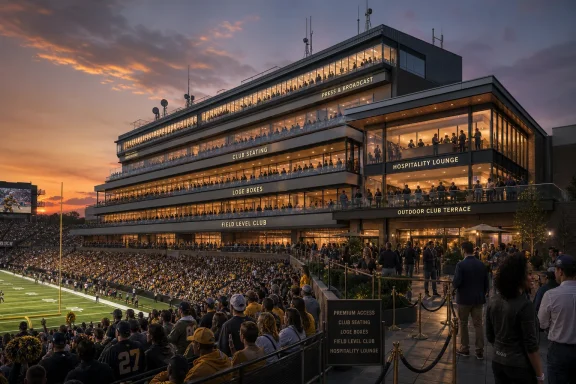
That is why the Copilot-generated concept is revealing even if nobody should mistake it for architectural work. It does not propose turning SHI Stadium into Michigan Stadium or Beaver Stadium. It proposes taking under-monetized vertical space and converting it into a stack of products: outdoor club seats, suites, loge boxes, shared lounges, private corridors, and hospitality areas.
For Rutgers, that is the right category of answer. The school’s athletics finances have been under pressure for years, and recent reporting has put the department’s annual deficit in the tens of millions. The department’s challenge is not simply to “win more,” though winning obviously helps. It is to make the existing audience more valuable on the days when that audience is already showing up.
Level one would combine press functions with outdoor club seating and a continuous club lounge. Level two would add loge boxes, upper club rows, and a quieter shared lounge. Level three would focus on suites and possibly smaller sky-loge pods, with private corridors and limited shared hospitality space. Stairs and elevators would link the levels at each end.
As a stadium concept, this is basic premium-inventory thinking. As an AI artifact, it is exactly what one would expect: plausible, generic, confident, and insufficiently burdened by engineering, code, cost, donor demand, construction phasing, ADA requirements, broadcast infrastructure, food-service logistics, and the thousand unglamorous details that make stadium work expensive.
But that does not make it useless. The value of the exercise is that it separates the strategic question from the drafting table. Rutgers does not need artificial intelligence to decide where load-bearing steel should go. It may, however, benefit from the conversation Copilot accidentally sharpens: what kinds of fans are not being served by SHI Stadium today, and how much revenue is Rutgers leaving on the table by failing to serve them?
The answer is probably not one monolithic luxury deck. Modern premium design is increasingly segmented. Some buyers want a private suite because they are entertaining clients. Some want four or six seats in a loge box because a full suite is too much money and too much coordination. Some want club access because they care about weather protection, food, restrooms, and a less chaotic concourse. A good renovation turns those preferences into price points.
That does not mean Rutgers can simply bolt three new levels onto SHI Stadium and start printing money. The site would need structural analysis, circulation planning, utility upgrades, food-service capacity, life-safety review, and a construction plan that does not wreck football operations. The moment indoor clubs enter the conversation, the project stops being just seating and becomes a building.
Still, the concept’s basic location is stronger than a vague “renovate the stadium” talking point. Premium customers are buying sight lines, comfort, exclusivity, and access. A midfield or near-midfield vertical addition can command those prices in a way that corner decks or end-zone party platforms usually cannot.
There is also a political advantage. Expanding premium seating can be framed as a revenue project rather than a vanity project. Rutgers would not be telling ordinary fans that it needs a palace. It would be telling donors, corporate partners, and high-spend season-ticket holders that the stadium has to catch up with the economics of the conference Rutgers chose to join.
That distinction matters. Public universities live with scrutiny that private franchises often avoid. A stadium project attached to a department running large deficits will invite criticism before the first rendering appears. Rutgers would need to make the case that the renovation is not simply an expense but a path toward recurring revenue.
That is the trap for schools outside the sport’s traditional aristocracy. Joining a richer neighborhood does not automatically make you rich. It raises your property taxes.
Rutgers has had to build, spend, and staff like a Big Ten program while trying to grow a donor and ticket base that did not have generations of Power Four habits behind it. The New Jersey market is huge, but it is also fragmented, professional-sports-saturated, and historically less captive than the markets surrounding many flagship football powers. Rutgers has opportunity; it does not have automatic loyalty at Ohio State or Penn State scale.
This is where SHI Stadium becomes more than a venue. It is one of the few assets the department can reshape to create annual cash flow. Television money is conference-controlled. The College Football Playoff economy is performance-dependent. Philanthropy is relationship-driven. But premium seating is a product Rutgers can design, price, sell, and renew.
A successful premium project would not solve the athletics deficit by itself. That is an important caveat. Even a well-conceived suite-and-club addition would need years of sales, renewals, and event utilization to justify its cost. But it could create a more durable revenue stream than simply hoping for one more sellout against a ranked opponent.
That is not a knock on Copilot alone. It is a reminder that generative AI is strongest at producing the shape of a familiar answer. Stadium premium concepts are familiar. The hard part is not imagining suites; it is proving that the market will buy them.
Rutgers would need a serious feasibility study before committing to anything resembling this plan. That study would have to test price sensitivity across alumni, corporate buyers, donors, season-ticket holders, and casual premium customers. It would need to understand whether fans want all-inclusive food and beverage, climate-controlled lounges, seat licenses, multi-sport packages, parking guarantees, private entrances, or flexible event access.
The wrong premium mix can be worse than no premium mix. Too many suites can sit empty. Too many club seats can dilute exclusivity. Too few shared amenities can leave buyers wondering what they are paying for. Too much luxury can alienate the broader fan base if the rest of the building feels neglected.
This is why the loge-box idea may be the most interesting part of the proposal. Loge seating often works because it bridges the gap between a full suite and a standard club seat. It gives smaller groups a sense of ownership without requiring a corporation-sized commitment. For a market like Rutgers’, where the corporate base is real but not infinitely deep, that middle tier may matter.
The average fan wants better entry, better concessions, better bathrooms, better Wi-Fi, cleaner circulation, and a smoother trip home. The premium fan wants all of that plus scarcity, comfort, service, and status. The donor wants access and recognition. The corporate buyer wants a controlled environment for entertaining. The school wants revenue that renews.
Those needs overlap, but they are not identical. A renovation that treats premium seating as the whole project risks missing the broader game-day experience. A renovation that treats every fan equally risks failing to capture the money that keeps the department competitive. The art is to let the high-end product subsidize improvements that ordinary fans can feel.
Parking is the obvious warning sign. If Rutgers builds a handsome new premium tower but leaves traffic flow and parking operations untouched, the highest-paying customers will still remember the frustration at the end of the night. Premium hospitality begins before kickoff and extends after the final whistle. A club lounge cannot fully compensate for a miserable arrival and exit pattern.
That does not mean every stadium project has to solve every infrastructure problem at once. It means Rutgers should resist the temptation to think of the proposed structure as a stand-alone jewel box. The stadium’s revenue strategy and its logistics strategy have to be part of the same plan.
Premium seating smooths that volatility when it is sold through multi-year commitments. Suites and clubs can be packaged with donations, parking, events, recognition, and access. They can become part of a broader relationship between the university and its most financially important supporters.
That is especially important in the revenue-sharing era. Schools are now operating in a world where athlete compensation, NIL infrastructure, roster management, and donor collectives all compete for the same dollars. Every dollar spent on a suite lease is not automatically additive if it merely displaces a donation that would have gone elsewhere. Rutgers has to design the product so it expands the pool rather than cannibalizing it.
This is where leadership matters. Athletic Director Keli Zinn’s comments about luxury boxes and shared club space suggest that Rutgers understands the premium gap. But acknowledging the gap is easier than closing it. The department will need to align athletics, university finance, donors, trustees, architects, ticketing, sponsorship, operations, and fans behind one credible plan.
The financing structure will be watched closely. If the project is donor-funded, sponsorship-backed, and supported by pre-sold premium commitments, it will be easier to defend. If it depends heavily on university borrowing while the department continues to post large deficits, critics will have an opening. Rutgers should assume the public debate will be unforgiving and plan accordingly.
For decades, facility planning was hidden behind feasibility studies, donor meetings, and glossy renderings released only when an institution was ready to shape the narrative. Now the fan base can ask an AI system to produce a stadium plan, seating counts, square-footage estimates, and revenue ideas before the school has announced anything formal. Much of it will be wrong. Some of it will still be useful.
This creates a strange accountability pressure. If fans can see the obvious premium-seating gap, they will ask why the school has not addressed it. If AI can sketch a rough version of a solution, administrators have to explain why the real world is harder. That explanation may be valid, but it has to be made.
It also raises the risk of false precision. Copilot’s seat counts and square-footage ranges look authoritative because they are numerical. They are not the same as measured architectural output. They are prompts in spreadsheet clothing.
For WindowsForum readers, that is the familiar generative-AI bargain. The tool is useful for ideation, comparison, and forcing a conversation into concrete terms. It is dangerous when its confidence is mistaken for verification. Rutgers fans should treat the Copilot plan as a provocation, not a blueprint.
The second priority should be flexibility. The college sports economy is moving too quickly for overly rigid spaces. Suites that can convert, lounges that can host non-football events, loge products that can be repackaged, and hospitality areas that can serve donors, recruits, corporate partners, and university events all reduce risk.
The third priority should be integration with the rest of the stadium. Premium buyers will expect a better experience, but ordinary fans should not feel as if the school built a private building on top of a public inconvenience. Concourse upgrades, parking improvements, wayfinding, mobile connectivity, restrooms, and concessions remain part of the value equation.
The fourth priority should be restraint. Rutgers does not need to win the renderings arms race. It needs a project sized to its market, its football trajectory, and its financial reality. Overbuilding premium inventory would be an expensive way to learn that not every Big Ten template fits Piscataway.
The fifth priority should be honesty. If the project is about revenue, say so. Fans can handle the truth that modern college athletics is expensive and that premium seating helps pay the bills. What they will not tolerate is being told that a luxury buildout is primarily about tradition, atmosphere, or vague excellence.
That leaves Rutgers with a practical set of conclusions:
 Rutgers Does Not Need a Bigger Stadium So Much as a Richer One
The old college football instinct was to add seats, chase capacity, and make the stadium look more imposing on television. That is not the problem Rutgers is trying to solve. SHI Stadium already sits in the 50,000-seat range, and the Big Ten schedule gives it enough recognizable opponents to make sellouts plausible when the team is competitive and the calendar cooperates.The bigger issue is that a sold seat is no longer just a sold seat. In the upper tiers of college athletics, the difference between a functional stadium and a financially productive one is the number of places where a fan can spend far more than the face value of a ticket. Suites, clubs, loge boxes, hospitality lounges, branded spaces, donor rooms, and corporate inventory are not decorative amenities. They are the monetization layer.
That is why the Copilot-generated concept is revealing even if nobody should mistake it for architectural work. It does not propose turning SHI Stadium into Michigan Stadium or Beaver Stadium. It proposes taking under-monetized vertical space and converting it into a stack of products: outdoor club seats, suites, loge boxes, shared lounges, private corridors, and hospitality areas.
For Rutgers, that is the right category of answer. The school’s athletics finances have been under pressure for years, and recent reporting has put the department’s annual deficit in the tens of millions. The department’s challenge is not simply to “win more,” though winning obviously helps. It is to make the existing audience more valuable on the days when that audience is already showing up.
The Copilot Plan Is Crude, but the Business Logic Is Not
The OnTheBanks experiment asked Microsoft Copilot to imagine how Rutgers could renovate SHI Stadium to improve premium seating and revenue generation. Copilot’s answer centered on the press box and party-deck side of the stadium, replacing or expanding that zone with a three-story structure containing a mix of media space, club seating, suites, loge boxes, lounges, and support areas.Level one would combine press functions with outdoor club seating and a continuous club lounge. Level two would add loge boxes, upper club rows, and a quieter shared lounge. Level three would focus on suites and possibly smaller sky-loge pods, with private corridors and limited shared hospitality space. Stairs and elevators would link the levels at each end.
As a stadium concept, this is basic premium-inventory thinking. As an AI artifact, it is exactly what one would expect: plausible, generic, confident, and insufficiently burdened by engineering, code, cost, donor demand, construction phasing, ADA requirements, broadcast infrastructure, food-service logistics, and the thousand unglamorous details that make stadium work expensive.
But that does not make it useless. The value of the exercise is that it separates the strategic question from the drafting table. Rutgers does not need artificial intelligence to decide where load-bearing steel should go. It may, however, benefit from the conversation Copilot accidentally sharpens: what kinds of fans are not being served by SHI Stadium today, and how much revenue is Rutgers leaving on the table by failing to serve them?
The answer is probably not one monolithic luxury deck. Modern premium design is increasingly segmented. Some buyers want a private suite because they are entertaining clients. Some want four or six seats in a loge box because a full suite is too much money and too much coordination. Some want club access because they care about weather protection, food, restrooms, and a less chaotic concourse. A good renovation turns those preferences into price points.
The Press Box Side Is Where the Argument Becomes Real
The proposal’s focus on the press box and party-deck area makes intuitive sense. Stadium renovations often succeed when they exploit a side of the venue that already has some vertical infrastructure, service access, and a reason to be rebuilt. The press box is not just a workplace for reporters and broadcasters; it is often the spine around which premium inventory can be arranged.That does not mean Rutgers can simply bolt three new levels onto SHI Stadium and start printing money. The site would need structural analysis, circulation planning, utility upgrades, food-service capacity, life-safety review, and a construction plan that does not wreck football operations. The moment indoor clubs enter the conversation, the project stops being just seating and becomes a building.
Still, the concept’s basic location is stronger than a vague “renovate the stadium” talking point. Premium customers are buying sight lines, comfort, exclusivity, and access. A midfield or near-midfield vertical addition can command those prices in a way that corner decks or end-zone party platforms usually cannot.
There is also a political advantage. Expanding premium seating can be framed as a revenue project rather than a vanity project. Rutgers would not be telling ordinary fans that it needs a palace. It would be telling donors, corporate partners, and high-spend season-ticket holders that the stadium has to catch up with the economics of the conference Rutgers chose to join.
That distinction matters. Public universities live with scrutiny that private franchises often avoid. A stadium project attached to a department running large deficits will invite criticism before the first rendering appears. Rutgers would need to make the case that the renovation is not simply an expense but a path toward recurring revenue.
Big Ten Membership Raised the Ceiling and the Bill
Rutgers’ Big Ten move was always a long game. The conference delivered national visibility, better opponents, larger media distributions, and a seat at the table that many schools would envy. It also brought the expectations of a league where facilities, staffing, recruiting, travel, nutrition, athlete support, and now revenue sharing all operate at a punishing scale.That is the trap for schools outside the sport’s traditional aristocracy. Joining a richer neighborhood does not automatically make you rich. It raises your property taxes.
Rutgers has had to build, spend, and staff like a Big Ten program while trying to grow a donor and ticket base that did not have generations of Power Four habits behind it. The New Jersey market is huge, but it is also fragmented, professional-sports-saturated, and historically less captive than the markets surrounding many flagship football powers. Rutgers has opportunity; it does not have automatic loyalty at Ohio State or Penn State scale.
This is where SHI Stadium becomes more than a venue. It is one of the few assets the department can reshape to create annual cash flow. Television money is conference-controlled. The College Football Playoff economy is performance-dependent. Philanthropy is relationship-driven. But premium seating is a product Rutgers can design, price, sell, and renew.
A successful premium project would not solve the athletics deficit by itself. That is an important caveat. Even a well-conceived suite-and-club addition would need years of sales, renewals, and event utilization to justify its cost. But it could create a more durable revenue stream than simply hoping for one more sellout against a ranked opponent.
AI Can Sketch the Stadium, but It Cannot Price the Donor
The funniest part of the Copilot exercise is also the most important limitation: the chatbot can invent seating counts, but it cannot validate demand. It can say there should be 20 to 40 loge boxes per side. It cannot tell Rutgers how many New Jersey businesses will sign multi-year agreements at a price that supports construction debt.That is not a knock on Copilot alone. It is a reminder that generative AI is strongest at producing the shape of a familiar answer. Stadium premium concepts are familiar. The hard part is not imagining suites; it is proving that the market will buy them.
Rutgers would need a serious feasibility study before committing to anything resembling this plan. That study would have to test price sensitivity across alumni, corporate buyers, donors, season-ticket holders, and casual premium customers. It would need to understand whether fans want all-inclusive food and beverage, climate-controlled lounges, seat licenses, multi-sport packages, parking guarantees, private entrances, or flexible event access.
The wrong premium mix can be worse than no premium mix. Too many suites can sit empty. Too many club seats can dilute exclusivity. Too few shared amenities can leave buyers wondering what they are paying for. Too much luxury can alienate the broader fan base if the rest of the building feels neglected.
This is why the loge-box idea may be the most interesting part of the proposal. Loge seating often works because it bridges the gap between a full suite and a standard club seat. It gives smaller groups a sense of ownership without requiring a corporation-sized commitment. For a market like Rutgers’, where the corporate base is real but not infinitely deep, that middle tier may matter.
The Fan Experience Problem Is Really a Segmentation Problem
OnTheBanks framed SHI Stadium’s general fan experience as relatively healthy, with parking inefficiency as a notable pain point. That seems like the correct starting point. Rutgers does not appear to need a total stadium reinvention so much as a sharper separation of products.The average fan wants better entry, better concessions, better bathrooms, better Wi-Fi, cleaner circulation, and a smoother trip home. The premium fan wants all of that plus scarcity, comfort, service, and status. The donor wants access and recognition. The corporate buyer wants a controlled environment for entertaining. The school wants revenue that renews.
Those needs overlap, but they are not identical. A renovation that treats premium seating as the whole project risks missing the broader game-day experience. A renovation that treats every fan equally risks failing to capture the money that keeps the department competitive. The art is to let the high-end product subsidize improvements that ordinary fans can feel.
Parking is the obvious warning sign. If Rutgers builds a handsome new premium tower but leaves traffic flow and parking operations untouched, the highest-paying customers will still remember the frustration at the end of the night. Premium hospitality begins before kickoff and extends after the final whistle. A club lounge cannot fully compensate for a miserable arrival and exit pattern.
That does not mean every stadium project has to solve every infrastructure problem at once. It means Rutgers should resist the temptation to think of the proposed structure as a stand-alone jewel box. The stadium’s revenue strategy and its logistics strategy have to be part of the same plan.
The Best Version of This Project Pays for More Than Itself
The strongest case for a premium renovation is not aesthetics. It is that Rutgers needs revenue streams that do not depend entirely on annual win totals. Winning accelerates demand, but a department cannot budget responsibly on the assumption that every season will produce perfect weather, rivalry buzz, and bowl-level optimism.Premium seating smooths that volatility when it is sold through multi-year commitments. Suites and clubs can be packaged with donations, parking, events, recognition, and access. They can become part of a broader relationship between the university and its most financially important supporters.
That is especially important in the revenue-sharing era. Schools are now operating in a world where athlete compensation, NIL infrastructure, roster management, and donor collectives all compete for the same dollars. Every dollar spent on a suite lease is not automatically additive if it merely displaces a donation that would have gone elsewhere. Rutgers has to design the product so it expands the pool rather than cannibalizing it.
This is where leadership matters. Athletic Director Keli Zinn’s comments about luxury boxes and shared club space suggest that Rutgers understands the premium gap. But acknowledging the gap is easier than closing it. The department will need to align athletics, university finance, donors, trustees, architects, ticketing, sponsorship, operations, and fans behind one credible plan.
The financing structure will be watched closely. If the project is donor-funded, sponsorship-backed, and supported by pre-sold premium commitments, it will be easier to defend. If it depends heavily on university borrowing while the department continues to post large deficits, critics will have an opening. Rutgers should assume the public debate will be unforgiving and plan accordingly.
Copilot’s Hidden Lesson Is That Everyone Now Has a Stadium Consultant in Their Browser
There is a broader technology story here, and it is not that Microsoft Copilot is ready to replace Populous or HOK. It is that fans can now generate plausible facilities concepts in seconds and publish them into the discourse. That changes how schools, beat writers, message boards, and donors talk about capital projects.For decades, facility planning was hidden behind feasibility studies, donor meetings, and glossy renderings released only when an institution was ready to shape the narrative. Now the fan base can ask an AI system to produce a stadium plan, seating counts, square-footage estimates, and revenue ideas before the school has announced anything formal. Much of it will be wrong. Some of it will still be useful.
This creates a strange accountability pressure. If fans can see the obvious premium-seating gap, they will ask why the school has not addressed it. If AI can sketch a rough version of a solution, administrators have to explain why the real world is harder. That explanation may be valid, but it has to be made.
It also raises the risk of false precision. Copilot’s seat counts and square-footage ranges look authoritative because they are numerical. They are not the same as measured architectural output. They are prompts in spreadsheet clothing.
For WindowsForum readers, that is the familiar generative-AI bargain. The tool is useful for ideation, comparison, and forcing a conversation into concrete terms. It is dangerous when its confidence is mistaken for verification. Rutgers fans should treat the Copilot plan as a provocation, not a blueprint.
Rutgers Should Build a Revenue Machine, Not a Rendering
If Rutgers moves forward with a real SHI Stadium premium project, the first priority should be market proof. Before renderings, before naming packages, before ceremonial shovels, the department needs to know who will buy what, at what price, and for how many years. A stadium renovation without committed demand is a construction project. A stadium renovation with committed demand is a business plan.The second priority should be flexibility. The college sports economy is moving too quickly for overly rigid spaces. Suites that can convert, lounges that can host non-football events, loge products that can be repackaged, and hospitality areas that can serve donors, recruits, corporate partners, and university events all reduce risk.
The third priority should be integration with the rest of the stadium. Premium buyers will expect a better experience, but ordinary fans should not feel as if the school built a private building on top of a public inconvenience. Concourse upgrades, parking improvements, wayfinding, mobile connectivity, restrooms, and concessions remain part of the value equation.
The fourth priority should be restraint. Rutgers does not need to win the renderings arms race. It needs a project sized to its market, its football trajectory, and its financial reality. Overbuilding premium inventory would be an expensive way to learn that not every Big Ten template fits Piscataway.
The fifth priority should be honesty. If the project is about revenue, say so. Fans can handle the truth that modern college athletics is expensive and that premium seating helps pay the bills. What they will not tolerate is being told that a luxury buildout is primarily about tradition, atmosphere, or vague excellence.
The Stadium Math Rutgers Cannot Duck
The Copilot proposal should not be read as Rutgers’ plan, but it does identify the right battlefield. SHI Stadium’s future is not about adding mass capacity for its own sake. It is about extracting more value from the building without breaking the game-day culture that makes the building worth improving.That leaves Rutgers with a practical set of conclusions:
- Rutgers should treat premium seating at SHI Stadium as a revenue strategy first and an amenities project second.
- The most credible version of the concept would be backed by pre-sold suites, club seats, loge boxes, sponsorships, and donor commitments before construction begins.
- Loge boxes and shared clubs may fit Rutgers’ market better than an oversized suite-heavy model aimed at deeper football economies.
- Parking, access, concessions, restrooms, and connectivity must be part of the plan because premium customers and regular fans experience the same stadium ecosystem.
- Copilot’s numbers should start a conversation, not end one, because artificial intelligence can produce plausible concepts without validating costs, demand, or feasibility.
- Rutgers’ financial situation makes inaction risky, but it also makes overbuilding risky.
References
- Primary source: onthebanks.com
Published: 2026-06-05T17:59:12.410973
Loading…
www.onthebanks.com - Related coverage: sportsbusinessjournal.com
Loading…
www.sportsbusinessjournal.com - Related coverage: podbay.fm
Loading…
podbay.fm - Related coverage: stadiumdb.com
Loading…
stadiumdb.com - Related coverage: sports.yahoo.com
Loading…
sports.yahoo.com - Related coverage: si.com
Loading…
www.si.com
- Related coverage: seatgeek.com
Loading…
seatgeek.com - Related coverage: newsminimalist.com
Loading…
www.newsminimalist.com - Related coverage: ipo.rutgers.edu
Loading…
ipo.rutgers.edu - Related coverage: governingboards.rutgers.edu
Loading…
governingboards.rutgers.edu - Related coverage: finance.rutgers.edu
Loading…
finance.rutgers.edu