

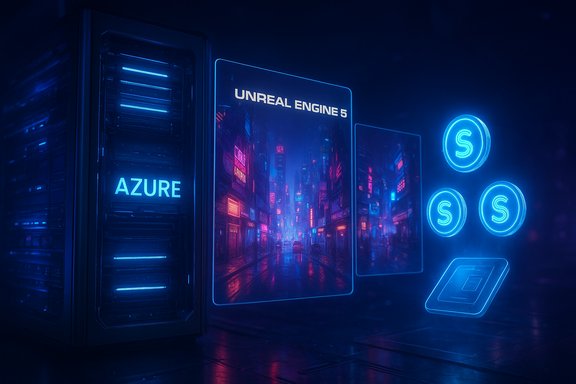
SACHI’s announcement that it has “partnered with Microsoft Azure” to stream Unreal Engine 5 worlds via pixel streaming — and its announced $SACHI Token Generation Event (TGE) on November 18, 2025 — is a high‑visibility play that stitches together three of the industry’s loudest trends: cloud gaming, real‑time Unreal Engine 5 fidelity, and Web3 tokenized economies. The claim is technically plausible — Azure and Epic provide a mature pixel‑streaming stack — but the current public record shows the story is primarily a syndicated company press release with no visible corporate press confirmation from Microsoft/Azure at the time of reporting.
SACHI bills itself as an immersive Web3 gaming universe built in Unreal Engine 5 and delivered via pixel streaming, enabling instant, browser‑native access to what the company calls “console‑quality” experiences without downloads or high‑end hardware. The project has openly advertised a Token Generation Event (TGE) for November 18, 2025, launching a native token called $SACHI on Solana, and it lists partners including Microsoft Azure, Aethir (decentralized GPU), Tokacity (iGaming content), and several Solana projects. These details have been widely distributed through press‑release syndication across crypto and finance outlets. Technically, the blueprint SACHI describes — cloud rendering of Unreal Engine assets and streaming interactive frames to browsers via WebRTC (pixel streaming) — is a documented and supported architecture. Microsoft maintains a public Unreal Pixel Streaming reference repository and official Azure documentation that describe the deployment patterns, autoscaling, and operational components required to run interactive pixel streams at scale. Those resources establish the architecture's feasibility independent of any single startup’s claim.
For readers tracking the intersection of cloud gaming and Web3, SACHI’s upcoming BETA and November 18 TGE are meaningful milestones to monitor. The correct test for the claim will be measurable: real beta sessions, published latency and concurrency numbers, transparent token economics, and independent audits. If those appear and verify SACHI’s numbers, the combination of Azure pixel streaming and tokenized in‑game economies could become an important case study in modern game distribution and monetization. Until those proofs are published, treat the announcement as an ambitious plan backed by a plausible technical blueprint — but still, for now, a plan.
Source: Coinpedia SACHI × Microsoft Azure: Powering the Next Generation of Cloud Gaming
 Background / Overview
SACHI bills itself as an immersive Web3 gaming universe built in Unreal Engine 5 and delivered via pixel streaming, enabling instant, browser‑native access to what the company calls “console‑quality” experiences without downloads or high‑end hardware. The project has openly advertised a Token Generation Event (TGE) for November 18, 2025, launching a native token called $SACHI on Solana, and it lists partners including Microsoft Azure, Aethir (decentralized GPU), Tokacity (iGaming content), and several Solana projects. These details have been widely distributed through press‑release syndication across crypto and finance outlets. Technically, the blueprint SACHI describes — cloud rendering of Unreal Engine assets and streaming interactive frames to browsers via WebRTC (pixel streaming) — is a documented and supported architecture. Microsoft maintains a public Unreal Pixel Streaming reference repository and official Azure documentation that describe the deployment patterns, autoscaling, and operational components required to run interactive pixel streams at scale. Those resources establish the architecture's feasibility independent of any single startup’s claim. What the announcement actually says
- SACHI claims a strategic cloud backbone relationship with Microsoft Azure to power global infrastructure and pixel streaming for its Unreal Engine 5 content.
- The startup positions pixel streaming as the core technical layer to make AAA visuals instantly available through a browser, no installs required.
- SACHI has scheduled a $SACHI Token Generation Event (TGE) on November 18, 2025, to mint tokens on Solana, linking token utility to access, governance and in‑game economies. This TGE date is repeated across multiple syndicated outlets.
- SACHI lists additional partners — Aethir (decentralized GPU), Tokacity (iGaming) — and promises a BETA game launch tied to the token/roadmap.
Why the claim is plausible — technical reality check
Azure and Unreal Pixel Streaming: an existing blueprint
Microsoft and Epic have publicly documented an end‑to‑end Pixel Streaming architecture on Azure. That work includes:- A GitHub repository and Terraform-based autoscaling examples tailored for Azure.
- Marketplace packages and documented quick‑start guides for running Pixel Streaming on Azure GPU VMs.
- Operational components such as matchmakers, signaling servers, TURN/STUN for NAT traversal, telemetry, and VM Scale Sets for autoscaling.
Pixel streaming is interactive, not passive
Pixel streaming is fundamentally different from passive video: it must carry inputs back to the cloud, and low end‑to‑end latency is a hard requirement for responsive gameplay. The Microsoft documentation and open GitHub examples cover how to run signaling/matchmaking, how to pack multiple streams per GPU, and how to scale out in response to demand — all of which are central to the claim SACHI makes.Critical analysis — strengths, opportunities, and realistic limits
Strengths and credible opportunities
- Lowered onboarding friction. Browser‑native streaming removes downloads and expensive hardware requirements — a genuine distribution lever for mass adoption of casual and social titles.
- Proven deployment path. The Azure/Epic reference architecture is production‑oriented, providing teams a repeatable route to deploy and monitor pixel streaming at scale.
- Hybrid capacity options. Combining hyperscaler capacity with decentralized GPU providers (Aethir) can, in theory, provide edge‑proximate nodes or cost arbitrage during peaks if implemented with strong engineering controls.
Practical constraints and near‑term risks
- Latency is physics, not marketing. For twitch‑sensitive genres (FPS, fighting games), cloud streaming rarely equals a native install unless players are close to edge nodes and ISP peering is excellent. Operational targets often aim for sub‑50 ms round‑trip times for acceptable responsiveness — a nontrivial engineering target at global scale.
- Unit economics at scale are expensive. Each interactive stream consumes GPU cycles and egress bandwidth. Claims of “millions” of concurrent interactive players should be read as aspirational until independent telemetry and cost models are published.
- Hybrid/DePIN integration complexity. Mixing centralized Azure orchestration with decentralized GPU nodes raises driver, consistency, quality‑of‑service and SLA questions that increase engineering overhead substantially.
- Regulatory exposure for iGaming and token models. Integrating casino mechanics and token economies multiplies legal complexity across jurisdictions and can materially constrain where and how features operate. Tokacity's presence amplifies but also complicates regulatory exposure.
What’s verifiable today — cross‑checked facts
- The company press release and multiple syndicated crypto/finance outlets report the SACHI × Microsoft Azure announcement and the TGE date of November 18, 2025. Independent reproductions appear on CoinCodex, KuCoin news feeds, CoinPedia and other outlets repeating the same messaging. These independent news reproductions corroborate that SACHI has run a coordinated press campaign.
- Microsoft and Epic maintain public documentation and a GitHub repo describing Unreal Pixel Streaming in Azure, including autoscaling and a deployable reference architecture. This confirms the technical feasibility of running interactive UE content on Azure and streaming it to browsers. Teams using Azure can reproduce the same core architecture described by SACHI.
- At the time of analysis, a formal corporate confirmation from Microsoft/Azure naming SACHI was not found in Microsoft’s public press channels or official Azure blog posts; that absence is material because Microsoft typically documents strategic co‑marketing or customer case studies publicly when formal partnerships exist. The SACHI announcement appears to be a company press release syndicated across crypto media rather than a joint Microsoft/Azure press release. Readers should treat this as a vendor‑announced customer story until Microsoft/Azure provides explicit confirmation.
What to watch for in the coming days (verification checklist)
- A Microsoft or Azure corporate press release, Azure blog post, or Azure customer case study explicitly naming SACHI. Public vendor confirmation is the clearest evidence of a strategic or co‑marketing relationship.
- Live beta tests and independent latency/quality benchmarks from multiple global regions showing real round‑trip times, frame rates, and average bitrate. Performance dashboards or telemetry published by SACHI would materially change the assessment.
- Public documentation of the token economics (supply, vesting schedules, allocation, legal counsel/advice, and on‑chain mechanics) and any formal audits performed on the $SACHI smart contracts.
- Evidence of a working hybrid integration (Azure + Aethir): technical posts, architecture diagrams, or open‑source repos showing how driver consistency, autoscaling and failover are managed across centralized and decentralized nodes.
- Regulatory filings or jurisdictional restrictions disclosed for any iGaming features powered by Tokacity; licenses or geo‑blocking rules must be clear for compliance.
Developer and operator considerations (practical engineering checklist)
- Select the right GPU SKUs and test streams‑per‑GPU packing early — underestimating this changes both latency and cost materially. Microsoft’s Azure repo and docs recommend specific SKUs and provide autoscaling guidance.
- Architect for multi‑region edge proximity: route users to the closest Azure region and validate ISP peering; last‑mile variability will dominate perceived responsiveness.
- Implement TURN capacity planning: many mobile/enterprise networks require TURN relays, and relaying video at scale is bandwidth‑intensive and costly. Plan egress budgets and autoscaling.
- Validate codec and bitrate strategies: choose encoders and adaptive bitrate logic that minimize latency while preserving visual quality for target genres. AV1/HEVC experimentation can yield gains but adds operational complexity.
- Publish transparent metrics: latency percentiles (p50/p90/p99), average GPU streams per node, cost per concurrent user, and region‑by‑region performance dashboards to build trust with players and partners.
Token‑economy & regulatory analysis
SACHI plans to mint $SACHI on Solana, citing low fees and high throughput as rationales. Solana’s low per‑transaction cost and high theoretical throughput make it an attractive choice for microtransactions and frequent on‑chain item transfers; however, on‑chain fees can rise under congestion and priority fees can change behavior during drops. A few cautions:- Token utility claims (access, governance, staking rewards) should be accompanied by a detailed whitepaper and an auditable vesting schedule to evaluate centralization and manipulation risks.
- Jurisdictional compliance around tokens and gaming—especially if integrated with social casino mechanics—can trigger gambling regulations or securities laws depending on how tokens are marketed and used. Legal clarity is essential before expanding into regulated markets.
- Token launches tied to user access or revenue should disclose how on‑chain flows interact with off‑chain game operations to avoid mismatched incentives or unintended regulatory classifications.
Risk summary — a plain summary for players, developers and investors
- For players: the promise (instant AAA UE5 visuals in a browser) is exciting, but wait for hands‑on beta and independent latency tests before judging playability. A click‑to‑play demo is the single most persuasive test of the claim.
- For developers: the architecture is reproducible today using Azure/Epic materials, but be conservative about cost models and design for observability from day one.
- For investors/partners: distinguish marketing copy from operational evidence. Ask the team for published performance dashboards, independent token audits, and legal opinions covering their iGaming and token mechanics.
Final assessment
SACHI’s narrative — combining Unreal Engine 5, pixel streaming, Microsoft Azure infrastructure and a Solana‑based $SACHI token — is an attention‑grabbing example of how cloud gaming and Web3 are being pitched as a single product stack. The engineering path described is technically feasible because Azure and Epic provide the necessary building blocks and reference architectures to run pixel streaming at scale. However, the current public evidence shows this is a company‑led announcement syndicated across multiple crypto and financial outlets, rather than a jointly published Microsoft/Azure case study. That distinction matters: choosing Azure as your cloud provider is common and plausible; being a formally endorsed Azure partner with customer case study status is a different and verifiable corporate event. Until Microsoft or Azure publish a confirming statement or SACHI releases independent performance telemetry, the claim should be treated as a vendor announcement with credible architecture — not as proof the global scale and latency goals have been achieved.For readers tracking the intersection of cloud gaming and Web3, SACHI’s upcoming BETA and November 18 TGE are meaningful milestones to monitor. The correct test for the claim will be measurable: real beta sessions, published latency and concurrency numbers, transparent token economics, and independent audits. If those appear and verify SACHI’s numbers, the combination of Azure pixel streaming and tokenized in‑game economies could become an important case study in modern game distribution and monetization. Until those proofs are published, treat the announcement as an ambitious plan backed by a plausible technical blueprint — but still, for now, a plan.
Source: Coinpedia SACHI × Microsoft Azure: Powering the Next Generation of Cloud Gaming
