

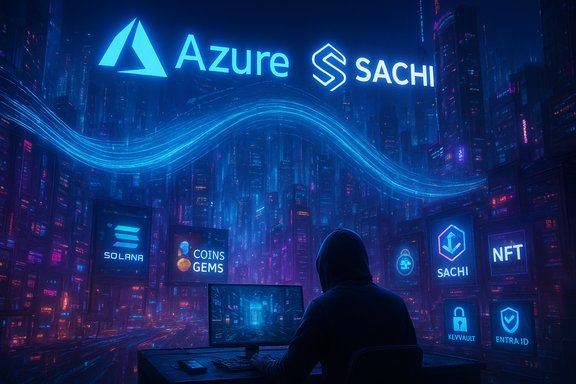
SACHI’s announced alliance with Microsoft Azure marks a pivotal inflection point for Web3 gaming: a small, blockchain‑native studio is now promising AAA‑quality, Unreal Engine 5 pixel‑streamed worlds backed by one of the largest, most battle‑tested enterprise clouds on the planet, and that pairing raises both clear technical opportunities and practical questions about decentralization, costs, and long‑term viability.
Background
SACHI, an emerging Web3 gaming project that bills itself as an immersive, social‑casino and competitive gaming universe, recently put forward a coordinated media campaign announcing a strategic cloud partnership with Microsoft Azure alongside other ecosystem partners and a Token Generation Event (TGE) scheduled for mid‑November 2025. The SACHI narrative is straightforward: combine Unreal Engine 5 visuals, pixel streaming to remove local hardware constraints, a layered token economy (Coins, Gems, and native $SACHI), and Solana rails for on‑chain transactions — and use Azure as the enterprise backbone to guarantee scale, low latency, and reliability.This alliance — as communicated in SACHI’s public materials and widely republished press releases — is emblematic of a broader trend in 2024–2025 where major cloud vendors increasingly position gaming‑specific products (PlayFab, Kubernetes/AKS orchestrations, GPU VMs, DDoS protection, and enterprise security stacks) as enablers for both traditional and blockchain‑infused gaming workloads. At the same time, other major Web3 gaming studios and publishers have pursued similar cloud relationships in recent months, signaling that large cloud providers see strategic value in serving as the connective tissue for next‑gen gaming ecosystems.
Overview: What SACHI says the Azure partnership will deliver
SACHI’s public messaging lays out a clear technical and user experience value proposition, centered on four pillars:- Scalability — Use Azure’s elastic infrastructure to scale GPU and server capacity up and down in response to fluctuating player counts, live events, and tournaments.
- Performance — Leverage Azure’s global footprint and networking to reduce round‑trip times for pixel streaming and real‑time multiplayer services.
- Reliability — Rely on enterprise grade uptime, redundancy, and DDoS mitigation to keep persistent worlds online during critical events.
- Security & Compliance — Apply Azure’s identity, key management, confidential computing, and threat detection tooling to harden wallets, NFT storage patterns, and transaction handling.
Warning note: while SACHI’s press and syndicated coverage describe an Azure partnership, there was no parallel, public Microsoft press release explicitly announcing a joint go‑to‑market statement at the time of SACHI’s campaign; the messaging therefore should be treated as a company‑led announcement until independently confirmed by the cloud provider’s corporate channels or a formal case study / partner page published by Microsoft.
Technical anatomy: how Azure actually supports high‑fidelity, cloud‑native Web3 gaming
Breaking down the stack helps separate marketing claims from engineering reality. Azure provides several concrete building blocks that map to SACHI’s stated goals:1) Pixel streaming and remote GPU rendering
- Pixel streaming turns a cloud‑hosted Unreal Engine instance into an interactive video stream delivered via WebRTC. The engine runs on GPU‑accelerated VMs (NVIDIA‑equipped ND/NC/NDv4 families, or comparable H100/A100 instances), encodes frames via NVENC, and streams to any browser. This enables console‑quality graphics on low‑spec devices because rendering happens server‑side.
- Azure maintains reference architectures and an open‑source deployment for “Unreal Pixel Streaming” with autoscaling and multi‑region options, specifically engineered to run at production scale (matchmaker, signalling servers, TURN/STUN servers, VM scale sets, health‑checks, and telemetry).
- In practice, running many concurrent pixel streams requires selecting GPU SKUs, careful provisioning for multiple streams per GPU, and robust autoscaling thresholds to balance cost and performance.
2) Backend game services and live ops
- Azure PlayFab provides managed backend services for live games: authentication, matchmaking, party/voice, leaderboards, analytics, and content rollout. PlayFab and AKS are common ways to host server‑side game logic, microservices, and persistent world state with globally distributed regions.
- For Web3 workflows, PlayFab can interoperate with external blockchain services (e.g., minting APIs, custody services, and webhooks) though the on‑chain operations themselves typically run against third‑party blockchains or layer‑2s.
3) Global edge and networking
- Azure’s broad regional footprint and traffic management constructs permit lower latency by routing users to the nearest region and, when necessary, using multi‑region deployments to keep state and compute closer to players.
- Pixel streaming’s perceived responsiveness depends on round‑trip latency (WebRTC RTT + input processing + frame render time). For competitive or twitch‑sensitive titles, engineering is required to minimize input‑to‑display latency and to ensure network quality for remote clients.
4) Security and asset protection
- Azure supplies an enterprise security stack: identity and access management (Entra ID), secrets and key storage (Key Vault), confidential computing (trusted execution/TEEs), DDoS protection, and security monitoring (Defender, Sentinel).
- Those tools can materially raise the bar for protecting private keys, transaction signing primitives, and off‑chain custodial services, but they do not by themselves eliminate smart‑contract or economic exploitation risks inherent to tokenized in‑game assets.
Why this matters: strengths and immediate opportunities
The SACHI + Azure message ties directly into several pressing problems that have historically limited mainstream Web3 gaming:- Hardware barriers fall — Pixel streaming democratizes access to visually demanding titles by moving the heavy GPU work to cloud instances. This lowers distribution friction for mainstream gamers who do not own high‑end PCs or consoles.
- Global scale is realistic — Azure’s autoscaling, regional availability, and game‑specific services can plausibly handle spikes during tournaments, marketing pushes, or cultural events if correctly architected.
- Faster, hybrid on‑chain interactions — Offloading rendering and gameplay loops to Azure while using Solana (or other fast chains) for asset settlement enables a hybrid model: smooth client experiences without requiring every action to await on‑chain finality.
- Enterprise tooling for trust — DDoS protection, SIEM, confidential compute, and identity tooling provide measurable improvements in platform security and regulatory posture compared with ad‑hoc hosting.
Risk assessment: what the partnership does not solve (and what it introduces)
Beneath the optimistic headline are non‑trivial tradeoffs and operational challenges that deserve careful scrutiny.Centralization vs. decentralization
- Relying heavily on a centralized cloud provider for compute, streaming, matchmaker, and parts of the asset pipeline naturally introduces central points of control. That undermines some canonical promises of Web3 (full decentralization, censorship resistance).
- Even if ownership of tokens and NFTs remains on a public chain, the user experience and critical real‑time gameplay loop remain subject to the uptime and policies of a single cloud provider unless the project invests in federated or hybrid compute approaches (e.g., decentralized GPU providers, multi‑cloud failover).
Cost and economics
- GPU‑backed cloud instances (A100/H100 class) are expensive when used continuously at scale. Pixel streaming is combo‑intensive: you need GPUs, signalling infrastructure, bandwidth (egress), storage, and telemetry. Spot instances reduce cost but introduce preemption risk and complexity.
- Predictability of operating expenses for a tokenized economy is critical. If gameplay rewards or tokenomics assume marginal costs that are lower than real world Azure bills, the economics can become unsustainable quickly.
Integration complexity
- Bridging real‑time gameplay state with asynchronous blockchain transactions is not trivial. Developers must reconcile eventual consistency, prevent double‑spend in off‑chain marketplaces, and design UX that hides burn/confirm latency without sacrificing security.
- NFT minting and trading require secure custody patterns, anti‑fraud mechanisms, and careful UX to avoid user mistakes (irreversible on‑chain actions, lost keys, and phishing vectors).
Regulatory and iGaming concerns
- SACHI’s stated integration with iGaming content (social‑casino mechanics) plus token economies raises regulatory flags in many jurisdictions. Tokenized rewards, in‑game currencies, and gambling‑like mechanics may fall under gaming/gambling regulations depending on geography and how tokens are fungible or tradable for value.
- Regulatory costs and compliance tooling (KYC/AML, age gating, consumer protections) add complexity and expense not covered by a technical cloud partnership alone.
Blockchain choice tradeoffs
- Choosing Solana as on‑chain rails delivers speed and low fees but also inherits network‑level tradeoffs: historical outages, validator centralization concerns, and differing security properties than EVM chains. Those risks flow directly into a game economy that needs continuous, reliable settlement.
Practical implications for players, developers, and operators
For players
- Expect easier access: browser play without downloads will attract casual users and reduce friction for token onboarding.
- Beware of emergent complexity: owning in‑game NFTs and tokens means exposure to market volatility, custody risks, and potential regulatory limitations on withdrawals or secondary market sales.
For developers
- Engineering discipline becomes paramount: real‑time telemetry, hybrid off‑chain/on‑chain logic, and autoscaling policies are the differentiators between a smooth launch and a reputational disaster.
- Cost optimization strategies — batching, multi‑stream per GPU, spot capacity, multi‑region placement — will decide whether the project can scale economically.
For operators / business leaders
- Model multiple scenarios: peak concurrent players, tournament loads, and edge case failures. Include cloud egress, storage, and load balancing in budgets — GPU hours dominate costs.
- Prepare a governance and compliance plan ahead of release, especially if iGaming or prize mechanics are included.
How to evaluate SACHI’s claims — a short checklist for technologists and journalists
- Is there an independent confirmation from Microsoft or Azure partner pages beyond syndication of SACHI PRs? If not, treat the announcement as a company claim supported by partner‑level technical integration rather than a signed enterprise case study.
- Are performance benchmarks available (end‑to‑end latency numbers, concurrent stream counts per GPU, frame‑rates with multi‑player inputs)? Public metrics matter; marketing platitudes do not.
- Has the team disclosed cost models or stress‑test results showing sustainable ops under expected tx and usage loads?
- What redundancy and failover mechanisms exist if a cloud region becomes unavailable — multi‑region active/active, pixel stream handoff, or fallbacks to decentralized GPU providers?
- Does the token design account for cloud costs, regulatory reserve, and user protection measures (refunds, disputed trades, lost key recovery options)?
Broader industry implications
- Hybridization is accelerating: mainstream cloud providers can no longer be dismissed by Web3 teams as incompatible with decentralization; instead, they are being positioned as scalability layers that allow blockchain value layers to focus on ownership and settlement.
- Expect a wave of similar announcements: as studios chase better UX and faster onboarding, we will likely see other blockchain‑native projects announce support relationships with Azure, AWS, or GCP. Those announcements will continue to blend engineering capability with commercial positioning — meaning independent verification and engineering postmortems will be the gold standard for credibility.
- New tooling will emerge: major cloud vendors have commercial incentives to create gaming‑centric Web3 developer tooling (wallet management patterns, event‑driven on‑chain connectors, secure hardware enclaves for key management). This can accelerate developer productivity but could create new proprietary dependencies.
Recommendations for stakeholders
- For engineers: design with modularity. Keep on‑chain logic and economic rules decoupled from real‑time rendering pipelines so that parts of the service can be moved, replicated, or run on decentralized alternatives if needed.
- For product leads: publish clear KPIs and economic sensitivity analysis (cost per concurrent player, break‑even token funding thresholds, and contingency budgets for network or cloud outages).
- For community managers and token holders: set realistic expectations. Token launches tied to service availability need communications plans that address downtime, service degradation, and refund or compensatory policies.
- For enterprise partners and cloud vendors: transparency matters. If a cloud provider’s tooling materially reduces decentralization risks (e.g., through multi‑cloud failover playbooks or validated confidential compute key‑management flows), make those capabilities explicit and documentable.
Conclusion
SACHI’s presentation of an Azure‑backed Web3 gaming universe outlines a technically plausible and commercially attractive model: cloud‑rendered AAA visuals combined with on‑chain ownership can remove friction for mainstream adoption. Azure brings credible tooling for scalability, security, and live operations that many blockchain projects previously lacked.However, the announcement must be parsed carefully. There is a material difference between a marketing partnership and an operational, audited, multi‑region roll‑out proving millions of concurrent players. Centralization tradeoffs, operating costs, blockchain choice vulnerabilities, and regulatory complexity remain real and immediate challenges. The path to mainstream Web3 gaming will be paved not merely by marquee cloud partnerships but by transparent engineering, reproducible performance data, sustainable economics, and mature governance models that protect both players and the underlying ecosystems.
This SACHI‑Azure story is therefore a useful indicator: mainstream cloud providers are now active participants in Web3 gaming’s growth. That fact alone accelerates technical possibilities, but it also forces the sector to mature faster — from speculative tokenomics to accountable product engineering and bona fide operational readiness. The next 12 months of launches, stress tests, and independent performance audits will determine whether these alliances produce durable, player‑friendly Web3 experiences or simply another round of unproven promises.
Source: tmastreet.com SACHI and Microsoft Azure Forge Alliance: Powering the Next Generation of Cloud-Native Web3 Gaming
