

Liquid Swords has published the official PC system requirements for Samson: A Tyndalston Story, and the headline is simple: the studio says a machine with a GeForce GTX 1070–class GPU and 16 GB of RAM is enough to run the game at launch, while a GeForce RTX 3060 Ti–class card is the studio’s recommended baseline. The developer also lists Windows 10/11, an SSD, and a modest 15 GB install as part of the minimum/recommended table — and the game is scheduled to arrive on April 8, 2026. (store.steampowered.com)
Samson: A Tyndalston Story is the first major release from Liquid Swords, the Swedish studio founded by industry veteran Christofer Sundberg — the designer behind the Just Cause franchise — and it positions itself as a hard‑boiled, open‑world action brawler that blends close‑quarters combat with vehicular violence. Liquid Swords markets Samson as a focused narrative chapter inside a gritty, reactive city where consequences matter. The studio’s pedigree and the project's scope have generated significant attention ahead of launch.
The Steam store lists the full PC requirements under a clear two‑tier table: Minimum and Recommended. Minimum calls out Intel Core i5‑10505 / AMD Ryzen 5 3600 CPUs, 16 GB RAM, and a GPU on the level of a Nvidia GTX 1070 (Steam’s page oddly lists it as “GTX 1070 6 GB”) or AMD RX 5600 6 GB. Recommended upgrades the CPU to an Intel i5‑11400 / Ryzen 5 5600 XT pair and the GPU to an RTX 3060 Ti / RX 6700 XT, but keeps memory at 16 GB and the storage footprint at 15 GB — SSD required. (store.steampowered.com)
This article dissects those requirements, explains what they mean for real‑world players, points out a few inconsistencies and risks, and gives actionable advice for owners of older GPUs (notably the GTX 1070) who want to play Samson at launch.
The CPU minimums — Intel i5‑10505 / Ryzen 5 3600 — are mid‑range chips from the 10th/3rd gen families. Paired with 16 GB RAM and a GTX 1070‑class GPU, this points at a design target of 1080p playability with reasonable settings and solid single‑player frame rates rather than pushing for 4K, ray tracing, or other high‑end features at launch. (store.steampowered.com)
Important caveat: Steam’s copy calls the GTX 1070 “6 GB,” but the GTX 1070 shipped with 8 GB of GDDR5 as the standard specification. The Steam listing appears to contain a VRAM figure mismatch (6 GB is correct for the GTX 1060, not the 1070). This looks like a simple editorial error on the store page and is worth noting for clarity — players should assume the intent was a GTX 1070 class card in the traditional 8 GB configuration. (store.steampowered.com)
However, there are clear caveats: the Steam page’s VRAM typo (GTX 1070 listed as 6 GB) needs correction to avoid confusion, and the absence of explicit upscaling or ray‑tracing support leaves important performance levers unknown. The studio’s small size and recent staffing moves introduce real risk around post‑launch support and long‑term optimization. Until those questions are answered — through patches, technical updates from Liquid Swords, and community benchmarks — players should prepare conservatively: ensure SSD storage and 16 GB RAM, update drivers, and be ready to tune settings for a GTX 1070 to hit stable FPS. (store.steampowered.com)
Samson looks poised to be accessible to a broad slice of PC gamers while offering higher fidelity for those with modern midrange hardware — but the details that matter most to enthusiasts (upscaling, ray tracing, Steam Deck support, specific VRAM guidance) remain to be confirmed. Watch launch week for hands‑on benchmarks and official follow‑ups from Liquid Swords; those will convert the Steam spec table into reliable, actionable performance guidance for every class of PC player. (store.steampowered.com)
Source: IXBT.games Samson System Requirements - Criminal Action Game from the Creators of Just Cause Will Run on GTX 1070
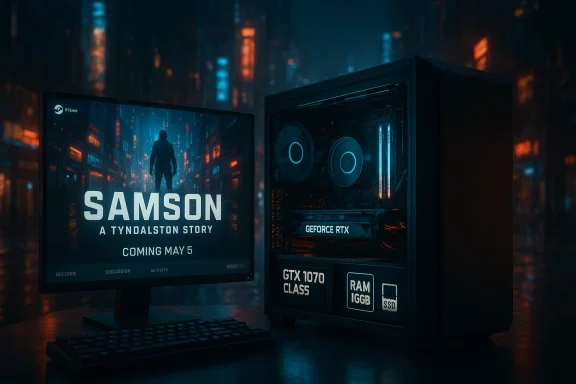 Background / Overview
Samson: A Tyndalston Story is the first major release from Liquid Swords, the Swedish studio founded by industry veteran Christofer Sundberg — the designer behind the Just Cause franchise — and it positions itself as a hard‑boiled, open‑world action brawler that blends close‑quarters combat with vehicular violence. Liquid Swords markets Samson as a focused narrative chapter inside a gritty, reactive city where consequences matter. The studio’s pedigree and the project's scope have generated significant attention ahead of launch.The Steam store lists the full PC requirements under a clear two‑tier table: Minimum and Recommended. Minimum calls out Intel Core i5‑10505 / AMD Ryzen 5 3600 CPUs, 16 GB RAM, and a GPU on the level of a Nvidia GTX 1070 (Steam’s page oddly lists it as “GTX 1070 6 GB”) or AMD RX 5600 6 GB. Recommended upgrades the CPU to an Intel i5‑11400 / Ryzen 5 5600 XT pair and the GPU to an RTX 3060 Ti / RX 6700 XT, but keeps memory at 16 GB and the storage footprint at 15 GB — SSD required. (store.steampowered.com)
This article dissects those requirements, explains what they mean for real‑world players, points out a few inconsistencies and risks, and gives actionable advice for owners of older GPUs (notably the GTX 1070) who want to play Samson at launch.
What the official requirements actually say
Minimum system requirements (Steam)
- OS: Windows 10 / 11. (store.steampowered.com)
- CPU: Intel Core i5‑10505 or AMD Ryzen 5 3600. (store.steampowered.com)
- Memory: 16 GB RAM. (store.steampowered.com)
- GPU: Nvidia GTX 1070 (Steam text lists “6 GB”) or AMD Radeon RX 5600 (6 GB). (store.steampowered.com)
- Storage: 15 GB, SSD required. (store.steampowered.com)
Recommended system requirements (Steam)
- OS: Windows 10 / 11. (store.steampowered.com)
- CPU: Intel Core i5‑11400 or AMD Ryzen 5 5600 XT. (store.steampowered.com)
- Memory: 16 GB RAM. (store.steampowered.com)
- GPU: Nvidia GeForce RTX 3060 Ti (8 GB) or AMD Radeon RX 6700 XT (8–12 GB depending on model). (store.steampowered.com)
- Storage: 15 GB, SSD required. (store.steampowered.com)
Reading the lines: what the numbers reveal
1) Minimum = practical baseline, not “low end”
It’s unusual — for 2026 — to see 16 GB of system RAM listed as the minimum rather than recommended. That suggests the game’s textures, streaming, or runtime footprint expects a modern memory baseline and that running with less will be unsupported or will degrade the experience. In short: Liquid Swords treats 16 GB as table stakes. (store.steampowered.com)The CPU minimums — Intel i5‑10505 / Ryzen 5 3600 — are mid‑range chips from the 10th/3rd gen families. Paired with 16 GB RAM and a GTX 1070‑class GPU, this points at a design target of 1080p playability with reasonable settings and solid single‑player frame rates rather than pushing for 4K, ray tracing, or other high‑end features at launch. (store.steampowered.com)
2) The GTX 1070 baseline is a pragmatic choice
The GTX 1070 (Pascal architecture) launched in 2016 and was a high‑end card at the time; it remains a very common older‑generation GPU in the market and is still capable of playable 1080p performance in many modern titles when settings are tuned. Steam’s minimum explicitly lists a GTX 1070–level GPU, which lowers the barrier for a large installed base of mid‑tier PC gamers. That’s a deliberate accessibility move by Liquid Swords.Important caveat: Steam’s copy calls the GTX 1070 “6 GB,” but the GTX 1070 shipped with 8 GB of GDDR5 as the standard specification. The Steam listing appears to contain a VRAM figure mismatch (6 GB is correct for the GTX 1060, not the 1070). This looks like a simple editorial error on the store page and is worth noting for clarity — players should assume the intent was a GTX 1070 class card in the traditional 8 GB configuration. (store.steampowered.com)
3) Recommended spec points to a modern 1440p mid‑range target
Liquid Swords recommends an RTX 3060 Ti or RX 6700 XT — GPUs that are widely considered solid 1440p performers and support modern rasterization performance headroom and upscaling features. In practical terms, if you own a 3060 Ti/6700 XT, expect to run Samson at higher fidelity and push beyond 1080p with stable frame rates. The 16 GB of RAM remains the memory floor.4) SSD required — not optional
The store page explicitly calls out an SSD requirement. A required SSD is an important sign: it tells us the game likely relies on faster streaming or frequent I/O (streaming textures, city chunks, or rapid asset swaps in an open world). Players with only HDDs can expect longer load times and potential stutters; Liquid Swords has made SSD mandatory. That’s a modern expectation and should be budgeted in by players. (store.steampowered.com)What this means for GTX 1070 owners (real‑world guidance)
If you own a GTX 1070 system and meet the CPU and 16 GB RAM requirement, you’re in the minimum box — but “will run” doesn’t equal “will look the same as on an RTX 3060 Ti.”- Expect the playable target to be 1080p, medium to high settings, with some advanced options dialed back. The GTX 1070 remains competent at 1080p and can reach reasonable frame rates in games released in the mid‑2020s, but modern AAA features and high-resolution textures are a bigger burden.
- VRAM headroom is relevant: although Steam’s listing misstates the GTX 1070’s VRAM as 6 GB, the card historically shipped with 8 GB. Still, 8 GB of VRAM is increasingly the minimum for higher‑resolution textures; if Samson exposes ultra texture packs, the card will need settings lowered to avoid memory pressure. (store.steampowered.com)
- CPU balance matters: paired with an i5‑10505 or Ryzen 5 3600, the 1070 will be less likely to bottleneck at 1080p — but heavy physics, dense NPC populations, or high vehicle chaos could be CPU‑bound scenarios. (store.steampowered.com)
- Start at 1080p and Medium preset, then step shadows/ambient occlusion and post‑process down first. Texture quality and draw distance matter less for framerate than shadows and post effects in most modern engines.
- If the game includes dynamic resolution or any in‑engine upscaling, use it to stabilize FPS — but do not rely on it until official support is confirmed (see the “unknowns” section below).
- Use the latest GPU drivers for Pascal cards and ensure Windows power settings are on “High performance” during play.
Strengths signaled by the spec sheet
- Accessibility: selecting GTX 1070 as the minimum widens the pool of players who can try Samson on day one, lowering upgrade pressure for many 1080p gamers. The 15 GB install is also modest for an open‑world title, which helps adoption for players with limited drive space. (store.steampowered.com)
- Focus on modern baseline: requiring SSD and 16 GB RAM suggests Liquid Swords has designed the game around modern PCs — better streaming, fewer IO‑driven hiccups, and fewer memory swapping issues. That can improve stability and reduce patch cycles for trivial streaming bugs. (store.steampowered.com)
- Clear recommended hardware: naming the RTX 3060 Ti / RX 6700 XT as the recommended tier helps buyers set expectations for a 1440p experience without expensive flagship hardware. That’s a realistic mid‑range target in 2026.
Risks, inconsistencies, and unanswered technical questions
A. The GTX 1070 VRAM typo and the danger of store copy errors
Steam lists the GTX 1070 as "6 GB" in the minimum spec; the 1070’s widely documented spec is 8 GB. That mismatch is likely an editorial error, but such inaccuracies create confusion for gamers shopping on tight budgets. Liquid Swords or Valve should correct the copy to avoid players assuming they need a different card. We verified the 1070’s official spec in third‑party hardware references. (store.steampowered.com)B. Missing mentions: upscaling, ray tracing, frame generation, Steam Deck
The Steam system requirements do not list ray tracing, DLSS / FSR / XeSS, or any form of hardware upscaling in the specification table. Because the recommended GPU list includes an RTX 3060 Ti (a card that supports DLSS), and because many contemporaneous titles use upscaling to hit higher frametimes, the omission is notable: Liquid Swords may not be shipping day‑one support for those vendor features, or the studio simply didn't include them in the spec blurb. Until Liquid Swords clarifies, do not assume DLSS/XeSS/FSR or ray tracing support. That matters for GTX 1070 owners and RTX owners alike. (store.steampowered.com)C. Studio scale and operational risks
Liquid Swords is a small studio with a high‑profile founder; press reports indicate the company has undergone staffing adjustments and a public “sustainable work model” pledge. Smaller teams and recent layoffs raise real questions about post‑launch support, patch cadence, and the ability to follow up with performance patches or platform expansions. That’s not a mark against the game itself, but it is a business risk for day‑one buyers who prioritize polished launches and responsive hotfixes.D. Performance variability across laptop and mobile GPU variants
A desktop GTX 1070 and mobile GTX 1070 Max‑Q behave differently. Steam’s GPU shorthand can obscure those differences; laptop owners should check their exact GPU model and thermal headroom. The Pascal architecture’s mobile implementations frequently run at reduced clocks and TDP, which changes expected framerates. Benchmark references for the 1070 family illustrate this variability.Practical checklist: get ready to play Samson on day one
- Ensure Windows 10 or Windows 11 is updated and you have the latest GPU drivers (NVIDIA/AMD) installed. This reduces driver‑related launch issues.
- Confirm you have at least 16 GB RAM and an SSD with 15 GB free for the install. If you’re currently on an HDD, plan an SSD upgrade before launch. (store.steampowered.com)
- If your card is a GTX 1070 laptop variant, verify exact model clocks and thermal limits; treat mobile 1070 numbers as weaker than desktop ones.
- Update the OS and have any background recording/overlay software (Discord, OBS, Steam overlay) disabled while testing performance — overlays can sometimes cause stutters with new releases.
- If you own an RTX 3060 Ti / RX 6700 XT, ensure you’re running updated drivers and watch for patch notes from Liquid Swords in the first week for any performance or profile updates.
Optimization steps for GTX 1070 owners (numbered guide)
- Install on an SSD (required). Confirm the game runs from that drive.
- Start at 1080p resolution and apply the Medium preset (or the game’s “balanced” option if present). (store.steampowered.com)
- Reduce or disable “Post processing” and “Motion blur” first — they’re cheap visual downgrades for big FPS gains in many engines.
- Lower shadow quality and ambient occlusion next; these often cost the most CPU/GPU cycles at similar visual impact.
- Keep texture quality at a level that matches VRAM; if the card is reported as 8 GB, higher textures may be possible, but monitor VRAM use.
- If frame pacing is inconsistent, cap the framerate to a level your card can hold (for example, 60 FPS) to reduce micro‑stutters.
- Revisit in‑game benchmark or community frame reports in the first 48 hours and apply any recommended driver settings from the GPU vendor.
Broader implications for PC gamers and the market
Liquid Swords’ system table is an interesting snapshot of contemporary PC priorities in 2026:- 16 GB as minimum reflects a maturing baseline for RAM in games that stream assets dynamically and expect background system complexity.
- SSD required is now mainstream even for mid‑sized open worlds; it’s moving from “nice to have” to “must have” for smoother texture streaming and quicker load times. (store.steampowered.com)
- Balancing accessibility and visual ambition: a GTX 1070 minimum opens the door to older hardware owners, while the 3060 Ti recommendation positions the game for pleasing visuals at 1440p without forcing players into a top‑tier GPU purchase. That’s a sensible spectrum for indie/AA teams trying to maximize reach while preserving a visually compelling product.
What to watch for after launch (and what questions you should ask)
- Patch cadence and performance patches: will Liquid Swords release timely fixes for any frame‑time or streaming issues? Smaller studios sometimes struggle to support all platforms quickly, so keep an eye on the developer’s update history and community posts.
- Upscaling and driver features: if the studio later adds DLSS/XeSS/FSR support, that will materially affect performance targets and upgrade recommendations, especially for GTX 1070 owners. Look for post‑launch patch notes mentioning these technologies. (store.steampowered.com)
- Community benchmarks: once reviewers and players publish framerate charts for GTX 1070 systems, use those real‑world numbers rather than raw spec comparisons to decide whether to upgrade. Community data often arrives within days of launch.
- Console versions and cross‑platform parity: Liquid Swords indicated PC launch first, with consoles to follow. How close the console experience is to PC will hint at engine scalability and how well graphics/CPU tradeoffs are handled.
Final verdict — measured optimism, caution where warranted
Samson’s official system requirements are encouragingly pragmatic. By naming a GTX 1070‑class GPU as the minimum and an RTX 3060 Ti class card as recommended, Liquid Swords sets up a realistic bridge between older gaming rigs and modern midrange hardware. The SSD and 16 GB RAM floor reflect a sensible baseline for an open‑world / city‑heavy action title that streams assets aggressively. If you meet the minimum, you will likely play the game at 1080p with a respectable experience; if you have the recommended hardware, you should be able to push fidelity toward 1440p. (store.steampowered.com)However, there are clear caveats: the Steam page’s VRAM typo (GTX 1070 listed as 6 GB) needs correction to avoid confusion, and the absence of explicit upscaling or ray‑tracing support leaves important performance levers unknown. The studio’s small size and recent staffing moves introduce real risk around post‑launch support and long‑term optimization. Until those questions are answered — through patches, technical updates from Liquid Swords, and community benchmarks — players should prepare conservatively: ensure SSD storage and 16 GB RAM, update drivers, and be ready to tune settings for a GTX 1070 to hit stable FPS. (store.steampowered.com)
Samson looks poised to be accessible to a broad slice of PC gamers while offering higher fidelity for those with modern midrange hardware — but the details that matter most to enthusiasts (upscaling, ray tracing, Steam Deck support, specific VRAM guidance) remain to be confirmed. Watch launch week for hands‑on benchmarks and official follow‑ups from Liquid Swords; those will convert the Steam spec table into reliable, actionable performance guidance for every class of PC player. (store.steampowered.com)
Source: IXBT.games Samson System Requirements - Criminal Action Game from the Creators of Just Cause Will Run on GTX 1070