

Samsungsung’s Galaxy Book 6 family arrives as a bold Windows 11 refresh — promising Intel’s newest Core Ultra Series 3 silicon, redesigned vapor‑chamber cooling and headline battery numbers — yet Samsung has left a crucial commercial question unanswered for many buyers: UK pricing and exact global MSRP remain undisclosed even as South Korea listings reveal local KRW tags and a January 27, 2026 on‑sale window.
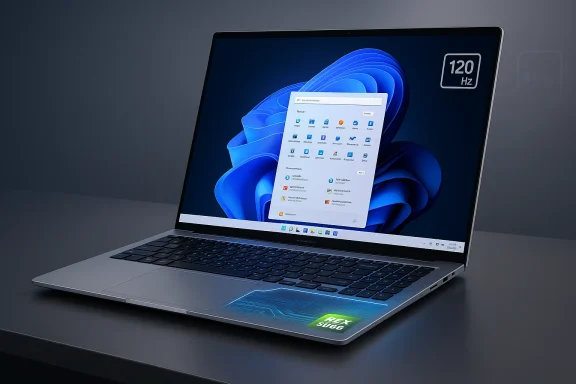
Samsung unveiled the Galaxy Book 6 lineup at CES and positioned the three new models — Galaxy Book 6, Galaxy Book 6 Pro, and Galaxy Book 6 Ultra — as the company’s most advanced Windows laptops to date. The pitch centers on three pillars: the adoption of Intel’s Core Ultra Series 3 (Panther Lake) platform, a reworked cooling architecture to sustain higher sustained performance, and on‑device AI features integrated with Samsung’s Galaxy ecosystem.
That positioning follows industry trends visible across OEMs: a shift from single‑thread headline clock speeds to sustained performance per watt, tighter integration of NPUs for on‑device AI, and display and battery claims intended to differentiate premium Windows devices. Samsung’s roadmap emphasizes ecosystem continuity (phone↔tablet↔PC) as a productivity lever and highlights hardware choices aimed at creators, hybrid workers and Galaxy‑loyal users.
The practical implications for Windows users are twofold:
Practical note: vendor thermal deltas are informative as directional guidance but are typically produced under controlled, internally defined conditions. Independent thermal and sustained workload testing is the only reliable way to validate whether that 35% improvement translates into meaningful real‑world gains across creative and AI workloads.
Important context around these numbers:
Design highlights include impressively thin profiles — Samsung quotes 15.4 mm for the Ultra and 11.9 mm for the Pro 16 — along with a two‑tone keyboard and a haptic trackpad. The Ultra is offered in a single Grey finish, while Pro and base models ship in Grey or Silver. These choices point to Samsung’s intent to balance premium aesthetics with portability.
That said, Windows‑level AI features — including Microsoft’s Copilot+ initiatives — often require specific on‑device NPUs and platform certification to deliver the full local model experience. Samsung’s Panther Lake adoption suggests many Galaxy Book 6 SKUs will be well‑positioned for Copilot+ features, but staged rollouts, region‑dependent availability and driver maturity will influence timing and feature parity. Enterprises and power users should verify specific Copilot+ or secured‑Core options for the exact SKU they intend to buy.
What readers must understand about those KRW figures:
Yet the tangible value of those claims depends on factors Samsung can control (chassis engineering, display quality) and factors it cannot (third‑party driver maturity, app integration and regional pricing). The lack of UK/MSRP details at launch leaves an important purchasing variable unresolved for many buyers, and the company’s lab‑focused battery and thermal numbers must be validated by independent testing to establish real‑world credibility.
For early adopters with Galaxy phones who prize display fidelity and portability, the Galaxy Book 6 series is an attractive proposition on paper. For enterprise buyers and anyone budgeting cross‑regionally, the prudent move is to wait for hands‑on reviews, sustained workload benchmarks and final UK/EU/US MSRPs before committing.
Source: GB News Samsung promises major Windows 11 upgrade, but keeps quiet about a crucial detail about Galaxy Book 6 lineup
 Background
Samsung unveiled the Galaxy Book 6 lineup at CES and positioned the three new models — Galaxy Book 6, Galaxy Book 6 Pro, and Galaxy Book 6 Ultra — as the company’s most advanced Windows laptops to date. The pitch centers on three pillars: the adoption of Intel’s Core Ultra Series 3 (Panther Lake) platform, a reworked cooling architecture to sustain higher sustained performance, and on‑device AI features integrated with Samsung’s Galaxy ecosystem.That positioning follows industry trends visible across OEMs: a shift from single‑thread headline clock speeds to sustained performance per watt, tighter integration of NPUs for on‑device AI, and display and battery claims intended to differentiate premium Windows devices. Samsung’s roadmap emphasizes ecosystem continuity (phone↔tablet↔PC) as a productivity lever and highlights hardware choices aimed at creators, hybrid workers and Galaxy‑loyal users.
What Samsung announced — the essentials
- Three models: Galaxy Book 6, Galaxy Book 6 Pro (14" and 16"), and Galaxy Book 6 Ultra (16" only).
- New platform: Intel Core Ultra Series 3 (Panther Lake) system‑on‑a‑chip, with integrated NPUs and upgraded iGPU capabilities intended for low‑latency AI inference and better graphics efficiency.
- Display and audio: Dynamic AMOLED 2X displays with HDR peak brightness up to 1,000 nits, 120 Hz variable refresh, and multi‑speaker Dolby Atmos tuning on Ultra.
- Cooling: redesigned vapor chamber and airflow system, with Samsung claiming up to 35% improved heat dissipation versus the prior generation in internal testing.
- Battery/charging: lab‑rated up to 30 hours of local video playback on Pro and Ultra models, and fast charging restoring up to 63% charge in 30 minutes on the Ultra.
- GPU options (Ultra): discrete NVIDIA GeForce RTX 5060 and RTX 5070 laptop GPUs available on select SKUs.
- Launch timing: Samsung’s South Korea store lists availability and KRW price points for Pro and Ultra models with a January 27, 2026 retail date in Korea.
Technical deep dive
Silicon: Intel Core Ultra Series 3 (Panther Lake) — what it brings
Samsung’s choice to ship Galaxy Book 6 models with Intel Core Ultra Series 3 marks a broad OEM embrace of Intel’s Panther Lake client platform. That platform is positioned around a more advanced process node and tighter integration of CPU, GPU and NPU resources to boost performance per watt — a key metric for thin‑and‑light machines. Samsung’s product pages and early coverage highlight this as the technical heart of the line.The practical implications for Windows users are twofold:
- Better efficiency: denser silicon and power management improvements should yield longer battery life in sustained light and mixed workloads.
- On‑device AI: an integrated NPU (Samsung quotes platform‑level TOPS on marketing materials) is intended to accelerate local inference for tasks such as image processing, real‑time translation, intelligent search and other Galaxy AI features. However, the real benefit will depend on driver maturity and application support.
Graphics and discrete GPU options
The Ultra model ships with optional NVIDIA laptop GPUs (RTX 5060/5070), giving Samsung a channel for heavier GPU workloads like rendering or accelerated ML inference beyond what integrated Xe3/Arc GPU blocks provide. This hybrid strategy — integrated NPU + optional discrete GPU — aligns with the needs of creators who require both long battery life and bursts of discrete‑GPU performance.Thermal engineering: more than marketing speak?
Samsung redesigned the internal cooling architecture around the denser Panther Lake package. Key engineering moves include a larger vapor chamber (now used in Pro models too), increased fin area, enlarged fan fin density and a dual‑path outlet fan design that Samsung says yields 35% better heat dissipation versus the previous generation Galaxy Book5 Pro in its internal comparison. Those changes are explicitly intended to preserve performance under prolonged CPU/GPU/NPU workloads while maintaining quiet acoustics.Practical note: vendor thermal deltas are informative as directional guidance but are typically produced under controlled, internally defined conditions. Independent thermal and sustained workload testing is the only reliable way to validate whether that 35% improvement translates into meaningful real‑world gains across creative and AI workloads.
Battery life and fast charging — lab claims vs. reality
Samsung’s claim of up to 30 hours of local video playback on a single charge for the Pro and Ultra models is impressive on paper and represents a meaningful step over prior Galaxy Book generations. The company pairs that number with a fast‑charge promise — 63% in 30 minutes on the Ultra — for a usable quick‑top when travelling.Important context around these numbers:
- The 30‑hour figure is explicitly from local playback lab testing, which typically controls brightness (e.g., 150 nits), disables wireless radios (airplane mode), uses looped local content, and turns off energy‑consuming features (keyboard backlight, background sync). Those conditions are optimized to maximize runtime.
- Real‑world mixed usage — browsing, cloud sync, active Copilot/Galaxy AI inference, video calls, brightness set to ambient levels, and background updates — will reduce runtime substantially.
- Fast charging figures are useful for travel scenarios but do not replace the need to validate thermal behaviour and charging throttling during heavy load while plugged in.
Display, audio and industrial design
Samsung continues to leverage its smartphone display expertise by equipping the higher‑end models with Dynamic AMOLED 2X panels that offer high contrast, wide color gamut and up to 1,000 nits peak HDR brightness — a boon for creators and outdoor usability. Variable 120 Hz refresh and touch support round out the panel credentials. The Ultra model adds a richer multi‑speaker array with Dolby Atmos certification for improved media playback.Design highlights include impressively thin profiles — Samsung quotes 15.4 mm for the Ultra and 11.9 mm for the Pro 16 — along with a two‑tone keyboard and a haptic trackpad. The Ultra is offered in a single Grey finish, while Pro and base models ship in Grey or Silver. These choices point to Samsung’s intent to balance premium aesthetics with portability.
Software and AI: Galaxy AI vs. Copilot+
A significant portion of Samsung’s product narrative is built on Galaxy AI features and continuity with Galaxy phones and tablets. Features such as AI Select promise cross‑device workflows: pulling context (text, images) from nearby Galaxy devices into the laptop for quick transformations like cutouts, translations and intent‑aware search. Samsung frames this ecosystem experience as complementary to Microsoft’s Copilot efforts rather than directly competitive.That said, Windows‑level AI features — including Microsoft’s Copilot+ initiatives — often require specific on‑device NPUs and platform certification to deliver the full local model experience. Samsung’s Panther Lake adoption suggests many Galaxy Book 6 SKUs will be well‑positioned for Copilot+ features, but staged rollouts, region‑dependent availability and driver maturity will influence timing and feature parity. Enterprises and power users should verify specific Copilot+ or secured‑Core options for the exact SKU they intend to buy.
Pricing and availability: the missing piece
Here’s where the narrative gets messy for buyers outside Samsung’s initial markets. For many regions — notably the UK — Samsung has not published final retail prices for the Galaxy Book 6 series. Samsung’s South Korea online store, however, shows KRW pricing for Pro and Ultra configurations and a January 27, 2026 on‑sale date in Korea. Example KRW listings published in regional pages show Pro 14 and Pro 16 in the KRW 3.41M–3.51M range, and Ultra SKUs with RTX 5060/5070 configurations listed at KRW 4.63M–4.93M. These Korea figures provide a rough reference but are not definitive global MSRP.What readers must understand about those KRW figures:
- Currency conversions are approximate and don’t account for VAT, tariffs, local distribution margins, or SKU splits that OEMs commonly apply by region.
- Retail prices in the UK, EU and US historically differ meaningfully from Korean launch pricing for the same configuration.
- Samsung’s regional marketing cadence often staggers releases and prices; a Korea launch date does not guarantee simultaneous global availability.
Critical analysis — strengths and potential risks
Strengths
- Tight integration of recent silicon: Adopting Intel’s Panther Lake platform early gives Samsung a potential edge in power efficiency and local AI inference capability if Intel’s drivers and runtimes are mature.
- Display and battery differentiation: The Dynamic AMOLED 2X panels and Samsung’s long‑playback battery headlines create distinct marketing advantages, especially for content creators and frequent travelers.
- Balanced product architecture: The ability to offer both integrated NPU acceleration and optional discrete NVIDIA GPUs in the Ultra model addresses a spectrum of creators — from photo/video editors to users who need GPU compute.
- Ecosystem continuity: For Galaxy phone/tablet owners, Galaxy AI and cross‑device features may provide workflow improvements that are hard to replicate on other OEMs.
Risks and caveats
- Lab numbers vs. real world: The 30‑hour playback and 35% cooling improvement are vendor‑supplied lab claims. Independent testing is required to validate how those numbers translate under mixed workloads.
- Driver and NPU maturity: The platform’s AI benefits rely on driver stacks, runtimes and app integration. Early launches historically surface kinks in acceleration stacks that only get ironed out after several driver and firmware updates.
- Pricing opacity: With UK/EU pricing withheld at announcement, buyers cannot confidently budget or compare value against competing premium Windows laptops or Apple’s MacBook lineup until official MSRPs are published.
- Thermal trade‑offs in thin enclosures: Delivering thin chassis (11–15 mm) while supporting sustained 45W+ workloads requires engineering compromises; buyers should watch independent sustained load results for performance versus acoustics and thermal throttling.
- Ecosystem lock‑in: Galaxy continuity features are powerful but increase dependency on Samsung’s software and services, which may not provide equivalent cross‑platform experiences for mixed‑ecosystem teams.
How Galaxy Book 6 stacks up against the competition
- Against Apple’s MacBook Pro (Apple Silicon): Samsung’s display peak brightness and optional discrete GPUs are areas of advantage, but Apple’s M‑series continues to lead in power‑efficient sustained throughput for many creative apps due to tight hardware/software co‑design. Software availability and ecosystem choice (macOS creative suites) remain considerations.
- Against Dell XPS / Lenovo Yoga: Samsung differentiates on display tech, Galaxy continuity and aggressive battery claims. Dell and Lenovo, however, historically provide broader enterprise manageability, longer channel support and a track record of steady thermal tuning in premium Windows notebooks.
- Against other Copilot+/AI‑focused OEMs: The Galaxy Book 6’s NPU + optional discrete GPU strategy places it in competition with other Panther Lake designs; success will hinge on driver maturity and the depth of on‑device AI experiences actually shipping at launch.
Practical guidance for buyers and IT pros
- Wait for independent reviews: Look for tests that run mixed productivity, sustained rendering and AI inference workloads across multiple driver revisions.
- Validate battery in your real‑world workload: run mixed usage tests (browser tabs, cloud sync, live video conferencing, and local AI features) rather than accepting vendor playback numbers.
- Confirm exact SKU specs: check whether an RTX listing indicates a discrete GPU with dedicated VRAM or an integrated/classified GPU block — vendors have historically used ambiguous spec language early in launch cycles.
- For enterprise buyers: verify Secured‑Core, vPro (if needed), firmware update cadence and manageability tooling before procurement.
- For Galaxy ecosystem users: map the Galaxy AI features to your workflows and confirm cross‑device compatibility and privacy controls.
Verification checklist — what to look for in reviews
- Sustained CPU/GPU thermal behaviour (Blender, 3DMark Stress, long render passes)
- Real‑world battery life for mixed workloads (office productivity, web conferencing, creative apps)
- Driver coverage and Windows/NPU runtime stability (Intel + Samsung updates)
- Acoustic profile under both light and heavy loads
- Display calibration and brightness under practical viewing scenarios
- Region‑specific retail pricing and available configurations (RAM, SSD, discrete GPU)
Conclusion
Samsung’s Galaxy Book 6 lineup ambitiously marries Intel’s latest Panther Lake silicon with refined thermal engineering, high‑brightness AMOLED displays and stronger ecosystem tie‑ins — all packaged in impressively thin hardware. The technical direction is logical: improved performance per watt, on‑device AI acceleration, and long battery life are precisely the features premium Windows buyers are asking for in 2026.Yet the tangible value of those claims depends on factors Samsung can control (chassis engineering, display quality) and factors it cannot (third‑party driver maturity, app integration and regional pricing). The lack of UK/MSRP details at launch leaves an important purchasing variable unresolved for many buyers, and the company’s lab‑focused battery and thermal numbers must be validated by independent testing to establish real‑world credibility.
For early adopters with Galaxy phones who prize display fidelity and portability, the Galaxy Book 6 series is an attractive proposition on paper. For enterprise buyers and anyone budgeting cross‑regionally, the prudent move is to wait for hands‑on reviews, sustained workload benchmarks and final UK/EU/US MSRPs before committing.
Source: GB News Samsung promises major Windows 11 upgrade, but keeps quiet about a crucial detail about Galaxy Book 6 lineup
