

Samsung’s Galaxy Book6 series is the clearest sign yet that the PC industry is pivoting from raw single-threaded speed to an integrated vision of sustained performance, long battery life, and device‑level AI, and Samsung is staking that claim with new chassis engineering, Intel’s latest Panther Lake silicon (branded as Intel Core Ultra Series 3), and a deeper tie‑in to its Galaxy AI ecosystem.
Samsung unveiled the Galaxy Book6 family at CES 2026 as a three‑tier product line: Galaxy Book6 Ultra, Galaxy Book6 Pro, and the standard Galaxy Book6. The headline items are the pairing with Intel Core Ultra Series 3 (Panther Lake) processors, a redesigned thermal architecture with vapor chamber cooling, and an aggressive battery claim — up to 30 hours of video playback on Ultra and Pro models. Samsung positions the lineup as its most refined Galaxy Book effort yet: slimmer profiles, Dynamic AMOLED 2X displays, Dolby Atmos audio, and deeper Galaxy AI features such as AI Select that tie phone, tablet and PC workflows together. This launch reflects three industry currents visible at CES 2026: (1) the arrival of Panther Lake / Core Ultra Series 3 as an AI‑first client platform built on Intel’s 18A process, (2) OEMs emphasizing on‑device AI and local NPUs to reduce cloud reliance, and (3) design and thermal engineering becoming core differentiators for thin‑and‑light premium laptops. Intel and Samsung’s materials and several independent outlets confirm those strands.
However, the launch rests on claims that require independent verification. The 30‑hour battery number derives from tightly controlled playback tests, the 35% thermal improvement is an OEM‑supplied delta, and Panther Lake’s NPU advantages will only become tangible if drivers, runtimes, and app integrations mature quickly. For early adopters and IT teams, the prudent path is to wait for hands‑on reviews that measure sustained throughput, mixed‑use battery life, and the practical utility of Galaxy AI features — then decide based on real‑world trade‑offs between performance, thermals, and ecosystem fit.
Key takeaways for prospective buyers:
Source: The Tech Buzz https://www.techbuzz.ai/articles/samsung-launches-galaxy-book6-at-ces-2026-with-intel-core-ultra/
 Background
Samsung unveiled the Galaxy Book6 family at CES 2026 as a three‑tier product line: Galaxy Book6 Ultra, Galaxy Book6 Pro, and the standard Galaxy Book6. The headline items are the pairing with Intel Core Ultra Series 3 (Panther Lake) processors, a redesigned thermal architecture with vapor chamber cooling, and an aggressive battery claim — up to 30 hours of video playback on Ultra and Pro models. Samsung positions the lineup as its most refined Galaxy Book effort yet: slimmer profiles, Dynamic AMOLED 2X displays, Dolby Atmos audio, and deeper Galaxy AI features such as AI Select that tie phone, tablet and PC workflows together. This launch reflects three industry currents visible at CES 2026: (1) the arrival of Panther Lake / Core Ultra Series 3 as an AI‑first client platform built on Intel’s 18A process, (2) OEMs emphasizing on‑device AI and local NPUs to reduce cloud reliance, and (3) design and thermal engineering becoming core differentiators for thin‑and‑light premium laptops. Intel and Samsung’s materials and several independent outlets confirm those strands. What Samsung announced: hardware highlights
Processors and platform
- Galaxy Book6 Ultra and Pro are offered with Intel Core Ultra Series 3 processors (Panther Lake family), including new X‑class SKUs designed for higher integrated GPU and NPU throughput. Intel markets Series 3 as the first client platform built on Intel 18A and claims significant multi‑thread and graphics gains over the prior Lunar Lake generation.
- Samsung’s platform notes an integrated NPU of up to 50 TOPS on Panther Lake SKUs in some configurations, intended to accelerate local AI tasks (image cleanup, low‑latency translation, intelligent search). Samsung and Intel both highlight the local inference capability as central to the product story.
Display and audio
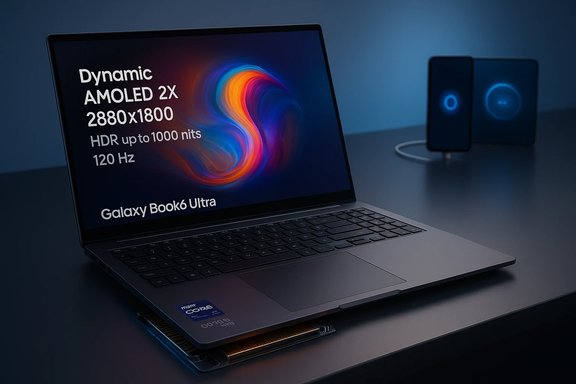
- The Ultra and Pro models ship with Dynamic AMOLED 2X displays (WQXGA+ 2880×1800 on 16‑inch Ultra), HDR peak brightness up to 1,000 nits, 120 Hz variable refresh, touch support and an anti‑reflective layer. Samsung borrows smartphone display DNA for laptop panels in a push to differentiate on color and contrast.
- Audio is marketed as premium with multi‑speaker arrays and Dolby Atmos support, paired with a refreshed two‑tone keyboard and haptic‑enabled trackpad design. Independent early coverage echoes the premium audio and keyboard styling as part of the positioning.
Thermals and chassis engineering
- Samsung emphasizes a new cooling architecture: wider and redesigned vapor chambers (now used in Pro for the first time), larger fins, a dual‑path outlet fan, and revised fan blade spacing to reduce noise. The company claims up to 35% improved heat dissipation vs. the prior generation in internal testing. Those redesigns are intended to maintain sustained performance under long creative or AI inference workloads.
Battery and charging
- Samsung claims up to 30 hours of local video playback on Galaxy Book6 Ultra and Pro (their lab test conditions are explicitly for local playback, fixed brightness, airplane mode, etc., and super‑fast charging that restores up to 63% in 30 minutes on Ultra. Samsung frames these results as the longest battery life in the Galaxy Book lineup to date. Multiple outlets repeated the 30‑hour claim in early coverage. Readers should note the lab test cadence Samsung used when comparing with real‑world mixed‑use numbers.
Expandability and ports
- Ultra models support higher‑end GPU options (NVIDIA GeForce RTX 5060/5070 Laptop GPUs on some SKUs), dual Thunderbolt 4 ports, HDMI 2.1, SDXC, and mixed USB‑A. Memory and storage top out at higher configurations on Ultra (32 GB+ RAM, 2 TB SSD options) while Pro and base models offer smaller configurations. Independent previews list similar port and GPU options.
Software: Galaxy AI and continuity
- Samsung’s Galaxy AI features — notably AI Select — are front‑and‑center. AI Select lets users pull text, images or context from nearby Galaxy phones/tablets into the laptop and apply simple AI transformations (cutouts, instant translation, intent‑aware file search). This is a clear continuity play leaning on hardware‑level NPUs and cross‑device trust. Samsung contrasts its ecosystem‑centred integration with Microsoft’s Copilot‑centric approach, arguing that device continuity and context transfer are stronger differentiators for day‑to‑day productivity.
Verification of the most consequential claims
To make sense of Samsung’s promises, it’s important to verify the load‑bearing technical claims from multiple sources:- Intel’s claim that Core Ultra Series 3 is built on Intel 18A and brings notable gains is confirmed in Intel’s CES release and trade reporting. Intel’s press material lists up to 60% better multithread performance vs. Lunar Lake for top SKUs (company‑presented benchmarks) and positions the platform as broadly available across OEM designs this month. Independent trade outlets and Reuters also reported Intel’s Panther Lake debut at CES.
- Samsung’s 30‑hour battery number and 63% 30‑minute charging figure come from Samsung’s lab results and are repeated in Samsung’s global newsroom and regional press pages. Crucially, Samsung documents the test conditions (local 1080p playback, brightness at 150 nits, airplane mode, wired earphones, keyboard backlight off) — parameters that are optimized for achieving long playback times but differ from mixed‑use workloads where background networking, content creation, and screen brightness vary. Independent sites (Android Authority, Digital Trends) reported the same claims, corroborating Samsung’s messaging. Readers should understand the difference between vendor lab playback numbers and real‑world battery life under mixed workloads.
- The vapor chamber + 35% improved dissipation claim is a Samsung engineering claim cited across its product materials. The 35% figure is explicitly based on Samsung’s internal comparison with a prior generation Galaxy Book5 Pro 16” sample and is therefore a vendor‑supplied delta rather than an independent lab result. Independent preview coverage references the vapor chamber introduction and expanded fin area but has not yet validated the 35% number in third‑party thermal runs. Treat the figure as an OEM improvement metric pending independent testing.
- The presence of Panther Lake‑era Core Ultra SKUs in Samsung devices was foreshadowed in leak and community benchmark captures in late 2025; community threads and early Geekbench captures discussed possible Core Ultra 5 338H entries and Arc iGPU sightings for Galaxy Book prototypes. Those community discussions provide context but are not a substitute for final retail firmware and independent sustained workload benchmarks.
Critical analysis — strengths, practical implications, and real‑world expectations
Strengths: Where Samsung is playing to win
- Ecosystem continuity as a productivity lever. Samsung is not just selling a display and silicon; it’s selling an experience that spans phone, tablet, and PC. AI Select and on‑device AI shortcuts are built to make cross‑device workflows feel immediate. For users already invested in Galaxy phones or tablets, this increases the utility of a Galaxy Book beyond raw specs.
- Sustained performance focus. Panther Lake silicon plus a larger vapor chamber and more aggressive heatsink design are intended to reduce thermal throttling and preserve multi‑hour responsiveness under real creative workloads. If Samsung’s thermal design and Intel’s Series 3 efficiency deliver, the Book6 line could beat competitors on sustained throughput rather than short bursts.
- Display and battery headline specs. The Dynamic AMOLED 2X panels promise high contrast, deep blacks and HDR peak brightness up to 1,000 nits — a plus for creators and media consumers. Combined with Samsung’s quoted 30‑hour playback, this sets clear marketing differentiation versus many Windows rivals. Independent outlets have reiterated the display and battery claims in coverage.
Risks and caveats: where buyers should be cautious
- Lab battery numbers vs real usage. Samsung’s 30‑hour figure is for controlled local video playback and explicitly uses airplane mode and specific brightness. Mixed real‑world usage with background sync, browser tabs, and continuous on‑device AI inference (e.g., Copilot+ or Galaxy AI features) will reduce runtime substantially. Prospective buyers should wait for independent battery tests that reflect typical usage patterns.
- Driver and NPU software maturity. Panther Lake’s NPU and Intel’s integrated GPU claims are only as useful as the drivers, runtimes, and application integrations that use them. Early silicon launches frequently expose gaps in runtime support, model compatibility, and optimized developer libraries. Independent reviewers will need to test AI workloads across multiple models and driver revisions to confirm real gains. Community leak discussions noted this exact risk in previous Panther Lake probes.
- Thermals in a thin chassis are a balancing act. Samsung’s thin profiles (15.4 mm for Ultra, 11.9 mm for Pro 16”) are impressive, but thin enclosures constrain how much cooling mass and airflow you can add. Vendor claims of 35% heat dissipation improvement are promising, but only independent sustained Blender/Premiere/ML runs will show whether Samsung’s tuning favors battery life and silence versus absolute sustained throughput. Expect trade‑offs across fan noise, clock sustainability, and battery drain.
- Ecosystem lock‑in and feature parity. Samsung’s Galaxy AI features offer tangible convenience for Galaxy device owners, but they also increase lock‑in to Samsung’s services and hardware. Enterprises and mixed‑ecosystem users should weigh cross‑platform compatibility (Windows + iOS/macOS + Android) before assuming Galaxy continuity will materially improve workflows across their teams.
How Galaxy Book6 stacks up against competitors
- Apple MacBook Pro (Apple Silicon):
- Strengths for Samsung: brighter HDR peaks on AMOLED, Thunderbolt/Windows flexibility, NVIDIA discrete GPU options in Ultra, closer Galaxy ecosystem continuity for Android users.
- Weaknesses for Samsung: Apple’s M‑series continues to lead in single‑thread and power‑efficient sustained workloads for many creative apps, and macOS remains a strong creative platform with mature app support.
- Other Windows OEM premium devices (Dell XPS, Lenovo Yoga, etc.:
- Samsung competes on display tech, battery claims, and Galaxy AI continuity. However, Dell and Lenovo will emphasize mature enterprise manageability, longer-standing channel partnerships, and their own thermal/keyboard tradeoffs.
- AI‑first PC challengers:
- Samsung’s advantage is combining the Galaxy ecosystem and on‑device NPU acceleration with established Windows workflows. The question mark is how fast developer adoption and Microsoft Store / Copilot+ integrations will iterate to truly leverage on‑device NPUs across mainstream apps.
Enterprise and IT considerations
- Security: Samsung lists Samsung Knox and Secured‑core Windows features as part of the Galaxy Book6 package, which aligns with enterprise security baselines. IT teams should verify specific SKU features (TPM version, vPro options, firmware update cadence) before rolling out at scale.
- Manageability: For corporate fleets, Samsung’s Enterprise Edition (announced availability in some markets in April 2026) may include manageability optimizations; procurement teams should confirm driver support, vendor firmware update timelines, and warranty/repair coverage terms before committing. Early community threads caution that OEM cadence and regional SKU variations can complicate mass deployments.
- Lifecycle: If Panther Lake delivers as promised, vendors will ship multiple SKUs rapidly this quarter — IT should plan validation pilots for software compatibility (AI features, GPU drivers, container runtimes) and confirm vendor patching policies.
What we’ll watch during independent reviews
- Sustained multi‑hour workloads (video export, 4K timelines, inference loops) to validate thermal claims and whether the chassis preserves performance over time.
- Real‑world battery life under mixed workloads (web browsing, Teams calls, cloud sync, occasional local inference).
- The maturity and usefulness of Galaxy AI features across workflows (e.g., how often AI Select or on‑device translation actually speeds a task versus existing clipboard/phone link features).
- Driver stability and NPU acceleration availability across mainstream creative and productivity apps.
- Fan noise and surface temperatures during sustained loads.
Conclusion
Samsung’s Galaxy Book6 is a bold, coherent push: it stitches Intel’s Panther Lake ambition to Samsung’s display and device ecosystem strengths, and it emphasizes sustained, everyday productivity rather than raw burst scores. The combination of Intel Core Ultra Series 3 silicon, redesigned vapor chamber cooling, bright Dynamic AMOLED displays, and Galaxy AI continuity yields a compelling value proposition for Galaxy‑centric users and creators who prize display fidelity and long battery life.However, the launch rests on claims that require independent verification. The 30‑hour battery number derives from tightly controlled playback tests, the 35% thermal improvement is an OEM‑supplied delta, and Panther Lake’s NPU advantages will only become tangible if drivers, runtimes, and app integrations mature quickly. For early adopters and IT teams, the prudent path is to wait for hands‑on reviews that measure sustained throughput, mixed‑use battery life, and the practical utility of Galaxy AI features — then decide based on real‑world trade‑offs between performance, thermals, and ecosystem fit.
Key takeaways for prospective buyers:
- If you own Galaxy phones/tablets: Galaxy Book6 promises the smoothest cross‑device continuity to date.
- If you need sustained creative throughput: Samsung’s vapor chamber and Panther Lake pairing are promising; validate with long‑run benchmarks first.
- If battery life is the chief priority: Expect best‑case 30‑hour playback under lab conditions; anticipate far lower numbers for mixed everyday workloads and on‑device AI tasks.
- If you manage fleets: Confirm enterprise SKUs, driver timelines, and firmware update policies before large rollouts.
Source: The Tech Buzz https://www.techbuzz.ai/articles/samsung-launches-galaxy-book6-at-ces-2026-with-intel-core-ultra/
