

Samsung’s Galaxy Glasses have not been formally launched, but leaked renders published this week show a pair of Android XR smart glasses that look much like Meta’s Ray-Ban line and are reportedly built around Gemini-powered voice, camera, translation, navigation, and media features. That resemblance is not the scandal; it is the strategy. Samsung appears to have accepted the central lesson of the first mainstream smart-glasses wave: the winning product is not the one that looks most futuristic, but the one people will actually wear in public. The fight now is less about spectacle and more about who gets to own the face as the next AI interface.
The leaked Galaxy Glasses renders are striking mostly because they are not striking. The frames look like ordinary sunglasses, with thicker temples, small camera cutouts near the front edges, and a silhouette that seems deliberately close to Ray-Ban Meta rather than to the science-fiction headsets that have defined much of the XR conversation.
That is easy to mock as derivative design. It is also probably the right call. Smart eyewear has spent more than a decade proving that consumers will not tolerate hardware that makes them look like beta testers, even when the technical pitch is compelling.
Google Glass failed partly because it looked like a product from a different social contract. Apple Vision Pro proved that superb engineering does not automatically solve the problem of wearability. Meta’s Ray-Ban collaboration, by contrast, worked because it smuggled cameras, microphones, speakers, and AI into a form factor people already understood.
Samsung’s apparent bet is that the first Galaxy Glasses do not need to reinvent the category. They need to normalize Samsung and Google’s presence in it.
Ray-Ban gave Meta something the company could not build in-house: cultural permission. The glasses looked like glasses, came from an eyewear brand, and could be sold as a lifestyle accessory rather than a developer kit. That changed the adoption curve because the device did not ask buyers to explain themselves every time they wore it.
Samsung’s leaked design suggests it has learned the same lesson. If smart glasses are going to become an AI input device, they have to disappear into daily routines. The less a person has to think about whether wearing them is socially awkward, the more often the assistant gets used.
That matters because AI eyewear is not like a smartwatch, which can wait passively on the wrist until summoned. Glasses sit on the face, point outward, and alter how other people experience the wearer. The design has to earn trust before the software can earn usage.
That gives Samsung a credible answer to Meta’s current lead. Meta owns the best-known AI glasses brand today, but Samsung and Google can pitch something broader: glasses that plug into Android, Google Maps, Google Photos, Search, translation, messaging, and the rest of the services many users already rely on.
For WindowsForum readers, the comparison to old platform wars is obvious. Hardware matters, but ecosystems decide whether a new device becomes a curiosity or a habit. Android XR could make Galaxy Glasses feel less like a standalone gadget and more like a peripheral for the phone, the cloud account, and the assistant people already carry.
That is also why Gemini matters. Voice assistants were mostly disappointing because they were command lines with microphones. Multimodal AI changes the pitch: the assistant can theoretically respond to what the camera sees, what the user says, where the user is, and what services are available.
The promise is a wearable assistant that can translate a sign, describe a landmark, capture a photo, give walking directions, answer a contextual question, or control music without forcing the user to pull out a phone. Whether Samsung delivers that smoothly is another question. But the pitch is no longer science fiction.
That distinction matters. Display glasses promise augmented reality, but they also create harder engineering problems around battery life, weight, heat, brightness, field of view, and prescription support. Camera-and-audio glasses are less glamorous, but they are much easier to make comfortable.
Samsung may eventually pursue true AR display glasses under a separate line or later generation. For now, the rumored Galaxy Glasses seem aimed at the same market as Ray-Ban Meta: capture, voice, audio, translation, and AI assistance rather than floating windows in your field of view.
That is not a retreat. It is a recognition that the path to AR may run through simpler AI glasses first. Before users accept persistent visual overlays, they may need to accept the idea of an always-near assistant that can see and hear on request.
Putting all compute on the glasses would make them heavier, hotter, more expensive, and more power-hungry. Offloading work to a Galaxy phone allows Samsung to keep the eyewear closer to normal glasses while using the phone as the compute and connectivity hub.
This is the same broad pattern that made early wearables tolerable. The watch did not replace the phone. It borrowed the phone’s network, account, and app ecosystem until it became useful enough to justify more independence.
Galaxy Glasses may follow that path. The first version does not need to be a self-contained computer. It needs to be a convincing front end for Android, Gemini, and Samsung’s hardware ecosystem.
That also gives Samsung a commercial advantage. If the glasses work best with Galaxy phones, they become another reason to stay in the Samsung ecosystem. If they work broadly across Android, they become a wedge for Android XR. Either way, they extend the phone war onto the face.
Meta has already normalized some of this with recording LEDs, voice cues, and the simple fact that millions of people have seen Ray-Ban Meta glasses in the wild. Samsung still has to prove it can communicate when recording is happening, what data is processed locally, what goes to the cloud, and how Gemini handles visual context.
This is where Android XR’s platform status cuts both ways. A Google-backed ecosystem can make the glasses more useful, but it also raises sharper questions about data flow. If the assistant can interpret what the user sees, users and bystanders will want to know what is stored, what is analyzed, and what is discarded.
For enterprise IT, the questions become even more concrete. Can the camera be disabled by policy? Can the glasses be blocked from sensitive locations? Will Android Enterprise controls extend cleanly to XR hardware? Will logs, recordings, or AI interactions create compliance exposure?
Samsung cannot treat those as afterthoughts. The more normal the glasses look, the more important explicit trust signals become.
The center of gravity is moving from screens to ambient interfaces. Users increasingly expect the assistant to follow them across devices, summarize context, answer questions, capture media, and bridge apps. Microsoft is pursuing that future through Copilot on PCs; Google is pursuing it through Android and Gemini; Meta is pursuing it through eyewear and social AI.
Smart glasses are one of the cleanest expressions of that shift because they change the input model. Instead of typing into a search box or opening an app, the user asks a question while looking at the thing they care about. The interface becomes situational.
That will eventually collide with workplace policy. A pair of AI glasses in a meeting room is not just a consumer gadget; it is a recording device, a translation device, a note-taking device, and possibly a confidential-data exposure point. The same organizations now writing rules for Copilot and ChatGPT will have to write rules for wearable cameras with AI attached.
Samsung’s move therefore deserves attention beyond mobile enthusiasts. It is another sign that AI hardware is shifting from novelty devices toward ordinary endpoints.
Smart glasses may be entering that phase. The first successful mainstream template appears to be classic eyewear with thickened temples, camera cutouts, microphones, speakers, a charging case, and an assistant. Samsung’s job is not necessarily to make that template look radically different. It is to make it work better for Android users.
The risk is that Samsung looks like a follower. The opportunity is that many Android users may not care, especially if the glasses integrate more naturally with Google services than Meta’s do.
That is where the competitive line sharpens. Meta has the cultural lead and the eyewear partnerships. Samsung has phone distribution, component expertise, carrier relationships, and Google’s platform. Google has the AI and services layer. Qualcomm has the silicon story. Together, they can form a coalition that Meta cannot simply duplicate.
But coalitions are messy. Samsung and Google have often been both partners and rivals, especially where assistants, app stores, messaging, and services are concerned. Galaxy Glasses will need one coherent user experience, not three companies’ strategies fighting through a pair of temples.
Meta wants that assistant to be Meta AI, sitting between the user, social media, messaging, media capture, and eventually display-based interfaces. Google wants it to be Gemini, attached to Search, Maps, Android, Gmail, Photos, YouTube, and the web. Microsoft wants Copilot to own productivity context, especially on the PC and in enterprise workflows.
Glasses make this fight more intimate. A phone assistant waits in a pocket. A glasses assistant is inches from the user’s eyes and ears. It can become the interface for moments that never used to involve a computer at all.
That is why Samsung’s entry matters even if the first model is imperfect. The company is not just launching another wearable. It is helping Google contest the most important AI endpoint after the phone.
That conservatism may frustrate enthusiasts who want true AR. But it gives Samsung a better chance of shipping something normal people can wear, afford, and understand.
The product still has to clear several hurdles. Battery life must survive real use. Audio leakage must be controlled. Camera quality must be good enough to justify capture from the face. Gemini must be fast, context-aware, and reliable enough that users do not retreat to their phones.
Samsung also has to decide how aggressively to price the product. If Galaxy Glasses land near mainstream premium eyewear plus gadget pricing, they can challenge Meta. If they are priced like XR hardware, they will remain a niche accessory for early adopters.
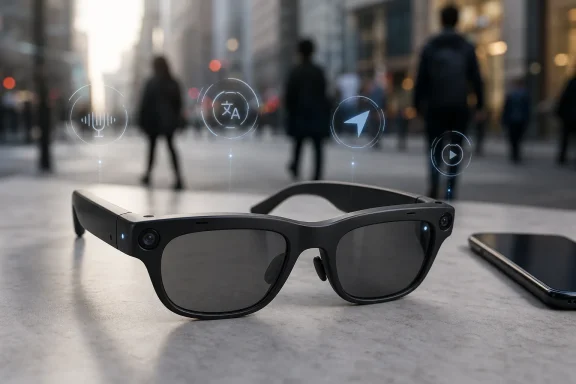 Samsung Chooses Familiarity Over Futurism
The leaked Galaxy Glasses renders are striking mostly because they are not striking. The frames look like ordinary sunglasses, with thicker temples, small camera cutouts near the front edges, and a silhouette that seems deliberately close to Ray-Ban Meta rather than to the science-fiction headsets that have defined much of the XR conversation.That is easy to mock as derivative design. It is also probably the right call. Smart eyewear has spent more than a decade proving that consumers will not tolerate hardware that makes them look like beta testers, even when the technical pitch is compelling.
Google Glass failed partly because it looked like a product from a different social contract. Apple Vision Pro proved that superb engineering does not automatically solve the problem of wearability. Meta’s Ray-Ban collaboration, by contrast, worked because it smuggled cameras, microphones, speakers, and AI into a form factor people already understood.
Samsung’s apparent bet is that the first Galaxy Glasses do not need to reinvent the category. They need to normalize Samsung and Google’s presence in it.
Meta Already Proved the Market Was Hiding in the Frame
Meta’s biggest smart-glasses breakthrough was not the camera, the speakers, or even Meta AI. It was the admission that eyewear is fashion hardware before it is computing hardware.Ray-Ban gave Meta something the company could not build in-house: cultural permission. The glasses looked like glasses, came from an eyewear brand, and could be sold as a lifestyle accessory rather than a developer kit. That changed the adoption curve because the device did not ask buyers to explain themselves every time they wore it.
Samsung’s leaked design suggests it has learned the same lesson. If smart glasses are going to become an AI input device, they have to disappear into daily routines. The less a person has to think about whether wearing them is socially awkward, the more often the assistant gets used.
That matters because AI eyewear is not like a smartwatch, which can wait passively on the wrist until summoned. Glasses sit on the face, point outward, and alter how other people experience the wearer. The design has to earn trust before the software can earn usage.
Android XR Gives Samsung a Platform Story Meta Cannot Copy
The more interesting part of the leak is not the frame; it is the operating system. Galaxy Glasses are expected to run Android XR, Google’s extended-reality platform developed with Samsung and Qualcomm, with Gemini deeply integrated into the experience.That gives Samsung a credible answer to Meta’s current lead. Meta owns the best-known AI glasses brand today, but Samsung and Google can pitch something broader: glasses that plug into Android, Google Maps, Google Photos, Search, translation, messaging, and the rest of the services many users already rely on.
For WindowsForum readers, the comparison to old platform wars is obvious. Hardware matters, but ecosystems decide whether a new device becomes a curiosity or a habit. Android XR could make Galaxy Glasses feel less like a standalone gadget and more like a peripheral for the phone, the cloud account, and the assistant people already carry.
That is also why Gemini matters. Voice assistants were mostly disappointing because they were command lines with microphones. Multimodal AI changes the pitch: the assistant can theoretically respond to what the camera sees, what the user says, where the user is, and what services are available.
The promise is a wearable assistant that can translate a sign, describe a landmark, capture a photo, give walking directions, answer a contextual question, or control music without forcing the user to pull out a phone. Whether Samsung delivers that smoothly is another question. But the pitch is no longer science fiction.
The First Version May Be Smart Glasses, Not AR Glasses
The leaked feature set points toward a restrained first-generation product. Reports have described a 12MP camera, microphones, speakers, touch controls, photochromic lenses, and phone-assisted processing. Just as important is what appears to be missing: a built-in display.That distinction matters. Display glasses promise augmented reality, but they also create harder engineering problems around battery life, weight, heat, brightness, field of view, and prescription support. Camera-and-audio glasses are less glamorous, but they are much easier to make comfortable.
Samsung may eventually pursue true AR display glasses under a separate line or later generation. For now, the rumored Galaxy Glasses seem aimed at the same market as Ray-Ban Meta: capture, voice, audio, translation, and AI assistance rather than floating windows in your field of view.
That is not a retreat. It is a recognition that the path to AR may run through simpler AI glasses first. Before users accept persistent visual overlays, they may need to accept the idea of an always-near assistant that can see and hear on request.
The Phone Remains the Hidden Computer
One of the more practical details in the reporting is that much of the processing is expected to be handled by a connected smartphone. That is not merely a compromise; it is the architecture that may make the product viable.Putting all compute on the glasses would make them heavier, hotter, more expensive, and more power-hungry. Offloading work to a Galaxy phone allows Samsung to keep the eyewear closer to normal glasses while using the phone as the compute and connectivity hub.
This is the same broad pattern that made early wearables tolerable. The watch did not replace the phone. It borrowed the phone’s network, account, and app ecosystem until it became useful enough to justify more independence.
Galaxy Glasses may follow that path. The first version does not need to be a self-contained computer. It needs to be a convincing front end for Android, Gemini, and Samsung’s hardware ecosystem.
That also gives Samsung a commercial advantage. If the glasses work best with Galaxy phones, they become another reason to stay in the Samsung ecosystem. If they work broadly across Android, they become a wedge for Android XR. Either way, they extend the phone war onto the face.
Privacy Is the Product Test Samsung Cannot Avoid
Smart glasses carry an unavoidable privacy problem: they put a camera at eye level and microphones near every conversation. The design may look familiar, but the social implications remain unsettled.Meta has already normalized some of this with recording LEDs, voice cues, and the simple fact that millions of people have seen Ray-Ban Meta glasses in the wild. Samsung still has to prove it can communicate when recording is happening, what data is processed locally, what goes to the cloud, and how Gemini handles visual context.
This is where Android XR’s platform status cuts both ways. A Google-backed ecosystem can make the glasses more useful, but it also raises sharper questions about data flow. If the assistant can interpret what the user sees, users and bystanders will want to know what is stored, what is analyzed, and what is discarded.
For enterprise IT, the questions become even more concrete. Can the camera be disabled by policy? Can the glasses be blocked from sensitive locations? Will Android Enterprise controls extend cleanly to XR hardware? Will logs, recordings, or AI interactions create compliance exposure?
Samsung cannot treat those as afterthoughts. The more normal the glasses look, the more important explicit trust signals become.
The Windows Angle Is the Return of Ambient Computing
At first glance, Samsung’s Galaxy Glasses may seem distant from the Windows world. They run Android XR, lean on Gemini, and pair most naturally with smartphones. But the broader shift matters to anyone managing modern computing environments.The center of gravity is moving from screens to ambient interfaces. Users increasingly expect the assistant to follow them across devices, summarize context, answer questions, capture media, and bridge apps. Microsoft is pursuing that future through Copilot on PCs; Google is pursuing it through Android and Gemini; Meta is pursuing it through eyewear and social AI.
Smart glasses are one of the cleanest expressions of that shift because they change the input model. Instead of typing into a search box or opening an app, the user asks a question while looking at the thing they care about. The interface becomes situational.
That will eventually collide with workplace policy. A pair of AI glasses in a meeting room is not just a consumer gadget; it is a recording device, a translation device, a note-taking device, and possibly a confidential-data exposure point. The same organizations now writing rules for Copilot and ChatGPT will have to write rules for wearable cameras with AI attached.
Samsung’s move therefore deserves attention beyond mobile enthusiasts. It is another sign that AI hardware is shifting from novelty devices toward ordinary endpoints.
Copying Meta May Be the Price of Entering the Category
The visual similarity to Ray-Ban Meta is the least surprising part of the leak. Consumer electronics history is full of products converging once a workable shape is found. Laptops look like laptops. Smartphones look like slabs. Earbuds look like small white or black objects that vanish into the ear.Smart glasses may be entering that phase. The first successful mainstream template appears to be classic eyewear with thickened temples, camera cutouts, microphones, speakers, a charging case, and an assistant. Samsung’s job is not necessarily to make that template look radically different. It is to make it work better for Android users.
The risk is that Samsung looks like a follower. The opportunity is that many Android users may not care, especially if the glasses integrate more naturally with Google services than Meta’s do.
That is where the competitive line sharpens. Meta has the cultural lead and the eyewear partnerships. Samsung has phone distribution, component expertise, carrier relationships, and Google’s platform. Google has the AI and services layer. Qualcomm has the silicon story. Together, they can form a coalition that Meta cannot simply duplicate.
But coalitions are messy. Samsung and Google have often been both partners and rivals, especially where assistants, app stores, messaging, and services are concerned. Galaxy Glasses will need one coherent user experience, not three companies’ strategies fighting through a pair of temples.
The Real Battle Is the Default Assistant
The market will not be decided by whether a camera is 12MP or whether the lenses darken outdoors. Those details matter, but they are not the strategic center. The real battle is which assistant becomes the default way people ask the physical world for help.Meta wants that assistant to be Meta AI, sitting between the user, social media, messaging, media capture, and eventually display-based interfaces. Google wants it to be Gemini, attached to Search, Maps, Android, Gmail, Photos, YouTube, and the web. Microsoft wants Copilot to own productivity context, especially on the PC and in enterprise workflows.
Glasses make this fight more intimate. A phone assistant waits in a pocket. A glasses assistant is inches from the user’s eyes and ears. It can become the interface for moments that never used to involve a computer at all.
That is why Samsung’s entry matters even if the first model is imperfect. The company is not just launching another wearable. It is helping Google contest the most important AI endpoint after the phone.
Samsung’s Smartest Move Is Also Its Most Conservative One
The leaked Galaxy Glasses suggest a device built around pragmatic restraint. Ordinary-looking frames. No obvious display. Phone-assisted compute. Gemini instead of a bespoke Samsung-only assistant. Android XR instead of a proprietary platform island.That conservatism may frustrate enthusiasts who want true AR. But it gives Samsung a better chance of shipping something normal people can wear, afford, and understand.
The product still has to clear several hurdles. Battery life must survive real use. Audio leakage must be controlled. Camera quality must be good enough to justify capture from the face. Gemini must be fast, context-aware, and reliable enough that users do not retreat to their phones.
Samsung also has to decide how aggressively to price the product. If Galaxy Glasses land near mainstream premium eyewear plus gadget pricing, they can challenge Meta. If they are priced like XR hardware, they will remain a niche accessory for early adopters.
The Leak Points to a Platform War Wearing Sunglasses
Samsung’s leaked frames may look like Meta’s, but the competition underneath is much larger than a design comparison.- Samsung appears to be aiming at mainstream AI glasses first, not full augmented-reality display glasses.
- The expected Android XR and Gemini integration gives Galaxy Glasses a stronger ecosystem argument for Android users than a standalone wearable could offer.
- The rumored reliance on a paired smartphone is likely a deliberate way to keep the glasses lighter, cheaper, and more wearable.
- Meta’s Ray-Ban success has made normal-looking eyewear the default design language for the category.
- Privacy, enterprise controls, and visible recording indicators will be central to whether AI glasses can move from novelty to everyday endpoint.
- The long-term fight is about the default assistant for the physical world, not just about cameras in sunglasses.
References
- Primary source: Android Authority
Published: Thu, 02 Jul 2026 16:39:37 GMT
Loading…
www.androidauthority.com - Related coverage: tomsguide.com
Loading…
www.tomsguide.com - Related coverage: sammobile.com
Loading…
www.sammobile.com - Related coverage: androidcentral.com
Loading…
www.androidcentral.com - Related coverage: samsung.gadgethacks.com
Loading…
samsung.gadgethacks.com - Related coverage: digitalcitizen.life
Loading…
www.digitalcitizen.life
- Related coverage: samsung.com
Loading…
www.samsung.com - Related coverage: notebookcheck.net
Loading…
www.notebookcheck.net - Related coverage: techadvisor.com
Loading…
www.techadvisor.com - Related coverage: techradar.com
Loading…
www.techradar.com - Related coverage: ashgabattimes.com
Loading…
ashgabattimes.com - Related coverage: t3.com
Loading…
www.t3.com - Related coverage: about.fb.com
Loading…
about.fb.com - Related coverage: tbpndigest.com
Loading…
www.tbpndigest.com - Related coverage: nasdaq.com
Loading…
www.nasdaq.com - Related coverage: uploadvr.com
Loading…
www.uploadvr.com - Related coverage: android.com
Loading…
www.android.com - Related coverage: wareable.com
Loading…
www.wareable.com - Related coverage: pcgamer.com
Loading…
www.pcgamer.com - Related coverage: techxplore.com
Loading…
techxplore.com