

Samsung’s plan to bring stablecoin support into Samsung Wallet marks one of the clearest signals yet that mainstream smartphone makers see tokenized money as more than a niche crypto feature. Announced during Galaxy Unpacked in London on July 22, the initiative would expand Samsung Wallet beyond payment cards, passes, IDs, rewards, and linked crypto services into a more direct home for digital-dollar assets. Apple, by comparison, still has no equivalent native stablecoin balance or account experience inside Apple Wallet.
The distinction matters because digital wallets are no longer simple card containers. They have become a key layer of the personal-computing experience: the place where people verify identity, enter buildings, board flights, unlock vehicles, pay merchants, and manage increasingly diverse forms of value. If Samsung follows through on its presentation, stablecoins could become another first-party category in that everyday wallet interface rather than a service that remains isolated inside an exchange or specialist crypto app.
For Galaxy users, the announcement promises a potentially simpler route to holding and transferring digital dollars. For the wider technology industry, it raises harder questions about custody, consumer protection, transaction reversibility, regulation, and whether “native stablecoin support” will ultimately mean practical payments rather than just another balance shown on a phone screen.
Samsung used Galaxy Unpacked to outline a broader vision for Samsung Wallet as a connected financial ecosystem. The company said the wallet will extend beyond cash-like payment methods and savings-related products to include new forms of digital value, explicitly mentioning stablecoins.
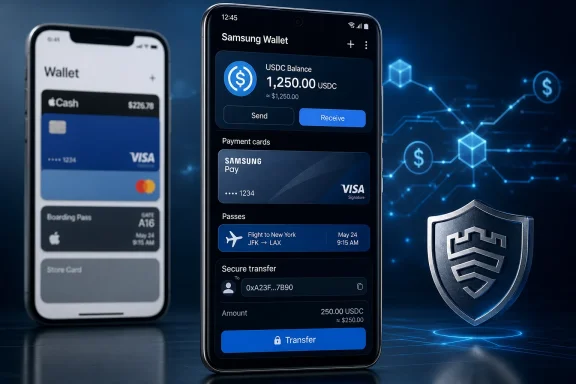
An on-stage Wallet mockup showed USDC, Circle’s dollar-pegged stablecoin, with apparent options to send, receive, and top up a balance. That visual was notable, but it should not be mistaken for a complete product specification. Samsung has not publicly confirmed a formal Circle partnership, an exact list of supported stablecoins, the underlying blockchain networks, eligibility rules, supported Galaxy models, or the first countries scheduled to receive the feature.
That leaves a meaningful gap between the promise and the eventual experience. A Wallet interface can make stablecoins look as familiar as a debit card, but the technical and legal work behind that simple presentation is considerable.
At this stage, the most accurate reading is that Samsung has made a product-direction announcement, not released a finished global stablecoin wallet. The public demonstration suggests that USDC is a significant reference point for Samsung’s strategy. It does not by itself establish that every Galaxy user will soon be able to buy, hold, transfer, or spend USDC directly in Samsung Wallet.
The company’s existing relationship with Coinbase provided an important stepping stone. In 2025, Samsung expanded a partnership that enabled eligible U.S. Galaxy users to access Coinbase-related crypto purchasing and promotional benefits through the Samsung Wallet environment. Samsung and Coinbase said the rollout initially targeted more than 75 million Galaxy users in the United States.
That integration was significant, but it was not the same thing as Samsung Wallet becoming a fully fledged native crypto wallet. Coinbase remained the exchange and account provider. Samsung Wallet provided an easier route into the ecosystem, including Samsung Pay integration for funding and promotional access to Coinbase One.
Stablecoin support suggests a possible next phase: moving from accessing a third-party crypto platform to making digital-dollar functionality feel more integral to the Wallet itself.
A stablecoin aims to maintain a predictable value against a reference asset, commonly the U.S. dollar. In practice, that makes it more understandable as a medium for moving value than an asset such as Bitcoin or Ether, which can fluctuate sharply over short periods.
The typical appeal is straightforward:
Samsung’s real challenge will be to offer the ease of a mainstream wallet while making those distinctions clear enough for ordinary users to understand.
Today, a person interested in stablecoins commonly needs to choose an exchange or wallet, establish identity, navigate region-specific services, learn the difference between custodial and self-custodial storage, select a network, understand transaction fees, and keep track of recovery information. Even experienced users can make costly mistakes when moving assets between incompatible networks or entering an incorrect wallet address.
Embedding carefully designed stablecoin features into Samsung Wallet could conceal much of that complexity for basic use cases.
Samsung Wallet already has an established role on Galaxy phones as a place for sensitive digital items. Presenting a stablecoin account beside payment cards and loyalty passes could make digital assets feel less like a separate financial universe.
Potential usability benefits include:
A secure device is an essential layer. It is not a guarantee against every form of loss.
Peer-to-peer transfers are easier to implement conceptually. Samsung could allow a user to send value between compatible accounts or external addresses, subject to compliance controls and network support. That alone could be useful for remittances, family transfers, online commerce, and payments between people who already use compatible services.
Retail payments are tougher. Most merchants expect card-network authorization and settlement, familiar refund rules, dispute processes, fraud controls, and predictable accounting. A consumer might tap their phone, but the merchant would still need a mechanism to receive local fiat currency or accept the stablecoin directly.
For stablecoin payments to feel as seamless as Samsung Pay card transactions, Samsung would need to resolve issues such as:
The Galaxy Card places Samsung more directly in the mainstream consumer-finance market, while planned stablecoin support extends Samsung Wallet toward newer forms of digital value. Together, the moves suggest Samsung does not view Wallet as an accessory to its hardware business. It increasingly appears to see Wallet as a strategic services platform that can connect payments, credit, loyalty, travel, identity, device security, and eventually digital assets.
That approach has obvious commercial logic. A preinstalled wallet that becomes useful every day can deepen customer loyalty and make a Galaxy phone harder to replace with a competing device. It can also give Samsung opportunities to build partnerships with banks, card networks, exchanges, merchants, travel firms, governments, and service providers.
For Samsung, stablecoins could extend that control point into a market positioned between conventional banking and the open blockchain ecosystem. The company’s advantage is distribution. It does not need to convince users to install an obscure app before they can see the feature; Samsung Wallet already sits in the Galaxy software experience.
That distribution does not guarantee adoption. Plenty of users may have no interest in digital assets, while others may prefer independent wallets that offer greater control. But Samsung has an opportunity to make stablecoins visible to a far larger mainstream audience than most crypto-native firms can reach on their own.
That does not mean stablecoin activity is impossible on an iPhone. Apple permits qualifying third-party crypto wallets and exchange apps in the App Store, subject to its rules and applicable law. Users can also use crypto-linked cards that convert a digital-asset balance into conventional card-network payments before the merchant is paid.
But these are distinct from a first-party Apple Wallet experience.
A crypto-backed Visa or Mastercard can be added to Apple Pay, but that does not mean Apple Pay is settling a transaction in USDC. In most cases, the card issuer or payment provider handles conversion in the background, and the merchant receives ordinary card-network payment proceeds.
This arrangement has advantages. It lets Apple retain tight control over Wallet’s core categories and leaves crypto-specific compliance, custody, conversions, and customer support to specialized firms. It also gives iPhone owners access to digital-asset services without Apple taking on the operational burden of becoming a central stablecoin provider.
However, it creates more friction than a truly native balance. The user must piece together multiple products rather than finding a stablecoin account next to their everyday cards.
Native stablecoin support would present several complications:
Stablecoins add new threat models that are less common with conventional card payments.
The privacy outcome will depend on Samsung’s product architecture. Key questions include what data Samsung itself sees, what data is shared with issuers or regulated partners, whether transaction information is stored locally or in cloud services, and how users can understand the relationship between their real identity and on-chain activity.
For Windows users who regularly move between a Galaxy phone and a PC, this is particularly relevant. Financial activity may begin on a phone but lead to notifications, browser sessions, account-management portals, exportable records, and support requests on a Windows desktop. The broader the financial ecosystem becomes, the more important it is to maintain strong account security across every connected device and browser.
When Samsung provides more information, the first practical considerations should be simple:
The move is strategically bold because it connects Samsung’s enormous device footprint, its established Knox security platform, its growing payment ambitions, and its existing crypto partnerships. It also comes with substantial execution risk. A stablecoin feature that is limited to a few markets, expensive to fund, difficult to transfer, or disconnected from real merchant payments will not redefine digital money.
Apple’s slower approach may look conservative, but it is not necessarily a weakness. The company has a mature wallet platform and strong incentives to wait for more settled rules, clearer consumer protections, and a partner model that fits its tightly managed financial-services strategy.
Still, Samsung has changed the conversation. Stablecoins are no longer being framed only as assets held in specialist apps or traded through exchanges. If Samsung Wallet delivers on the promise shown in London, digital dollars may soon appear in the same everyday interface where Galaxy users keep payment cards, travel passes, keys, and IDs. That would not settle the debate over stablecoins—but it would make the technology far harder for the mainstream smartphone market to ignore.
The distinction matters because digital wallets are no longer simple card containers. They have become a key layer of the personal-computing experience: the place where people verify identity, enter buildings, board flights, unlock vehicles, pay merchants, and manage increasingly diverse forms of value. If Samsung follows through on its presentation, stablecoins could become another first-party category in that everyday wallet interface rather than a service that remains isolated inside an exchange or specialist crypto app.
For Galaxy users, the announcement promises a potentially simpler route to holding and transferring digital dollars. For the wider technology industry, it raises harder questions about custody, consumer protection, transaction reversibility, regulation, and whether “native stablecoin support” will ultimately mean practical payments rather than just another balance shown on a phone screen.
 What Samsung Actually Announced
Samsung used Galaxy Unpacked to outline a broader vision for Samsung Wallet as a connected financial ecosystem. The company said the wallet will extend beyond cash-like payment methods and savings-related products to include new forms of digital value, explicitly mentioning stablecoins.An on-stage Wallet mockup showed USDC, Circle’s dollar-pegged stablecoin, with apparent options to send, receive, and top up a balance. That visual was notable, but it should not be mistaken for a complete product specification. Samsung has not publicly confirmed a formal Circle partnership, an exact list of supported stablecoins, the underlying blockchain networks, eligibility rules, supported Galaxy models, or the first countries scheduled to receive the feature.
That leaves a meaningful gap between the promise and the eventual experience. A Wallet interface can make stablecoins look as familiar as a debit card, but the technical and legal work behind that simple presentation is considerable.
At this stage, the most accurate reading is that Samsung has made a product-direction announcement, not released a finished global stablecoin wallet. The public demonstration suggests that USDC is a significant reference point for Samsung’s strategy. It does not by itself establish that every Galaxy user will soon be able to buy, hold, transfer, or spend USDC directly in Samsung Wallet.
The Important Unknowns
Several details will determine whether Samsung’s move is transformative or merely symbolic:- Supported assets: USDC appeared in the demonstration, but Samsung has not confirmed whether it will support USDC alone, multiple dollar stablecoins, euro-denominated stablecoins, or other tokenized assets.
- Geographic availability: Wallet services are already highly region-dependent. Financial licensing, sanctions compliance, tax rules, and local payment regulations will all shape where stablecoin features can launch.
- Custody model: Samsung has not clarified whether users will control on-chain keys, whether assets will be held through a regulated partner, or whether the product will use a hybrid arrangement.
- Blockchain support: A stablecoin can exist across several networks. The selected networks will affect transfer speed, cost, reliability, compatibility, and the likelihood of users sending funds to the wrong address.
- Funding methods: “Top up” could mean bank transfers, debit cards, existing exchange balances, payroll connections, or other routes. Each option carries different fees and compliance requirements.
- Merchant payments: Sending stablecoins to another Wallet user is very different from tapping a Galaxy phone at a retailer. Samsung has not yet said whether its plan includes direct point-of-sale stablecoin payments.
From Coinbase Access to a Native Digital-Asset Layer
Samsung did not arrive at this point overnight. Its Wallet strategy has steadily expanded from contactless payments toward a broader digital identity and services hub. Payment cards remain central, but Samsung Wallet also accommodates credentials, passes, keys, rewards, and region-specific financial features.The company’s existing relationship with Coinbase provided an important stepping stone. In 2025, Samsung expanded a partnership that enabled eligible U.S. Galaxy users to access Coinbase-related crypto purchasing and promotional benefits through the Samsung Wallet environment. Samsung and Coinbase said the rollout initially targeted more than 75 million Galaxy users in the United States.
That integration was significant, but it was not the same thing as Samsung Wallet becoming a fully fledged native crypto wallet. Coinbase remained the exchange and account provider. Samsung Wallet provided an easier route into the ecosystem, including Samsung Pay integration for funding and promotional access to Coinbase One.
Stablecoin support suggests a possible next phase: moving from accessing a third-party crypto platform to making digital-dollar functionality feel more integral to the Wallet itself.
Why Stablecoins Are Different From Traditional Crypto Trading
For mainstream consumers, buying volatile crypto assets and using a stablecoin for transfers serve very different purposes.A stablecoin aims to maintain a predictable value against a reference asset, commonly the U.S. dollar. In practice, that makes it more understandable as a medium for moving value than an asset such as Bitcoin or Ether, which can fluctuate sharply over short periods.
The typical appeal is straightforward:
- A user may be able to send dollar-equivalent value internationally without relying on conventional bank-transfer timings.
- Transfers can potentially settle faster than certain traditional payment rails.
- Digital dollars can be held and moved across compatible services.
- Funds can be available outside ordinary banking hours, depending on the wallet, network, and jurisdiction.
- Developers and financial platforms can build programmable payment flows around stablecoin balances.
Samsung’s real challenge will be to offer the ease of a mainstream wallet while making those distinctions clear enough for ordinary users to understand.
Samsung Wallet Could Make Stablecoins Feel Ordinary
The greatest potential impact is not that Samsung can display a USDC icon. Plenty of third-party apps can already hold or transfer stablecoins. The larger opportunity is friction reduction.Today, a person interested in stablecoins commonly needs to choose an exchange or wallet, establish identity, navigate region-specific services, learn the difference between custodial and self-custodial storage, select a network, understand transaction fees, and keep track of recovery information. Even experienced users can make costly mistakes when moving assets between incompatible networks or entering an incorrect wallet address.
Embedding carefully designed stablecoin features into Samsung Wallet could conceal much of that complexity for basic use cases.
A Familiar User Interface Has Real Value
A mainstream wallet can make unfamiliar technology approachable because it already has a trusted interaction model. Users understand balances, transaction histories, cards, confirmations, biometric authentication, and notifications.Samsung Wallet already has an established role on Galaxy phones as a place for sensitive digital items. Presenting a stablecoin account beside payment cards and loyalty passes could make digital assets feel less like a separate financial universe.
Potential usability benefits include:
- No separate primary wallet app for simple holding and transfers.
- Biometric authentication through the device’s established security model.
- Consistent transaction records alongside other wallet activity.
- Reduced onboarding friction if identity checks and eligibility workflows are integrated sensibly.
- A clearer recovery path than the seed-phrase-only model associated with many self-custody wallets.
- Better contextual controls, such as spending limits, alerts, address verification, and transaction warnings.
A secure device is an essential layer. It is not a guarantee against every form of loss.
The Difference Between “Send” and “Pay”
The presentation’s send, receive, and top-up controls are more immediately plausible than a universal stablecoin tap-to-pay system.Peer-to-peer transfers are easier to implement conceptually. Samsung could allow a user to send value between compatible accounts or external addresses, subject to compliance controls and network support. That alone could be useful for remittances, family transfers, online commerce, and payments between people who already use compatible services.
Retail payments are tougher. Most merchants expect card-network authorization and settlement, familiar refund rules, dispute processes, fraud controls, and predictable accounting. A consumer might tap their phone, but the merchant would still need a mechanism to receive local fiat currency or accept the stablecoin directly.
For stablecoin payments to feel as seamless as Samsung Pay card transactions, Samsung would need to resolve issues such as:
- Merchant acceptance: Retailers must either accept a stablecoin settlement flow or work with a payment processor that converts the asset.
- Authorization timing: The payment experience must be fast enough for a checkout queue.
- Exchange and conversion: If a merchant receives dollars through a conversion layer, the rate, fees, and timing must be transparent.
- Refunds and disputes: Card payments often have established consumer-protection processes that blockchain transfers do not automatically replicate.
- Network fees: Someone must absorb or clearly disclose transaction costs.
- Offline resilience: Conventional tap-to-pay systems can handle some edge cases that public blockchain systems may not.
- Compliance screening: Wallets and payment partners must manage sanctions, fraud monitoring, and suspicious-activity obligations.
The Galaxy Card Shows Samsung’s Broader Ambition
Samsung’s stablecoin plans emerged alongside the launch of the Galaxy Card, its first U.S. credit card, issued with Barclays on the Visa network. The timing is revealing.The Galaxy Card places Samsung more directly in the mainstream consumer-finance market, while planned stablecoin support extends Samsung Wallet toward newer forms of digital value. Together, the moves suggest Samsung does not view Wallet as an accessory to its hardware business. It increasingly appears to see Wallet as a strategic services platform that can connect payments, credit, loyalty, travel, identity, device security, and eventually digital assets.
That approach has obvious commercial logic. A preinstalled wallet that becomes useful every day can deepen customer loyalty and make a Galaxy phone harder to replace with a competing device. It can also give Samsung opportunities to build partnerships with banks, card networks, exchanges, merchants, travel firms, governments, and service providers.
A Wallet Is Becoming an Ecosystem Control Point
Digital wallets matter because they control more than transactions. They can become the interface through which a phone owner proves who they are, grants access to physical spaces, stores tickets, uses transit, manages cards, and receives tailored services.For Samsung, stablecoins could extend that control point into a market positioned between conventional banking and the open blockchain ecosystem. The company’s advantage is distribution. It does not need to convince users to install an obscure app before they can see the feature; Samsung Wallet already sits in the Galaxy software experience.
That distribution does not guarantee adoption. Plenty of users may have no interest in digital assets, while others may prefer independent wallets that offer greater control. But Samsung has an opportunity to make stablecoins visible to a far larger mainstream audience than most crypto-native firms can reach on their own.
Apple’s Cautious Position Is Deliberate
Apple has not announced native stablecoin balances, direct stablecoin transfers, or an operating-system-level stablecoin account within Apple Wallet. The Wallet app remains focused on supported credit, debit, and prepaid cards, Apple Cash where available, transit cards, identity documents, tickets, keys, loyalty passes, and other credential-like items.That does not mean stablecoin activity is impossible on an iPhone. Apple permits qualifying third-party crypto wallets and exchange apps in the App Store, subject to its rules and applicable law. Users can also use crypto-linked cards that convert a digital-asset balance into conventional card-network payments before the merchant is paid.
But these are distinct from a first-party Apple Wallet experience.
Third-Party Access Is Not Native Integration
The difference is easy to underestimate. A third-party app can be feature-rich, but it lives outside the core Apple Wallet model. Users may need a separate login, balance, recovery process, exchange relationship, or external card product.A crypto-backed Visa or Mastercard can be added to Apple Pay, but that does not mean Apple Pay is settling a transaction in USDC. In most cases, the card issuer or payment provider handles conversion in the background, and the merchant receives ordinary card-network payment proceeds.
This arrangement has advantages. It lets Apple retain tight control over Wallet’s core categories and leaves crypto-specific compliance, custody, conversions, and customer support to specialized firms. It also gives iPhone owners access to digital-asset services without Apple taking on the operational burden of becoming a central stablecoin provider.
However, it creates more friction than a truly native balance. The user must piece together multiple products rather than finding a stablecoin account next to their everyday cards.
Why Apple May Continue to Wait
Apple’s restraint is consistent with its broader approach to financial services. Apple Pay, Apple Cash, and Apple Card have all relied heavily on regulated financial partners, card networks, and carefully bounded product roles.Native stablecoin support would present several complications:
- Regulatory fragmentation across countries and U.S. states.
- Licensing and compliance obligations for buying, holding, transferring, or redeeming digital assets.
- Reputational risk if customers lose funds through scams or misunderstand irreversible transactions.
- Support complexity when a payment, transfer, address, network, or token goes wrong.
- A difficult custody decision between user-controlled keys and partner-managed accounts.
- Potential conflict with Apple’s highly curated platform model, especially if it must accommodate open blockchain standards and external networks.
Security, Privacy, and Consumer Protection Will Decide the Outcome
Samsung’s Knox platform provides a strong foundation for sensitive information stored and used on Galaxy devices. Hardware-backed protection, encryption, biometric authentication, and tokenization are familiar ingredients in modern mobile-wallet security.Stablecoins add new threat models that are less common with conventional card payments.
The Risks Users Will Still Face
Even the best Samsung Wallet implementation cannot remove every hazard. The critical risks include:- Phishing and social engineering: Attackers may impersonate Samsung, a stablecoin issuer, an exchange, or a support agent.
- Irreversible transfers: Depending on the product design, a transfer to the wrong address may be difficult or impossible to recover.
- Address poisoning: Malicious actors can create look-alike transaction records or addresses designed to fool hurried users.
- Network confusion: Sending assets over the wrong blockchain or to an unsupported destination can lead to loss.
- Custody uncertainty: A partner-managed account and a self-custody wallet offer different protections, trade-offs, and recovery paths.
- Stablecoin issuer risk: A dollar peg depends on the issuer’s reserves, redemption process, governance, and legal standing.
- Account freezes and compliance interventions: Regulated stablecoin systems can restrict or freeze assets in certain circumstances.
- Scam-driven payments: Fast transfers are convenient for legitimate users and attractive to fraudsters seeking irreversible payment methods.
Privacy Is Not Automatically Better
Stablecoins are often described as more private than bank payments, but that claim is too simplistic. Public blockchains can expose transaction data in ways that enable extensive analysis. Wallet providers and regulated partners may also collect identity, compliance, and transaction information.The privacy outcome will depend on Samsung’s product architecture. Key questions include what data Samsung itself sees, what data is shared with issuers or regulated partners, whether transaction information is stored locally or in cloud services, and how users can understand the relationship between their real identity and on-chain activity.
For Windows users who regularly move between a Galaxy phone and a PC, this is particularly relevant. Financial activity may begin on a phone but lead to notifications, browser sessions, account-management portals, exportable records, and support requests on a Windows desktop. The broader the financial ecosystem becomes, the more important it is to maintain strong account security across every connected device and browser.
What This Means for Galaxy Owners
For now, Galaxy users should view the stablecoin announcement as a roadmap milestone, not a feature ready to activate. There is no confirmed public rollout schedule, no finalized country list, and no complete explanation of how balances will be funded, held, transferred, or protected.When Samsung provides more information, the first practical considerations should be simple:
- Confirm that the feature is officially available in the user’s country and on the specific Galaxy device.
- Read the custody terms to understand whether Samsung, a partner, or the user controls the assets.
- Check all fees, including purchase fees, conversion spreads, transfer fees, withdrawal costs, and possible network charges.
- Understand transaction finality before sending any funds.
- Use biometric protection and a strong Samsung account password, with multi-factor authentication enabled where offered.
- Treat unsolicited support messages as suspicious, especially messages requesting codes, passwords, recovery phrases, or transfers.
- Start with small amounts until the mechanics of top-ups, transfers, withdrawals, and recovery are fully understood.
A Significant Lead, but Not a Finished Victory
Samsung has taken a visible lead in the race to normalize stablecoins on smartphones. By positioning digital-dollar assets inside Samsung Wallet’s broader financial and identity ecosystem, it is betting that stablecoins can become part of ordinary consumer technology rather than remain the preserve of exchanges and dedicated crypto applications.The move is strategically bold because it connects Samsung’s enormous device footprint, its established Knox security platform, its growing payment ambitions, and its existing crypto partnerships. It also comes with substantial execution risk. A stablecoin feature that is limited to a few markets, expensive to fund, difficult to transfer, or disconnected from real merchant payments will not redefine digital money.
Apple’s slower approach may look conservative, but it is not necessarily a weakness. The company has a mature wallet platform and strong incentives to wait for more settled rules, clearer consumer protections, and a partner model that fits its tightly managed financial-services strategy.
Still, Samsung has changed the conversation. Stablecoins are no longer being framed only as assets held in specialist apps or traded through exchanges. If Samsung Wallet delivers on the promise shown in London, digital dollars may soon appear in the same everyday interface where Galaxy users keep payment cards, travel passes, keys, and IDs. That would not settle the debate over stablecoins—but it would make the technology far harder for the mainstream smartphone market to ignore.
References
- Primary source: quasa.io
Published: 2026-07-25T06:23:35+00:00
Samsung Adds Stablecoin Support to Wallet — While Apple Still Holds Back
Samsung positioned the move as making it “one of the first major mobile brands to bring native stablecoins to a smartphonequasa.io
- Independent coverage: Decrypt
Published: 2026-07-24T19:30:01+00:00
Samsung Wallet Will Add Stablecoin Support, Including USDC - Decrypt
Samsung showed a wallet mockup holding Circle's USDC at Galaxy Unpacked. But details are scarce.decrypt.co - Independent coverage: TradingView
Published: 2026-07-24T10:10:07+00:00
Samsung Wallet plans stablecoin support in digital payments expansion — TradingView News
South Korean technology giant Samsung Electronics said it plans to expand Samsung Wallet beyond traditional payments by adding support for stablecoins.The company is moving toward integrating payments, rewards and digital assets into a single wallet experience, Samsung product manager Lee Dinham sa…www.tradingview.com
- Related coverage: news.samsung.com
Samsung Wallet Offers Users Special Access to Coinbase One
Starting today, Samsung Electronics is expanding its partnership with Coinbase, the nation’s leading cryptocurrency exchange, to bring user-friendly crypto access to Galaxy users in the U.S. The partnership, initially announced in July, allows Coinbase users in the U.S. to purchase crypto...news.samsung.com
- Official source: apple.com
Apple Pay Wallet Terms and Conditions
www.apple.com - Related coverage: coindesk.com
Samsung Adds Coinbase Crypto Access for 75M Galaxy Device Users
Galaxy owners in the U.S. will get exclusive Coinbase One access through Samsung Wallet integration.www.coindesk.com