

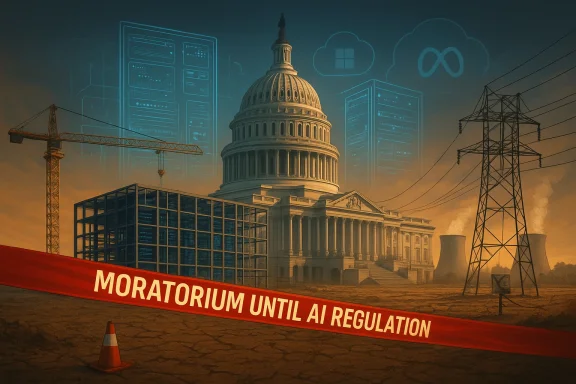
Bernie Sanders and Alexandria Ocasio-Cortez have turned the AI infrastructure debate into a direct political confrontation, introducing companion bills that would freeze new data center construction until Congress enacts comprehensive AI regulation. If advanced, the proposal would strike at the physical backbone of the generative-AI boom, threatening billions of dollars in planned investment from Amazon, Microsoft, Google, Meta, and other hyperscale players. The idea is as provocative as it is consequential: lawmakers are no longer talking only about model safeguards, but about whether the computing factories that power AI should be allowed to expand at all.
The fight over AI has rapidly moved beyond software policy and into the realm of concrete, steel, power contracts, and utility planning. For much of the last decade, data centers were a quiet back-office necessity, but the explosion of generative AI turned them into strategic assets. The biggest cloud and platform companies now need massive clusters of GPUs, specialized networking, and cooling systems to train and serve large models, and that has made buildouts a central competitive battleground.
That shift has also made data centers politically visible in a way they never were before. Communities from Virginia to Arizona have objected to new facilities over electricity prices, water consumption, diesel backup generation, land use, and grid strain. What once looked like an abstract digital issue now shows up as a local utility bill problem, a drought concern, or a zoning fight in a suburban county.
Sanders has been among the most vocal national critics of unchecked AI infrastructure expansion, and the new proposal fits his broader critique of Big Tech power. Ocasio-Cortez, meanwhile, has built a reputation for using legislative theater to force public debate on monopoly power, labor disruption, and climate impacts. Together, they are trying to move the discussion from “how fast can AI scale?” to “should it scale this fast at all?”
This is not the first time lawmakers have floated a pause on AI-related activity, but it is among the most direct attempts to target physical infrastructure rather than software deployment. Earlier proposals focused on state-level AI regulation or moratoriums on model development. Here, the target is more concrete: if the facilities aren’t built, the compute doesn’t exist, and the AI race slows down by definition.
The timing matters. Big cloud providers and hyperscalers have been pouring money into capacity at a remarkable pace, and the market has come to treat data center supply as a scarce strategic input. That scarcity has pushed up leasing activity, intensified land grabs, and made every new gigawatt of power a competitive win. Sanders and Ocasio-Cortez are effectively arguing that Congress should step in before the market cements a path that regulators may later struggle to reverse.
The move lands as AI infrastructure spending is becoming one of the defining capex stories of the decade. Hyperscalers are racing to build the compute required for training frontier models and serving consumer and enterprise AI workloads. The companies involved often describe this as a long-term strategic necessity, not a speculative buildout, which is precisely why a moratorium is so politically charged.
The environmental argument is central. Data centers consume enormous amounts of electricity and water, and the local burden can be hard to separate from broader grid and climate issues. Critics say the industry externalizes costs onto nearby residents and utilities, while companies argue they are investing in jobs, tax revenue, and more efficient infrastructure. Both can be true, which is why the debate has become so hard to settle.
The policy question is also broader than climate. Sanders and Ocasio-Cortez are tying data center expansion to concerns about labor displacement, democracy, and AI safety. Their argument is that the physical infrastructure enabling unregulated AI should not be allowed to scale faster than the public can understand and govern it. That is a deliberately slowing strategy in an industry that has been rewarded for speed.
A final point is political realism. A federal moratorium would face intense resistance from industry, utilities, local economic-development offices, and lawmakers worried about surrendering AI leadership to China. Even if the bills do not advance, they may still succeed as a pressure campaign. In Washington, forcing a debate can be nearly as influential as winning the vote.
The reported exceptions matter because they narrow the appearance of absolutism. Facilities already under construction would be protected, and critical infrastructure sites would not be swept into the freeze. Even so, a moratorium on new permits and construction starts would still have a chilling effect because firms plan years ahead and often rely on sequencing multiple projects across different states.
That uncertainty could ripple quickly through the buildout pipeline:
The political salience also comes from the fact that data centers affect local communities in ways that are easy to explain. Residents can see the land use, hear about substations, worry about water tables, and feel the effect on electricity pricing. By contrast, AI safety debates often sound abstract until they become tied to jobs, misinformation, or security incidents.
This is why the proposal has symbolic force beyond its legislative odds:
Nvidia’s Jensen Huang has become one of the loudest voices arguing that AI infrastructure spending is just getting started, and he has repeatedly framed data center buildout as an industrial transformation rather than a temporary boom. Nvidia’s own financial disclosures underscore the strength of data center demand, with the company reporting record revenue and substantial data center growth in fiscal 2026. That broader market reality is why any interruption to buildout plans would be felt well beyond Washington.
The spending logic is straightforward:
That public frustration is now translating into policy pressure. New York lawmakers have proposed a multi-year pause on new data centers, and TechCrunch has documented growing opposition from both environmental groups and local advocates who say the sector is expanding faster than communities can absorb. Sanders’ national proposal can be read as the federal expression of that same local resistance.
At the same time, companies argue they are improving efficiency and investing in better cooling designs. That claim is not trivial. But the key policy issue is not whether a single new data center can be efficient; it is whether the cumulative buildout path is sustainable at the scale now being pursued.
That matters because hyperscale infrastructure has network effects. A company with earlier access to power, land, and cooling can move faster on model training and product deployment. Once a company secures a regional advantage, it can feed that advantage back into its cloud, enterprise, and consumer businesses.
The likely industry response would include:
There is a logic to that approach. AI regulation has proved difficult because lawmakers disagree on everything from definition to jurisdiction to enforcement. A construction moratorium avoids some of that complexity by focusing on physical assets that are easier to identify, permit, and delay. But it also risks being too blunt, because it cannot distinguish between harmful uses and economically beneficial ones.
At the same time, the approach is limited because:
Consumers would see the impact differently. They might not notice a permit freeze directly, but they could experience slower feature rollouts, less responsive AI services, and potentially higher subscription or cloud prices if supply becomes tighter. Consumer AI products often depend on the invisible headroom created by giant infrastructure investments, and those margins matter more than most users realize.
Key distinctions include:
The proposal also puts moderate Democrats and Republicans in a difficult position. Opposing a moratorium can look like endorsing unregulated AI expansion. Supporting it can look like anti-growth overreach or a threat to American competitiveness. That is the kind of issue that forces lawmakers to choose between local backlash and national ambition.
Its resonance comes from a few factors:
The more interesting question is whether the industry responds by changing its own behavior before Congress acts. Companies may increase public commitments on power sourcing, water use, and community benefits in order to blunt regulatory pressure. They may also lean harder into efficiency gains and retrofit existing campuses rather than building entirely new ones.
The most important thing to understand is that Sanders and Ocasio-Cortez are not merely trying to stop construction; they are trying to slow an entire logic of accumulation. Whether or not their bills advance, they have already exposed the central contradiction of the AI era: the same infrastructure that promises productivity and progress can also concentrate power, stress public resources, and outpace the institutions meant to govern it. That tension is likely to define the next phase of the AI boom just as much as the next model release.
Source: The Tech Buzz https://www.techbuzz.ai/articles/sanders-and-aoc-move-to-freeze-data-center-construction/
 Background
The fight over AI has rapidly moved beyond software policy and into the realm of concrete, steel, power contracts, and utility planning. For much of the last decade, data centers were a quiet back-office necessity, but the explosion of generative AI turned them into strategic assets. The biggest cloud and platform companies now need massive clusters of GPUs, specialized networking, and cooling systems to train and serve large models, and that has made buildouts a central competitive battleground.That shift has also made data centers politically visible in a way they never were before. Communities from Virginia to Arizona have objected to new facilities over electricity prices, water consumption, diesel backup generation, land use, and grid strain. What once looked like an abstract digital issue now shows up as a local utility bill problem, a drought concern, or a zoning fight in a suburban county.
Sanders has been among the most vocal national critics of unchecked AI infrastructure expansion, and the new proposal fits his broader critique of Big Tech power. Ocasio-Cortez, meanwhile, has built a reputation for using legislative theater to force public debate on monopoly power, labor disruption, and climate impacts. Together, they are trying to move the discussion from “how fast can AI scale?” to “should it scale this fast at all?”
This is not the first time lawmakers have floated a pause on AI-related activity, but it is among the most direct attempts to target physical infrastructure rather than software deployment. Earlier proposals focused on state-level AI regulation or moratoriums on model development. Here, the target is more concrete: if the facilities aren’t built, the compute doesn’t exist, and the AI race slows down by definition.
The timing matters. Big cloud providers and hyperscalers have been pouring money into capacity at a remarkable pace, and the market has come to treat data center supply as a scarce strategic input. That scarcity has pushed up leasing activity, intensified land grabs, and made every new gigawatt of power a competitive win. Sanders and Ocasio-Cortez are effectively arguing that Congress should step in before the market cements a path that regulators may later struggle to reverse.
Overview
The reported bills would impose an immediate moratorium on permits and construction starts for new data centers, with exceptions for sites already under construction or facilities serving critical infrastructure. That framing is important because it suggests the lawmakers are not trying to shutter the cloud economy outright; they are trying to stop further expansion until there is a federal AI rulebook. In practice, though, a freeze like this would still be disruptive enough to alter investment timing, contract negotiations, and power-market assumptions.The move lands as AI infrastructure spending is becoming one of the defining capex stories of the decade. Hyperscalers are racing to build the compute required for training frontier models and serving consumer and enterprise AI workloads. The companies involved often describe this as a long-term strategic necessity, not a speculative buildout, which is precisely why a moratorium is so politically charged.
The environmental argument is central. Data centers consume enormous amounts of electricity and water, and the local burden can be hard to separate from broader grid and climate issues. Critics say the industry externalizes costs onto nearby residents and utilities, while companies argue they are investing in jobs, tax revenue, and more efficient infrastructure. Both can be true, which is why the debate has become so hard to settle.
The policy question is also broader than climate. Sanders and Ocasio-Cortez are tying data center expansion to concerns about labor displacement, democracy, and AI safety. Their argument is that the physical infrastructure enabling unregulated AI should not be allowed to scale faster than the public can understand and govern it. That is a deliberately slowing strategy in an industry that has been rewarded for speed.
A final point is political realism. A federal moratorium would face intense resistance from industry, utilities, local economic-development offices, and lawmakers worried about surrendering AI leadership to China. Even if the bills do not advance, they may still succeed as a pressure campaign. In Washington, forcing a debate can be nearly as influential as winning the vote.
What the Bills Would Do
At the heart of the proposal is a simple but sweeping premise: stop new data center construction until Congress passes comprehensive AI regulation. That is an unusually blunt instrument for a tech policy debate, and it shifts the conversation from gradual oversight to a hard pause. The implication is that lawmakers believe AI development has outpaced the legal and social frameworks meant to control it.The reported exceptions matter because they narrow the appearance of absolutism. Facilities already under construction would be protected, and critical infrastructure sites would not be swept into the freeze. Even so, a moratorium on new permits and construction starts would still have a chilling effect because firms plan years ahead and often rely on sequencing multiple projects across different states.
The practical effect on developers
For developers, the biggest damage would not just be lost ground-breaking dates. It would be uncertainty. Once investors believe permitting can be frozen by Congress, the cost of capital rises, contract timing gets more cautious, and utility interconnections become harder to justify.That uncertainty could ripple quickly through the buildout pipeline:
- power-purchase agreements would be renegotiated more conservatively
- land acquisition pipelines would slow
- leasing decisions would be delayed
- utility planning assumptions would become less reliable
- equipment orders for cooling and electrical systems could soften
Why Data Centers Became the Target
The target is not accidental. Data centers are the visible, physical expression of the AI race, and they are much easier to regulate than models that can be trained anywhere with enough chips and power. That makes them an attractive policy lever for lawmakers who want to slow AI growth without drafting a sprawling federal AI code from scratch.The political salience also comes from the fact that data centers affect local communities in ways that are easy to explain. Residents can see the land use, hear about substations, worry about water tables, and feel the effect on electricity pricing. By contrast, AI safety debates often sound abstract until they become tied to jobs, misinformation, or security incidents.
Infrastructure as a choke point
The modern AI stack depends on several physical chokepoints, but data centers are the most visible. Without them, even the best model research does not scale into a mass-market product. That means a construction freeze would not just slow capacity growth; it would constrain the entire lifecycle of AI deployment.This is why the proposal has symbolic force beyond its legislative odds:
- it redefines AI governance as infrastructure governance
- it treats compute as a public-policy issue, not just a private investment decision
- it makes energy and water use part of the AI safety conversation
- it creates a direct line between local resentment and federal action
- it challenges the assumption that more compute is always a social good
The Scale of Hyperscaler Spending
The timing of the bills becomes clearer when set against the scale of planned spending. Amazon, Microsoft, Google, and Meta have all been expanding their cloud and AI footprints aggressively, and the market has repeatedly signaled that demand for compute remains strong. The revised spending trajectories described in recent industry coverage suggest that the largest players may collectively spend hundreds of billions of dollars a year on data center and infrastructure-related buildouts.Nvidia’s Jensen Huang has become one of the loudest voices arguing that AI infrastructure spending is just getting started, and he has repeatedly framed data center buildout as an industrial transformation rather than a temporary boom. Nvidia’s own financial disclosures underscore the strength of data center demand, with the company reporting record revenue and substantial data center growth in fiscal 2026. That broader market reality is why any interruption to buildout plans would be felt well beyond Washington.
Why the money keeps flowing
Hyperscalers are not building data centers as vanity projects. They are doing it because AI workloads are hungry, persistent, and strategically important. Every delay threatens model iteration speed, inference capacity, and the ability to absorb enterprise demand.The spending logic is straightforward:
- more users means more inference load
- more model training means more GPU clusters
- more GPU clusters means more cooling and power demand
- more power demand means more permitting and transmission coordination
- more coordination means more political exposure
Environmental and Community Backlash
The environmental case against rapid data center expansion has grown stronger because it is rooted in concrete local impacts, not just ideology. These facilities use large amounts of electricity and often substantial water for cooling, and the indirect footprint from power generation can be just as significant as the water drawn onsite. Recent reporting has highlighted how opposition has spread across states as communities begin to connect data centers with higher bills, stressed utilities, and resource competition.That public frustration is now translating into policy pressure. New York lawmakers have proposed a multi-year pause on new data centers, and TechCrunch has documented growing opposition from both environmental groups and local advocates who say the sector is expanding faster than communities can absorb. Sanders’ national proposal can be read as the federal expression of that same local resistance.
The water and power problem
Water usage is especially difficult for the industry to defend because it is both region-specific and emotionally immediate. In drought-prone regions, even modestly sized facilities can become flashpoints. Energy use is similarly contentious because customers fear that utility upgrades and transmission costs will be pushed onto households.At the same time, companies argue they are improving efficiency and investing in better cooling designs. That claim is not trivial. But the key policy issue is not whether a single new data center can be efficient; it is whether the cumulative buildout path is sustainable at the scale now being pursued.
Tech Giants and Competitive Pressure
The proposed moratorium would land hardest on the very companies that have been most aggressive in building AI capacity: Amazon, Microsoft, Google, and Meta. These firms are in a race not only against one another, but also against specialized AI labs and, in a geopolitical sense, against Chinese competitors. Delaying one player may not stop the race, but it could absolutely distort the competitive ranking.That matters because hyperscale infrastructure has network effects. A company with earlier access to power, land, and cooling can move faster on model training and product deployment. Once a company secures a regional advantage, it can feed that advantage back into its cloud, enterprise, and consumer businesses.
The strategic risk for rivals
A moratorium would not affect all players equally. Large incumbents with existing campuses, multi-year utility relationships, and deep balance sheets would be better positioned than newcomers. But even incumbents would lose momentum, especially if projects in multiple states were delayed simultaneously.The likely industry response would include:
- lobbying for narrower definitions of “new” construction
- arguing for exemptions tied to jobs or grid reliability
- accelerating lease-based capacity rather than greenfield development
- shifting more spending into existing campuses
- pushing the debate toward energy policy rather than AI safety
AI Regulation by Infrastructure
What makes the Sanders-Ocasio-Cortez proposal unusual is that it treats infrastructure as a proxy for AI governance. Instead of trying to regulate every model or use case directly, the bills would freeze the supply side of compute growth until Congress has a broader framework. It is a strategy based on leverage rather than comprehensiveness.There is a logic to that approach. AI regulation has proved difficult because lawmakers disagree on everything from definition to jurisdiction to enforcement. A construction moratorium avoids some of that complexity by focusing on physical assets that are easier to identify, permit, and delay. But it also risks being too blunt, because it cannot distinguish between harmful uses and economically beneficial ones.
Why this approach is both clever and limited
The proposal is clever because it links AI power to real-world tradeoffs. It says, in effect, that if the industry wants to keep scaling, it must accept a public governance framework first. That reframes AI from an innovation story into a public-utility-style question about externalities and accountability.At the same time, the approach is limited because:
- AI compute is globally mobile
- regulation may shift activity offshore rather than stop it
- research labs could use smaller but more efficient systems to circumvent the intended effect
- firms may rely more heavily on already-permitted sites
- Congress may never agree on the “comprehensive” rules the moratorium is waiting for
Enterprise vs. Consumer Impacts
For enterprises, a data center moratorium would probably show up first as capacity constraints, longer wait times, and more expensive cloud services. Businesses trying to deploy AI in customer support, software development, document processing, and analytics would face slower product rollout if cloud providers could not expand quickly enough. The effect would likely be uneven, hurting smaller firms and late adopters more than hyperscale customers with direct contracts.Consumers would see the impact differently. They might not notice a permit freeze directly, but they could experience slower feature rollouts, less responsive AI services, and potentially higher subscription or cloud prices if supply becomes tighter. Consumer AI products often depend on the invisible headroom created by giant infrastructure investments, and those margins matter more than most users realize.
Different pain points, same bottleneck
The enterprise case is about operational continuity. The consumer case is about convenience and price. Both converge on the same fundamental issue: AI services are only as scalable as the infrastructure underneath them.Key distinctions include:
- enterprises care about SLA reliability and deployment timelines
- consumers care about speed, pricing, and feature availability
- startups are most vulnerable to supply constraints
- large hyperscalers can absorb disruption better than smaller cloud rivals
- regulated industries may delay adoption if infrastructure uncertainty grows
The Political Optics
Sanders and Ocasio-Cortez know exactly what they are doing politically. They are turning a technical infrastructure issue into a moral one, with climate, labor, and democracy all folded into the frame. That is classic progressive messaging, but it is especially potent here because data centers are easy to visualize and hard to romanticize.The proposal also puts moderate Democrats and Republicans in a difficult position. Opposing a moratorium can look like endorsing unregulated AI expansion. Supporting it can look like anti-growth overreach or a threat to American competitiveness. That is the kind of issue that forces lawmakers to choose between local backlash and national ambition.
Why the message resonates
The political strength of the proposal lies in its simplicity. “No new data centers until AI is regulated” is easy to repeat, easy to oppose, and easy to explain at a town hall. It is the sort of message that can travel far beyond the committee room.Its resonance comes from a few factors:
- voters are already nervous about AI job effects
- utilities and water systems are politically salient
- Big Tech remains unpopular across ideological lines
- climate arguments still have force in progressive circles
- “pause” politics can sound prudent even to non-activists
Strengths and Opportunities
The proposal has real strengths, even if its legislative odds are uncertain. It forces a national conversation about the physical costs of AI, something too often left out of the hype cycle. It also gives local communities and regulators a clearer political language for opposing projects they believe are outpacing public planning.- It connects AI policy to energy, water, and land use, which makes the stakes more tangible.
- It creates a federal pressure point in a debate often dominated by state and local fights.
- It gives lawmakers a way to address AI externalities without drafting a model-by-model statute.
- It could slow speculative overbuilding if companies think demand may cool or face regulation.
- It may encourage more efficient siting, cooling, and grid planning if developers seek to avoid political backlash.
- It aligns with growing public concerns about electric bills and community impacts.
- It could re-center the debate on governance before growth, a frame that resonates with skeptical voters.
Risks and Concerns
The obvious risk is that a moratorium could slow beneficial investment along with harmful expansion. AI infrastructure supports not just chatbots but enterprise software, scientific research, cybersecurity, and cloud computing at large. If the pause is too broad, the policy could become a drag on productivity and innovation rather than a check on excess.- It could delay productivity gains from legitimate AI deployments.
- It may push investment to less regulated jurisdictions instead of stopping it.
- It could create capacity bottlenecks that raise prices for businesses and consumers.
- It might strengthen incumbents with existing capacity while hurting startups and challengers.
- It risks becoming a symbolic gesture if Congress never produces the “comprehensive regulation” trigger.
- It could complicate utility planning and undermine long-term grid investments.
- It may intensify the us-versus-them narrative between Silicon Valley and Washington.
Looking Ahead
What happens next will depend on whether the bills gain traction beyond the progressive wing of the Democratic Party. If they do, the debate will quickly shift from whether to pause data center construction to what kind of AI regulation would justify lifting the pause. If they do not, the proposal may still succeed in changing the tone of the conversation and making infrastructure a more central piece of AI oversight.The more interesting question is whether the industry responds by changing its own behavior before Congress acts. Companies may increase public commitments on power sourcing, water use, and community benefits in order to blunt regulatory pressure. They may also lean harder into efficiency gains and retrofit existing campuses rather than building entirely new ones.
Key things to watch
- whether the Senate and House versions attract co-sponsors beyond the progressive bloc
- whether utilities and local governments publicly support or oppose the freeze
- whether hyperscalers respond with more aggressive sustainability commitments
- whether additional state-level moratoriums gain momentum
- whether the debate shifts from data centers to broader AI power policy
The most important thing to understand is that Sanders and Ocasio-Cortez are not merely trying to stop construction; they are trying to slow an entire logic of accumulation. Whether or not their bills advance, they have already exposed the central contradiction of the AI era: the same infrastructure that promises productivity and progress can also concentrate power, stress public resources, and outpace the institutions meant to govern it. That tension is likely to define the next phase of the AI boom just as much as the next model release.
Source: The Tech Buzz https://www.techbuzz.ai/articles/sanders-and-aoc-move-to-freeze-data-center-construction/
