
 Santander Wants AI to Look Less Like a Lab and More Like a Ledger
The most important word in Santander’s announcement is not “agentic,” “Copilot,” or even “AI-first.” It is “measurable.” For the banking industry, which has spent the last two years issuing glossy AI statements with all the specificity of a cloud vendor keynote, Santander is making a more dangerous claim: that AI is already producing operational numbers worth publishing.
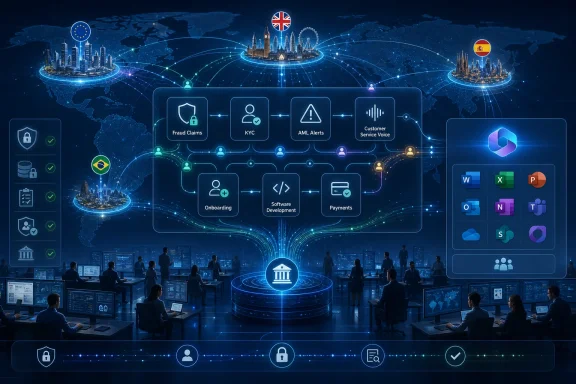
Those numbers are deliberately concrete. The bank says it has more than 280 process automation agents in production. In Brazil, AI has made card fraud claims processing roughly 95 percent faster, with up to 90 percent automation and an error rate below 1 percent. In Openbank, AI models process about 100,000 anti-money-laundering alerts per year, with investigations that once took hours now reportedly completed in minutes.
That is the kind of claim that changes the conversation inside a bank. AI is no longer framed as a productivity accessory for white-collar workers who want faster summaries. It becomes part of the machinery of risk, operations, compliance, customer contact, and software delivery — the places where banks either become more efficient or slowly drown in accumulated process.
Santander’s message is also aimed beyond investors. It is a signal to regulators, employees, and competitors that the bank wants to be judged on implementation, not aspiration. That is both the strength and the risk of the announcement, because once a bank ties AI to fraud claims, AML review, software development, and payments, it has invited a harder question: who is accountable when the model-assisted workflow gets it wrong?
The Bank’s Advantage Is Not the Model, It Is the Map
Santander is not pretending that it has invented the foundation model era. Its AI stack, as described by the bank, is intentionally multi-provider: Microsoft Copilot for broad employee productivity, plus OpenAI’s ChatGPT, Anthropic’s Claude, Google’s Gemini, startups, other technology partners, and G42 for more specialized banking solutions. That is a pragmatic architecture, not a romantic one.
The strategic bet is that a global bank’s advantage lies less in owning the model than in knowing where to apply it. Santander operates across markets with different customers, regulators, products, and operational bottlenecks. If a fraud process in Brazil can be automated safely, or a customer-service capability in the UK can be reused in Spain, the bank is turning local proof into group-wide leverage.
That “local execution, global capabilities” framing is the quiet center of the announcement. Banks have long struggled to translate innovation across borders because systems, compliance obligations, and product designs vary by market. AI does not magically erase those differences, but it can make reusable process patterns more valuable if the bank has enough governance discipline to keep them from becoming a patchwork of uncontrolled tools.
The model vendors will happily sell the same broad capabilities to everyone. Santander’s defensible asset is the combination of its data estate, process knowledge, regulatory muscle memory, and distribution. The bank is effectively saying that AI becomes valuable when it is embedded into the workflows that only a bank of Santander’s scale can see end to end.
Fraud Claims Are Where the AI Story Gets Real
The Brazilian card-fraud example is the cleanest illustration of why banks are so eager to automate. Fraud claims are repetitive, time-sensitive, emotionally charged, and expensive to process manually. Customers want speed, banks want accuracy, and regulators want fair treatment.
A process that becomes 95 percent faster with 90 percent automation is not merely a back-office improvement. It changes the customer’s experience of whether the bank appears competent at the moment of stress. It also changes staffing assumptions, escalation design, and the economics of handling high-volume dispute categories.
But fraud is also where the easy AI narrative starts to fray. A low error rate sounds reassuring, yet even a small percentage of mistakes can become material when applied to large volumes of financial decisions. In banking, an automated error is not an abstract hallucination; it can delay reimbursement, trigger a false suspicion, or leave a customer fighting a system they do not understand.
That is why Santander’s emphasis on secure environments and risk frameworks matters. The announcement says AI-enabled processes operate within ethical, legal, cybersecurity, and risk controls, and that customer data is not shared externally to train third-party models. Those assurances are now table stakes, but they are also the line between AI as a productivity program and AI as a regulated operating model.
Customer Service Is Becoming the Next Self-Service Battlefield
Santander’s UK voice-channel rollout is smaller in percentage terms but revealing in direction. The bank says AI will support card-related queries, with a target of roughly 240,000 calls resolved through self-service, representing about 40 percent of annual volume. It estimates customer time savings of about 26,000 hours and about 45,000 hours returned to service teams.
That language is careful. Santander is not saying every customer interaction should be swallowed by a bot. It is saying that a large class of predictable card queries can be routed through a more natural AI-assisted self-service channel, while human teams focus on more complex needs.
The distinction matters because customer-service automation has a reputation problem earned over decades. Consumers have been trapped in phone trees, chatbots, authentication loops, and “I didn’t understand that” dead ends long before generative AI arrived. If Santander’s AI voice experiences feel like a smarter front door, customers may accept them. If they feel like a more fluent obstruction, the bank will have made a bad system sound better without making it better.
The deployment into Santander and Openbank in Spain suggests that the bank sees voice AI as a reusable customer-experience layer, not a one-market experiment. That is precisely where scale helps — and where bad design can scale just as quickly. A bank rolling out AI customer interactions across markets needs not only language support and intent recognition, but also clear escalation paths, auditability, consent handling, and a sober view of when a human should take over.
Onboarding Is Becoming a Prediction Moment
The Spain onboarding example is less dramatic than autonomous payments, but it may be more commercially important. Santander says it is using machine learning and real-time data during onboarding to assess whether a new customer may be eligible for a credit card from day one. The goal is to make offers more timely and relevant.
That is the banking version of a long-running digital-commerce ambition: recognize the customer’s likely need before the customer has fully articulated it. In the best case, it reduces friction. A customer who qualifies for a product does not have to discover it later through a separate application journey.
In the worst case, predictive onboarding can blur into over-targeting or poorly explained automated decision-making. Credit is not a playlist recommendation. Eligibility assessments carry fairness, explainability, and compliance obligations, especially when machine-learning models influence whether a customer is shown or offered a financial product.
Santander’s framing suggests that AI is being used to bring information into the relationship earlier, not to remove underwriting discipline. That is the right line to draw. The larger industry question is whether banks can use AI to improve relevance without recreating the opacity that regulators have spent years trying to reduce in automated credit decisions.
The Developer Desk Is Already an AI Workplace
One of Santander’s most striking claims is that in May 2026 more than 17,000 people were already working with agentic AI in software development, and that 40 percent of all code in June was developed by AI. That number will make some engineers nod and others wince.
Code generation is among the most mature enterprise uses of generative AI because the feedback loops are relatively tight. Code can be compiled, tested, reviewed, scanned, benchmarked, and reverted. Unlike a customer-facing banking decision, a bad code suggestion usually encounters several layers of tooling before it reaches production — at least in a healthy engineering organization.
But “40 percent of all code” is also a slippery metric. It can mean lines accepted from AI tools, code drafted with AI assistance, generated boilerplate, test code, refactoring output, or something else entirely. The distinction matters because more AI-written code is not automatically better software, and line volume has never been a clean proxy for engineering value.
For IT pros, the operational implication is familiar: the bottleneck moves. If AI accelerates code creation, the pressure shifts to architecture, code review, security scanning, dependency management, testing, and incident response. A bank that generates code faster without strengthening those controls has not modernized software delivery; it has increased the velocity of potential mistakes.
Santander’s scale makes this particularly consequential. A 17,000-person AI-assisted development population is not a hackathon. It is a change in how one of Europe’s largest banking groups builds and maintains systems. The winners in this phase will be the organizations that treat AI coding as a disciplined software-engineering transformation, not a magical discount on developers.
Agentic Commerce Is the Moonshot Hiding Inside the Operations Story
The announcement’s payments section is where Santander’s AI-first strategy points beyond internal efficiency. Getnet, Santander’s payments business, is using AI to improve experiences for international customers and merchants, including cases where customers paying by card abroad may prefer to pay in their home currency. That sounds like a familiar payments optimization problem — improve conversion, reduce confusion, make cross-border commerce less awkward.
Then the story widens into agentic commerce. Santander says it was the first bank in Europe to test payments with AI agents with Mastercard, and the first in Latin America to do so with Visa. Those pilots matter because they move AI from recommending an action to initiating and completing a transaction under defined controls.
This is the point at which AI stops being just an interface and starts becoming an actor in commerce. A customer might authorize an agent to find a product, compare offers, stay under a spending limit, and complete a purchase. For banks and payment networks, the critical problem becomes identity, consent, fraud prevention, dispute handling, merchant acceptance, and the audit trail of machine-initiated transactions.
The bank’s role could become more important, not less, if agentic commerce takes off. Consumers may trust an AI assistant to search, but they will still expect their bank and payment network to enforce limits, authenticate credentials, tokenize sensitive details, and reverse or investigate bad transactions. The checkout page may fade, but the trust layer does not.
That is why Santander’s work with both Mastercard and Visa is strategically interesting. The bank is not choosing a single walled garden for AI payments. It is positioning itself inside the emerging standards fight over how agents will be authorized to spend money in the real economy.
Giving 185,000 Employees AI Is the Easy Part
The headline move — extending AI access to all 185,000 employees — is enormous as a rollout, but less decisive than it sounds. Enterprise software history is full of tools deployed to everyone and adopted meaningfully by a fraction. Licenses do not change work by themselves.
Santander says nearly 40,000 employees were already actively using AI tools before the company-wide expansion. That matters because it gives the bank an internal base of practice rather than a cold start. Still, moving from early adopters to universal access changes the governance problem.
For many employees, the AI experience will be mundane and useful: summarizing documents, preparing analysis, finding information faster, drafting customer communications, or simplifying internal processes. Those are the tasks where Microsoft 365 Copilot and similar tools can make AI feel less like a separate destination and more like a layer inside daily work.
But democratization also increases the risk of sloppy usage. Employees need to understand when outputs should be checked, when sensitive information should not be entered, when a generated summary is insufficient, and when a model’s confident answer is not evidence. Santander’s emphasis on training, practical guidance, and communities of learning is not corporate garnish; it is the difference between a controlled rollout and a thousand informal experiments.
The phrase AI-first can sound like a slogan imported from Silicon Valley, but in a bank it has a narrower and more serious meaning. It means employees are expected to ask whether a workflow can be made faster, safer, or more relevant with AI — while also knowing when the answer is no.
Microsoft Copilot Is the Front Door, Not the Whole House
Santander’s announcement places Microsoft Copilot in the role most large enterprises are assigning to it: the broad productivity layer. For WindowsForum readers, that is the part of the story closest to home. Microsoft 365 Copilot is becoming the default way many office workers encounter generative AI inside Outlook, Word, Excel, Teams, and other familiar tools.
That has a practical advantage. Workers do not need to learn a new AI environment for every basic task, and IT departments can manage access, identity, and policy through enterprise systems they already understand. For a 185,000-person workforce, that kind of administrative gravity matters.
But Santander is also explicit that Copilot is only one part of a broader, secure, multi-provider strategy. Specialized banking capabilities may use OpenAI, Anthropic, Google, startups, G42, or other partners. That is the direction many large organizations are taking because no single model family, vendor, or product suite is optimal for every use case.
The multi-provider approach reduces dependency risk, but it increases integration and governance complexity. Security teams must understand where data flows, which models are used for which tasks, what logging exists, how outputs are validated, and whether any third-party system can use customer data for training. Santander says it does not share customer data externally to train third-party models, which is exactly the kind of boundary large banks need to state plainly.
For Microsoft, the announcement is still a validation of the Copilot strategy. The most valuable enterprise AI deployments will not necessarily be the flashiest model demos; they will be the ones embedded in daily productivity for massive regulated workforces. Copilot gives Microsoft the front door. The rest of the house will remain contested.
The Risk Framework Is Now Part of the Product
Santander repeatedly returns to trust, ethics, cybersecurity, legal controls, and risk frameworks. That is not merely defensive language. In financial services, governance is part of the product because customers and regulators do not experience AI separately from the bank’s obligations.
A chatbot that summarizes a policy incorrectly, a model that prioritizes the wrong fraud signal, a coding assistant that introduces a security flaw, or an onboarding model that makes eligibility less transparent all create different kinds of risk. They cannot be handled by a single AI policy stapled onto the intranet.
The bank’s challenge is to keep innovation from outrunning accountability. That requires model inventories, use-case classification, human oversight where appropriate, testing regimes, audit logs, vendor controls, incident response plans, and clear ownership. None of that sounds as exciting as agentic commerce, but it is what makes bank-scale AI possible.
There is also a cultural risk. When AI becomes ubiquitous, employees may either overtrust it or ignore it. The sweet spot is disciplined reliance: use the tool to accelerate work, but do not outsource judgment to it. That is especially important in an institution where small operational decisions can carry customer, legal, and reputational consequences.
Santander’s public stance is that AI is being embedded progressively, not unleashed indiscriminately. The word “progressively” is doing a lot of work. It implies sequencing, measurement, reuse, and control — the opposite of the “move fast and break things” mythology that banks cannot afford.
The Announcement Is Also a Competitive Warning
Santander is not alone in pursuing AI at scale, but its announcement is unusually specific about the operational footprint. That specificity matters competitively. If one large bank can automate fraud workflows, accelerate AML reviews, improve customer self-service, assist tens of thousands of developers, and roll AI tools to the whole workforce, others will be pressed to explain why they cannot.
The competitive pressure will not only be about cost. AI-driven relevance in onboarding, faster dispute resolution, smoother cross-border payments, and better self-service can all affect customer perception. In consumer banking, convenience compounds. A bank that handles ordinary problems faster begins to feel more trustworthy, even before customers think consciously about the technology behind it.
For enterprise and commercial customers, the stakes are different but just as real. Faster compliance workflows, better payment intelligence, and more responsive service can shape where businesses route transactions and maintain relationships. AI becomes part of the service layer, not merely an internal efficiency program.
The danger for the industry is that every bank will now be tempted to publish its own AI scoreboard. That can be useful if metrics are comparable and honest. It can also become a new form of theater if institutions count pilots as production, generated code as delivered value, or chatbot containment as customer satisfaction.
Santander’s claims deserve attention precisely because they are measurable enough to be tested over time. If the bank’s AI strategy continues to show lower costs, faster service, controlled risk, and growth in payments, the announcement will look like an inflection point. If the metrics remain isolated examples, it will look more like a well-packaged progress report.
The Fine Print Windows Pros Should Notice
For Windows enthusiasts and IT administrators, Santander’s announcement is a preview of how AI is likely to enter large enterprises: not as one dramatic replacement event, but as a steady layering of tools into identity systems, productivity suites, developer workflows, contact centers, analytics platforms, and process automation. The operating question is not whether employees will use AI. It is whether IT can govern the many places where AI is already appearing.
- Santander is moving from selective AI adoption to workforce-wide access, with all 185,000 employees now included in the rollout.
- The bank says it already has more than 280 process automation agents in production across areas including credit, fraud, KYC, and operations.
- The strongest operational claims come from Brazil’s card-fraud workflow and Openbank’s AML alert processing, where Santander says AI has materially reduced handling time.
- Microsoft Copilot is the broad productivity layer, but Santander is deliberately using a multi-provider model for specialized AI capabilities.
- The agentic payments pilots with Mastercard in Europe and Visa in Latin America show that Santander sees AI as a future commerce interface, not only as an internal productivity tool.
- The hardest work ahead is governance, because AI that touches fraud, compliance, credit, payments, software, and customer service must be controlled as part of the bank’s core operating model.
Santander’s announcement is best read as a statement of intent backed by enough operational evidence to be taken seriously. The bank is arguing that AI will not be a separate digital initiative but a layer inside the daily mechanics of banking, from the employee desktop to the fraud queue to the future checkout flow. That makes the strategy more credible and more consequential. The next phase will be less about who has access to AI and more about which institutions can prove, repeatedly and safely, that AI makes the bank faster without making it less accountable.
