
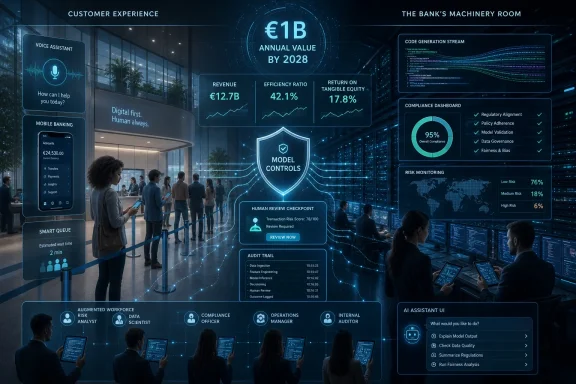
Banco Santander is targeting more than €1 billion in annual business value from data and artificial intelligence by 2028, using automation across customer service, software development, risk controls, and internal productivity to lift revenue, cut costs, and reshape work across its global banking operations. This is not another corporate pilot dressed up as transformation. It is a large incumbent bank telling investors, employees, and customers that AI has moved from the innovation lab into the operating model. The interesting question is no longer whether banks will use AI, but how much of banking they are prepared to let AI perform before the customer, the regulator, or the workforce pushes back.
Santander’s AI plan matters because it is being framed in the language investors understand best: revenue, efficiency ratio, and return on tangible equity. The bank’s 2026–2028 strategy puts AI inside a broader simplification drive, not beside it. That distinction is important. A chatbot on a website is a feature; an AI-enabled cost base is a restructuring plan.
The bank says data and AI initiatives should contribute more than €1 billion in annual business value by 2028, combining cost savings and additional revenues. That target sits alongside a much larger strategic promise: more than 210 million customers, more than €20 billion in profit, and a return on tangible equity above 20% by 2028. AI is therefore not being sold as a speculative moonshot. It is being baked into the arithmetic of Santander’s medium-term financial model.
That is the most revealing part of the announcement. Banks have spent years talking about machine learning for fraud detection, personalization, and document processing. What has changed is that the technology is now being treated as a lever of operating leverage — a way to grow customers and revenue without allowing headcount, branches, call centers, and back-office teams to grow at the same pace.
For a global bank with operations across Europe and the Americas, this is the prize. Santander’s scale has always been both its advantage and its tax. AI gives management a way to argue that the sprawl can be standardized, queried, automated, and monetized.
That is not automatically bad for customers. Anyone who has waited on hold to freeze a card, check a transaction, reset an app login, or confirm a payment knows that much of retail banking support is repetitive, rules-based, and miserable for both sides of the call. If AI can authenticate a customer securely, understand the problem, execute a limited action, and escalate cleanly when it fails, the customer gets time back and the bank saves money.
The danger is that banks often describe the best-case version of automation while customers encounter the edge cases. A lost card is routine until it happens abroad, late at night, after a suspicious transaction, with a mobile app that will not authenticate. An account review is standard workflow until an automated system freezes funds needed for rent, payroll, or medical expenses. In banking, the annoying exception is often the moment that defines trust.
That is why call center automation is a governance story as much as a productivity story. Santander can save waiting time and free human agents for complex cases only if escalation works quickly and visibly. If AI becomes a maze rather than a filter, the bank may save cost while spending customer goodwill.
A bank employee with a secure AI assistant can summarize documents, draft customer communications, query internal policies, prepare meeting notes, analyze spreadsheets, review code, or accelerate compliance work. None of those tasks individually destroys the structure of a bank. Together, they change how many people are needed to move the same volume of work through the institution.
This is where Microsoft Copilot, OpenAI-style assistants, Anthropic-style models, and other enterprise AI platforms become strategically useful. They do not need to replace the core banking system on day one. They sit above messy internal processes and make knowledge work faster. The productivity pitch is seductive because it does not require a single grand migration; it can start with thousands of small accelerations.
But the workforce implications are obvious. If a junior analyst can produce a first draft in minutes, if a relationship manager can prepare client briefs automatically, if a developer can generate boilerplate code, and if a compliance worker can triage alerts with machine assistance, the bank eventually asks a brutal question: how much of the old staffing pyramid still makes economic sense?
Santander’s executives may prefer the language of productivity to the language of redundancies. That is understandable. But productivity at this scale is never neutral. It either produces more output with the same workforce, the same output with a smaller workforce, or some unstable combination of both.
Software development inside banks is slow for reasons that are both bureaucratic and legitimate. Core systems are old, regulatory constraints are strict, audit trails matter, and outages can become national news. If AI coding tools can safely accelerate documentation, testing, migration scripts, integration work, and application development, they may become as important to banks as cloud migration was over the past decade.
The optimistic version is straightforward. AI helps engineers clear repetitive tasks, write tests, understand legacy code, generate documentation, and reduce the backlog of internal tooling requests. That improves security patching, developer velocity, and the quality of customer-facing services. In a sector where technical debt often hides behind polished mobile apps, faster engineering could be a real gain.
The less comfortable version is that AI-generated code can also create a new kind of technical debt: plausible, fast, and difficult to review at scale. Banks cannot treat generated code as magic. They need secure development pipelines, model controls, human code review, automated testing, dependency scanning, and clear accountability when AI-generated suggestions introduce defects.
This is the part of the AI banking story that will not fit neatly into an investor slide. The return on AI coding tools is not just measured in faster releases. It is measured in whether the bank can preserve engineering discipline when code becomes cheaper to produce than to understand.
Santander’s digital operations, including Openbank, are reported to be using machine learning and automation in areas such as AML alert processing. This is exactly where banks want AI to shine: high-volume, rules-heavy, document-rich work with measurable outcomes. The technology does not need to make every final decision to be valuable. It only needs to reduce the human time spent on low-risk, repetitive review.
Yet compliance is also where the phrase autonomous agent should make regulators sit up. A model that summarizes an alert is one thing. A model that closes an alert, deprioritizes a suspicious customer, or recommends no further action is something else. The more consequential the output, the more important explainability, auditability, and independent validation become.
Banks know this, which is why the public language usually emphasizes assistance rather than replacement. But operational pressure has a way of creeping. First the AI drafts. Then it recommends. Then it auto-resolves the easy cases. Then the definition of “easy” expands because the cost-saving target is still there.
The central question is not whether AI belongs in compliance. It already does. The question is whether banks can prove, after the fact, why a machine-supported decision was made — and whether the proof will satisfy supervisors when something goes wrong.
No serious global bank wants to be locked into one model provider, one cloud assumption, or one jurisdictional risk profile. Different models are better at different tasks. Different regulators will have different comfort levels. Different business units will demand different controls. The safest enterprise strategy is to build a governed layer that can route work to the right tool without turning the entire bank into a dependency of one vendor’s roadmap.
The Microsoft angle is especially relevant for corporate IT. Copilot-style tools are already embedded into the productivity stack many banks use every day: Outlook, Teams, Word, Excel, PowerPoint, SharePoint, and the broader Microsoft 365 universe. That makes adoption feel less like a new platform rollout and more like a feature expansion inside the software employees already inhabit.
But that familiarity can obscure risk. The more AI is woven into ordinary office work, the easier it becomes for sensitive data to move into prompts, summaries, drafts, and embeddings without employees fully understanding where the boundaries are. Enterprise controls can mitigate that, but they cannot eliminate the need for training and discipline.
For sysadmins and security teams, this is the practical lesson. AI adoption is no longer a specialist project owned by a data science group. It is identity management, data loss prevention, logging, retention, access control, endpoint policy, and vendor governance all at once.
Standard Chartered has reportedly tied thousands of planned job cuts to automation and AI-driven efficiency, particularly in back-office and corporate functions. Lloyds and other banks are hiring specialized AI and engineering talent even as traditional operational roles come under pressure. The pattern is not hard to read: banks are not simply reducing labor; they are changing the kind of labor they want.
The old retail banking workforce was built around branches, call centers, operations teams, compliance queues, relationship managers, and IT departments that maintained increasingly complex estates. The new model still needs people, but it prizes software engineers, AI governance specialists, data scientists, cloud architects, cyber professionals, product managers, and compliance experts who can supervise automated systems.
That does not make the transition painless. A call center worker cannot become a model risk specialist because an executive says the word reskilling. A back-office processor cannot instantly become a cloud security engineer. Some employees will move up the value chain, some will be redeployed into customer-facing exception handling, and some will simply discover that the bank’s definition of valuable work has changed faster than their career path.
This is the social bargain banks now face. They want the market to reward AI-driven efficiency. They want regulators to trust AI-assisted controls. They want customers to accept automated service. They want employees to embrace tools that may eventually reduce the need for employees. That is a lot to ask from a technology still capable of confident errors.
Banking is unforgiving because trust is cumulative and failure is personal. A streaming service can recommend the wrong film. A bank’s AI can block a mortgage application, misclassify fraud, mishandle bereavement support, or trap a small business in an account review. The margin for charming imperfection is much smaller.
This is why Santander’s plan should be read as both ambitious and risky. The bank has the scale to capture large efficiencies, but scale also magnifies mistakes. A flawed AI workflow in a small pilot is a contained problem. A flawed AI workflow deployed across millions of customers and thousands of employees becomes an institutional event.
The best banks will not be the ones that automate the most aggressively. They will be the ones that know which processes should be automated, which should be augmented, and which should remain stubbornly human. That line will move over time, but pretending it does not exist is how banks turn innovation into reputational damage.
For Santander, the regulatory challenge is not merely whether a particular model is accurate. It is whether the bank can demonstrate governance over a sprawling AI estate. That includes who approved each use case, what data it uses, how outputs are monitored, how bias is tested, how customers can appeal decisions, how vendors are supervised, and how the bank responds when models behave unexpectedly.
This is where the tension between speed and accountability becomes acute. Investors want AI value by 2028. Customers want better service now. Employees want tools that work. Regulators want evidence that the bank understands what it has built. Those clocks do not tick at the same speed.
The result will be a new class of banking infrastructure that looks less like a single application and more like a controlled ecosystem of models, prompts, retrieval systems, guardrails, logs, and human review points. In practical terms, the governance layer may become as important as the model itself.
That is not glamorous, but it is decisive. Banks do not win long-term trust by showing that AI can answer a question. They win it by proving that AI can be constrained.
AI becomes valuable because it attacks this fragmentation. It can turn policy into searchable guidance, turn conversations into structured records, turn legacy code into explainable summaries, and turn repetitive workflows into semi-automated queues. The technology is not creating the inefficiency. It is exposing inefficiency that scale had normalized.
That is why the AI push is tied to Santander’s broader “ONE Transformation” language. The bank is trying to make global platforms, shared technology, and common processes do more of the work previously handled through local variation. AI is a force multiplier for that standardization.
This also explains why the strategy is likely to spread across the sector. Once one large bank claims measurable AI savings, rivals will be pressed to explain why their own cost bases remain stubbornly human. In banking, efficiency ratios are competitive weapons. If AI lowers one bank’s cost-to-serve, others cannot politely ignore it.
The risk is that banks chase each other into automation targets before the operational lessons are fully absorbed. A cost-saving race can be useful when it kills bureaucracy. It becomes dangerous when it treats human judgment as merely an expensive legacy dependency.
The emotional demand for humans returns when something goes wrong. That is why AI customer service is not a binary contest between bots and people. The real design question is when the bank recognizes that a case has crossed from routine into distress.
A good AI banking system should know when to stop. It should detect confusion, vulnerability, complaint language, fraud risk, bereavement, financial hardship, accessibility needs, and repeated failed attempts. It should then move the customer to a capable human without forcing them to perform anger as an authentication method.
If Santander can build that kind of system, automation may genuinely improve service. If it cannot, the bank risks creating a two-tier experience: efficient for customers with simple needs, punishing for customers with complicated lives.
That distinction matters because banks are not ordinary retailers. They hold wages, savings, mortgages, pensions, and business liquidity. A bad support loop is not just inconvenient. It can become financially harmful.
The most concrete reading is this:
Santander’s bet is that AI can make a sprawling global bank feel more like a software platform without breaking the trust that makes banking possible in the first place. If it works, the next few years will make today’s branch-and-call-center model look as dated as paper passbooks. If it fails, the industry will learn again that efficiency is only valuable when customers, regulators, and employees believe the machine still answers to someone.
 Santander Is Turning AI From Experiment Into Operating Discipline
Santander’s AI plan matters because it is being framed in the language investors understand best: revenue, efficiency ratio, and return on tangible equity. The bank’s 2026–2028 strategy puts AI inside a broader simplification drive, not beside it. That distinction is important. A chatbot on a website is a feature; an AI-enabled cost base is a restructuring plan.The bank says data and AI initiatives should contribute more than €1 billion in annual business value by 2028, combining cost savings and additional revenues. That target sits alongside a much larger strategic promise: more than 210 million customers, more than €20 billion in profit, and a return on tangible equity above 20% by 2028. AI is therefore not being sold as a speculative moonshot. It is being baked into the arithmetic of Santander’s medium-term financial model.
That is the most revealing part of the announcement. Banks have spent years talking about machine learning for fraud detection, personalization, and document processing. What has changed is that the technology is now being treated as a lever of operating leverage — a way to grow customers and revenue without allowing headcount, branches, call centers, and back-office teams to grow at the same pace.
For a global bank with operations across Europe and the Americas, this is the prize. Santander’s scale has always been both its advantage and its tax. AI gives management a way to argue that the sprawl can be standardized, queried, automated, and monetized.
The Call Center Is Where Customers Will Feel the Strategy First
The most visible front line of Santander’s AI push is customer service. Reports around the bank’s plan point to a target of routing a large share of routine customer interactions through AI-powered self-service voice channels. Whether framed as shorter queues or fewer human handoffs, the direction is unmistakable: the first responder in retail banking is increasingly likely to be software.That is not automatically bad for customers. Anyone who has waited on hold to freeze a card, check a transaction, reset an app login, or confirm a payment knows that much of retail banking support is repetitive, rules-based, and miserable for both sides of the call. If AI can authenticate a customer securely, understand the problem, execute a limited action, and escalate cleanly when it fails, the customer gets time back and the bank saves money.
The danger is that banks often describe the best-case version of automation while customers encounter the edge cases. A lost card is routine until it happens abroad, late at night, after a suspicious transaction, with a mobile app that will not authenticate. An account review is standard workflow until an automated system freezes funds needed for rent, payroll, or medical expenses. In banking, the annoying exception is often the moment that defines trust.
That is why call center automation is a governance story as much as a productivity story. Santander can save waiting time and free human agents for complex cases only if escalation works quickly and visibly. If AI becomes a maze rather than a filter, the bank may save cost while spending customer goodwill.
The Bank Wants Every Employee to Become an AI User
Santander’s strategy also points inward. The bank has said AI is becoming part of daily work, with tens of thousands of employees already trained or using AI tools and a wider ambition to extend access across the workforce. That is the quiet revolution behind the louder customer-service story.A bank employee with a secure AI assistant can summarize documents, draft customer communications, query internal policies, prepare meeting notes, analyze spreadsheets, review code, or accelerate compliance work. None of those tasks individually destroys the structure of a bank. Together, they change how many people are needed to move the same volume of work through the institution.
This is where Microsoft Copilot, OpenAI-style assistants, Anthropic-style models, and other enterprise AI platforms become strategically useful. They do not need to replace the core banking system on day one. They sit above messy internal processes and make knowledge work faster. The productivity pitch is seductive because it does not require a single grand migration; it can start with thousands of small accelerations.
But the workforce implications are obvious. If a junior analyst can produce a first draft in minutes, if a relationship manager can prepare client briefs automatically, if a developer can generate boilerplate code, and if a compliance worker can triage alerts with machine assistance, the bank eventually asks a brutal question: how much of the old staffing pyramid still makes economic sense?
Santander’s executives may prefer the language of productivity to the language of redundancies. That is understandable. But productivity at this scale is never neutral. It either produces more output with the same workforce, the same output with a smaller workforce, or some unstable combination of both.
Code Generation Moves AI Into the Machinery Room
One of the more consequential claims around Santander’s AI adoption is that a significant portion of internal code is now being generated with AI assistance. For WindowsForum readers who live closer to the sysadmin and developer side of technology than the bank-branch side, this may be the part to watch most closely.Software development inside banks is slow for reasons that are both bureaucratic and legitimate. Core systems are old, regulatory constraints are strict, audit trails matter, and outages can become national news. If AI coding tools can safely accelerate documentation, testing, migration scripts, integration work, and application development, they may become as important to banks as cloud migration was over the past decade.
The optimistic version is straightforward. AI helps engineers clear repetitive tasks, write tests, understand legacy code, generate documentation, and reduce the backlog of internal tooling requests. That improves security patching, developer velocity, and the quality of customer-facing services. In a sector where technical debt often hides behind polished mobile apps, faster engineering could be a real gain.
The less comfortable version is that AI-generated code can also create a new kind of technical debt: plausible, fast, and difficult to review at scale. Banks cannot treat generated code as magic. They need secure development pipelines, model controls, human code review, automated testing, dependency scanning, and clear accountability when AI-generated suggestions introduce defects.
This is the part of the AI banking story that will not fit neatly into an investor slide. The return on AI coding tools is not just measured in faster releases. It is measured in whether the bank can preserve engineering discipline when code becomes cheaper to produce than to understand.
Compliance Automation Is Powerful Because Compliance Is Full of Repetition
Financial crime, fraud, and anti-money-laundering operations are natural targets for AI because they generate huge volumes of alerts, many of which are false positives. Every large bank has armies of systems and analysts trying to distinguish suspicious behavior from ordinary customer messiness. If AI can triage obvious cases, surface patterns, and draft investigation notes, the savings can be substantial.Santander’s digital operations, including Openbank, are reported to be using machine learning and automation in areas such as AML alert processing. This is exactly where banks want AI to shine: high-volume, rules-heavy, document-rich work with measurable outcomes. The technology does not need to make every final decision to be valuable. It only needs to reduce the human time spent on low-risk, repetitive review.
Yet compliance is also where the phrase autonomous agent should make regulators sit up. A model that summarizes an alert is one thing. A model that closes an alert, deprioritizes a suspicious customer, or recommends no further action is something else. The more consequential the output, the more important explainability, auditability, and independent validation become.
Banks know this, which is why the public language usually emphasizes assistance rather than replacement. But operational pressure has a way of creeping. First the AI drafts. Then it recommends. Then it auto-resolves the easy cases. Then the definition of “easy” expands because the cost-saving target is still there.
The central question is not whether AI belongs in compliance. It already does. The question is whether banks can prove, after the fact, why a machine-supported decision was made — and whether the proof will satisfy supervisors when something goes wrong.
Santander’s Vendor Stack Shows That No Bank Wants to Bet on One Model
Santander’s AI ecosystem appears deliberately plural. The bank has been linked to major AI providers including OpenAI, Microsoft, Anthropic, and G42, while also building internal data and AI capabilities. That is not indecision. It is the architecture of modern enterprise AI procurement.No serious global bank wants to be locked into one model provider, one cloud assumption, or one jurisdictional risk profile. Different models are better at different tasks. Different regulators will have different comfort levels. Different business units will demand different controls. The safest enterprise strategy is to build a governed layer that can route work to the right tool without turning the entire bank into a dependency of one vendor’s roadmap.
The Microsoft angle is especially relevant for corporate IT. Copilot-style tools are already embedded into the productivity stack many banks use every day: Outlook, Teams, Word, Excel, PowerPoint, SharePoint, and the broader Microsoft 365 universe. That makes adoption feel less like a new platform rollout and more like a feature expansion inside the software employees already inhabit.
But that familiarity can obscure risk. The more AI is woven into ordinary office work, the easier it becomes for sensitive data to move into prompts, summaries, drafts, and embeddings without employees fully understanding where the boundaries are. Enterprise controls can mitigate that, but they cannot eliminate the need for training and discipline.
For sysadmins and security teams, this is the practical lesson. AI adoption is no longer a specialist project owned by a data science group. It is identity management, data loss prevention, logging, retention, access control, endpoint policy, and vendor governance all at once.
The Job Story Is Bigger Than Santander
Santander is careful to present AI as a productivity and growth story, not a mass redundancy announcement. That may be true in the narrow sense. But the banking sector around it is already making the labor implications difficult to ignore.Standard Chartered has reportedly tied thousands of planned job cuts to automation and AI-driven efficiency, particularly in back-office and corporate functions. Lloyds and other banks are hiring specialized AI and engineering talent even as traditional operational roles come under pressure. The pattern is not hard to read: banks are not simply reducing labor; they are changing the kind of labor they want.
The old retail banking workforce was built around branches, call centers, operations teams, compliance queues, relationship managers, and IT departments that maintained increasingly complex estates. The new model still needs people, but it prizes software engineers, AI governance specialists, data scientists, cloud architects, cyber professionals, product managers, and compliance experts who can supervise automated systems.
That does not make the transition painless. A call center worker cannot become a model risk specialist because an executive says the word reskilling. A back-office processor cannot instantly become a cloud security engineer. Some employees will move up the value chain, some will be redeployed into customer-facing exception handling, and some will simply discover that the bank’s definition of valuable work has changed faster than their career path.
This is the social bargain banks now face. They want the market to reward AI-driven efficiency. They want regulators to trust AI-assisted controls. They want customers to accept automated service. They want employees to embrace tools that may eventually reduce the need for employees. That is a lot to ask from a technology still capable of confident errors.
The AI-Native Bank Will Still Be Judged by Old Banking Failures
The phrase “AI-native bank” sounds futuristic, but the test will be familiar. Can customers access their money? Can fraud be stopped without trapping legitimate users? Can complaints be resolved? Can regulators reconstruct decisions? Can systems survive outages, model drift, cyberattacks, and vendor failures?Banking is unforgiving because trust is cumulative and failure is personal. A streaming service can recommend the wrong film. A bank’s AI can block a mortgage application, misclassify fraud, mishandle bereavement support, or trap a small business in an account review. The margin for charming imperfection is much smaller.
This is why Santander’s plan should be read as both ambitious and risky. The bank has the scale to capture large efficiencies, but scale also magnifies mistakes. A flawed AI workflow in a small pilot is a contained problem. A flawed AI workflow deployed across millions of customers and thousands of employees becomes an institutional event.
The best banks will not be the ones that automate the most aggressively. They will be the ones that know which processes should be automated, which should be augmented, and which should remain stubbornly human. That line will move over time, but pretending it does not exist is how banks turn innovation into reputational damage.
Regulators Will Not Let the Black Box Become the Bank
European and UK regulators have spent years warning financial firms about operational resilience, third-party risk, model governance, data protection, and consumer duty. AI does not replace those concerns. It bundles them into a single technology wave and accelerates them.For Santander, the regulatory challenge is not merely whether a particular model is accurate. It is whether the bank can demonstrate governance over a sprawling AI estate. That includes who approved each use case, what data it uses, how outputs are monitored, how bias is tested, how customers can appeal decisions, how vendors are supervised, and how the bank responds when models behave unexpectedly.
This is where the tension between speed and accountability becomes acute. Investors want AI value by 2028. Customers want better service now. Employees want tools that work. Regulators want evidence that the bank understands what it has built. Those clocks do not tick at the same speed.
The result will be a new class of banking infrastructure that looks less like a single application and more like a controlled ecosystem of models, prompts, retrieval systems, guardrails, logs, and human review points. In practical terms, the governance layer may become as important as the model itself.
That is not glamorous, but it is decisive. Banks do not win long-term trust by showing that AI can answer a question. They win it by proving that AI can be constrained.
The Numbers Are Big Because the Work Was Always Fragmented
Santander’s €1 billion target sounds dramatic, but it also reveals something obvious about large banks: they are full of duplicated work. Similar customer queries are handled in different countries. Similar documents are reviewed by different teams. Similar code is written inside different units. Similar compliance alerts are processed by people following similar manuals.AI becomes valuable because it attacks this fragmentation. It can turn policy into searchable guidance, turn conversations into structured records, turn legacy code into explainable summaries, and turn repetitive workflows into semi-automated queues. The technology is not creating the inefficiency. It is exposing inefficiency that scale had normalized.
That is why the AI push is tied to Santander’s broader “ONE Transformation” language. The bank is trying to make global platforms, shared technology, and common processes do more of the work previously handled through local variation. AI is a force multiplier for that standardization.
This also explains why the strategy is likely to spread across the sector. Once one large bank claims measurable AI savings, rivals will be pressed to explain why their own cost bases remain stubbornly human. In banking, efficiency ratios are competitive weapons. If AI lowers one bank’s cost-to-serve, others cannot politely ignore it.
The risk is that banks chase each other into automation targets before the operational lessons are fully absorbed. A cost-saving race can be useful when it kills bureaucracy. It becomes dangerous when it treats human judgment as merely an expensive legacy dependency.
Customers May Like the Speed Until They Need Mercy
Retail customers often say they want human service, but their behavior is more complicated. They use mobile apps, self-service flows, instant card controls, biometric login, and automated fraud alerts because speed matters. For most routine banking tasks, customers do not miss the human being if the software works.The emotional demand for humans returns when something goes wrong. That is why AI customer service is not a binary contest between bots and people. The real design question is when the bank recognizes that a case has crossed from routine into distress.
A good AI banking system should know when to stop. It should detect confusion, vulnerability, complaint language, fraud risk, bereavement, financial hardship, accessibility needs, and repeated failed attempts. It should then move the customer to a capable human without forcing them to perform anger as an authentication method.
If Santander can build that kind of system, automation may genuinely improve service. If it cannot, the bank risks creating a two-tier experience: efficient for customers with simple needs, punishing for customers with complicated lives.
That distinction matters because banks are not ordinary retailers. They hold wages, savings, mortgages, pensions, and business liquidity. A bad support loop is not just inconvenient. It can become financially harmful.
The Santander Signal Is Clearer Than the Slogan
Santander’s AI plan should be stripped of both utopian and dystopian fog. It is neither a harmless productivity upgrade nor an overnight replacement of the bank by machines. It is a disciplined attempt to industrialize AI across a complex financial institution, with explicit financial targets and inevitable labor consequences.The most concrete reading is this:
- Santander expects data and AI to generate more than €1 billion in annual business value by 2028 through a mixture of revenue growth and cost savings.
- Customer service automation will be one of the first areas where ordinary users notice the change, especially in routine voice and self-service interactions.
- Employee-facing AI tools may matter as much as customer-facing bots because they compress the time required for analysis, documentation, coding, and internal operations.
- AI-generated software can accelerate bank technology work, but only if security, review, testing, and accountability scale with the volume of generated code.
- Compliance automation offers real efficiency gains, but regulators will expect banks to explain and audit machine-supported decisions.
- The workforce impact will be uneven, with demand rising for AI, data, cyber, and engineering skills while routine operational roles come under sustained pressure.
Santander’s bet is that AI can make a sprawling global bank feel more like a software platform without breaking the trust that makes banking possible in the first place. If it works, the next few years will make today’s branch-and-call-center model look as dated as paper passbooks. If it fails, the industry will learn again that efficiency is only valuable when customers, regulators, and employees believe the machine still answers to someone.
References
- Primary source: streamlinefeed.co.ke
Published: 2026-06-22T06:44:08.287147
Loading…
streamlinefeed.co.ke - Related coverage: bloomberg.com
Loading…
www.bloomberg.com - Related coverage: resultsense.com
Santander Targets €1bn in AI Business Value by 2028
Spanish banking giant plans mandatory AI training for all staff and aims to grow customer base to 210 million under its ONE Transformation strategy.www.resultsense.com
- Related coverage: ai2.work
Loading…
ai2.work - Related coverage: santander.com
2026 Santander Investor Day - Santander sets a new standard for profitable growth, targeting more than 210 million customers, over €20 billion profit and more than double cash dividend per share by 2028
Banco Santander today presents its strategic plan for 2026–2028 at its Investor Day in London, marking the next phase of value creation for the bank.www.santander.com - Related coverage: santanderus.com
Loading…
www.santanderus.com