

SAS has launched SAS Viya Essentials, a turnkey, low-cost managed deployment of select SAS Viya products on Microsoft Azure designed to get organizations up and running with cloud analytics and AI quickly while offloading platform operations to SAS Managed Cloud Services. This packaged offering includes four predefined architecture profiles (covering SAS Visual Analytics, SAS Visual Statistics and broader Viya configurations), a 99.5% uptime SLA, dedicated support teams, and deeper integrations across Microsoft tooling such as Azure AI Foundry, the Microsoft Marketplace and Microsoft Fabric—features SAS and Microsoft say will shorten time-to-value for analytics initiatives.
SAS Viya Essentials is positioned as a standardized, hosted path to the SAS Viya platform that reduces the engineering lift normally required to design, deploy and operate an enterprise analytics stack. The offering is delivered as a managed service on Microsoft Azure under SAS Managed Cloud Services and comes with four preset architectural profiles intended to meet common analytics use-cases—from dashboarding and governed self-service analytics to statistical modeling and broader cloud-native AI workloads. SAS emphasizes predictability (a fixed-cost model in marketing language), operational offload, and pre-integrated developer tooling to lower barriers for small and mid-size customers. This announcement builds on an ongoing commercial and technology partnership between SAS and Microsoft that has been extended through a new multi-year agreement. As part of that collaboration, SAS is shipping complementary capabilities—including SAS Viya Copilot, an AI-driven assistant built on Azure AI Foundry (private preview), SAS Viya Workbench (now available via Microsoft Marketplace), and SAS Decision Builder, a decision-intelligence workload integrated within Microsoft Fabric (public preview). These adjacent innovations aim to make Viya less of a standalone stack and more of an integrated set of experiences inside the Microsoft cloud ecosystem.
For IT leaders evaluating Viya Essentials, the prudent path is clear: treat the offering as a pragmatic, lower-friction path to SAS analytics—but require contractual clarity on SLA scope, costs, security responsibilities and migration playbooks, then validate those promises with a production-like pilot that measures real workload behavior before committing at scale.
Conclusion
SAS Viya Essentials reframes a classic enterprise analytics stack into an opinionated, managed service on Azure, lowering the barrier to adoption for many organizations while folding in powerful integrations such as Viya Copilot and Fabric decisioning. The product will likely accelerate adoption among Azure-first customers and smaller teams that prize vendor-managed reliability. At the same time, buyers must prepare for trade-offs—particularly around cost transparency, customization limits, governance and exit strategy—and require contractual and technical assurances before migrating mission-critical analytics into a managed Viya environment.
Source: Brand Icon Image SAS Unveils Turnkey, Low-Cost Cloud Analytics on Microsoft Azure
 Background / Overview
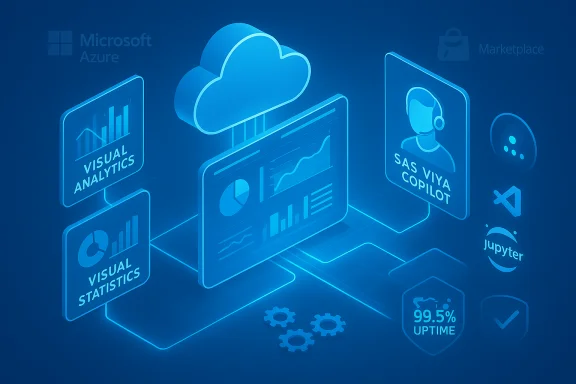
SAS Viya Essentials is positioned as a standardized, hosted path to the SAS Viya platform that reduces the engineering lift normally required to design, deploy and operate an enterprise analytics stack. The offering is delivered as a managed service on Microsoft Azure under SAS Managed Cloud Services and comes with four preset architectural profiles intended to meet common analytics use-cases—from dashboarding and governed self-service analytics to statistical modeling and broader cloud-native AI workloads. SAS emphasizes predictability (a fixed-cost model in marketing language), operational offload, and pre-integrated developer tooling to lower barriers for small and mid-size customers. This announcement builds on an ongoing commercial and technology partnership between SAS and Microsoft that has been extended through a new multi-year agreement. As part of that collaboration, SAS is shipping complementary capabilities—including SAS Viya Copilot, an AI-driven assistant built on Azure AI Foundry (private preview), SAS Viya Workbench (now available via Microsoft Marketplace), and SAS Decision Builder, a decision-intelligence workload integrated within Microsoft Fabric (public preview). These adjacent innovations aim to make Viya less of a standalone stack and more of an integrated set of experiences inside the Microsoft cloud ecosystem. What exactly is included in Viya Essentials?
Four predefined architectural profiles
SAS describes four standardized profiles that customers can choose from depending on workload needs:- A profile focused on SAS Visual Analytics for dashboards, reporting and governed self-service analytics.
- A profile for SAS Visual Statistics aimed at advanced statistical modeling and analytical workflows.
- A full SAS Viya cloud-native profile for data and AI workloads that need the broader Viya platform capabilities.
- A smaller, out-of-the-box configuration targeted at SMBs or lightweight use-cases.
Managed operations, support and SLA
Under Viya Essentials, SAS operates the Viya environment on Azure through SAS Managed Cloud Services. The company guarantees a 99.5% uptime SLA for the managed service and advertises dedicated support teams and fixed-cost packaging intended to simplify procurement and budgeting. The press materials emphasize speed-of-deployment as a core benefit for organizations that lack extensive cloud platform teams.Integrated developer and AI tooling
Key adjacent components available alongside Viya Essentials include:- SAS Viya Copilot: an AI conversational assistant integrated into Viya that leverages Azure AI Foundry to offer code assistance and model-pipeline help (currently private preview).
- SAS Viya Workbench: a cloud coding environment for SAS, Python and R with support for Visual Studio Code and Jupyter; listed as available through Microsoft Marketplace.
- SAS Decision Builder: SAS’ decision-intelligence capability surfaced as a workload inside Microsoft Fabric and available in public preview for Fabric users who want to operationalize models into decision flows.
Why SAS packaged Viya this way
Speed, predictability and lower ops load
Enterprises frequently struggle with long deployment timelines, complex platform builds, and the ongoing maintenance burden of analytics platforms. SAS Viya Essentials responds by offering a prescriptive architecture, operational management, and an SLA that shifts day-to-day platform operations to SAS. For many small-to-medium teams without deep cloud platform expertise, this simplifies procurement and accelerates time-to-insight.Deeper partnership with Microsoft
SAS has publicly deepened its strategic relationship with Microsoft, extending commercial ties and integrating Viya features into Microsoft product experiences. That relationship yields advantages for customers—particularly compliance coverage, Azure regional reach, and integrations within Microsoft Fabric and the Azure Marketplace—that SAS can now exploit to reduce friction for customers adopting Viya.Technical and operational considerations
What the SLA covers — and what it likely doesn’t
A 99.5% uptime SLA is a material commitment, but enterprises should validate the contract specifics before signing. Key details to verify include which components the SLA covers (control plane vs. data plane, storage, network connectivity), the measurement windows and exclusion clauses, credit calculations, and remediation procedures. Marketing materials do not replace the need to review the full service description and SLA annexes.Shared responsibility model
Even with a managed service, customers retain responsibilities typical for cloud deployments: identity and access management, data governance, backup and retention policies, and secure connectivity. Enterprises should insist on clear delineation in the contract of what SAS manages and what remains the customer’s responsibility, especially for identity controls and sensitive-data governance. Standard Azure best practices (Entra RBAC, Private Link, Defender for Storage, least-privilege access) should be enforced as part of onboarding.Cost transparency and long-term TCO
SAS promotes a "low fixed cost" model for Viya Essentials, but public materials do not provide line-item pricing or long-term TCO models. For any managed offering that bundles vendor fees with hyperscaler infrastructure costs, it is essential to receive detailed scenarios for 1-, 3- and 5-year horizons that include compute, storage, egress, backup and potential change-of-service or migration fees. Procurement should request example contracts and modeled billing scenarios.Customization limits and exit planning
The standardized profiles speed deployment but reduce the ability to implement highly-customized architectures. Organizations with unusual security requirements, specialized networking topologies, or bespoke integrations may find the templates restrictive or costly to adapt. Exit and portability planning should be conducted up front: request data-export runbooks, backup/restore procedures, and sample migration playbooks to ensure you can recover or migrate workloads if needed.The integration story: Copilot, Workbench and Decision Builder
SAS Viya Copilot + Azure AI Foundry
SAS Viya Copilot is presented as a conversational assistant embedded within Viya that connects to Azure AI Foundry for model hosting and inference. SAS describes Copilot as a productivity accelerator—helping users with code assistance, model pipeline generation and workflow acceleration. The product is currently in private preview with broader availability slated later in 2025 per SAS product roadmaps. Organizations should evaluate Copilot's governance, traceability and audit capabilities before using it for production model generation.Viya Workbench on Microsoft Marketplace
Viya Workbench provides a cloud-based coding environment supporting multiple languages (SAS, Python, R) and IDEs (VS Code, Jupyter). SAS documents confirm availability through the Microsoft Marketplace, which eases procurement and can allow customers to leverage existing Azure contractual mechanisms such as consumption commitments or marketplace purchasing agreements. Ensure that the Marketplace offer’s terms align with any managed-service contract for Viya Essentials to avoid overlapping billing or licensing surprises.SAS Decision Builder inside Microsoft Fabric
SAS Decision Builder has been integrated into Microsoft Fabric as a workload that lets users construct decision flows combining multiple models, business rules and governance controls. SAS and Microsoft have been working on this integration since at least 2023, and the Decision Builder workload is now listed as available in public preview—an important step for customers who need to operationalize models within Microsoft’s unified analytics environment. Test the Fabric-level governance and data-access controls when piloting Decision Builder, and validate LLM- and generative-AI integration points for auditability.Strengths — where Viya Essentials genuinely helps
- Faster time-to-value: Prebuilt architectures and managed operations let teams move from procurement to production faster than building a bespoke Viya deployment.
- Operational offload: SAS Managed Cloud Services handles daily ops, updates and monitoring—reducing the need for a large in-house platform engineering team.
- Predictability and SLAs: A formal uptime commitment and fixed-cost positioning help IT and finance teams forecast ongoing spend.
- Ecosystem integration: Native availability on Microsoft Marketplace, Azure AI Foundry integration for Copilot, and a Fabric workload for decisioning make Viya Essentials attractive to Azure-native organizations.
- Vendor accountability: SAS’ long history in analytics and the managed-service model mean customers have a single vendor to hold accountable for platform availability and upgrades.
Risks, caveats and what to insist on during procurement
- Vendor lock-in and data gravity: Managed, hosted services increase the friction to move data and models elsewhere. Obtain explicit migration procedures and test them in a pilot.
- Hidden costs: Marketing language about "low fixed cost" does not substitute for a detailed TCO; insist on modeled scenarios that include Azure infrastructure and egress.
- SLA nuance: Understand precisely which components and failure modes the 99.5% SLA covers; request runbooks, RTO/RPO numbers and remediation terms.
- AI governance: Copilot and other AI accelerants speed development but must be governed. Require traceability (model lineage and changes), human-in-the-loop controls, and audit logs for models and generated code.
- Customization limits: If the business requires bespoke integrations or unconventional security postures, determine whether the standardized profiles can be customized—and at what cost.
Practical checklist before signing a Viya Essentials contract
- Request the full service definition and the complete SLA document; confirm scope and exclusions.
- Obtain sample TCOs for 1, 3 and 5 years that include Azure compute, storage, egress, backups and SAS managed fees.
- Insist on a shared-responsibility matrix that maps security controls to the customer and SAS responsibilities.
- Require exit-runbooks and a tested data-export procedure; run a staged export as a pre-production acceptance test.
- Pilot with representative data and workloads to measure latency, concurrency, model training costs and observability integration (logs to SIEM).
- Validate Copilot’s governance features in a controlled environment—ensure model provenance, review gates and code-review workflows are enforced.
Use cases that align well — and those that might not
Viya Essentials is well suited for:- Departments or mid-size businesses that require SAS analytics capabilities without the overhead of building a cloud platform.
- Teams that already use Microsoft Azure and want integrated experiences with Microsoft Marketplace, Fabric and Azure AI services.
- Organizations prioritizing speed, repeatability and vendor-managed operations over deep custom architecture.
- Enterprises demanding extreme customization, specialized on-prem-only controls, or full ownership of cloud infrastructure.
- Use-cases dominated by hyperscale model training or very specific hardware choices where fine-grained control of cloud resources is essential.
Competitive context and market implications
The move to package analytics platforms as managed, prescriptive services is a broader industry trend. Hyperscalers and ISVs increasingly offer "opinionated" stacks—pre-configured, managed environments that reduce friction for adoption. SAS Viya Essentials plays into that dynamic by offering SAS’ advanced analytics in a Microsoft-friendly wrapper. For enterprises, the choice narrows to: build significantly customized platforms in-house, adopt opinionated managed platforms for speed and predictability, or use pure-SaaS alternatives for lighter-weight analytics. Each approach carries trade-offs between agility, control and long-term costs.Final assessment
SAS Viya Essentials is a well-calibrated product for organizations that want trusted SAS analytics quickly and with predictable operations on Microsoft Azure. The combination of managed services, predefined architecture profiles, and native integrations with Azure AI Foundry, Microsoft Marketplace and Microsoft Fabric makes Viya Essentials an attractive option for Azure-centric teams that prioritize speed-to-insight and reduced internal ops overhead. Verified claims—such as the 99.5% uptime SLA, the availability of Viya Workbench on Microsoft Marketplace, and the public preview status of SAS Decision Builder—are supported by SAS’ press materials and independent distribution outlets. However, the offering’s strengths come with real caveats. The lack of publicly published, line-item pricing means buyers must insist on detailed TCO modeling. Standardized profiles limit architectural flexibility, raising potential issues for organizations with strict compliance or unique networking needs. Finally, the increased data gravity and vendor dependency that accompany managed, bundled offerings make exit planning and governance non-negotiable components of any procurement process.For IT leaders evaluating Viya Essentials, the prudent path is clear: treat the offering as a pragmatic, lower-friction path to SAS analytics—but require contractual clarity on SLA scope, costs, security responsibilities and migration playbooks, then validate those promises with a production-like pilot that measures real workload behavior before committing at scale.
Conclusion
SAS Viya Essentials reframes a classic enterprise analytics stack into an opinionated, managed service on Azure, lowering the barrier to adoption for many organizations while folding in powerful integrations such as Viya Copilot and Fabric decisioning. The product will likely accelerate adoption among Azure-first customers and smaller teams that prize vendor-managed reliability. At the same time, buyers must prepare for trade-offs—particularly around cost transparency, customization limits, governance and exit strategy—and require contractual and technical assurances before migrating mission-critical analytics into a managed Viya environment.
Source: Brand Icon Image SAS Unveils Turnkey, Low-Cost Cloud Analytics on Microsoft Azure
