

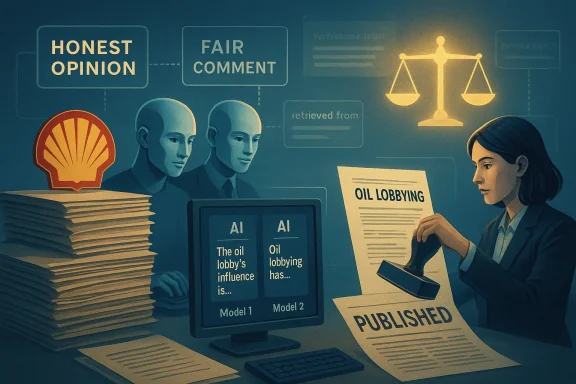
A satirical post on royaldutchshellplc.com that lampooned Big Oil’s lobbying in Venezuela did more than provoke laughs — it became a live, hybrid experiment in media, law and generative AI: a satirical text created with AI assistance, a second AI (Microsoft Copilot) asked to assess its legal safety, and a human editor publishing the loop as both commentary and case study.
The long-running Donovan–Shell story begins long before any AI was asked for an opinion. John Donovan and his late father, Alfred, have operated a cluster of adversarial websites focused on Royal Dutch Shell for decades, publishing court filings, leaked internal documents, and commentary. Their operation has on occasion been cited by mainstream outlets and survived a WIPO domain challenge in 2005 that the Donovans won. In late December 2025, Donovan deliberately staged an experiment: he fed curated portions of his archive into multiple public AI assistants and published the side‑by‑side outputs, including a satirical piece and a legal analysis produced by an AI. The experiment produced divergent model outputs — one assistant generated an invented, emotionally charged causal claim about a death, another corrected it, and Microsoft Copilot reportedly framed the satirical article as classic fair comment. The divergence — and the fact that machines were both author and critic — triggered wide discussion about hallucination, provenance and institutional silence.
The Donovan experiment is not merely academic; it has immediate editorial lessons:
Practical safeguards — provenance, hedging defaults, audit trails and disciplined editorial verification — will neither neuter satire nor cede corporate accountability. Instead, they will restore the human judgment that must sit between machine fluency and public fact. The Donovan experiment did what the best provocations do: it made a failure mode visible and forced a public conversation about fixes. That conversation, if translated into product and editorial practice, will determine whether AI becomes a force for clearer public truth or a vector for plausible, persistent falsehoods.
Source: Royal Dutch Shell Plc .com SATIRE VS. FAIR COMMENT: AI‑TO‑AI
 Background
The long-running Donovan–Shell story begins long before any AI was asked for an opinion. John Donovan and his late father, Alfred, have operated a cluster of adversarial websites focused on Royal Dutch Shell for decades, publishing court filings, leaked internal documents, and commentary. Their operation has on occasion been cited by mainstream outlets and survived a WIPO domain challenge in 2005 that the Donovans won. In late December 2025, Donovan deliberately staged an experiment: he fed curated portions of his archive into multiple public AI assistants and published the side‑by‑side outputs, including a satirical piece and a legal analysis produced by an AI. The experiment produced divergent model outputs — one assistant generated an invented, emotionally charged causal claim about a death, another corrected it, and Microsoft Copilot reportedly framed the satirical article as classic fair comment. The divergence — and the fact that machines were both author and critic — triggered wide discussion about hallucination, provenance and institutional silence. The satire: tone, form and legal framing
The satirical item published under the headline BREAKING: Oil Companies, including Shell, Lobby White House on Venezuela — Because Why Not Take the Whole Planet? used hyperbole, sarcasm and persona‑driven mockery. It explicitly lampooned corporations and political actors, and included a satire disclaimer. As published, the piece is unmistakably satirical in tone and targets mamatters of public interest — lobbying, foreign policy and fossil‑fuel extraction. Why that matters legally: in common‑law systems, satire and parody often receive strong expressive protections because they are recognizable as opinion or rhetorical hyperbole, not factual assertions. But the precise legal boundary between protected satire and actionable defamation is context‑sensitive and jurisdictional. The stakes are heightened when the target is a corporation with deep pockets and skilled counsel.The AI legal read: Microsoft Copilot as law clerk
According to the published transcript, Microsoft Copilot was asked to evaluate the satirical piece for defamation risk and returned a structured legal analysis concluding, broadly, that:- the piece was clearly satirical (exaggeration and irony),
- it addressed matters of public interest (lobbying, foreign policy, oil extraction),
- it targeted major corporations with established public reputations,
- it relied on publicly reported facts rather than fabricated allegations, and
- it included a satire disclaimer reinforcing its intent.
Legal doctrine: what “fair comment” and “honest opinion” actually protect
Defamation law differs significantly by jurisdiction, but two useful anchors help explain the legal landscape.- United Kingdom: The Defamation Act 2013 replaced the older common‑law “fair comment” defense with honest opinion. Under the statutory test, a defendant can succeed where (1) the statement complained of was a statement of opinion; (2) the opinion indicated the basis of the view; and (3) an honest person could have held that opinion on the facts known at publication. Importantly, the Act also requires the claimant to show serious harm for non‑parties and provides a separate defense for publication on matters of public interest.
- United States: The First Amendment colors defamation doctrine. The U.S. Supreme Court’s Milkovich decision clarified that there is no automatic constitutional “opinion” privilege: statements that imply provably false facts can be actionable even if framed as opinion. The key inquiry is whether the statement is verifiable as a fact or is rhetorical hyperbole. Where the subject is a public figure or a matter of public concern, the plaintiff must meet higher thresholds (actual malice) in many contexts.
The AI‑to‑AI loop: creator, critic, curator
What made the published episode novel was the chain:- An AI‑assisted author (satire drafted and edited with AI help).
- A second AI (Copilot) performing a legal risk analysis.
- Human publication of both the satire and the AI’s legal memo.
- Provenance: Did Copilot record retrieval context, citation snippets, and confidence markers? Without attached provenance, that legal “green light” is weak evidence of lawful judgment.
- Authority creep: Users (and editors) may infer that an AI legal memo equals lawyering — but an AI summary is not legal advice and lacks privilege and professional responsibility protections unless produced under a lawyer’s supervision.
- Amplification risk: A machine’s confident but incorrect factual completion (a hallucination) can be republished as a factual claim by secondary outlets, even if the original was satirical. The Donovan experiment showed exactly this dynamic — one assistant invented a causal claim about a death, another corrected it, and the resulting public spectacle focused on model disagreement rather than on documented truth.
Hallucinations, provenance and the “bot war”
The late‑December 2025 cross‑model episode — widely characterised as a “bot war” — is instructive. Donovan fed the same archive to multiple assistants. One assistant attributed a cause of death to a family member (“died from the stresses of the feud”), a highly sensitive, verifiable factual claim. Another assistant flagged this as obituary records. The juxtaposition produced a viral narrative about model reliability rather than clarifying the facts. This example sharply exposes a recurring failure mode in retrieval‑augmented model stacks:- Retrieval signals elevate certain archival fragments.
- LLMs optimise for narrative coherence and may supply plausible, but unsupported, connectors.
- Where audit trails and provenance are absent, downstream readers cannot distinguish invention from synthesis.
Why tters
Donovan’s archive is not a fringe Tumblr feed; it has a documented history of citations and legal encounters. Mainstream outlets have referenced the site and its materials, and a WIPO administrativeinistrative panel rejected Shell’s 2005 domain complaint — an objective legal anchor that confirms the archive’s contestedhat history matters because it makes the archive a high‑value retrieval target for RAG systems and gives the Donovan site a seed role in algorithmic narrative formation. However, the archive is heterogeneous: some items are court‑filed documents and contemporaneous records, while others are anonymous tips or interpretive commentary. The mixed evidentiary quality is precisely what makes automatic summarisation dangerous unless provenance and chain‑of‑custody metadata are surfaced alongside generated narrativel implications for journalists and publishersThe Donovan experiment is not merely academic; it has immediate editorial lessons:
- Treat AI outputs as leads, not facts. Use traditional documentary verification before publishing sensitive claims. Archive prompt/output pairs for traceability.
- Demand provenance. Require models to show retrieval snippets and document IDs for claims about living persons or sensitive events. This reduces hallucination risk and increases auditability.
- Default to hedging. Systems should flag low‑provenance claims with explicit uncertainty language; editors should prefer verified anchors over machine certainty.
- Prepare rapid rebuttal workflows. Corporations and subjects of archival attacks should maintain a public, authoritative record that can be referenced as rebuttal; silence can be interpreted as absence of contrary evidence in algorithmic assembly.
- Preserve the prompt and model output with timestamped provenance.
- Cross‑check model assertions against primary sources before publication.
- If publishing model outputs, label them clearly as machine‑generated and include retrieval snippets.
- When a model asserts sensitive facts (death, crime, medical conditions), require documentary proof before repeating.
Legal risk: corporations, authors and platforms
From the corporate perspective, several risk vectors merit attention:- Defamation exposure: Machine‑generated assertions of fact about individuals (or companies) that are false can create actionable claims. Even when the initial piece is satire, ambiguous phrasing that implies false facts raises risk. Jurisdictional tests vary, but in both the UK and US a factual, false imputation can be actionable.
- Reputational cascades: A hallucination in one assistant can propagate through social shares and downstream summarisation, making remediation costly.
- Regulatory scrutiny: As conversational systems become a vector for reputation harms, regulators may demand provenance, audit records and clearer labelling of AI‑generated content.
Strengths and risks of the AI‑augmented media experiment
Notable strengths- Speed and amplification: AI lets authors iterate satire quickly and produces legal analyses in minutes that would otherwise require lawyers days to draft. This increases agility in holding power to account.
- Comparative diagnosis: Side‑by‑side model outputs reveal failure modes (hallucination versus hedging) that are useful for assessing systems. Donovan’s multi‑model experiment made that visible.
- Public pedagogy: By publishing the full loop — prompts, outputs and annotations — the experiment forced a public discussion about provenance and model design in a way dry technical memos rarely do.
- False authority: An AI’s confident legal memo can be mistaken for privileged legal advice. That creates authority laundering, where machine confidence substitutes for counsel.
- Amplified falsehoods: Machines optimise coherence. When coherence conflicts with provenance, the result can be plausible but false narrative fragments that propagate.
- Operational opacity: Without standardized provenance APIs and retention policies, it can be impossible to verify an AI’s claimed observation after the fact. That undermines accountability and complicates remediation.
Where policy and product design should go next
The Donovan–Shell episode is a useful stress test that points to implementable improvements:- Require provenance attachments for retrieved documents used in model completions, including document identifiers and retrieval snippets.
- Default to conservative hedging on sensitive factual claims about living persons, deaths, crimes, or medical conditions.
- Preserve prompts, retrieval logs and model versions for a defined retention period to enable audits and redress.
- Encourage publishers to mark AI‑authored or AI‑assisted content clearly and to publish the provenance trail when the content bears on reputational or legal matters.
Conclusion: satire survives — if the context is clear
The royaldutchshellplc.com satire, the AI legal memo, and the ensuing cross‑model drama provide a compact case study of the era’s central tension: machines amplify voice and risk in equal measure. Satire remains a vital, protected form of expression in democratic discourse, but the interaction of AI‑generated text and contested archives raises new, avoidable hazards.Practical safeguards — provenance, hedging defaults, audit trails and disciplined editorial verification — will neither neuter satire nor cede corporate accountability. Instead, they will restore the human judgment that must sit between machine fluency and public fact. The Donovan experiment did what the best provocations do: it made a failure mode visible and forced a public conversation about fixes. That conversation, if translated into product and editorial practice, will determine whether AI becomes a force for clearer public truth or a vector for plausible, persistent falsehoods.
Source: Royal Dutch Shell Plc .com SATIRE VS. FAIR COMMENT: AI‑TO‑AI
