

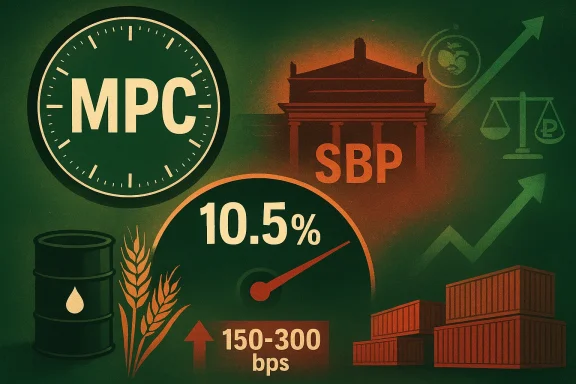
Pakistan’s next monetary policy meeting is shaping up to be one of the most consequential in recent years, and not because markets are expecting a routine pause. The real question is whether the State Bank of Pakistan will defend the current 10.5 percent policy rate or move aggressively to counter a new inflation shock that is being blamed on global oil, food, and shipping pressures. The ProPakistani report suggests a possible 150–300 basis-point hike if IMF support does not arrive in time, but the official SBP record and IMF materials show that the bank is still formally operating from a 10.5 percent base and remains focused on keeping inflation anchored through a tight stance. //www.sbp.org.pk/press/2026/Pr-26-Jan-2026.pdf)
The central theme here is less about one number and more about sequencing. If external financing lands before the next MPC meeting, policymakers may feel they can absorb the shock with fewer domestic consequences. If it does not, the SBP may have to choose between a sharper rate response and the risk of letting imported inflation, exchange-rate pressure, and expectations drift higher. The IMF has repeatedly emphasized that Pakistan’s policy mix must protect reserves, preserve exchange-rate flexibility, and keep monetary policy appropriately tight, which makes the reported logic of a pre-emptive hike plausible even if the exact size remains uncertain.
The ProPakistani account adds a political-economy layer that matters just as much as the macroeconomics. The piece says the government and SBP have already signaled readiness to tighten if inflation worsens, while a delayed IMF inflow could remove an important buffer for the currency and reserves. That is the sort of scenario in which ct before headline inflation fully reflects the shock, because waiting can make the eventual adjustment more painful.
What makes this moment especially sensitive is the interaction between domestic fragility and external volatility. Pakistan has spent much of the past two years trying to stabilize inflation, rebuild credibility, and restore reserve adequacy after repeated balance-of-payments strains. The IMF’s latest public materials still frame Pakistan as needing disciplined policy execution, exchange-rate flexibility, and continued reserve rebuilding, which means the room for delay is narrow if imported inflation accelerates again.
There is also a timing issue that makes the next few weeks unusually important. The SBP’s March 2026 monetary policy statement kept the rate unchanged at 10.5 percent even as it noted a rise in inflation to 7 percent in February 2026, suggesting the bank was already watching price momentum closely before this newer geopolitical shock entered the picture. If the inflation path worsens from here, the next decision is likely to be judged not by whether it is hawkish, but by whether it is late.
The ProPakistani report argues that the latest risk comeonflict spillover and the resulting rise in energy and food costs. Even if one treats the article’s war-related framing cautiously, the mechanism is familiar: higher imported fuel prices feed transportation, production, and food distribution costs, and those costs hit households first. In a country where consumer budgets are already stretched, a new fuel shock can translate into a broad squeeze within weeks.
The problem for Pakistan is that the pass-through can be especially fast. A weaker rupee, more expensive fuel, and tighter credit conditions can all collide at once, creating a loop that raises the cost of everyday goods more quickly than households can adjust. That is why policymakers often view rate action as a signal of discipline, not merely a tool for demand suppression.
The central bank’s challenge is therefore political as well as technical. A sharper rate hike can look harsh to borrowers, but a delayed response can be even more damaging if it triggers a broader loss of confidence. In that sense, the SBP’s decision is not simply about inflation datility under stress.
The IMF’s own public record supports the broader logic, even if it does not confirm the exact timing or amount described by the article. In 2024 and 2025, the Fund repeatedly tied Pakistan’s program to reserve rebuilding, exchange-rate flexibility, and tight monetary policy. The Fund’s recent review language also suggests that disbursements are linked to reform progress and program performance, which means timing is not purely a domestic matter.
That is especially true when the market is already sensitive to energy and political risk. Traders, importers, and banks tend to price in forward-looking stress quickly, so even the rumor of delayed funds can affect exchange-rate expectations. In that environment, a rate hike can become a defensive move against capital flight, not just a reaction to current inflation.
The result is a classic emerging-market dilemma. If the IMF money lands in time, the SBP may have more room to wait. If it does not, the bank may feel forced into a faster, harder adjustment than it otherwise would have preferred.
For borrowers, the consequences would be felt first in variable-rate loans, working-capital financing, and new credit demand. Businesses with thin margins would likely postpone expansion, while households dependent on installment borrowing would see monthly obligations rise. The ProPakistani report is right to note that purchasing power would be hit for several months if the move is large and sustained.
The ProPakistani report specifically highlights the risk to purchasing power over the coming months. That is a fair warning because inflation is regressive: it takes a larger share of income from lower- and middle-income households, especially when fuel and food prices rise together. A rate hike does not solve the initial shock, but it can prevent that shock from morphing into a broader inflation spiral.
If policymakers believe the shock is temporary, they may try to smooth it. If they believe it nt, they will lean toward a more forceful response. In Pakistan’s case, the IMF relationship raises the odds that officials will prefer credibility over short-term relief.
The political risk is obvious. Higher rates are unpopular, e already feel squeezed by fuel and food costs. But central banking is often about choosing the least damaging path, not the popular one.
The upside, of course, is that a tighter policy rate can improve deposit returns and strengthen bank funding dynamics. If fixed-income products become more attractive, households and institutions may shift more savings into formal instruments, which helps the financial system deepen domestic funding sources. Over time, that can support more stable lending, even if the transition is uncomfortable.
A tighter policy rate can help by making rupee assets more attractive and by signaling that the central bank is not passive. But it is only one part of the toolkit. Reserve inflows, fiscal discipline, and external financing still matter just as much, which is why the IMF deposit timing in the ProPakistani report is so important.
In that sense, the April MPC meeting may be less about inflation targeting in the textbook sense and more about crisis management. That is not unusual for emerging markets, but it is still costly. It also means the eventual decision will likely be judged against whether it calmed the currency, not just whether it nudged CPI lower.
That distinction matters because markets often react to rumors as if they were decisions. A central bank can create a lot of volatility simply by being the subject of unverified but plausible rate chatter. That is why readers should treat the ProPakistani piece as an informed signal, not as a final verdict.
There is also a regional competitiveness angle. A weaker rupee can help exporters at the margin, but only if macro instability does not overwhelm that benefit. A sharper rate hike may slow domestic demand enough to improve external balances, yet it could also suppress business investment and consumer spending at the worst possible time.
In macro terms, that trade-off is normal. In political terms, it is volatile. And in Pakistan’s current environment, it may be unavoidable if external conditions deteriorate further.
If the IMF deposit arrives in time, the bank may still choose a smaller move or a hold, especially if it believes the inflation shock is manageable. If the funds are delayed and the geopolitical backdrop worsens, the argument for a sharper hike becomes much stronger. In either case, the SBP will be trying to do something very difficult: restore confidence before the public fully feels the loss of it.
Source: ProPakistani SBP’s Next Big Decision Could Be a Rate Hike Unless IMF Deposit Arrives in Time
 Overview
The central theme here is less about one number and more about sequencing. If external financing lands before the next MPC meeting, policymakers may feel they can absorb the shock with fewer domestic consequences. If it does not, the SBP may have to choose between a sharper rate response and the risk of letting imported inflation, exchange-rate pressure, and expectations drift higher. The IMF has repeatedly emphasized that Pakistan’s policy mix must protect reserves, preserve exchange-rate flexibility, and keep monetary policy appropriately tight, which makes the reported logic of a pre-emptive hike plausible even if the exact size remains uncertain.The ProPakistani account adds a political-economy layer that matters just as much as the macroeconomics. The piece says the government and SBP have already signaled readiness to tighten if inflation worsens, while a delayed IMF inflow could remove an important buffer for the currency and reserves. That is the sort of scenario in which ct before headline inflation fully reflects the shock, because waiting can make the eventual adjustment more painful.
What makes this moment especially sensitive is the interaction between domestic fragility and external volatility. Pakistan has spent much of the past two years trying to stabilize inflation, rebuild credibility, and restore reserve adequacy after repeated balance-of-payments strains. The IMF’s latest public materials still frame Pakistan as needing disciplined policy execution, exchange-rate flexibility, and continued reserve rebuilding, which means the room for delay is narrow if imported inflation accelerates again.
There is also a timing issue that makes the next few weeks unusually important. The SBP’s March 2026 monetary policy statement kept the rate unchanged at 10.5 percent even as it noted a rise in inflation to 7 percent in February 2026, suggesting the bank was already watching price momentum closely before this newer geopolitical shock entered the picture. If the inflation path worsens from here, the next decision is likely to be judged not by whether it is hawkish, but by whether it is late.
The Inflation Problem Returns
Pakistan’s inflation story has been volatile enough over the last several years that any fresh external shock quickly becomes a policy problem. The IMF said in May 2025 that inflation had fallen to a historic low, but by early 2026 the SBP was again seeing a firming trend in prices, with the March 2026 statement pointing to 5.8 percent inflation in January and 7 percent in February. That shift matters because a central bank can tolerate one bad month; it cannot tolerate a new trend that starts to reshape expectations.The ProPakistani report argues that the latest risk comeonflict spillover and the resulting rise in energy and food costs. Even if one treats the article’s war-related framing cautiously, the mechanism is familiar: higher imported fuel prices feed transportation, production, and food distribution costs, and those costs hit households first. In a country where consumer budgets are already stretched, a new fuel shock can translate into a broad squeeze within weeks.
Why imported inflation is such a central-bank headache
Imported inflation is difficult because the SBP cannot manufacture cheaper oil or wheat. It can only try to prevent the second-round effects from spreading through wages, prices, and expectations. That is why rate hikes often follow external price shocks even when the initial source of inflation is entirely global.The problem for Pakistan is that the pass-through can be especially fast. A weaker rupee, more expensive fuel, and tighter credit conditions can all collide at once, creating a loop that raises the cost of everyday goods more quickly than households can adjust. That is why policymakers often view rate action as a signal of discipline, not merely a tool for demand suppression.
The central bank’s challenge is therefore political as well as technical. A sharper rate hike can look harsh to borrowers, but a delayed response can be even more damaging if it triggers a broader loss of confidence. In that sense, the SBP’s decision is not simply about inflation datility under stress.
The IMF Factor Is Doing a Lot of the Heavy Lifting
The ProPakistani story places a great deal of weight on a possible $1.2 billion IMF deposit arriving before April 20. That matters because IMF inflows do more than add reserves on paper; they improve the optics and, more importantly, the market’s sense that Pakistan has a credible external backstop. Once reserves stop looking fragile, the pressure to front-load monetary tightening may ease somewhat.The IMF’s own public record supports the broader logic, even if it does not confirm the exact timing or amount described by the article. In 2024 and 2025, the Fund repeatedly tied Pakistan’s program to reserve rebuilding, exchange-rate flexibility, and tight monetary policy. The Fund’s recent review language also suggests that disbursements are linked to reform progress and program performance, which means timing is not purely a domestic matter.
Why reserve timing matters before MPC
A central bank meeting is not held in a vacuum. If reserves are rising and external financing is visible, policymakers can frame a modest or even unchanged policy rate as a sign of confidence. If inflows are delayed, the same committee may feel compelled to send a stronger signal to calm the market.That is especially true when the market is already sensitive to energy and political risk. Traders, importers, and banks tend to price in forward-looking stress quickly, so even the rumor of delayed funds can affect exchange-rate expectations. In that environment, a rate hike can become a defensive move against capital flight, not just a reaction to current inflation.
The result is a classic emerging-market dilemma. If the IMF money lands in time, the SBP may have more room to wait. If it does not, the bank may feel forced into a faster, harder adjustment than it otherwise would have preferred.
What a 150–300 Basis-Point Move Would Mean
A hike of 150 to 300 basis points is not a tuning adjustment. It would be a statement that the SBP believes the inflation shock is serious enough to warrant immediate real-economy pain in exchange for longer-run stability. Moving from 10.5 percent to roughly 12 to 13.5 percent would quickly affect lending rates, rollover costs, and sentiment in both consumer and business credit markets.For borrowers, the consequences would be felt first in variable-rate loans, working-capital financing, and new credit demand. Businesses with thin margins would likely postpone expansion, while households dependent on installment borrowing would see monthly obligations rise. The ProPakistani report is right to note that purchasing power would be hit for several months if the move is large and sustained.
Transmission channels that matter most
- Bank lending rates would likely move up quickly, especially on floating-rate facilities.
- Consumer credit would become more expensive, slowing discretionary spending.
- Deposit rates could improve, especially for fixed-income savers.
- Exchange-rate expectations might stabilize if markets see the hike as credible.
- Corporate capex would likely soft rise.
- Import demand could cool if domestic activity slows enough.
Households Will Feel It First
For ordinary Pakistanis, rate hikes are rarely abstract. They show up in loan resets, higher prices for goods financed through credit, and more expensive installments on everything from appliances to vehicles. Even savers, who may benefit from higher deposit yields, usually experience the policy through a more immediate loss: lower real purchasing power before any interest income catches up.The ProPakistani report specifically highlights the risk to purchasing power over the coming months. That is a fair warning because inflation is regressive: it takes a larger share of income from lower- and middle-income households, especially when fuel and food prices rise together. A rate hike does not solve the initial shock, but it can prevent that shock from morphing into a broader inflation spiral.
Consumers and the credibility trade-off
Households generally dislike rate hikes because they are easy to feel and hard to appreciate. Yet the alternative—allowing inflation expectations to rise unchecked—usually hurts consumers more in the medium term. That makes the policy debate less about whether pain will exist and more about which kind of pain arrives first.If policymakers believe the shock is temporary, they may try to smooth it. If they believe it nt, they will lean toward a more forceful response. In Pakistan’s case, the IMF relationship raises the odds that officials will prefer credibility over short-term relief.
The political risk is obvious. Higher rates are unpopular, e already feel squeezed by fuel and food costs. But central banking is often about choosing the least damaging path, not the popular one.
Businesses Will Face a Cost of Capital Reset
For corporate Pakistan, the most immediate consequence of a major hike would be a reset in the cost of capital. Businesses that depend on revolving credit lines would pay more, and projects with long payback periods could suddenly look less attractive. That is especially relevant for sectors that already face imported input costs or weak consumer demand.The upside, of course, is that a tighter policy rate can improve deposit returns and strengthen bank funding dynamics. If fixed-income products become more attractive, households and institutions may shift more savings into formal instruments, which helps the financial system deepen domestic funding sources. Over time, that can support more stable lending, even if the transition is uncomfortable.
Enterprise reaction and market behavior
- Firms with heavy working-capital needs will likely delay inventory expansion.
- Exporters may be partially insulated if a tighter policy steadies the rupee.
- Import-dependent businesses could see margin pressure from both rates and fuel.
- Banks may benefit from higher spreads, though credit quality risks can rise.
- Smaller firms are more exposed because they have less pricing power.
- Capital-intensive projects may be deferred until policy clarity improves.
The Exchange Rate Story May Be the Hidden Story
What looks like an inflation decision may actually be a currency decision in disguise. If imported inflation is being driven by a weaker exchange rate and expensive fuel, then the SBP’s real objective may be to prevent further depreciation from feeding into domestic prices. The IMF has repeatedly stressed that Pakistan should allow exchange-rate flexibility to absorb shocks while rebuilding reserves, and that is a very different stance from defending a rigid peg.A tighter policy rate can help by making rupee assets more attractive and by signaling that the central bank is not passive. But it is only one part of the toolkit. Reserve inflows, fiscal discipline, and external financing still matter just as much, which is why the IMF deposit timing in the ProPakistani report is so important.
Why rates, reserves, and FX move together
When reserves are fragile, markets assume the currency is more exposed. That makes even modest external shocks feel larger, because traders know the central bank has less room to absorb them. A rate hike can temporarily blunt that pressure, but it cannot substitute for balance-of-pais why the IMF’s role is so central in Pakistan’s policy story. The Fund’s support is not just money; it is a credibility mechanism that helps anchor expectations around reforms and reserves. Without it, the SBP has to do more work on its own.In that sense, the April MPC meeting may be less about inflation targeting in the textbook sense and more about crisis management. That is not unusual for emerging markets, but it is still costly. It also means the eventual decision will likely be judged against whether it calmed the currency, not just whether it nudged CPI lower.
How Much Credence Should Be Given to the ProPakistani Report?
The report is plausible, but its strongest claims remain reportedly sourced rather than officially confirmed. The broad policy logic lines up with SBP and IMF materials: inflation has picked up again, reserves still matter, and every reason to stay alert. What is not confirmed by the public record is the specific 150–300 basis-point range or the exact IMF deposit timing referenced in the article.That distinction matters because markets often react to rumors as if they were decisions. A central bank can create a lot of volatility simply by being the subject of unverified but plausible rate chatter. That is why readers should treat the ProPakistani piece as an informed signal, not as a final verdict.
What the public record does confirm
- The SBP’s policy rate was 10.5 percent in the January and March 2026 statements.
- Inflation had already begun to edge higher again by February 2026.
- The IMF continues to frame Pakistan’s policy mix around tight monetary settings and reserve rebuilding.
- External financing rehe stabilization story.
Competitive and Regional Implications
Pakistan is not the only country dealing with imported inflation and geopolitical spillovers, and that creates a comparative policy problem. If rivals and peers can stabilize faster, Pakistan risks appearing more fragile to investors and importers alike. That perception can matter as much as the nominal policy rate, because markets trade on confidence as much as on arithmetic.There is also a regional competitiveness angle. A weaker rupee can help exporters at the margin, but only if macro instability does not overwhelm that benefit. A sharper rate hike may slow domestic demand enough to improve external balances, yet it could also suppress business investment and consumer spending at the worst possible time.
Who benefits if the SBP tightens?
A stronger policy stance could benefit bondholders, depositors, and foreign investors looking for signs of discipline. It could also help the banking system preserve real returns and reduce currency volatility. But those gains come with an obvious distributional cost, especially for households and small firms that borrow to survive rather than to speculate.In macro terms, that trade-off is normal. In political terms, it is volatile. And in Pakistan’s current environment, it may be unavoidable if external conditions deteriorate further.
Strengths and Opportunities
Pakistan still has a few things working in its favor, and that matters because rate hikes are much less dangerous when they are paired with credible stabilization measures. If the IMF inflow arrives, the SBP can lean on stronger reserves and a more convincing policy narrative. If inflation proves temporary, a firm response can actually shorten the period of uncertainty rather than prolong it.- A decisive hike could anchor expectations before inflation becomes embedded.
- Higher deposit rates may improve returns for savers and fixed-income investors.
- A stronger policy signal could reduce currency speculation.
- IMF support would reinforce credibility if disbursed on time.
- The banking sector may benefit from wider rate spreads.
- Better discipline now cfor harsher action later.
- Reserve rebuilding could improve the country’s external negotiating position.
Risks and Concerns
The downside is equally clear: if the SBP overcorrects or acts before the data fully justify it, it could deepen the slowdown without actually resolving the source of inflation. That would leave households paying more for credit while still facing high prices for fuel and food. The danger is not just economic pain; it is policy fatigue, where repeated shocks make every new intervention seem less effective.- A large hike could crush credit demand and slow business activity.
- Borrowing costs may rise faster than wages or sales.
- Consumer sentiment could weaken further.
- If IMF funds are delayed, market confidence may deteriorate.
- Over-tightening could worsen financial stress for small firms.
- Higher rates may not fully offset imported inflation.
- Political backlash could limit future policy flexibility.
Looking Ahead
The next MPC meeting will be watched for more than the headline number. Investors will want to know whether the SBP frames the decision as a temporary defense against a specific shock or as the start of a more prolonged anti-inflation cycle. The difference matters because markets react not only to the size of a hike, but to the implied path behind it.If the IMF deposit arrives in time, the bank may still choose a smaller move or a hold, especially if it believes the inflation shock is manageable. If the funds are delayed and the geopolitical backdrop worsens, the argument for a sharper hike becomes much stronger. In either case, the SBP will be trying to do something very difficult: restore confidence before the public fully feels the loss of it.
- Watch whether the IMF inflow is confirmed before the meeting.
- Watch the next PBS inflation releases for evidence of spillover.
- Watch the exchange rate for signs of renewed stress.
- Watch bank lending and deposit pricing for transmission effects.
- Watch the MPC language for hints about future tightening.
Source: ProPakistani SBP’s Next Big Decision Could Be a Rate Hike Unless IMF Deposit Arrives in Time